Poland Armored Vehicle Market Size, Share & Growth Rate
The Poland Armored Vehicle Market was estimated at USD 568 Million in 2025 and is projected to reach USD 830 Million by 2032, growing at a CAGR of 5.6% from 2026 to 2032. This upward trajectory is primarily driven by Poland's commitment to military modernization and the pressing need to enhance national defense capabilities. Increased defense budgets, coupled with the focus on advanced technologies, are expected to shape the market dynamics significantly.
Poland Armored Vehicle Market Year-wise Growth Rate and Key Drivers
This graph highlights how the Poland Armored Vehicle Market has steadily grown over the years, supported by major growth factors.
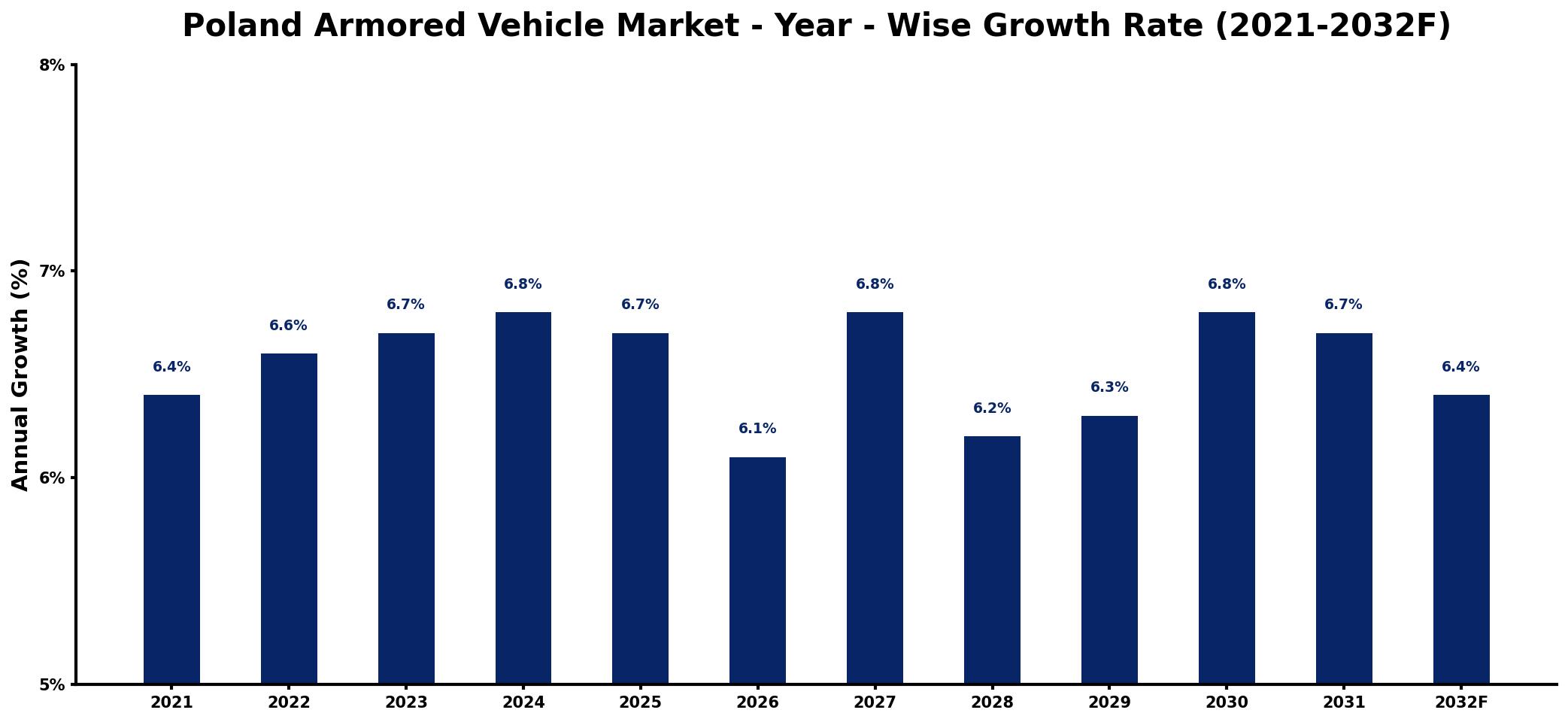
The table below presents the year‑wise growth rates along with the key drivers influencing the market
| Year | Growth Rate | Major Drivers |
| 2021 | 6.4% | Increased defense spending initiatives |
| 2022 | 6.6% | Growing geopolitical security concerns |
| 2023 | 6.7% | Rising demand for mobility solutions |
| 2024 | 6.8% | Expansion of military modernization programs |
| 2025 | 6.7% | Emerging technologies enhancing capabilities |
| 2026 | 6.1% | Strengthened partnerships with allies |
| 2027 | 6.8% | Increased focus on border security |
| 2028 | 6.2% | Investment in research and development |
| 2029 | 6.3% | Growing interest in tactical operations |
| 2030 | 6.8% | Strengthening national defense strategies |
| 2031 | 6.7% | Enhancement of urban warfare tactics |
| 2032 | 6.4% | Focus on sustainability and efficiency |
Note: Market size estimations and growth projections presented in this report are based on 6Wresearch's proprietary forecasting methodology, utilizing the latest available industry data, government publications, and primary research inputs.
Poland Armored Vehicle Market Synopsis
The demand for armored vehicles in Poland is fueled by heightened security concerns and the strategic importance of the region, which necessitates robust military solutions. Domestically produced vehicles are increasingly favored, supported by government initiatives aimed at fostering local manufacturing and technological advancement.
In addition to domestic production, foreign partnerships are becoming more common, allowing international companies to leverage local expertise and resources. This collaborative approach not only boosts the supply chain but also enhances the technological prowess of the Polish defense sector.
Poland Armored Vehicle Market Key Takeaways
- The market is witnessing robust growth due to increased defense spending and modernization efforts.
- Key advancements include the integration of unmanned systems and enhanced survivability technologies.
- Domestic manufacturers are strengthening their market presence while international collaborations rise.
- Government policies focus on promoting local production and compliance with international standards.
- Opportunities for investment are abundant, especially in maintenance and R&D for advanced solutions.
Evaluation of Restraints in Poland Armored Vehicle Market
Despite the favorable growth landscape, several factors pose limitations to the Poland Armored Vehicle Market. Increasing competition from global manufacturers necessitates that domestic companies continuously innovate and upgrade their offerings. Additionally, fluctuating defense budgets can impact procurement strategies and project timelines. Compliance with evolving regulatory standards also demands significant investment, which can strain resources, especially for smaller manufacturers. Furthermore, the necessity for high-quality solutions at competitive prices presents a challenging balance for local firms.
Poland Armored Vehicle Market Trends
Current trends in the Poland Armored Vehicle Market indicate a shift toward multi-role armored vehicles that can adapt to various operational scenarios. The integration of digital technologies for enhanced situational awareness and battlefield communication is becoming increasingly important. Moreover, there is a noticeable demand for innovative armor solutions that improve mobility and survivability without compromising performance. This trend signifies an evolving operational landscape that requires versatile and technologically advanced armored vehicles.
Poland Armored Vehicle Market Opportunities
Investment opportunities abound as Poland seeks to fortify its defense capabilities. The governments emphasis on acquiring advanced military technologies offers fertile ground for foreign companies looking to establish a foothold through partnerships with local manufacturers. Additionally, servicing and upgrading existing fleets represent a significant avenue for growth. Research and development initiatives targeting innovative armored vehicle solutions in alignment with national defense strategies can yield high returns in this burgeoning market.
Government Initiatives in the Poland Armored Vehicle Market
The Polish government is actively investing in defense modernization efforts, with policies designed to enhance national security. Significant budgets have been allocated for the procurement of advanced armored vehicles, with an emphasis on domestic production capabilities. Collaborative projects with international partners are encouraged, particularly those that facilitate technology transfers. Regulatory frameworks are being established to ensure that manufacturing processes adhere to industry standards, further bolstering the credibility and reliability of domestic armored vehicles.
Future Insights of the Poland Armored Vehicle Market
Looking forward to the period from 2026 to 2032, the Poland Armored Vehicle Market is expected to maintain its growth momentum. The emphasis on enhancing military capabilities through technology integration and modernization initiatives will remain a priority. Moreover, as Poland continues to address security challenges and geopolitical tensions, the demand for versatile and robust armored vehicles will likely escalate. This landscape will attract investment, research, and collaborative partnerships, reinforcing the market's future potential.
Poland Armored Vehicle Market Latest Developments (2025 - 2026)
Recent developments in the Poland Armored Vehicle Market reveal a strong focus on technological advancements and strategic partnerships. Efforts are underway to enhance the capabilities of existing armored vehicles, with an emphasis on integrating state-of-the-art surveillance and communication systems. Additionally, new procurement programs are being rolled out, reflecting a commitment to keeping pace with evolving defense needs. These industry movements highlight Poland's proactive approach to modernizing its defense sector.
Poland Armored Vehicle Market - Key Attractiveness of the Report
- 10 Years of Market Numbers
- Historical Data Starting from 2022 to 2025
- Base Year: 2025
- Forecast Data until 2032
- Key Performance Indicators Impacting the Market
- Major Upcoming Developments and Projects
Key Highlights of the Report:
- Poland Armored Vehicle Market Outlook
- Market Size of Poland Armored Vehicle Market, 2025
- Forecast of Poland Armored Vehicle Market, 2032
- Historical Data and Forecast of Poland Armored Vehicle Revenues & Volume for the Period 2022-2032F
- Poland Armored Vehicle Market Trend Evolution
- Poland Armored Vehicle Market Drivers and Challenges
- Poland Armored Vehicle Price Trends
- Poland Armored Vehicle Porter's Five Forces
- Poland Armored Vehicle Industry Life Cycle
- Historical Data and Forecast of Poland Armored Vehicle Market Revenues & Volume By Platform for the Period 2022-2032F
- Historical Data and Forecast of Poland Armored Vehicle Market Revenues & Volume By Combat Vehicles for the Period 2022-2032F
- Historical Data and Forecast of Poland Armored Vehicle Market Revenues & Volume By Combat Support Vehicles for the Period 2022-2032F
- Historical Data and Forecast of Poland Armored Vehicle Market Revenues & Volume By Unmanned Armored Ground Vehicles for the Period 2022-2032F
- Historical Data and Forecast of Poland Armored Vehicle Market Revenues & Volume By Mobility for the Period 2022-2032F
- Historical Data and Forecast of Poland Armored Vehicle Market Revenues & Volume By Wheeled for the Period 2022-2032F
- Historical Data and Forecast of Poland Armored Vehicle Market Revenues & Volume By Tracked for the Period 2022-2032F
- Historical Data and Forecast of Poland Armored Vehicle Market Revenues & Volume By System for the Period 2022-2032F
- Historical Data and Forecast of Poland Armored Vehicle Market Revenues & Volume By Engine for the Period 2022-2032F
- Historical Data and Forecast of Poland Armored Vehicle Market Revenues & Volume By Drive System for the Period 2022-2032F
- Historical Data and Forecast of Poland Armored Vehicle Market Revenues & Volume By Ballistic Armor for the Period 2022-2032F
- Historical Data and Forecast of Poland Armored Vehicle Market Revenues & Volume By Turret Drives for the Period 2022-2032F
- Historical Data and Forecast of Poland Armored Vehicle Market Revenues & Volume By Ammunition Handling System for the Period 2022-2032F
- Historical Data and Forecast of Poland Armored Vehicle Market Revenues & Volume By Fire Control Systems (FCS) for the Period 2022-2032F
- Historical Data and Forecast of Poland Armored Vehicle Market Revenues & Volume By Armaments for the Period 2022-2032F
- Historical Data and Forecast of Poland Armored Vehicle Market Revenues & Volume By Countermeasure System for the Period 2022-2032F
- Poland Armored Vehicle Import Export Trade Statistics
- Market Opportunity Assessment By Platform
- Market Opportunity Assessment By Mobility
- Market Opportunity Assessment By System
- Poland Armored Vehicle Top Companies Market Share
- Poland Armored Vehicle Competitive Benchmarking By Technical and Operational Parameters
- Poland Armored Vehicle Company Profiles
- Poland Armored Vehicle Key Strategic Recommendations






































