Poland Artificial Intelligence as a Service Market Size & Growth Rate (2026-2032)
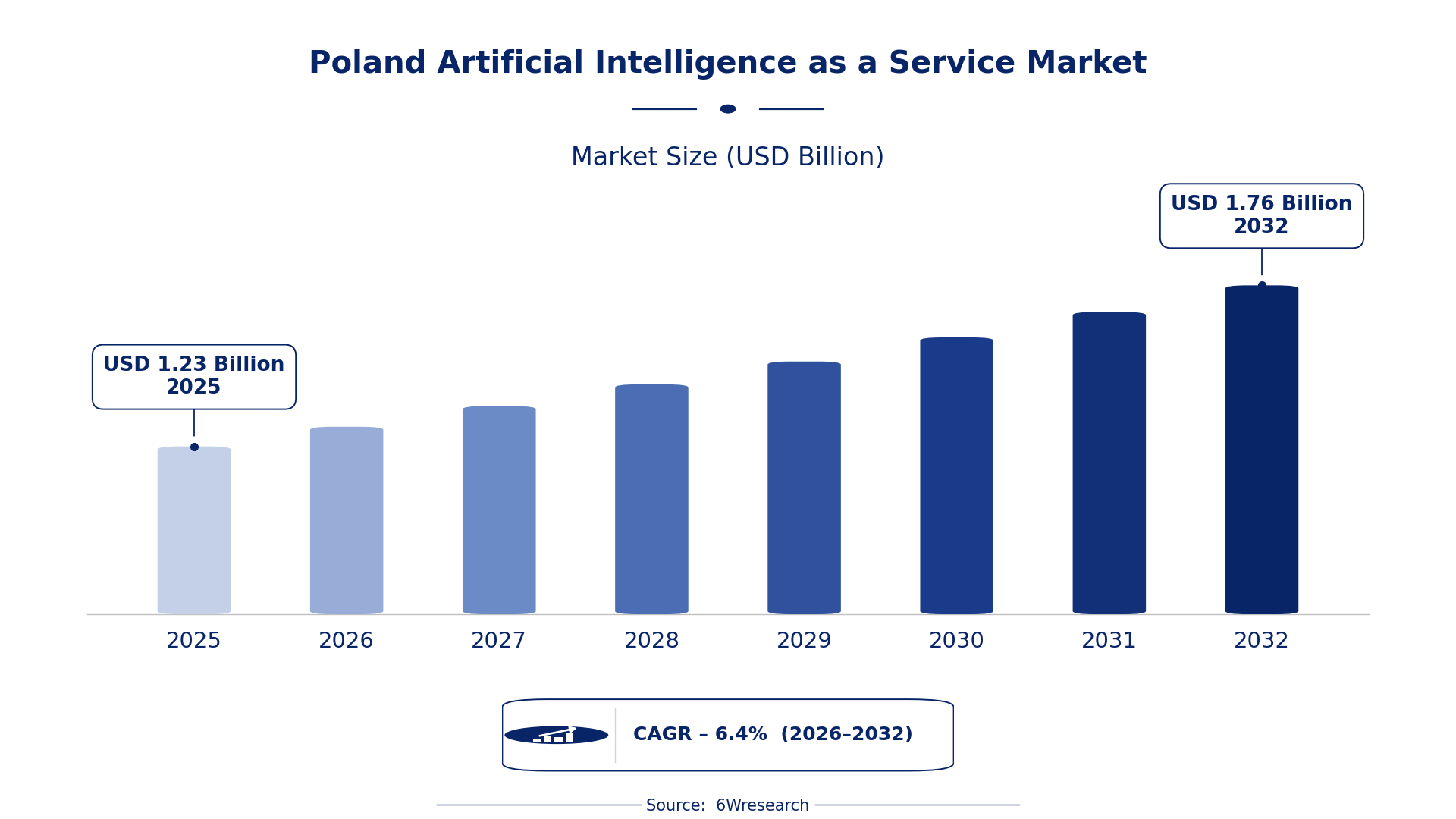
The Poland Artificial Intelligence as a Service Market was estimated at USD 1230 Million in 2025 and is projected to reach USD 1761 Million by 2032, growing at a CAGR of 6.4% from 2026 to 2032.
Poland Artificial Intelligence as a Service Market Synopsis
The Poland Artificial Intelligence as a Service (AIaaS) market is gaining momentum as industries increasingly embrace AI-driven solutions. From healthcare to finance, businesses are investing in AIaaS to boost operational efficiency and enhance customer experiences. This trend reflects a broader recognition of AI's potential to transform traditional practices.
As Polish companies seek to stay competitive, the demand for AIaaS solutions continues to grow. The market is marked by a diverse range of applications, including machine learning, natural language processing, and advanced analytics. This diversity not only caters to various business needs but also fosters innovation within the sector.
Poland Artificial Intelligence as a Service Market Year-wise Growth Rate and Key Drivers
This graph illustrates the annual growth rates of the Poland Artificial Intelligence as a Service Market from 2021 to 2032, highlighting a steady upward trajectory and projected expansion over the forecast period.
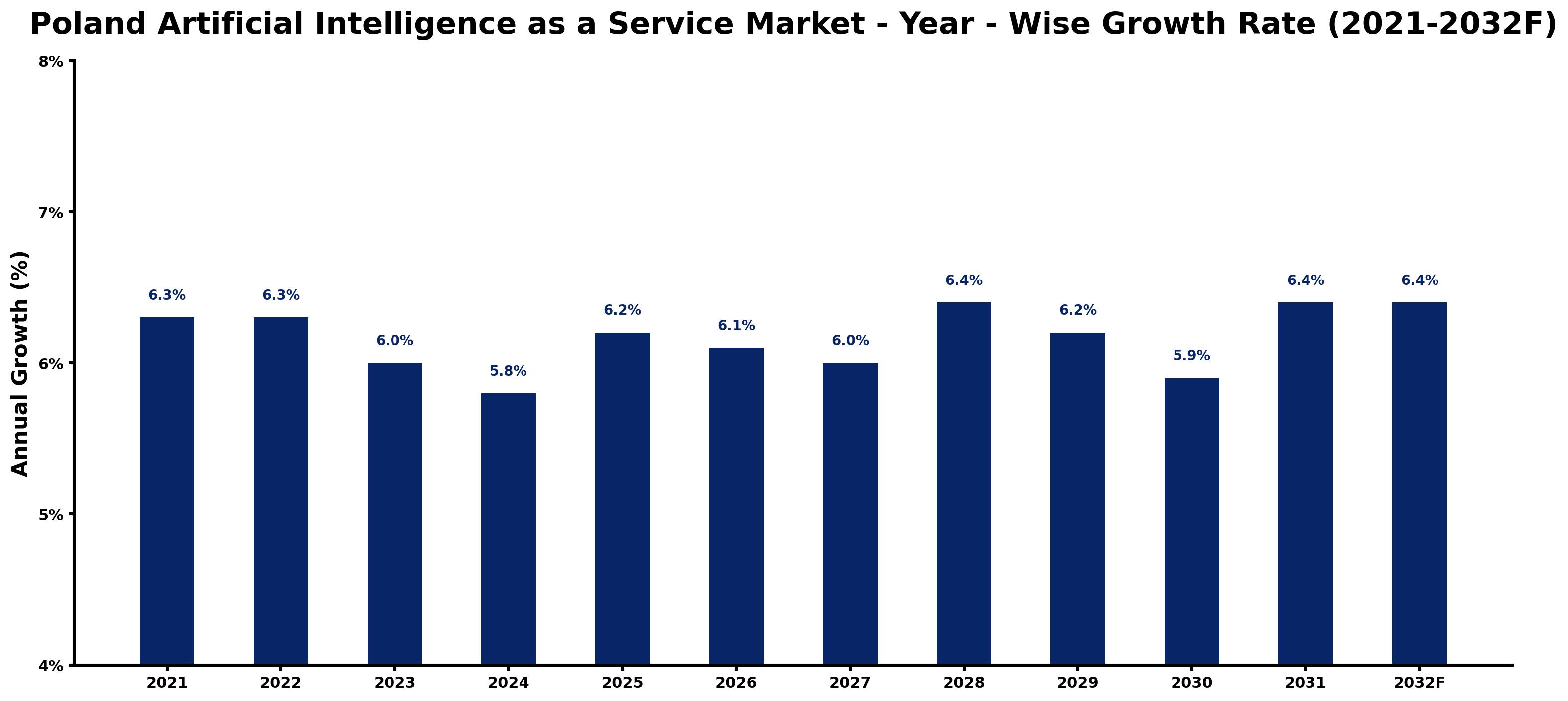
The table below presents the year‑wise growth rates along with the key drivers influencing the market
| Year | Growth Rate | Major Drivers |
| 2021 | 6.3% | Poland’s Digital Poland strategy boosting AI investments. |
| 2022 | 6.3% | Legislation supporting AI development and ethical standards. |
| 2023 | 6.0% | Increasing AI adoption in Polish healthcare sector. |
| 2024 | 5.8% | Growing interest in AI for fintech innovations. |
| 2025 | 6.2% | Supportive government grants for AI startups and R&D. |
| 2026 | 6.1% | Rising collaboration between universities and tech firms. |
| 2027 | 6.0% | Boost in AI for cybersecurity measures amid rising threats. |
| 2028 | 6.4% | Enhanced cloud infrastructure enabling AI service scalability. |
| 2029 | 6.2% | Local demand for AI in e-commerce personalization tools. |
| 2030 | 5.9% | Poland’s focus on smart city technologies incorporating AI. |
| 2031 | 6.4% | Increased funding for AI in agritech solutions. |
| 2032 | 6.4% | Investment in AI for logistics and supply chain optimization. |
Note: Market size estimations and growth projections presented in this report are based on 6Wresearch's proprietary forecasting methodology, utilizing the latest available industry data, government publications, and primary research inputs.
Poland Artificial Intelligence as a Service Market Key Takeaways
Below are some of the specific key takeaways from the market, including:
- AIaaS is becoming integral to enhancing efficiency and customer engagement across various sectors in Poland.
- The market is characterized by rising investments in AI research and development from both public and private sectors.
- Integration with cloud computing services is facilitating scalable AI solutions for businesses.
- Government initiatives are promoting AI innovation, focusing on ethical usage and data protection.
- There is a growing need for tailored AI solutions as businesses seek to address specific challenges.
Evaluation of Restraints in Poland Artificial Intelligence as a Service Market
The Poland Artificial Intelligence as a Service market faces several challenges that could impede its growth trajectory. A notable issue is the shortage of skilled AI professionals, which creates a competitive environment for talent acquisition. Additionally, concerns around data privacy and compliance with regulations like the GDPR add complexity to operations for AIaaS providers. These factors, combined with the necessity for substantial infrastructure investments, create a challenging environment for companies striving to adopt AIaaS solutions.
Poland Artificial Intelligence as a Service Market Trends
Key trends are shaping the AIaaS market in Poland, particularly the increasing reliance on data analytics and machine learning capabilities. Businesses are particularly focused on harnessing AI-powered analytics for better decision-making. The demand for natural language processing solutions is also on the rise, as companies aim to improve customer interactions. on top of that, the synergy between AIaaS and cloud services is creating new opportunities for scalability and flexibility.
Poland Artificial Intelligence as a Service Market Opportunities
The potential for growth in the Poland AIaaS market is substantial. As companies continue to prioritize digital transformation, the appetite for AI solutions that can automate processes and enhance operational efficiency is increasing. Emerging startups are entering the market with innovative offerings, creating opportunities for collaboration and investment. on top of that, the integration of AI into traditional sectors presents a unique avenue for service providers to tailor their solutions to meet specific business needs.
Government Initiatives in the Poland Artificial Intelligence as a Service Market
The Polish government is actively shaping the AIaaS market through targeted initiatives aimed at fostering innovation and economic growth. With a focus on ethical AI use and data protection, regulatory frameworks are being developed to support businesses in the sector. These policies are critical for building trust among consumers and encouraging wider adoption of AI technologies.
- A national AI strategy launched in 2025 aims to enhance investment in research and development initiatives.
- Current efforts include establishing partnerships between the public and private sectors to advance AI education and training.
- Ongoing regulatory reviews are focused on ensuring compliance with data protection standards while promoting innovation.
- A planned public initiative expected to be unveiled in 2026 will provide funding for AI startups and innovation projects.
Future Insights of the Poland Artificial Intelligence as a Service Market
Looking ahead to 2026-2032, the Poland AIaaS market is set to experience substantial growth. Companies are expected to increasingly adopt AI technologies as they seek to enhance their competitive positioning. The proliferation of cloud computing and advancements in machine learning will also catalyze demand. As businesses recognize the strategic advantages of AI, the market will likely see a surge in tailored offerings, pushing the boundaries of innovation.
Poland Artificial Intelligence as a Service Market Latest Developments
In recent months, the Poland AIaaS market has seen a flurry of activity indicative of its growth potential. Companies are increasingly launching new services and forming partnerships to enhance their offerings. This trend highlights a robust commitment to advancing AI capabilities and addressing market needs.
- A major technology vendor announced a product enhancement in early 2025, integrating advanced machine learning features into its AIaaS platform.
- A leading regional operator is currently underway with a customer engagement initiative that leverages AI-driven analytics to improve service delivery.
- In late 2025, a collaborative project was completed, bringing together various stakeholders to establish best practices for ethical AI implementation.
- A planned expansion of AI infrastructure is expected to begin in mid-2026, focusing on improving access for small and medium enterprises.
Poland Artificial Intelligence as a Service Market - Key Attractiveness of the Report
- 10 Years of Market Numbers
- Historical Data Starting from 2022 to 2025
- Base Year: 2025
- Forecast Data until 2032
- Key Performance Indicators Impacting the Market
- Major Upcoming Developments and Projects
Key Highlights of the Report:
- Poland Artificial Intelligence as a Service Market Outlook
- Market Size of Poland Artificial Intelligence as a Service Market, 2025
- Forecast of Poland Artificial Intelligence as a Service Market, 2032
- Historical Data and Forecast of Poland Artificial Intelligence as a Service Revenues & Volume for the Period 2022-2032F
- Poland Artificial Intelligence as a Service Market Trend Evolution
- Poland Artificial Intelligence as a Service Market Drivers and Challenges
- Poland Artificial Intelligence as a Service Price Trends
- Poland Artificial Intelligence as a Service Porter's Five Forces
- Poland Artificial Intelligence as a Service Industry Life Cycle
- Historical Data and Forecast of Poland Artificial Intelligence as a Service Market Revenues & Volume By Service Type for the Period 2022-2032F
- Historical Data and Forecast of Poland Artificial Intelligence as a Service Market Revenues & Volume By Software Tools for the Period 2022-2032F
- Historical Data and Forecast of Poland Artificial Intelligence as a Service Market Revenues & Volume By Services for the Period 2022-2032F
- Historical Data and Forecast of Poland Artificial Intelligence as a Service Market Revenues & Volume By Software Tool for the Period 2022-2032F
- Historical Data and Forecast of Poland Artificial Intelligence as a Service Market Revenues & Volume By Data Storage and Archiving for the Period 2022-2032F
- Historical Data and Forecast of Poland Artificial Intelligence as a Service Market Revenues & Volume By Modeler and Processing for the Period 2022-2032F
- Historical Data and Forecast of Poland Artificial Intelligence as a Service Market Revenues & Volume By Cloud and Web-Based Application Programming Interface (APIs) for the Period 2022-2032F
- Historical Data and Forecast of Poland Artificial Intelligence as a Service Market Revenues & Volume By Others for the Period 2022-2032F
- Historical Data and Forecast of Poland Artificial Intelligence as a Service Market Revenues & Volume By Service for the Period 2022-2032F
- Historical Data and Forecast of Poland Artificial Intelligence as a Service Market Revenues & Volume By Professional Services for the Period 2022-2032F
- Historical Data and Forecast of Poland Artificial Intelligence as a Service Market Revenues & Volume By Managed Services for the Period 2022-2032F
- Historical Data and Forecast of Poland Artificial Intelligence as a Service Market Revenues & Volume By Technology for the Period 2022-2032F
- Historical Data and Forecast of Poland Artificial Intelligence as a Service Market Revenues & Volume By Machine Learning (ML) and Deep Learning for the Period 2022-2032F
- Historical Data and Forecast of Poland Artificial Intelligence as a Service Market Revenues & Volume By Natural Language Processing (NLP) for the Period 2022-2032F
- Historical Data and Forecast of Poland Artificial Intelligence as a Service Market Revenues & Volume By Organizations Size for the Period 2022-2032F
- Historical Data and Forecast of Poland Artificial Intelligence as a Service Market Revenues & Volume By Large Enterprises for the Period 2022-2032F
- Historical Data and Forecast of Poland Artificial Intelligence as a Service Market Revenues & Volume By Small and Medium-sized Enterprises (SMEs) for the Period 2022-2032F
- Historical Data and Forecast of Poland Artificial Intelligence as a Service Market Revenues & Volume By Vertical for the Period 2022-2032F
- Historical Data and Forecast of Poland Artificial Intelligence as a Service Market Revenues & Volume By Banking, Financial, and Insurance (BFSI) for the Period 2022-2032F
- Historical Data and Forecast of Poland Artificial Intelligence as a Service Market Revenues & Volume By Healthcare and Life Sciences for the Period 2022-2032F
- Historical Data and Forecast of Poland Artificial Intelligence as a Service Market Revenues & Volume By Retail for the Period 2022-2032F
- Historical Data and Forecast of Poland Artificial Intelligence as a Service Market Revenues & Volume By Telecommunications for the Period 2022-2032F
- Historical Data and Forecast of Poland Artificial Intelligence as a Service Market Revenues & Volume By Government and defense for the Period 2022-2032F
- Historical Data and Forecast of Poland Artificial Intelligence as a Service Market Revenues & Volume By Manufacturing for the Period 2022-2032F
- Historical Data and Forecast of Poland Artificial Intelligence as a Service Market Revenues & Volume By Energy for the Period 2022-2032F
- Historical Data and Forecast of Poland Artificial Intelligence as a Service Market Revenues & Volume By Others for the Period 2022-2032F
- Poland Artificial Intelligence as a Service Import Export Trade Statistics
- Market Opportunity Assessment By Service Type
- Market Opportunity Assessment By Software Tool
- Market Opportunity Assessment By Service
- Market Opportunity Assessment By Technology
- Market Opportunity Assessment By Organizations Size
- Market Opportunity Assessment By Vertical
- Poland Artificial Intelligence as a Service Top Companies Market Share
- Poland Artificial Intelligence as a Service Competitive Benchmarking By Technical and Operational Parameters
- Poland Artificial Intelligence as a Service Company Profiles
- Poland Artificial Intelligence as a Service Key Strategic Recommendations






































