Poland Artificial Intelligence in Accounting Market Size & Growth Rate (2026-2032)
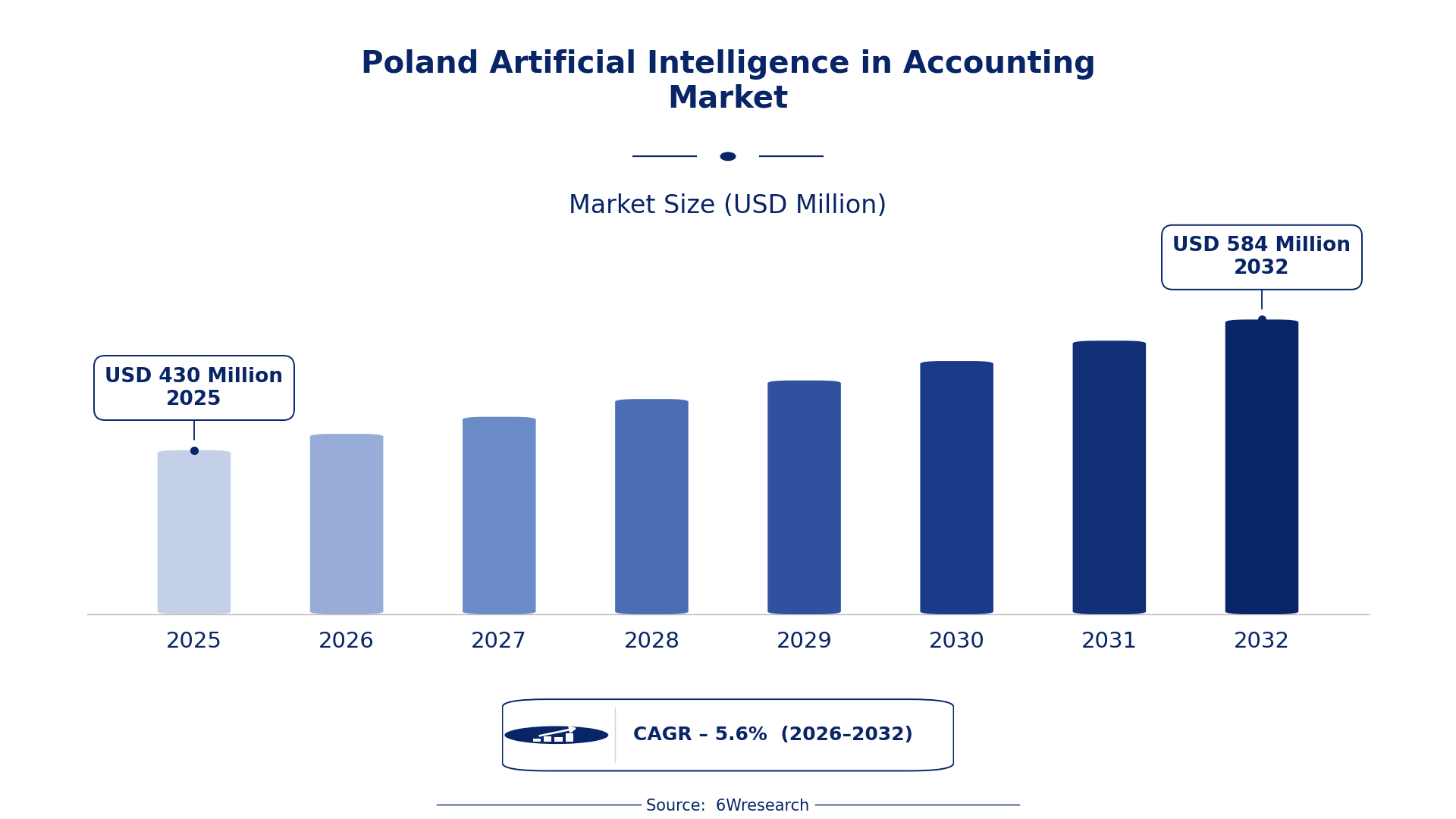
The Poland Artificial Intelligence in Accounting Market was estimated at USD 430 Million in 2025 and is projected to reach USD 584 Million by 2032, growing at a CAGR of 5.6% from 2026 to 2032.
Poland Artificial Intelligence in Accounting Market Synopsis
The Poland Artificial Intelligence in Accounting market is currently undergoing a transformative phase, with businesses rapidly adopting AI technologies to streamline their accounting processes. This surge reflects a growing recognition among Polish firms of the benefits that automation can bring, particularly in enhancing accuracy and facilitating data-driven decision-making.
As financial regulations become more complex, companies in Poland are increasingly integrating AI solutions for tasks such as data entry, reconciliation, and compliance monitoring. This trend not only reduces manual workloads but also opens avenues for improved analytics, setting the stage for a robust growth trajectory in the market.
Poland Artificial Intelligence in Accounting Market Year-wise Growth Rate and Key Drivers
This graph illustrates the annual growth rates of the Poland Artificial Intelligence in Accounting Market from 2021 to 2032, highlighting a steady upward trajectory and projected expansion over the forecast period.
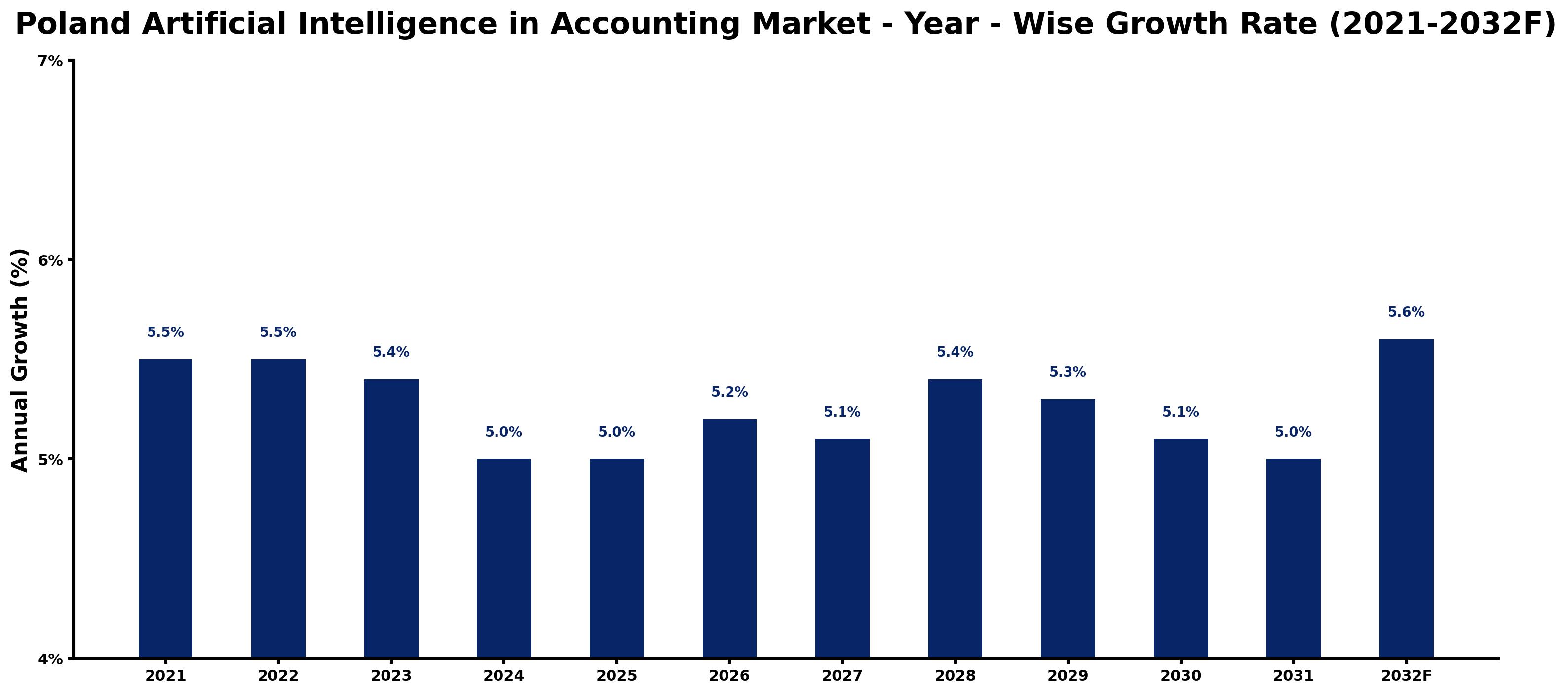
The table below presents the year‑wise growth rates along with the key drivers influencing the market
| Year | Growth Rate | Major Drivers |
| 2021 | 5.5% | Implementation of Polish tax robots by Ministry of Finance. |
| 2022 | 5.5% | E-invoicing mandate boosts AI adoption in accounting. |
| 2023 | 5.4% | Growing need for KYC compliance among local firms. |
| 2024 | 5.0% | Poland's increasing digital transformation in financial services. |
| 2025 | 5.0% | Emergence of local AI startups specializing in finance. |
| 2026 | 5.2% | Polish universities enhancing AI curriculum for accounting. |
| 2027 | 5.1% | Government grants supporting AI integration in SMEs. |
| 2028 | 5.4% | Demand for real-time financial reporting systems rises. |
| 2029 | 5.3% | Local accounting firms prioritizing data security solutions. |
| 2030 | 5.1% | Increased venture capital investment in fintech innovation. |
| 2031 | 5.0% | Expanded cloud accounting services driving AI integration. |
| 2032 | 5.6% | Adoption of AI-powered analytics by top accounting firms. |
Note: Market size estimations and growth projections presented in this report are based on 6Wresearch's proprietary forecasting methodology, utilizing the latest available industry data, government publications, and primary research inputs.
Poland Artificial Intelligence in Accounting Market Key Takeaways
Below are some of the specific key takeaways from the market, including:
- The market is driven by the demand for automation and increased efficiency in accounting practices.
- AI technologies are being leveraged for improved data analytics, fraud detection, and process optimization.
- Small and medium-sized enterprises are increasingly adopting AI solutions to streamline their financial processes.
- Integration with emerging technologies such as blockchain is creating new growth opportunities.
- Government initiatives are actively promoting the use of AI in the accounting sector.
Evaluation of Restraints in Poland Artificial Intelligence in Accounting Market
Several challenges are hindering the full potential of the Poland Artificial Intelligence in Accounting market. Chief among these is the apprehension surrounding data privacy and security. As AI solutions require access to sensitive financial information, businesses often hesitate to adopt these technologies due to fears of data breaches. on top of that, traditional accounting professionals may resist change, concerned that AI could threaten their roles. Ensuring the reliability and accuracy of AI algorithms also remains a crucial issue, necessitating ongoing validation to build trust in these systems.
Poland Artificial Intelligence in Accounting Market Trends
Several key trends are shaping the demand for AI in accounting within Poland. The integration of machine learning and natural language processing is becoming commonplace, allowing for more sophisticated data analysis and real-time reporting. Companies are also increasingly focused on using AI for fraud detection, as the complexity of financial transactions rises. Additionally, there is a noticeable shift towards cloud-based AI solutions, enabling remote access and collaboration, particularly important in the current business environment.
Poland Artificial Intelligence in Accounting Market Opportunities
The potential for growth in the Poland Artificial Intelligence in Accounting market is substantial. There is a growing demand for tailored AI solutions that cater to the unique needs of accounting firms and businesses. The integration of AI with other technologies, such as blockchain, presents opportunities for enhanced transparency and security in financial transactions. on top of that, as small and medium-sized enterprises seek to modernize their operations, they represent a significant market segment ready for AI adoption.
Government Initiatives in the Poland Artificial Intelligence in Accounting Market
The Polish government is actively fostering the adoption of AI technologies within the accounting sector through targeted policies and initiatives. These efforts are crucial for enhancing the efficiency and competitiveness of the industry. By establishing a clear regulatory framework, the government aims to ensure ethical practices while encouraging innovation.
- A recently launched initiative by the Ministry of Digital Affairs focuses on the "AI for Poland" strategy, aimed at supporting AI technology implementation across various sectors, including accounting.
- The Polish Artificial Intelligence Center (CPI), established in 2021, is currently coordinating research and development efforts to drive AI advancements.
- A planned public-private partnership is set to enhance AI infrastructure and capabilities within the accounting sector by 2027.
- Ongoing training programs for accounting professionals are being developed to equip them with the skills necessary to utilize AI tools effectively.
- The government has enacted data protection regulations in alignment with the EU's GDPR, ensuring the responsible use of AI in accounting practices.
Future Insights of the Poland Artificial Intelligence in Accounting Market
Looking ahead to 2026-2032, the Poland Artificial Intelligence in Accounting market is set for dynamic expansion. The shift towards automation will continue as firms strive for greater efficiency and accuracy in financial management. As AI technologies advance, they will likely become more accessible and tailored to specific business needs. This evolution will not only enhance operational efficiency but also foster a culture of innovation within the accounting sector, paving the way for new applications and market entrants.
Poland Artificial Intelligence in Accounting Market Latest Developments
Over the past year, the Poland Artificial Intelligence in Accounting market has witnessed significant developments as companies seek to optimize their financial processes through AI. The emphasis on compliance and data security remains a priority, influencing investment decisions across the industry.
- A leading technology vendor launched a new AI-powered accounting software solution in early 2025, aimed at small and medium-sized enterprises.
- In mid-2025, a major financial institution began implementing AI algorithms for real-time fraud detection in their accounting operations.
- Currently, several firms are testing AI-driven reconciliation tools to improve the speed and accuracy of their financial reporting.
- A planned initiative is expected to commence in Q2 2026, focusing on integrating AI with blockchain for enhanced financial transparency.
- By late 2025, training workshops aimed at upskilling accounting professionals in AI technologies are set to be rolled out.
Poland Artificial Intelligence in Accounting Market - Key Attractiveness of the Report
- 10 Years of Market Numbers
- Historical Data Starting from 2022 to 2025
- Base Year: 2025
- Forecast Data until 2032
- Key Performance Indicators Impacting the Market
- Major Upcoming Developments and Projects
Key Highlights of the Report:
- Poland Artificial Intelligence in Accounting Market Outlook
- Market Size of Poland Artificial Intelligence in Accounting Market, 2025
- Forecast of Poland Artificial Intelligence in Accounting Market, 2032
- Historical Data and Forecast of Poland Artificial Intelligence in Accounting Revenues & Volume for the Period 2022-2032F
- Poland Artificial Intelligence in Accounting Market Trend Evolution
- Poland Artificial Intelligence in Accounting Market Drivers and Challenges
- Poland Artificial Intelligence in Accounting Price Trends
- Poland Artificial Intelligence in Accounting Porter's Five Forces
- Poland Artificial Intelligence in Accounting Industry Life Cycle
- Historical Data and Forecast of Poland Artificial Intelligence in Accounting Market Revenues & Volume By Application for the Period 2022-2032F
- Historical Data and Forecast of Poland Artificial Intelligence in Accounting Market Revenues & Volume By Automated Bookkeeping for the Period 2022-2032F
- Historical Data and Forecast of Poland Artificial Intelligence in Accounting Market Revenues & Volume By Invoice Classification and Approvals for the Period 2022-2032F
- Historical Data and Forecast of Poland Artificial Intelligence in Accounting Market Revenues & Volume By Fraud and Risk Management for the Period 2022-2032F
- Historical Data and Forecast of Poland Artificial Intelligence in Accounting Market Revenues & Volume By Reporting for the Period 2022-2032F
- Historical Data and Forecast of Poland Artificial Intelligence in Accounting Market Revenues & Volume By Others for the Period 2022-2032F
- Historical Data and Forecast of Poland Artificial Intelligence in Accounting Market Revenues & Volume By Component for the Period 2022-2032F
- Historical Data and Forecast of Poland Artificial Intelligence in Accounting Market Revenues & Volume By Solutions for the Period 2022-2032F
- Historical Data and Forecast of Poland Artificial Intelligence in Accounting Market Revenues & Volume By Services for the Period 2022-2032F
- Historical Data and Forecast of Poland Artificial Intelligence in Accounting Market Revenues & Volume By Technology for the Period 2022-2032F
- Historical Data and Forecast of Poland Artificial Intelligence in Accounting Market Revenues & Volume By Machine Learning (ML) and Deep Learning for the Period 2022-2032F
- Historical Data and Forecast of Poland Artificial Intelligence in Accounting Market Revenues & Volume By NLP for the Period 2022-2032F
- Historical Data and Forecast of Poland Artificial Intelligence in Accounting Market Revenues & Volume By Deployment Mode for the Period 2022-2032F
- Historical Data and Forecast of Poland Artificial Intelligence in Accounting Market Revenues & Volume By On-premises for the Period 2022-2032F
- Historical Data and Forecast of Poland Artificial Intelligence in Accounting Market Revenues & Volume By Cloud for the Period 2022-2032F
- Historical Data and Forecast of Poland Artificial Intelligence in Accounting Market Revenues & Volume By Enterprise Size for the Period 2022-2032F
- Historical Data and Forecast of Poland Artificial Intelligence in Accounting Market Revenues & Volume By Large Enterprises for the Period 2022-2032F
- Historical Data and Forecast of Poland Artificial Intelligence in Accounting Market Revenues & Volume By Small and Medium-Sized Enterprises (SMEs) for the Period 2022-2032F
- Poland Artificial Intelligence in Accounting Import Export Trade Statistics
- Market Opportunity Assessment By Application
- Market Opportunity Assessment By Component
- Market Opportunity Assessment By Technology
- Market Opportunity Assessment By Deployment Mode
- Market Opportunity Assessment By Enterprise Size
- Poland Artificial Intelligence in Accounting Top Companies Market Share
- Poland Artificial Intelligence in Accounting Competitive Benchmarking By Technical and Operational Parameters
- Poland Artificial Intelligence in Accounting Company Profiles
- Poland Artificial Intelligence in Accounting Key Strategic Recommendations






































