Poland Auto Parts And Accessories Market Size, Share & Growth Rate
The Poland Auto Parts And Accessories Market was estimated at USD 302 Million in 2025 and is projected to reach USD 404 Million by 2032, growing at a CAGR of 4.2% from 2026 to 2032. This growth trajectory is primarily driven by an increasing number of vehicles on the road and a rising trend towards vehicle customization. As consumers seek to enhance the longevity and performance of their vehicles, the demand for high-quality auto parts and innovative accessories is set to expand.
Poland Auto Parts And Accessories Market Year-wise Growth Rate and Key Drivers
This graph highlights how the Poland Auto Parts And Accessories Market has steadily grown over the years, supported by major growth factors.
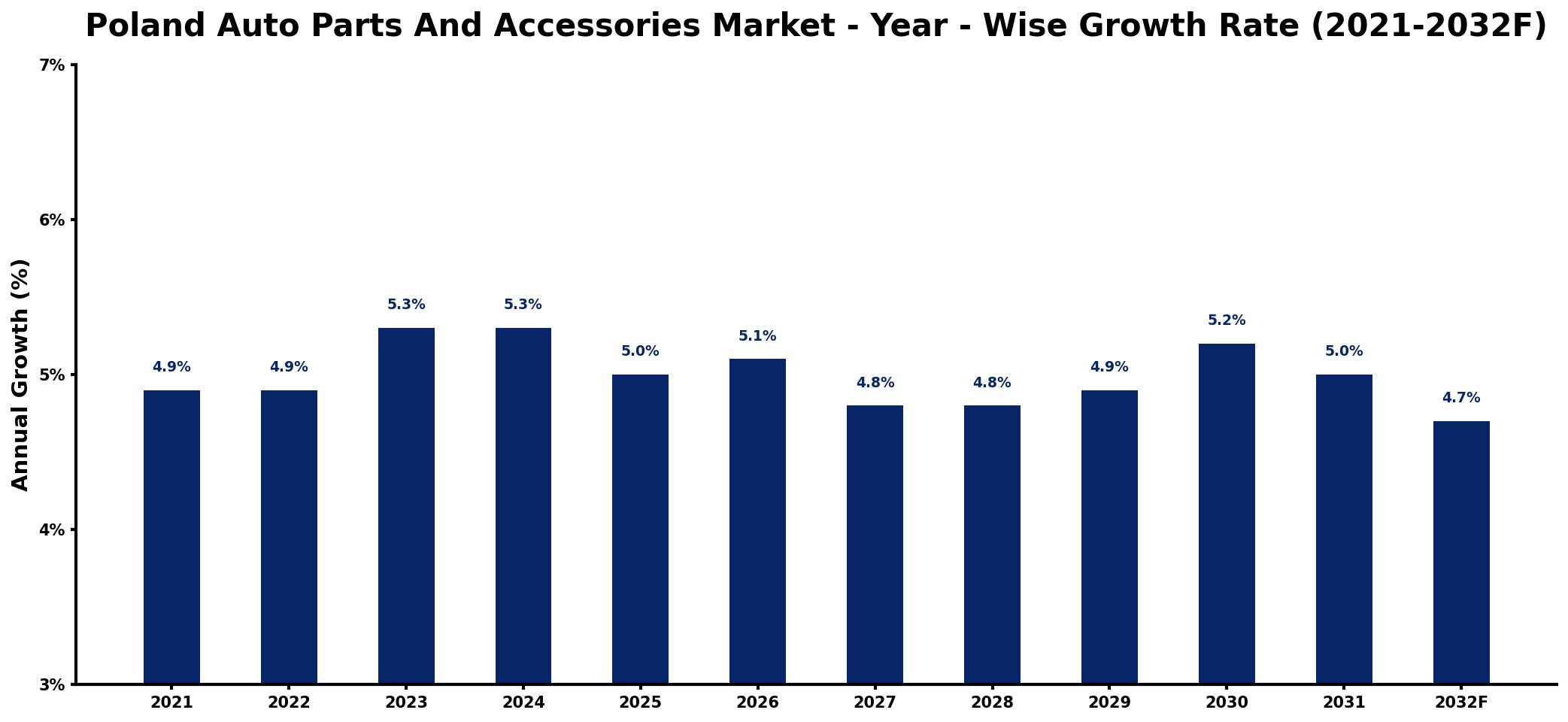
The table below presents the year‑wise growth rates along with the key drivers influencing the market
| Year | Growth Rate | Major Drivers |
| 2021 | 4.9% | Rising consumer vehicle ownership rates |
| 2022 | 4.9% | Increased focus on vehicle maintenance |
| 2023 | 5.3% | Expansion of electric vehicle market |
| 2024 | 5.3% | Growth in online retail channels |
| 2025 | 5.0% | increased domestic production output |
| 2026 | 5.1% | Surge in vehicle customization trends |
| 2027 | 4.8% | Demand for sustainable vehicle solutions |
| 2028 | 4.8% | increased pharmaceutical industry usage |
| 2029 | 4.9% | Increased vehicle leasing popularity |
| 2030 | 5.2% | Technological advancements in mobility |
| 2031 | 5.0% | stronger distribution network expansion |
| 2032 | 4.7% | growing downstream application demand |
Note: Market size estimations and growth projections presented in this report are based on 6Wresearch's proprietary forecasting methodology, utilizing the latest available industry data, government publications, and primary research inputs.
Poland Auto Parts And Accessories Market Synopsis
The growing automotive sector in Poland is propelling the demand for various auto parts, including engine components, brakes, and electrical systems. With the rise in vehicle ownership, there is a notable emphasis on maintaining vehicle performance through quality auto parts.
Additionally, the trend toward online shopping is reshaping how consumers purchase auto parts. E-commerce platforms are making it easier for customers to access a wide range of products, thus fostering competition and innovation in the market.
Poland Auto Parts And Accessories Market Key Takeaways
- Rising vehicle ownership and aging fleets drive demand for maintenance and aftermarket parts.
- Growth in electric vehicles necessitates innovative components and infrastructure.
- Shift towards online retail channels enhances consumer access to a variety of products.
- Environmental concerns fuel demand for sustainable and eco-friendly automotive solutions.
- Technological advancements in connected vehicles are reshaping the parts and accessories landscape.
Evaluation of Restraints in Poland Auto Parts And Accessories Market
Despite its growth potential, the Poland Auto Parts And Accessories Market faces significant challenges. One pressing issue is the intense competition from both local and global suppliers, which can drive prices down and squeeze margins for manufacturers. Fluctuating raw material costs further complicate production and pricing strategies. Moreover, as consumer preferences shift towards electric vehicles, companies must innovate continuously to keep up, which requires substantial investment in research and development. Regulatory changes can also introduce additional complexities, influencing market dynamics and operational costs.
Poland Auto Parts And Accessories Market Trends
Several notable trends are emerging in the Poland Auto Parts And Accessories Market. Firstly, the demand for electric and hybrid vehicle components is surging, driven by an increasing awareness of environmental issues. Consumers are also expressing a preference for advanced safety features, leading to greater demand for high-tech components like sensors and cameras. Additionally, the customization trend is gaining momentum, with consumers eager to personalize their vehicles, which boosts sales for aftermarket accessories. E-commerce continues to grow, reshaping purchasing behavior and logistics in the sector.
Poland Auto Parts And Accessories Market Opportunities
The market presents numerous investment opportunities, particularly in the realm of aftermarket parts and electric vehicle components. There is a significant potential for growth in supplying specialized components that cater to both domestic automotive manufacturers and international brands. As electric vehicles become increasingly popular, investing in charging infrastructure and related technology could yield high returns. Furthermore, the demand for sustainable products opens avenues for innovation in eco-friendly materials and manufacturing processes.
Government Initiatives in the Poland Auto Parts And Accessories Market
The Polish government supports the auto parts and accessories market through various policies aimed at ensuring product quality and safety. Regulations mandate adherence to quality standards, thus safeguarding consumer interests. Additionally, the government encourages local production by providing incentives to domestic manufacturers, fostering competitiveness both at home and abroad. Import regulations are also enforced to maintain high standards and prevent the influx of subpar products, further enhancing the market landscape.
Future Insights of the Poland Auto Parts And Accessories Market
Looking ahead, the Poland Auto Parts And Accessories Market is poised for steady growth through 2032. Factors such as an increasing number of vehicles requiring maintenance and a robust trend towards customization will drive demand for aftermarket parts. The rise of electric vehicles will introduce new components and necessitate innovations in manufacturing. Additionally, technological advancements in production, including 3D printing and the Internet of Things, are expected to enhance operational efficiencies and reshape the market dynamics.
Poland Auto Parts And Accessories Market Latest Developments (2025 - 2026)
Recent developments in the Poland Auto Parts And Accessories Market indicate a shift towards more integrated supply chains, with companies focusing on enhancing logistics and distribution strategies to meet the growing e-commerce demands. Additionally, there is a noticeable uptick in collaborations between tech firms and auto parts suppliers, aiming to integrate advanced technologies into vehicle components. Sustainability initiatives are also gaining traction as companies seek to align with consumer preferences and regulatory requirements.
Poland Auto Parts And Accessories Market - Key Attractiveness of the Report
- 10 Years of Market Numbers
- Historical Data Starting from 2022 to 2025
- Base Year: 2025
- Forecast Data until 2032
- Key Performance Indicators Impacting the Market
- Major Upcoming Developments and Projects
Key Highlights of the Report:
- Poland Auto Parts And Accessories Market Outlook
- Market Size of Poland Auto Parts And Accessories Market, 2025
- Forecast of Poland Auto Parts And Accessories Market, 2032
- Historical Data and Forecast of Poland Auto Parts And Accessories Revenues & Volume for the Period 2022-2032F
- Poland Auto Parts And Accessories Market Trend Evolution
- Poland Auto Parts And Accessories Market Drivers and Challenges
- Poland Auto Parts And Accessories Price Trends
- Poland Auto Parts And Accessories Porter's Five Forces
- Poland Auto Parts And Accessories Industry Life Cycle
- Historical Data and Forecast of Poland Auto Parts And Accessories Market Revenues & Volume By Product for the Period 2022-2032F
- Historical Data and Forecast of Poland Auto Parts And Accessories Market Revenues & Volume By Driveline & Powertrain for the Period 2022-2032F
- Historical Data and Forecast of Poland Auto Parts And Accessories Market Revenues & Volume By Interiors & Exteriors for the Period 2022-2032F
- Historical Data and Forecast of Poland Auto Parts And Accessories Market Revenues & Volume By Electronics for the Period 2022-2032F
- Historical Data and Forecast of Poland Auto Parts And Accessories Market Revenues & Volume By Bodies & Chassis for the Period 2022-2032F
- Historical Data and Forecast of Poland Auto Parts And Accessories Market Revenues & Volume By Wheel & Tires for the Period 2022-2032F
- Historical Data and Forecast of Poland Auto Parts And Accessories Market Revenues & Volume By Others for the Period 2022-2032F
- Historical Data and Forecast of Poland Auto Parts And Accessories Market Revenues & Volume By Application for the Period 2022-2032F
- Historical Data and Forecast of Poland Auto Parts And Accessories Market Revenues & Volume By OEMs for the Period 2022-2032F
- Historical Data and Forecast of Poland Auto Parts And Accessories Market Revenues & Volume By Aftermarket for the Period 2022-2032F
- Poland Auto Parts And Accessories Import Export Trade Statistics
- Market Opportunity Assessment By Product
- Market Opportunity Assessment By Application
- Poland Auto Parts And Accessories Top Companies Market Share
- Poland Auto Parts And Accessories Competitive Benchmarking By Technical and Operational Parameters
- Poland Auto Parts And Accessories Company Profiles
- Poland Auto Parts And Accessories Key Strategic Recommendations






































