Poland Bread Market Size (2020-2030)
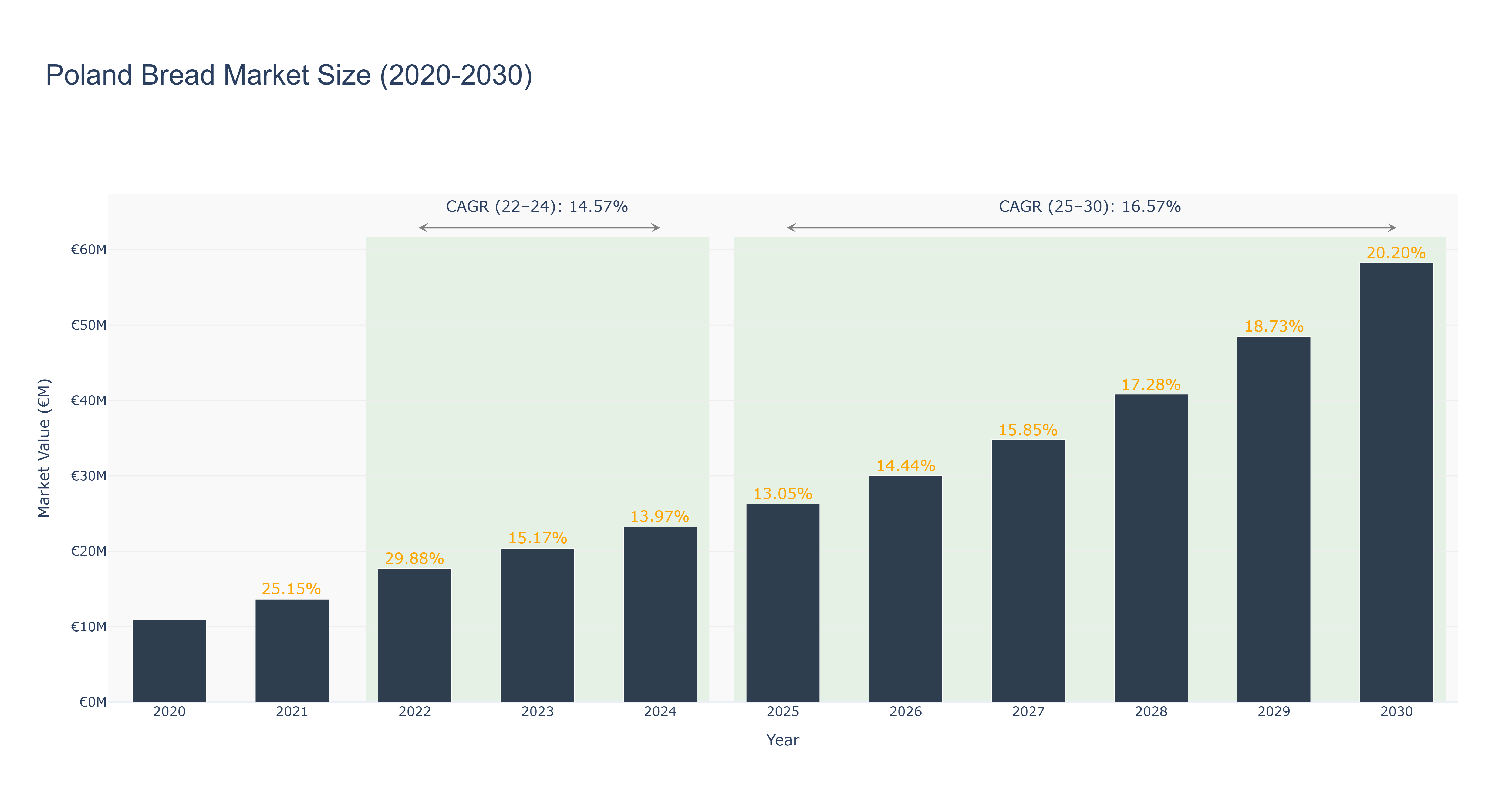
The Poland Bread Market has shown robust growth from €10.88 million in 2020 to €23.22 million in 2024, reflecting a significant actual CAGR of 14.57% between 2022 and 2024. The peak market size in this period was in 2024, driven by increasing consumer demand for diverse bread products and a growing trend towards artisanal and health-focused options. Looking ahead, the market is projected to expand further, reaching €58.25 million by 2030, with a forecasted CAGR of 16.57% from 2025 to 2030. This anticipated growth will likely be fueled by ongoing innovation in product offerings, including gluten-free and organic varieties, as well as the expansion of distribution channels. Additionally, rising health awareness among consumers and a strong push towards sustainability in production practices are expected to shape market dynamics positively in the coming years.
Poland Bread Market: Production & Trade Performance (2019-2025)
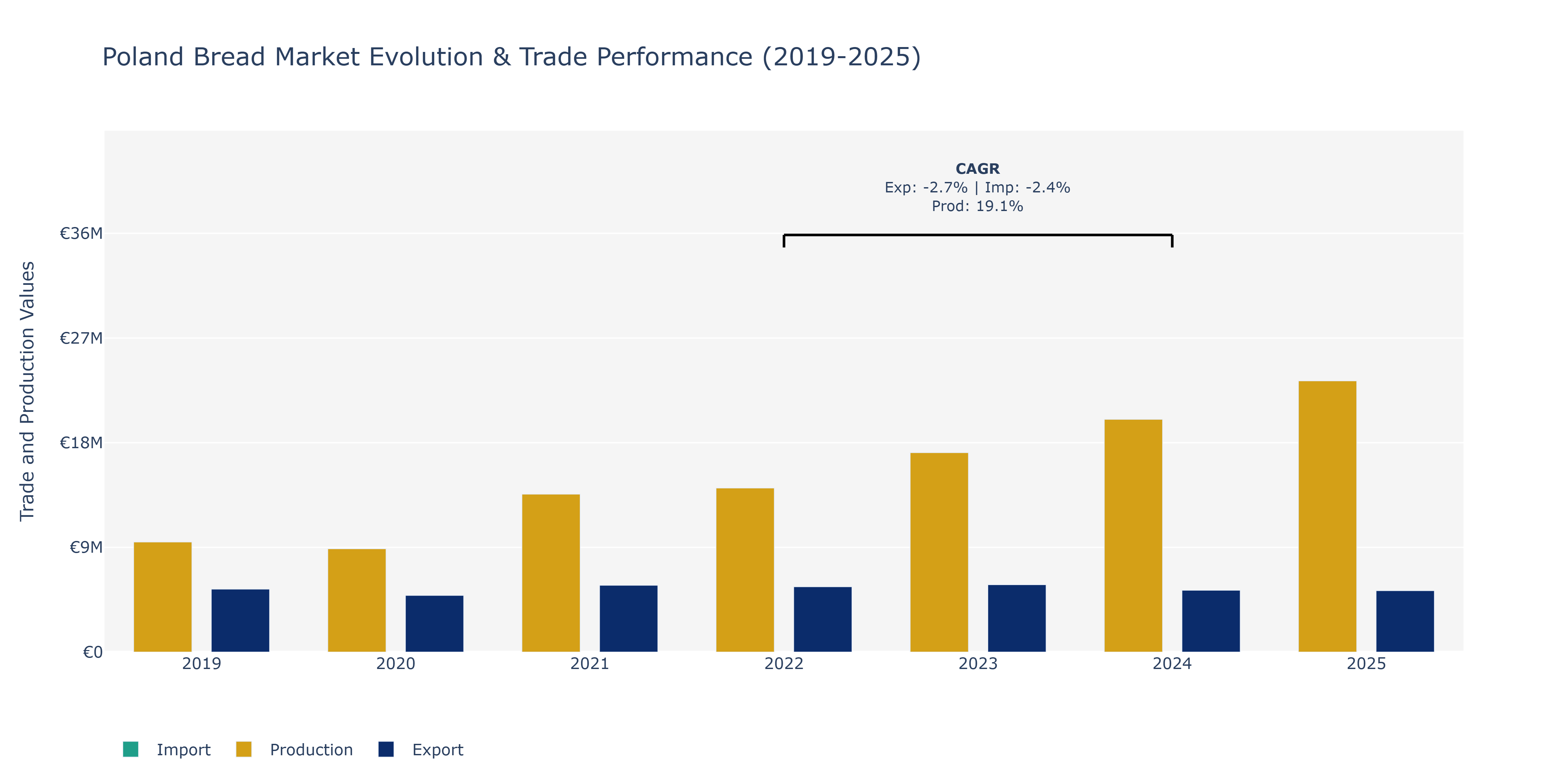
Between 2019 and 2025, the Poland Bread Market displayed varying trends in Exports, Imports, and Production. Exports witnessed a slight decline from €5.41 million in 2019 to approximately €5.27 million in 2025. Conversely, Imports experienced a more notable increase, rising from €5.3 million in 2019 to around €8.71 million in 2024 before slightly dropping to about €8.71 million in 2025. Production showed a consistent upward trajectory, growing from €9.46 million in 2019 to around €23.31 million in 2025. The surge in production can be attributed to evolving consumer preferences towards healthier bread options, increased investments in production technologies, and expanding distribution networks to meet the rising demand for bread products. Despite the fluctuations in Exports and Imports, the overall growth in Production reflects the market's efforts to adapt to changing consumer needs and capitalize on emerging opportunities in the bread industry.
Poland Bread Market Synopsis
The bread market in Poland is rapidly growing, with the country?s bread production increasing steadily over recent years. In 2018, total bread production in Poland amounted to about 4 million tons - an increase of 1% compared to 2017 levels. The growth rate of Polish bread production between 2016 and 2018 was slightly higher than overall food production growth rates in the same period.
Poland is one of Europe`s largest producers and consumers of bread products. Bread accounted for around 37% (about 710 thousand tonnes) of all bakery products produced in the country during 2018. White wheat-rye mixed-grain loaves as well as other white wheat flour based rolls and buns are the most popular types among Polish consumers. Rye-based dark sourdough rye loaves remain very popular on a regional level, especially in Eastern parts of Poland where traditional dishes such as ?bigos? are still made from them.
Most people still prefer baking their own loaves at home but there has been an increasing demand for prebaked or frozen packaged wholewheat/mixed grain industrial loaves sold by supermarkets chains throughout Poland, especially since health awareness campaigns have become more visible over recent years.. This trend is further supported by rising disposable incomes amongst Poles which has enabled them to purchase these healthier options which were previously unavailable due to high prices associated with them before this economic boom happened.
Key Highlights of the Report:
- Poland Bread Market Outlook
- Market Size of Poland Bread Market, 2019
- Forecast of Poland Bread Market, 2026
- Historical Data and Forecast of Poland Bread Revenues & Volume for the Period 2016 - 2026
- Poland Bread Market Trend Evolution
- Poland Bread Market Drivers and Challenges
- Poland Bread Price Trends
- Poland Bread Porter's Five Forces
- Poland Bread Industry Life Cycle
- Historical Data and Forecast of Poland Bread Market Revenues & Volume By Loaves for the Period 2016 - 2026
- Historical Data and Forecast of Poland Bread Market Revenues & Volume By Baguettes for the Period 2016 - 2026
- Historical Data and Forecast of Poland Bread Market Revenues & Volume By Rolls for the Period 2016 - 2026
- Historical Data and Forecast of Poland Bread Market Revenues & Volume By Burger Buns for the Period 2016 - 2026
- Historical Data and Forecast of Poland Bread Market Revenues & Volume By Ciabatta for the Period 2016 - 2026
- Historical Data and Forecast of Poland Bread Market Revenues & Volume By Others for the Period 2016 - 2026
- Historical Data and Forecast of Poland Bread Market Revenues & Volume By Convenience Stores for the Period 2016 - 2026
- Historical Data and Forecast of Poland Bread Market Revenues & Volume By Specialist Retailers for the Period 2016 - 2026
- Historical Data and Forecast of Poland Bread Market Revenues & Volume By Supermarkets and Hypermarkets for the Period 2016 - 2026
- Historical Data and Forecast of Poland Bread Market Revenues & Volume By Online Retail for the Period 2016 - 2026
- Historical Data and Forecast of Poland Bread Market Revenues & Volume By Variety Stores for the Period 2016 - 2026
- Historical Data and Forecast of Poland Bread Market Revenues & Volume By Others for the Period 2016 - 2026
- Poland Bread Import Export Trade Statistics
- Market Opportunity Assessment By Loaves
- Market Opportunity Assessment By Convenience Stores
- Poland Bread Top Companies Market Share
- Poland Bread Competitive Benchmarking By Technical and Operational Parameters
- Poland Bread Company Profiles
- Poland Bread Key Strategic Recommendations






































