Poland Canvas Market Size, Share & Growth Rate
The Poland Canvas Market was estimated at USD 201 Million in 2025 and is projected to reach USD 281 Million by 2032, growing at a CAGR of 4.9% from 2026 to 2032. This upward trajectory is largely driven by the increasing demand for canvas in both artistic endeavors and practical applications such as outdoor gear. The burgeoning creative sector, alongside the versatile nature of canvas in manufacturing and construction, supports robust market expansion.
Poland Canvas Market Year-wise Growth Rate and Key Drivers
This graph highlights how the Poland Canvas Market has steadily grown over the years, supported by major growth factors.
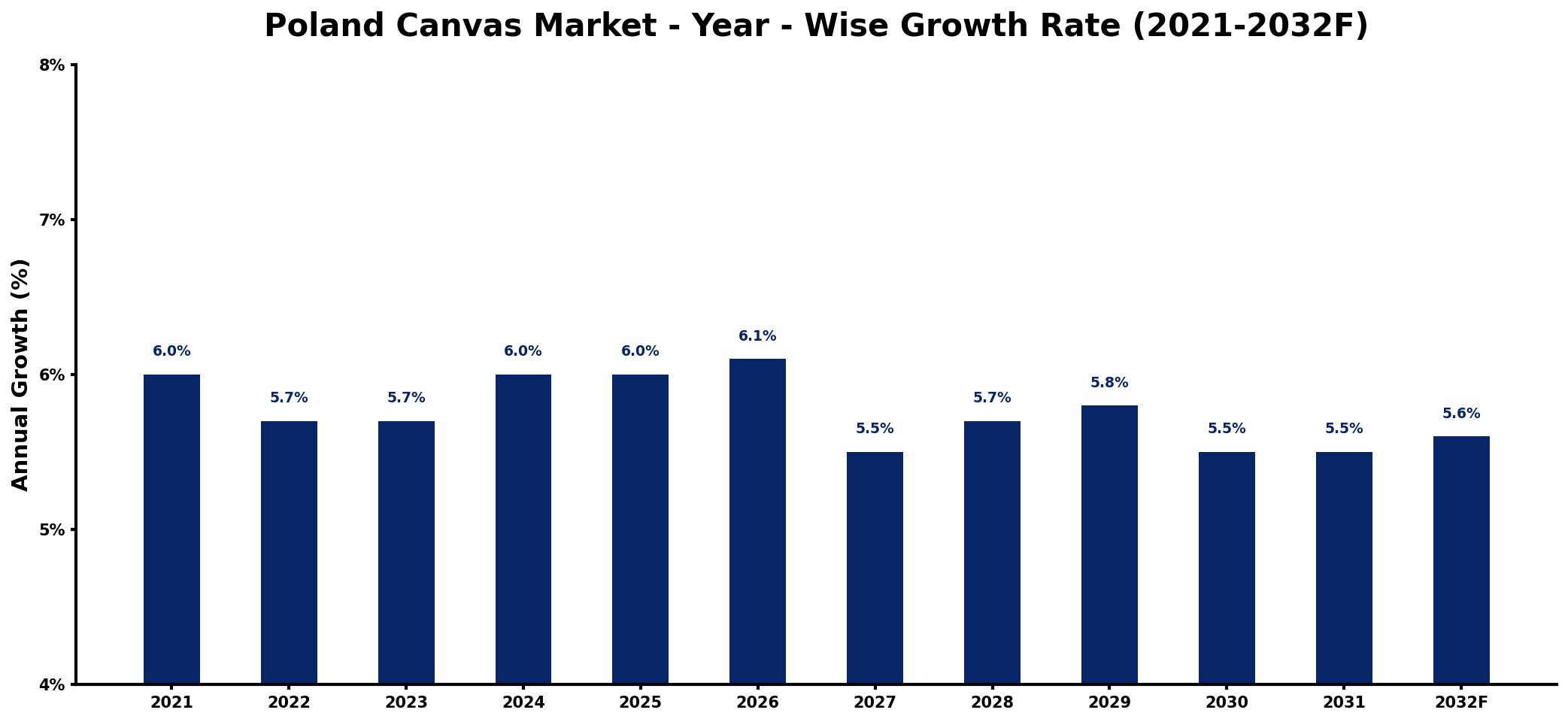
The table below presents the year‑wise growth rates along with the key drivers influencing the market
| Year | Growth Rate | Major Drivers |
| 2021 | 6.0% | Rising interest in home decor |
| 2022 | 5.7% | Increased investment in art supplies |
| 2023 | 5.7% | Growth in DIY project popularity |
| 2024 | 6.0% | Expansion of online shopping platforms |
| 2025 | 6.0% | Surge in educational art programs |
| 2026 | 6.1% | growing regional consumption patterns |
| 2027 | 5.5% | Increase in local artisan markets |
| 2028 | 5.7% | Rising demand for personalized gifts |
| 2029 | 5.8% | growing commercial sector adoption |
| 2030 | 5.5% | improved processing technologies adoption |
| 2031 | 5.5% | increased capital investment inflows |
| 2032 | 5.6% | Rising popularity of home workshops |
Note: Market size estimations and growth projections presented in this report are based on 6Wresearch's proprietary forecasting methodology, utilizing the latest available industry data, government publications, and primary research inputs.
Poland Canvas Market Synopsis
The strongest force currently shaping the Poland Canvas Market is the rising demand for high-quality canvas products across various sectors. The combination of art supplies and industrial applications, particularly in the production of tents, bags, and tarpaulins, is creating a fertile ground for growth.
Technological advancements in fabric treatments and innovations in canvas production are further fueling market developments. As consumers seek durable and weather-resistant materials, manufacturers are stepping up to meet these evolving preferences, enhancing the overall attractiveness of the canvas sector.
Poland Canvas Market Key Takeaways
- The market is witnessing a significant shift towards eco-friendly and durable canvas alternatives.
- Government regulations are increasingly favoring sustainable manufacturing practices.
- There is a notable rise in the utilization of canvas within the art and creative industries.
- Technological innovations are enhancing the performance of canvas materials.
- Competitive pressures from synthetic materials are influencing pricing strategies.
Evaluation of Restraints in Poland Canvas Market
Despite its promising growth trajectory, the Poland Canvas Market faces several constraints that may hinder its full potential. The high cost of raw materials, particularly cotton, often sourced from imports, creates challenges for manufacturers aiming to remain price competitive. Additionally, the market is characterized by fragmentation, with many small players intensifying competition and contributing to price pressures. Furthermore, the emergence of synthetic alternatives, which often offer lower costs and superior durability, poses a significant threat to traditional canvas suppliers.
Poland Canvas Market Trends
Emerging trends in the Poland Canvas Market highlight a growing consumer preference for sustainable products. This shift is prompting manufacturers to innovate in fabric treatments, making canvas not only more durable but also environmentally friendly. Additionally, the increasing popularity of outdoor activities fuels the demand for high-quality canvas in equipment such as tents and bags, further solidifying its market position.
Poland Canvas Market Opportunities
Investment opportunities within the Poland Canvas Market are abundant, particularly in the area of sustainable manufacturing processes. Companies focusing on eco-friendly practices can tap into a growing demographic of environmentally conscious consumers. Furthermore, as the creative industry flourishes, there is potential for niche markets catering to artists seeking premium canvas products. Expanding distribution channels and enhancing product offerings can also open new avenues for growth.
Government Initiatives in the Poland Canvas Market
Government initiatives play a vital role in shaping the Poland Canvas Market. Regulatory measures aimed at ensuring manufacturing standards help maintain quality across the sector, while policies promoting environmental sustainability encourage the adoption of green practices among manufacturers. Additionally, public support for innovation in textile technologies bolsters market development, aligning with EU regulations and sustainability goals.
Future Insights of the Poland Canvas Market
Looking ahead to 2026-2032, the Poland Canvas Market is poised for growth driven by evolving consumer preferences and technological advancements. As demand for durable, high-quality canvas products continues to rise, manufacturers that embrace sustainable practices and innovative production techniques will likely emerge as leaders in this landscape. With the intersection of art, industry, and environmental consciousness, the market is set for dynamic changes that will shape its future.
Poland Canvas Market Latest Developments (2025 - 2026)
In recent months, the Poland Canvas Market has seen a shift towards innovative fabric treatments that enhance durability and environmental sustainability. Various stakeholders are increasingly focusing on integrating eco-friendly materials into their production processes, aligning with consumer demand for greener products. Simultaneously, collaborations between artists and manufacturers are emerging, which not only enrich the product offerings but also promote the use of canvas in unique, creative applications.
Poland Canvas Market - Key Attractiveness of the Report
- 10 Years of Market Numbers
- Historical Data Starting from 2022 to 2025
- Base Year: 2025
- Forecast Data until 2032
- Key Performance Indicators Impacting the Market
- Major Upcoming Developments and Projects
Key Highlights of the Report:
- Poland Canvas Market Outlook
- Market Size of Poland Canvas Market, 2025
- Forecast of Poland Canvas Market, 2032
- Historical Data and Forecast of Poland Canvas Revenues & Volume for the Period 2022-2032F
- Poland Canvas Market Trend Evolution
- Poland Canvas Market Drivers and Challenges
- Poland Canvas Price Trends
- Poland Canvas Porter's Five Forces
- Poland Canvas Industry Life Cycle
- Historical Data and Forecast of Poland Canvas Market Revenues & Volume By Types for the Period 2022-2032F
- Historical Data and Forecast of Poland Canvas Market Revenues & Volume By Plane Canvas for the Period 2022-2032F
- Historical Data and Forecast of Poland Canvas Market Revenues & Volume By Duck Canvas for the Period 2022-2032F
- Historical Data and Forecast of Poland Canvas Market Revenues & Volume By Application for the Period 2022-2032F
- Historical Data and Forecast of Poland Canvas Market Revenues & Volume By Tent for the Period 2022-2032F
- Historical Data and Forecast of Poland Canvas Market Revenues & Volume By Luggage Fabric for the Period 2022-2032F
- Historical Data and Forecast of Poland Canvas Market Revenues & Volume By Automotive Fabric for the Period 2022-2032F
- Historical Data and Forecast of Poland Canvas Market Revenues & Volume By Apparel for the Period 2022-2032F
- Historical Data and Forecast of Poland Canvas Market Revenues & Volume By Others for the Period 2022-2032F
- Poland Canvas Import Export Trade Statistics
- Market Opportunity Assessment By Types
- Market Opportunity Assessment By Application
- Poland Canvas Top Companies Market Share
- Poland Canvas Competitive Benchmarking By Technical and Operational Parameters
- Poland Canvas Company Profiles
- Poland Canvas Key Strategic Recommendations






































