Poland Cellulose Acetate Fiber Market Size, Share & Growth Rate
The Poland Cellulose Acetate Fiber Market was estimated at USD 759 Million in 2025 and is projected to reach USD 1096 Million by 2032, growing at a CAGR of 5.4% from 2026 to 2032. This growth trajectory is primarily driven by the increasing consumer demand for sustainable and eco-friendly textile materials. As awareness about the environmental impact of synthetic fibers heightens, more manufacturers are pivoting towards cellulose acetate fibers, which offer not only aesthetic qualities but also align with green initiatives.
Poland Cellulose Acetate Fiber Market Year-wise Growth Rate and Key Drivers
This graph highlights how the Poland Cellulose Acetate Fiber Market has steadily grown over the years, supported by major growth factors.
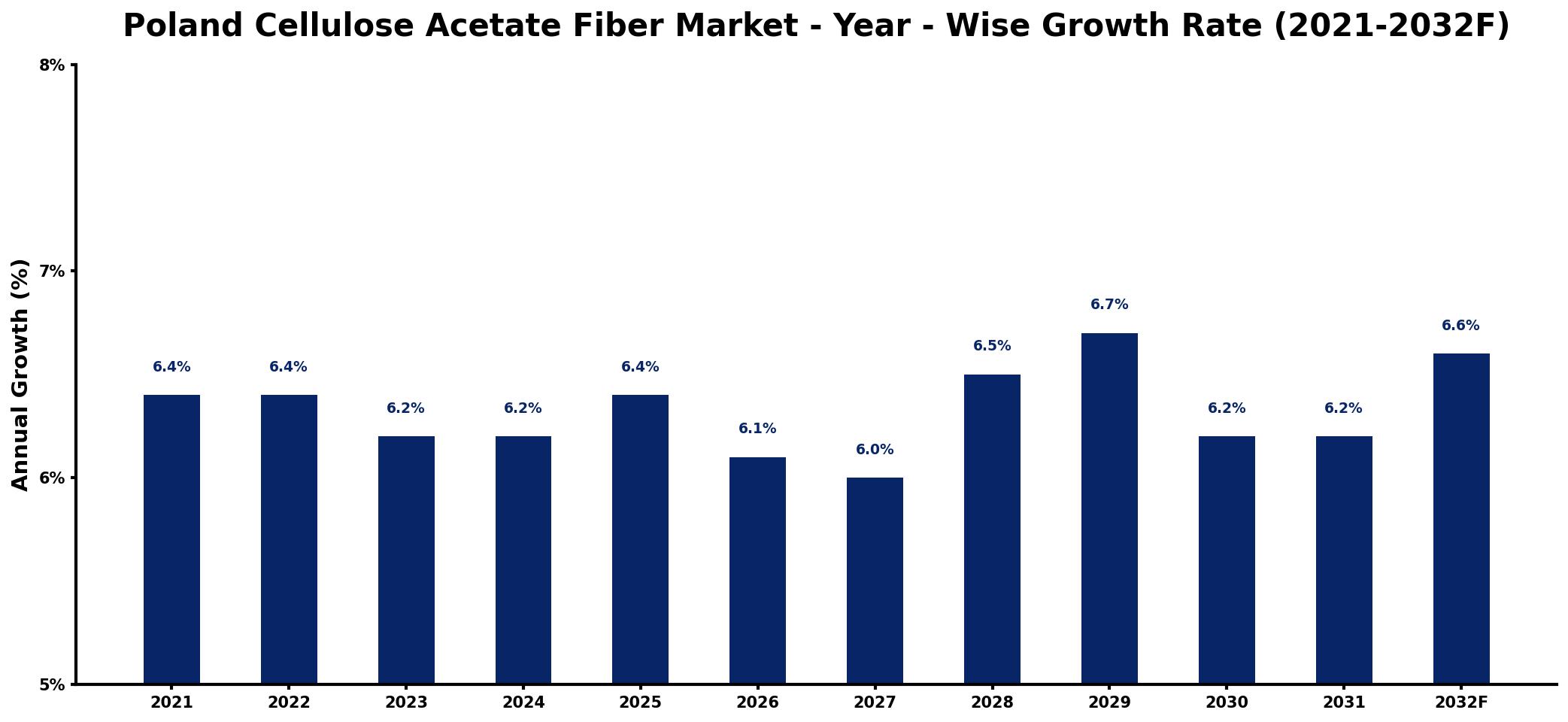
The table below presents the year‑wise growth rates along with the key drivers influencing the market
| Year | Growth Rate | Major Drivers |
| 2021 | 6.4% | Rising demand in textile sector |
| 2022 | 6.4% | Increased investment in sustainable materials |
| 2023 | 6.2% | Expansion in fashion industry applications |
| 2024 | 6.2% | expanding industrial usage applications |
| 2025 | 6.4% | Technological advancements in production processes |
| 2026 | 6.1% | Emerging markets boosting consumption rates |
| 2027 | 6.0% | Strengthening partnerships with manufacturers |
| 2028 | 6.5% | Innovations in product functionalities |
| 2029 | 6.7% | Enhanced marketing strategies driving sales |
| 2030 | 6.2% | Regulatory support for sustainable practices |
| 2031 | 6.2% | Diversification into new market segments |
| 2032 | 6.6% | Collaboration with research institutions |
Note: Market size estimations and growth projections presented in this report are based on 6Wresearch's proprietary forecasting methodology, utilizing the latest available industry data, government publications, and primary research inputs.
Poland Cellulose Acetate Fiber Market Synopsis
The most significant force currently shaping the Poland Cellulose Acetate Fiber Market is the growing consumer demand for sustainable textiles. The shift towards eco-friendly products is influencing manufacturers to enhance production capabilities and innovate processes. This trend is harmonizing with global movements towards sustainability, further accelerating market growth.
Moreover, the unique properties of cellulose acetate fibers, such as their softness and silk-like appearance, are appealing to various sectors, including apparel and home textiles. As these fibers are derived from renewable sources like wood pulp, they are garnering attention for their biodegradable characteristics, making them a preferred choice among environmentally-conscious consumers.
Poland Cellulose Acetate Fiber Market Key Takeaways
- The market is experiencing robust growth driven by consumer demand for eco-friendly products.
- Cellulose acetate fibers are increasingly favored over synthetic alternatives due to their unique properties and sustainability.
- Investments in technology and innovation are critical for manufacturers to stay competitive and meet evolving market needs.
- Government policies promoting sustainable practices are enhancing market prospects.
- Various end-use applications, including textiles and healthcare, present substantial growth opportunities.
Evaluation of Restraints in Poland Cellulose Acetate Fiber Market
Despite its growth, the Poland Cellulose Acetate Fiber Market faces specific constraints that could inhibit its full potential. Strong competition from synthetic fibers, like polyester and nylon, presents a challenge due to their lower costs and enhanced durability. Fluctuations in raw material prices can also impact production costs, creating profitability concerns for manufacturers. Moreover, shifting consumer preferences toward other natural fibers, such as cotton and wool, may pose additional obstacles in sustaining the demand for cellulose acetate fibers.
Poland Cellulose Acetate Fiber Market Trends
A prominent trend influencing the Poland Cellulose Acetate Fiber Market is the growing consumer awareness of environmental sustainability. As more consumers seek products that minimize ecological footprints, manufacturers are responding with innovations that enhance the fibers' sustainable attributes. Additionally, the integration of cellulose acetate fibers into fashion and home textile sectors highlights a broader acceptance of these materials in mainstream applications, further solidifying their market presence.
Poland Cellulose Acetate Fiber Market Opportunities
Significant investment opportunities abound in the Poland Cellulose Acetate Fiber Market, particularly in sectors such as automotive and healthcare, where demand for sustainable materials is rising. Manufacturers can capitalize on consumer trends favoring biodegradable and renewable materials by developing specialized products. Furthermore, government initiatives promoting circular economy practices and sustainable production methods provide an additional impetus for investment in this sector.
Government Initiatives in the Poland Cellulose Acetate Fiber Market
The Polish government has been active in establishing a regulatory framework that encourages sustainability within the cellulose acetate fiber sector. Policies focus on setting quality standards for production, ensuring that products are reliable and safe. Additionally, various incentives and subsidies are available to promote the use of cellulose acetate fibers across industries, fostering domestic production and reducing reliance on imported materials. Monitoring regulations on waste management also aim to mitigate environmental impacts, underscoring the commitment to sustainable practices.
Future Insights of the Poland Cellulose Acetate Fiber Market
Looking ahead to 2026-2032, the Poland Cellulose Acetate Fiber Market is poised for steady growth fueled by the rising demand for eco-friendly materials. With advancements in technology and an increased focus on sustainability, the market is likely to evolve further. The versatility of cellulose acetate fibers, complemented by their appealing properties, is expected to enhance their adoption across various applications. The ongoing global transition towards green fashion choices will undoubtedly drive this market forward.
Poland Cellulose Acetate Fiber Market Latest Developments (2025 - 2026)
Recent developments within the Poland Cellulose Acetate Fiber Market indicate a notable shift towards innovation. Manufacturers are increasingly investing in research and development to enhance fiber properties and explore new applications. Additionally, collaborations within the industry aim to streamline production processes and improve sustainability practices. The market is also witnessing an uptick in consumer awareness campaigns focused on the benefits of cellulose acetate fibers, further driving demand.
Poland Cellulose Acetate Fiber Market - Key Attractiveness of the Report
- 10 Years of Market Numbers
- Historical Data Starting from 2022 to 2025
- Base Year: 2025
- Forecast Data until 2032
- Key Performance Indicators Impacting the Market
- Major Upcoming Developments and Projects
Key Highlights of the Report:
- Poland Cellulose Acetate Fiber Market Outlook
- Market Size of Poland Cellulose Acetate Fiber Market, 2025
- Forecast of Poland Cellulose Acetate Fiber Market, 2032
- Historical Data and Forecast of Poland Cellulose Acetate Fiber Revenues & Volume for the Period 2022-2032F
- Poland Cellulose Acetate Fiber Market Trend Evolution
- Poland Cellulose Acetate Fiber Market Drivers and Challenges
- Poland Cellulose Acetate Fiber Price Trends
- Poland Cellulose Acetate Fiber Porter's Five Forces
- Poland Cellulose Acetate Fiber Industry Life Cycle
- Historical Data and Forecast of Poland Cellulose Acetate Fiber Market Revenues & Volume By Type for the Period 2022-2032F
- Historical Data and Forecast of Poland Cellulose Acetate Fiber Market Revenues & Volume By Plastic for the Period 2022-2032F
- Historical Data and Forecast of Poland Cellulose Acetate Fiber Market Revenues & Volume By Fiber for the Period 2022-2032F
- Historical Data and Forecast of Poland Cellulose Acetate Fiber Market Revenues & Volume By Application for the Period 2022-2032F
- Historical Data and Forecast of Poland Cellulose Acetate Fiber Market Revenues & Volume By Photographic Films for the Period 2022-2032F
- Historical Data and Forecast of Poland Cellulose Acetate Fiber Market Revenues & Volume By Cigarette Filters for the Period 2022-2032F
- Historical Data and Forecast of Poland Cellulose Acetate Fiber Market Revenues & Volume By Tapes & Labels for the Period 2022-2032F
- Historical Data and Forecast of Poland Cellulose Acetate Fiber Market Revenues & Volume By Textiles & Apparel for the Period 2022-2032F
- Poland Cellulose Acetate Fiber Import Export Trade Statistics
- Market Opportunity Assessment By Type
- Market Opportunity Assessment By Application
- Poland Cellulose Acetate Fiber Top Companies Market Share
- Poland Cellulose Acetate Fiber Competitive Benchmarking By Technical and Operational Parameters
- Poland Cellulose Acetate Fiber Company Profiles
- Poland Cellulose Acetate Fiber Key Strategic Recommendations






































