Poland Cloud CRM Market Size & Growth Rate (2026-2032)
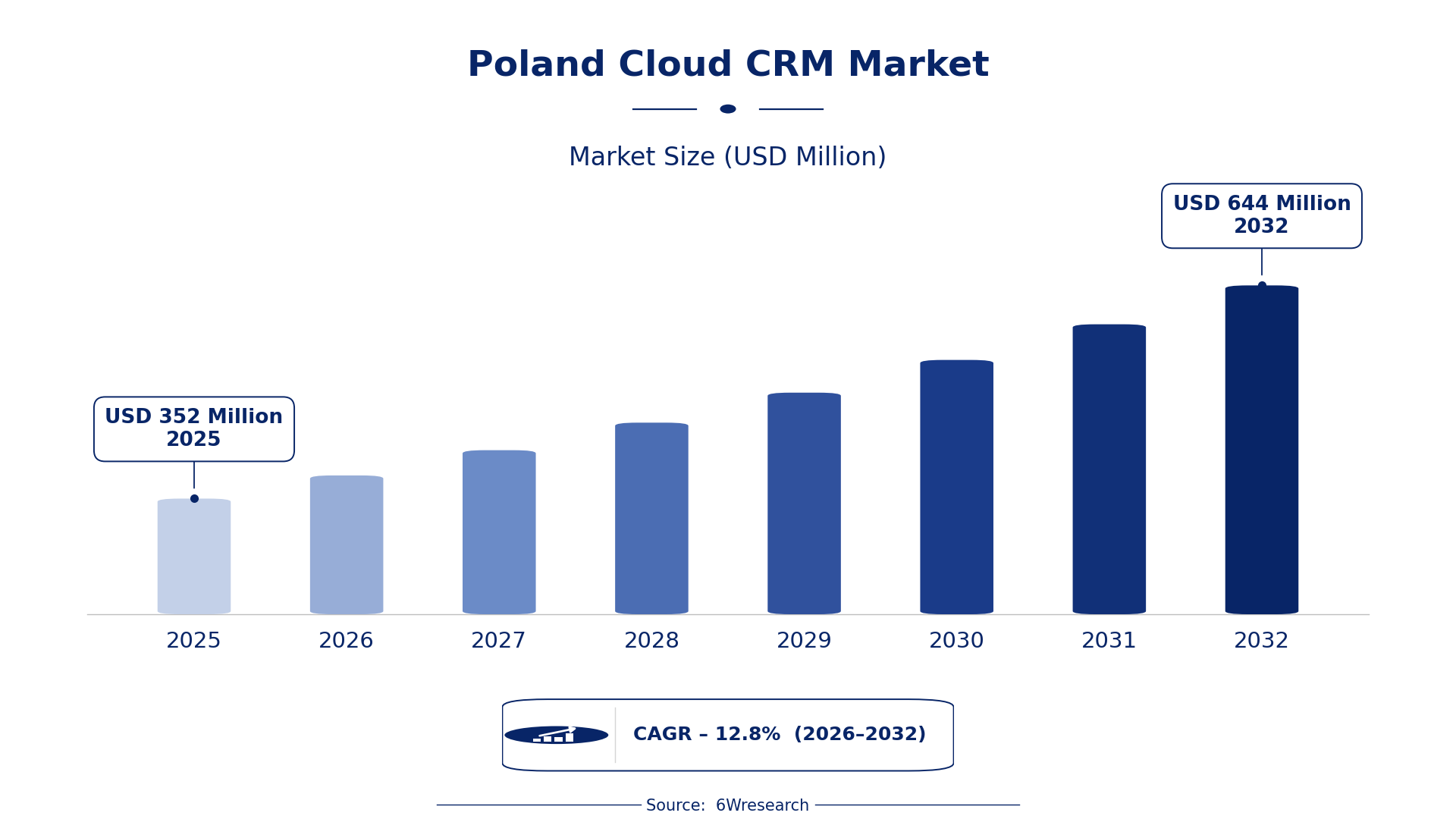
The Poland Cloud CRM Market was estimated at USD 352 Million in 2025 and is projected to reach USD 644 Million by 2032, growing at a CAGR of 12.8% from 2026 to 2032.
Poland Cloud CRM Market Synopsis
The most influential factor currently driving the Poland Cloud CRM market is the escalating demand for cloud-based solutions across various business sectors. Organizations are recognizing that efficient customer relationship management is vital for long-term success, pushing them towards advanced CRM systems that enhance interaction and streamline processes.
As companies increasingly prioritize customer-centric strategies, the integration of artificial intelligence into CRM systems is gaining traction. This technological shift not only improves engagement but also helps businesses analyze customer behaviors more effectively, creating a competitive edge.
Poland Cloud CRM Market Year-wise Growth Rate and Key Drivers
This graph illustrates the annual growth rates of the Poland Cloud CRM Market from 2021 to 2032, highlighting a steady upward trajectory and projected expansion over the forecast period.
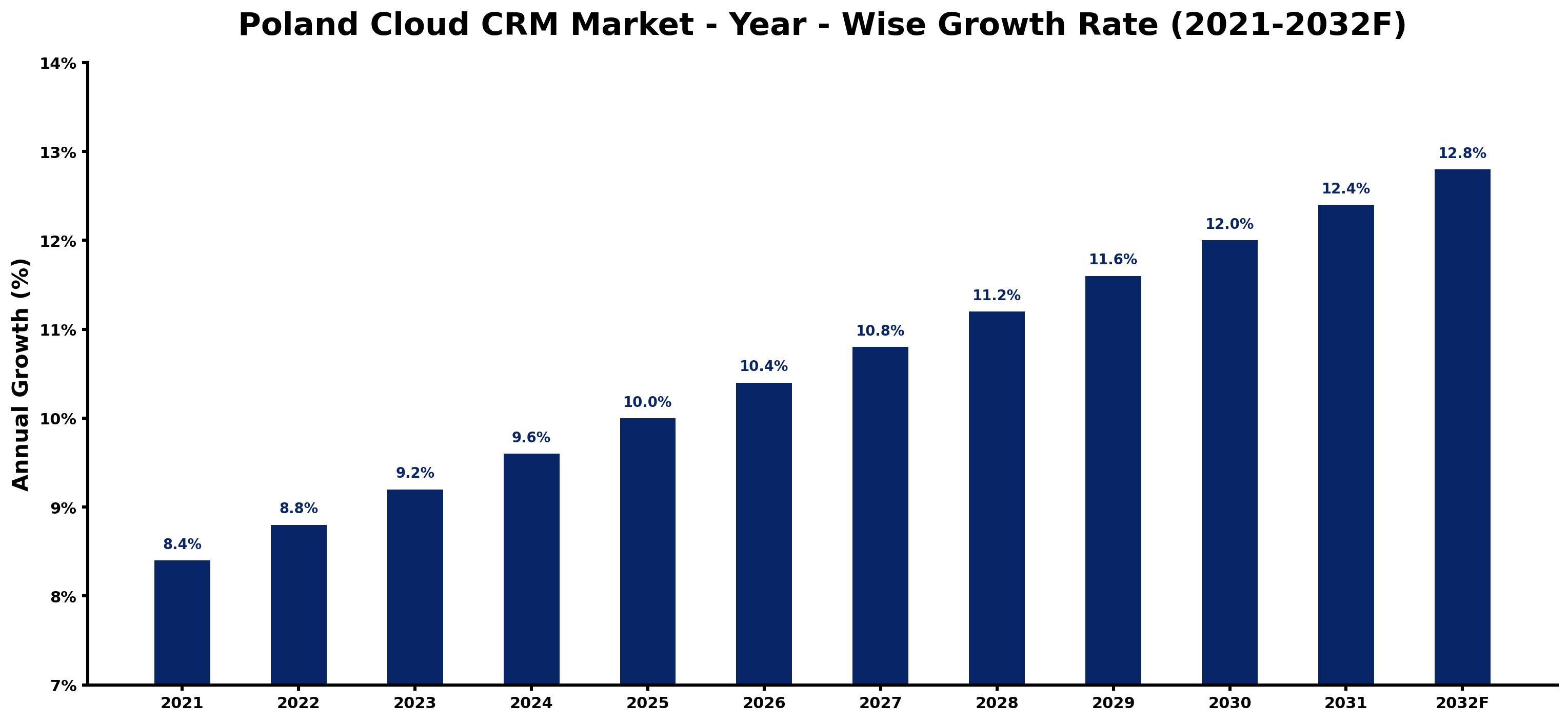
The table below presents the year‑wise growth rates along with the key drivers influencing the market
| Year | Growth Rate | Major Drivers |
| 2021 | 8.4% | Polish SMEs adopting cloud solutions for operational efficiency |
| 2022 | 8.8% | Local fintech innovations driving CRM data integration needs |
| 2023 | 9.2% | Increased focus on remote customer engagement strategies |
| 2024 | 9.6% | Growing e-commerce sector requiring enhanced customer management tools |
| 2025 | 10.0% | Rise in subscription-based services demanding personalized customer insights |
| 2026 | 10.4% | Regulatory push for customer data protection and management |
| 2027 | 10.8% | Enhanced local digital infrastructure boosting cloud service adoption |
| 2028 | 11.2% | Emergence of AI tools shaping CRM functionalities in Poland |
| 2029 | 11.6% | Shift towards omnichannel marketing strategies in Polish businesses |
| 2030 | 12.0% | Increase in consumer privacy regulations enhancing CRM compliance tools |
| 2031 | 12.4% | Growth of local startups leveraging CRM for customer acquisition |
| 2032 | 12.8% | Poland's tech-savvy youth driving demand for innovative CRM solutions |
Note: Market size estimations and growth projections presented in this report are based on 6Wresearch's proprietary forecasting methodology, utilizing the latest available industry data, government publications, and primary research inputs.
Poland Cloud CRM Market Key Takeaways
Below are some of the specific key takeaways from the market, including:
- The market is witnessing a rapid increase in cloud adoption among SMEs, driven by affordability and scalability.
- Integration of AI and automation is enhancing customer engagement strategies.
- Data security remains a critical concern for businesses, especially with GDPR compliance requirements.
- Mobile CRM solutions are on the rise, addressing the need for flexibility in remote work environments.
- Sector-specific CRM solutions are emerging, tailored to industries such as e-commerce and healthcare.
Evaluation of Restraints in Poland Cloud CRM Market
Despite the promising growth, the Poland Cloud CRM market faces several constraints. Data security and privacy issues, particularly regarding GDPR, complicate compliance for many organizations. The integration of new CRM systems with existing legacy systems can also pose significant challenges, often leading to increased costs and longer implementation times. on top of that, cultural resistance among employees accustomed to traditional systems can hinder adoption, necessitating robust training and change management strategies.
Poland Cloud CRM Market Trends
Emerging trends in the Poland Cloud CRM market reflect a clear shift towards personalized customer experiences. Businesses are increasingly investing in technologies that enable tailored interactions and predictive analytics. Additionally, the demand for mobile-friendly CRM solutions is climbing as remote work becomes standard. on top of that, the focus on data-driven decision-making is pushing organizations to adopt CRM solutions that provide comprehensive analytics and reporting capabilities.
Poland Cloud CRM Market Opportunities
The opportunities within the Poland Cloud CRM market are plentiful. Vendors can explore the development of industry-specific solutions that cater to unique requirements across sectors such as finance, healthcare, and retail. The growing emphasis on data security offers a chance for providers to differentiate themselves by offering enhanced security features. Additionally, as businesses increasingly seek to automate customer interactions, solutions incorporating AI-driven insights can capture substantial market share.
Government Initiatives in the Poland Cloud CRM Market
Government policies in Poland are shaping the Cloud CRM market by emphasizing data protection and promoting digital transformation. The implementation of GDPR has set a stringent regulatory framework that companies must navigate to ensure compliance. Concurrently, initiatives to foster digital innovation are encouraging businesses to adopt cloud technologies, aiming to create a secure and competitive environment for CRM solutions.
- A national digital infrastructure upgrade programme launched in early 2025 aims to enhance the connectivity essential for cloud services.
- A regulatory framework introduced in 2025 mandates greater transparency in data handling practices, impacting how CRM systems manage user information.
- Ongoing government grants support businesses investing in cloud technologies, facilitating smoother transitions to modern CRM systems.
- Upcoming initiatives will focus on increasing public awareness about the benefits of digital transformation in customer management practices.
Future Insights of the Poland Cloud CRM Market
Looking ahead to 2026-2032, the Poland Cloud CRM market is set for substantial expansion. The increasing emphasis on digital transformation will continue to drive demand for cloud-based solutions, particularly as organizations seek to enhance customer interactions. The integration of advanced analytics and AI functionalities will likely lead to more efficient CRM practices, making it imperative for vendors to innovate and adapt to the evolving needs of businesses.
Poland Cloud CRM Market Latest Developments
Recent activity in the Poland Cloud CRM market has been characterized by strategic innovations and partnerships. Companies are racing to enhance their offerings by integrating cutting-edge technologies that improve customer experience and operational efficiency.
- A major technology vendor announced the rollout of a new AI-driven CRM platform in Q1 2025, designed to streamline sales processes for SMEs.
- An initiative that began in mid-2025 is currently underway, focusing on the development of tailored CRM solutions for the healthcare sector.
- In late 2025, a partnership between two regional operators was established to provide combined cloud services aimed at enhancing customer engagement.
- Upcoming product upgrades slated for early 2026 promise to include enhanced data security features to address GDPR compliance more effectively.
Poland Cloud CRM Market - Key Attractiveness of the Report
- 10 Years of Market Numbers
- Historical Data Starting from 2022 to 2025
- Base Year: 2025
- Forecast Data until 2032
- Key Performance Indicators Impacting the Market
- Major Upcoming Developments and Projects
Key Highlights of the Report:
- Poland Cloud CRM Market Outlook
- Market Size of Poland Cloud CRM Market, 2025
- Forecast of Poland Cloud CRM Market, 2032
- Historical Data and Forecast of Poland Cloud CRM Revenues & Volume for the Period 2022-2032F
- Poland Cloud CRM Market Trend Evolution
- Poland Cloud CRM Market Drivers and Challenges
- Poland Cloud CRM Price Trends
- Poland Cloud CRM Porter's Five Forces
- Poland Cloud CRM Industry Life Cycle
- Historical Data and Forecast of Poland Cloud CRM Market Revenues & Volume By Vertical for the Period 2022-2032F
- Historical Data and Forecast of Poland Cloud CRM Market Revenues & Volume By Nonprofit for the Period 2022-2032F
- Historical Data and Forecast of Poland Cloud CRM Market Revenues & Volume By Higher Education for the Period 2022-2032F
- Historical Data and Forecast of Poland Cloud CRM Market Revenues & Volume By Nonprofit Sub Vertical for the Period 2022-2032F
- Historical Data and Forecast of Poland Cloud CRM Market Revenues & Volume By Education for the Period 2022-2032F
- Historical Data and Forecast of Poland Cloud CRM Market Revenues & Volume By Research and Innovation for the Period 2022-2032F
- Historical Data and Forecast of Poland Cloud CRM Market Revenues & Volume By Social Affairs for the Period 2022-2032F
- Historical Data and Forecast of Poland Cloud CRM Market Revenues & Volume By Children and Youth for the Period 2022-2032F
- Historical Data and Forecast of Poland Cloud CRM Market Revenues & Volume By Art and Culture for the Period 2022-2032F
- Historical Data and Forecast of Poland Cloud CRM Market Revenues & Volume By Others for the Period 2022-2032F
- Poland Cloud CRM Import Export Trade Statistics
- Market Opportunity Assessment By Vertical
- Market Opportunity Assessment By Nonprofit Sub Vertical
- Poland Cloud CRM Top Companies Market Share
- Poland Cloud CRM Competitive Benchmarking By Technical and Operational Parameters
- Poland Cloud CRM Company Profiles
- Poland Cloud CRM Key Strategic Recommendations






































