Poland Cognitive Analytics Market Size & Growth Rate (2026-2032)
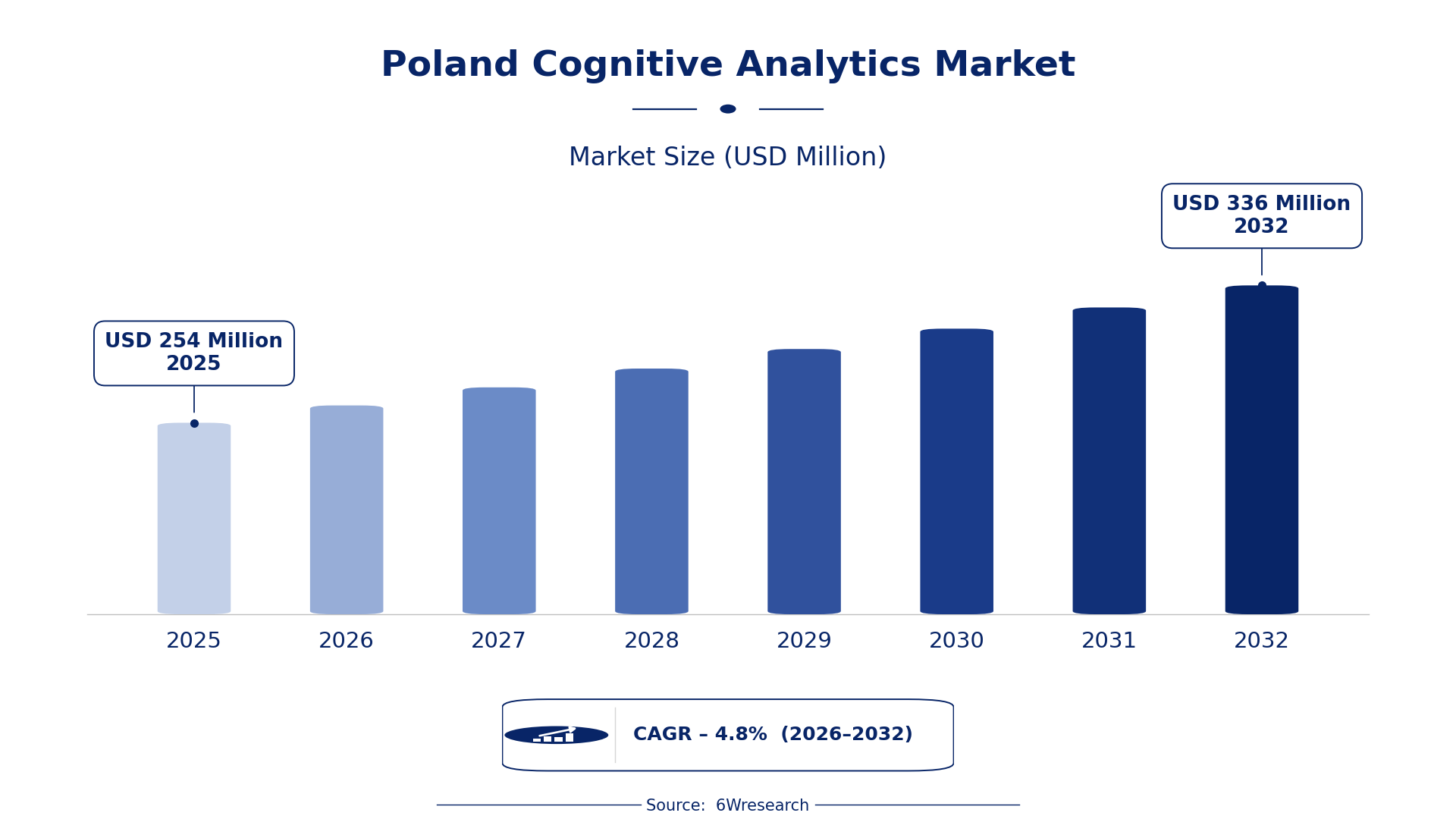
The Poland Cognitive Analytics Market was estimated at USD 254 Million in 2025 and is projected to reach USD 336 Million by 2032, growing at a CAGR of 4.8% from 2026 to 2032.
Poland Cognitive Analytics Market Synopsis
The Poland Cognitive Analytics Market is gaining traction as businesses increasingly recognize the importance of advanced analytics powered by AI and machine learning. This shift is not just a trend; it represents a fundamental change in how organizations leverage data to enhance decision-making and customer engagement.
Looking ahead, the demand for cognitive analytics is set to expand further, driven by mounting data complexity and the need for businesses to extract actionable insights from vast datasets. As digital transformation accelerates, companies across Poland are prioritizing cognitive analytics to stay competitive in a rapidly evolving marketplace.
Poland Cognitive Analytics Market Year-wise Growth Rate and Key Drivers
This graph illustrates the annual growth rates of the Poland Cognitive Analytics Market from 2021 to 2032, highlighting a steady upward trajectory and projected expansion over the forecast period.
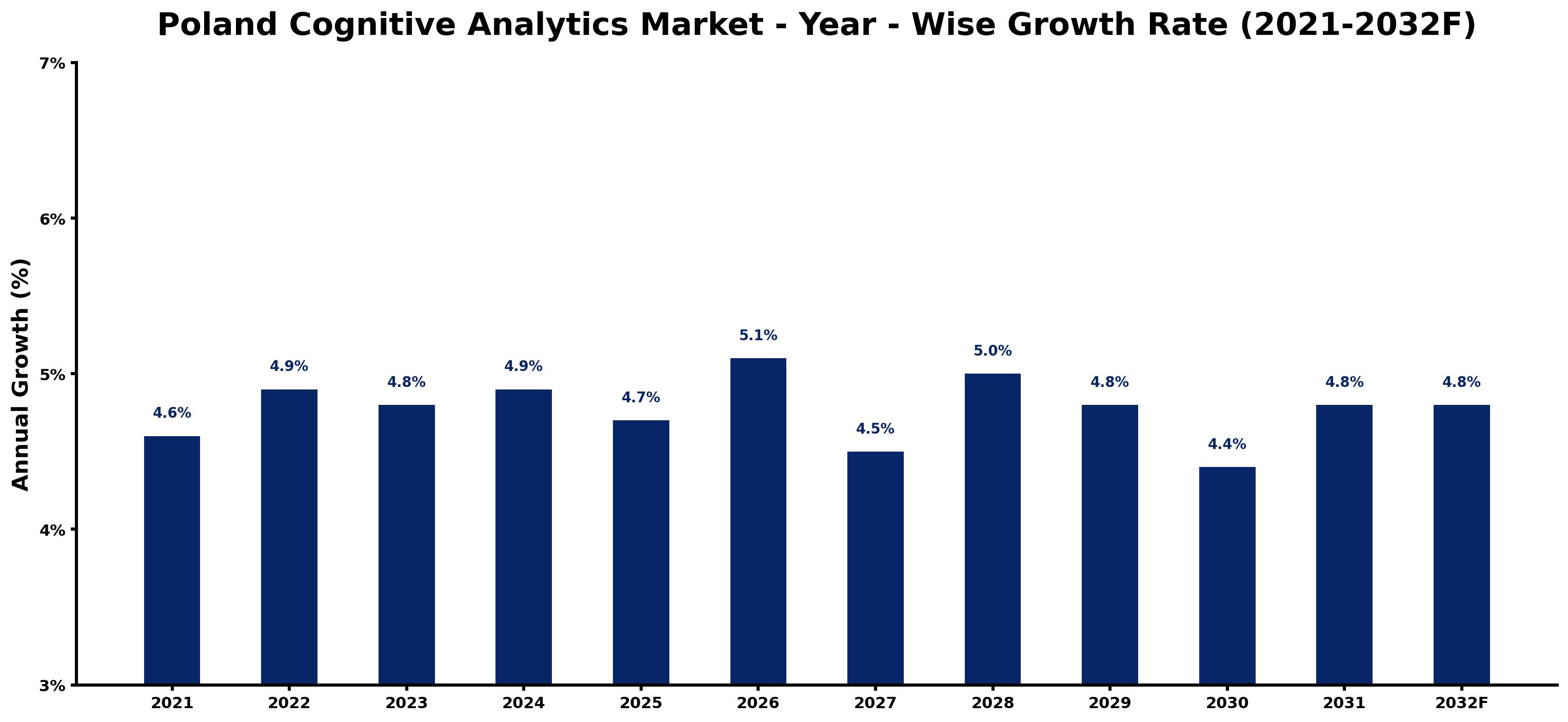
The table below presents the year‑wise growth rates along with the key drivers influencing the market
| Year | Growth Rate | Major Drivers |
| 2021 | 4.6% | Poland's AI Strategy supporting cognitive technology advancements. |
| 2022 | 4.9% | Growing investment in R&D for AI by Polish firms. |
| 2023 | 4.8% | Increased adoption of machine learning in finance sector. |
| 2024 | 4.9% | Implementation of GDPR driving need for advanced analytics. |
| 2025 | 4.7% | Surge in customer analytics demand among retail businesses. |
| 2026 | 5.1% | Development of AI research centers in major universities. |
| 2027 | 4.5% | Collaboration between tech hubs and educational institutions. |
| 2028 | 5.0% | Local enterprises leveraging AI for competitive advantages. |
| 2029 | 4.8% | Government grants boosting AI projects in healthcare. |
| 2030 | 4.4% | Growing workforce skilled in AI and machine learning. |
| 2031 | 4.8% | Rising importance of cognitive solutions in e-commerce. |
| 2032 | 4.8% | Increasing reliance on AI for supply chain optimization. |
Note: Market size estimations and growth projections presented in this report are based on 6Wresearch's proprietary forecasting methodology, utilizing the latest available industry data, government publications, and primary research inputs.
Poland Cognitive Analytics Market Key Takeaways
Below are some of the specific key takeaways from the market, including:
- The market is expected to grow from USD 254 Million in 2025 to USD 336 Million by 2032.
- Technological advancements in AI, ML, and NLP are enhancing cognitive analytics capabilities.
- Increasing data volumes across industries drive the demand for cognitive analytics solutions.
- Businesses face challenges related to data privacy and the need for skilled professionals.
- Government initiatives in AI and big data are shaping the cognitive analytics ecosystem.
Evaluation of Restraints in Poland Cognitive Analytics Market
Despite its promising growth, the Poland Cognitive Analytics Market is not without its challenges. Data privacy remains a significant concern, with organizations needing to navigate complex regulations while implementing advanced analytics solutions. on top of that, the integration of these technologies into existing business systems often proves difficult, requiring not only substantial investments but also skilled professionals who can manage these intricate systems. The shortage of such talent can slow down the adoption of cognitive analytics, hindering potential growth.
Poland Cognitive Analytics Market Trends
Several trends are currently shaping the cognitive analytics market in Poland. One prominent trend is the increasing incorporation of natural language processing, which enables organizations to analyze unstructured data more effectively. Companies are also focusing on real-time analytics, allowing for immediate insights that drive faster decision-making. As businesses continue to prioritize customer experience, the integration of cognitive analytics into customer relationship management systems is becoming more common.
Poland Cognitive Analytics Market Opportunities
The opportunities in the Poland Cognitive Analytics Market are substantial. Companies are increasingly looking for innovative ways to harness their data for competitive advantage. Sectors such as healthcare, finance, and retail stand to benefit significantly from tailored cognitive analytics solutions that address their specific needs. Additionally, the ongoing digital transformation initiatives across various industries present ripe opportunities for investment in cognitive analytics technologies, fostering further growth.
Government Initiatives in the Poland Cognitive Analytics Market
Government policy is playing a crucial role in shaping the cognitive analytics market in Poland. With a strong focus on fostering innovation and competitiveness, the Polish government is investing in AI and big data technologies. These initiatives aim to create a supportive environment for businesses to adopt cognitive analytics, ensuring that Poland remains a key player in the global AI-driven economy.
- A recently completed initiative under the Polish Artificial Intelligence Strategy aimed to fund R&D projects in cognitive analytics, promoting innovation.
- A current program is underway to enhance digital infrastructure across various sectors, facilitating better data management and analytics capabilities.
- Upcoming regulations are planned to support transparency in data usage, addressing privacy concerns while encouraging the adoption of cognitive analytics.
- Ongoing collaborations between public institutions and tech companies are expected to yield new cognitive analytics solutions tailored to local businesses.
- A strategic roadmap is being developed to position Poland as a leader in AI by 2028, focusing on education and workforce development in this field.
Future Insights of the Poland Cognitive Analytics Market
Looking towards 2026-2032, the Poland Cognitive Analytics Market is expected to witness substantial growth as enterprises continue to invest in advanced analytics solutions. The increasing emphasis on data-driven decision-making will push organizations to adopt more sophisticated cognitive analytics tools. As AI and machine learning technologies evolve, they will further enhance the capabilities of cognitive analytics, allowing businesses to derive deeper insights from complex datasets.
Poland Cognitive Analytics Market Latest Developments
In the last year, the Poland Cognitive Analytics Market has seen significant industry activity focused on enhancing analytics capabilities. With companies increasingly recognizing the value of data, there has been a noticeable uptick in investments and partnerships aimed at advancing cognitive analytics technologies.
- A major technology vendor launched a new cognitive analytics platform in early 2025, designed to simplify data integration and analysis for businesses.
- An ongoing collaboration between regional universities and tech firms is developing training programs to address the skills gap in cognitive analytics.
- A leading analytics provider announced a service upgrade in mid-2025, enhancing their cognitive analytics offerings with real-time processing capabilities.
- A public-private initiative aimed at improving access to big data resources for SMEs is currently underway, expected to be completed by late 2025.
- Plans are in motion for a national conference on AI and cognitive analytics, scheduled for Q3 2026, focusing on innovation and industry collaboration.
Poland Cognitive Analytics Market - Key Attractiveness of the Report
- 10 Years of Market Numbers
- Historical Data Starting from 2022 to 2025
- Base Year: 2025
- Forecast Data until 2032
- Key Performance Indicators Impacting the Market
- Major Upcoming Developments and Projects
The government is investing in AI and big data technologies through initiatives like the Polish Artificial Intelligence Strategy, which funds R&D in cognitive analytics.
Key Highlights of the Report:
- Poland Cognitive Analytics Market Outlook
- Market Size of Poland Cognitive Analytics Market, 2025
- Forecast of Poland Cognitive Analytics Market, 2032
- Historical Data and Forecast of Poland Cognitive Analytics Revenues & Volume for the Period 2022-2032F
- Poland Cognitive Analytics Market Trend Evolution
- Poland Cognitive Analytics Market Drivers and Challenges
- Poland Cognitive Analytics Price Trends
- Poland Cognitive Analytics Porter's Five Forces
- Poland Cognitive Analytics Industry Life Cycle
- Historical Data and Forecast of Poland Cognitive Analytics Market Revenues & Volume By Application for the Period 2022-2032F
- Historical Data and Forecast of Poland Cognitive Analytics Market Revenues & Volume By Automation for the Period 2022-2032F
- Historical Data and Forecast of Poland Cognitive Analytics Market Revenues & Volume By Intelligent Virtual Assistants for the Period 2022-2032F
- Historical Data and Forecast of Poland Cognitive Analytics Market Revenues & Volume By Behavioral Analysis for the Period 2022-2032F
- Historical Data and Forecast of Poland Cognitive Analytics Market Revenues & Volume By Biometrics for the Period 2022-2032F
- Historical Data and Forecast of Poland Cognitive Analytics Market Revenues & Volume By Others for the Period 2022-2032F
- Historical Data and Forecast of Poland Cognitive Analytics Market Revenues & Volume By Component for the Period 2022-2032F
- Historical Data and Forecast of Poland Cognitive Analytics Market Revenues & Volume By Platform for the Period 2022-2032F
- Historical Data and Forecast of Poland Cognitive Analytics Market Revenues & Volume By Service for the Period 2022-2032F
- Historical Data and Forecast of Poland Cognitive Analytics Market Revenues & Volume By Technology for the Period 2022-2032F
- Historical Data and Forecast of Poland Cognitive Analytics Market Revenues & Volume By Machine Learning (ML) for the Period 2022-2032F
- Historical Data and Forecast of Poland Cognitive Analytics Market Revenues & Volume By Human Computer Interaction for the Period 2022-2032F
- Historical Data and Forecast of Poland Cognitive Analytics Market Revenues & Volume By Natural Language Processing (NLP) for the Period 2022-2032F
- Historical Data and Forecast of Poland Cognitive Analytics Market Revenues & Volume By Deep Learning for the Period 2022-2032F
- Historical Data and Forecast of Poland Cognitive Analytics Market Revenues & Volume By Deployment Mode for the Period 2022-2032F
- Historical Data and Forecast of Poland Cognitive Analytics Market Revenues & Volume By On-premise for the Period 2022-2032F
- Historical Data and Forecast of Poland Cognitive Analytics Market Revenues & Volume By Cloud for the Period 2022-2032F
- Historical Data and Forecast of Poland Cognitive Analytics Market Revenues & Volume By Hybrid for the Period 2022-2032F
- Historical Data and Forecast of Poland Cognitive Analytics Market Revenues & Volume By Industry for the Period 2022-2032F
- Historical Data and Forecast of Poland Cognitive Analytics Market Revenues & Volume By BFSI for the Period 2022-2032F
- Historical Data and Forecast of Poland Cognitive Analytics Market Revenues & Volume By Retail and eCommerce for the Period 2022-2032F
- Historical Data and Forecast of Poland Cognitive Analytics Market Revenues & Volume By Telecommunication and IT for the Period 2022-2032F
- Historical Data and Forecast of Poland Cognitive Analytics Market Revenues & Volume By Healthcare and Life Sciences for the Period 2022-2032F
- Historical Data and Forecast of Poland Cognitive Analytics Market Revenues & Volume By Manufacturing for the Period 2022-2032F
- Historical Data and Forecast of Poland Cognitive Analytics Market Revenues & Volume By Government and Defense for the Period 2022-2032F
- Historical Data and Forecast of Poland Cognitive Analytics Market Revenues & Volume By Media and Entertainment for the Period 2022-2032F
- Historical Data and Forecast of Poland Cognitive Analytics Market Revenues & Volume By Organization Size for the Period 2022-2032F
- Historical Data and Forecast of Poland Cognitive Analytics Market Revenues & Volume By Large Enterprises for the Period 2022-2032F
- Historical Data and Forecast of Poland Cognitive Analytics Market Revenues & Volume By Small and Medium-Sized Enterprises (SMEs) for the Period 2022-2032F
- Poland Cognitive Analytics Import Export Trade Statistics
- Market Opportunity Assessment By Application
- Market Opportunity Assessment By Component
- Market Opportunity Assessment By Technology
- Market Opportunity Assessment By Deployment Mode
- Market Opportunity Assessment By Industry
- Market Opportunity Assessment By Organization Size
- Poland Cognitive Analytics Top Companies Market Share
- Poland Cognitive Analytics Competitive Benchmarking By Technical and Operational Parameters
- Poland Cognitive Analytics Company Profiles
- Poland Cognitive Analytics Key Strategic Recommendations






































