Poland Confectionery Processing Equipment Market Size, Share & Growth Rate
The Poland Confectionery Processing Equipment Market was estimated at USD 359 Million in 2025 and is projected to reach USD 489 Million by 2032, growing at a CAGR of 4.5% from 2026 to 2032. This robust growth trajectory can be attributed to the increasing demand for automation and modern processing solutions that improve production efficiency in the confectionery sector. As Polish manufacturers strive to enhance product quality and meet evolving consumer tastes, the demand for advanced equipment continues to surge.
Poland Confectionery Processing Equipment Market Year-wise Growth Rate and Key Drivers
This graph highlights how the Poland Confectionery Processing Equipment Market has steadily grown over the years, supported by major growth factors.
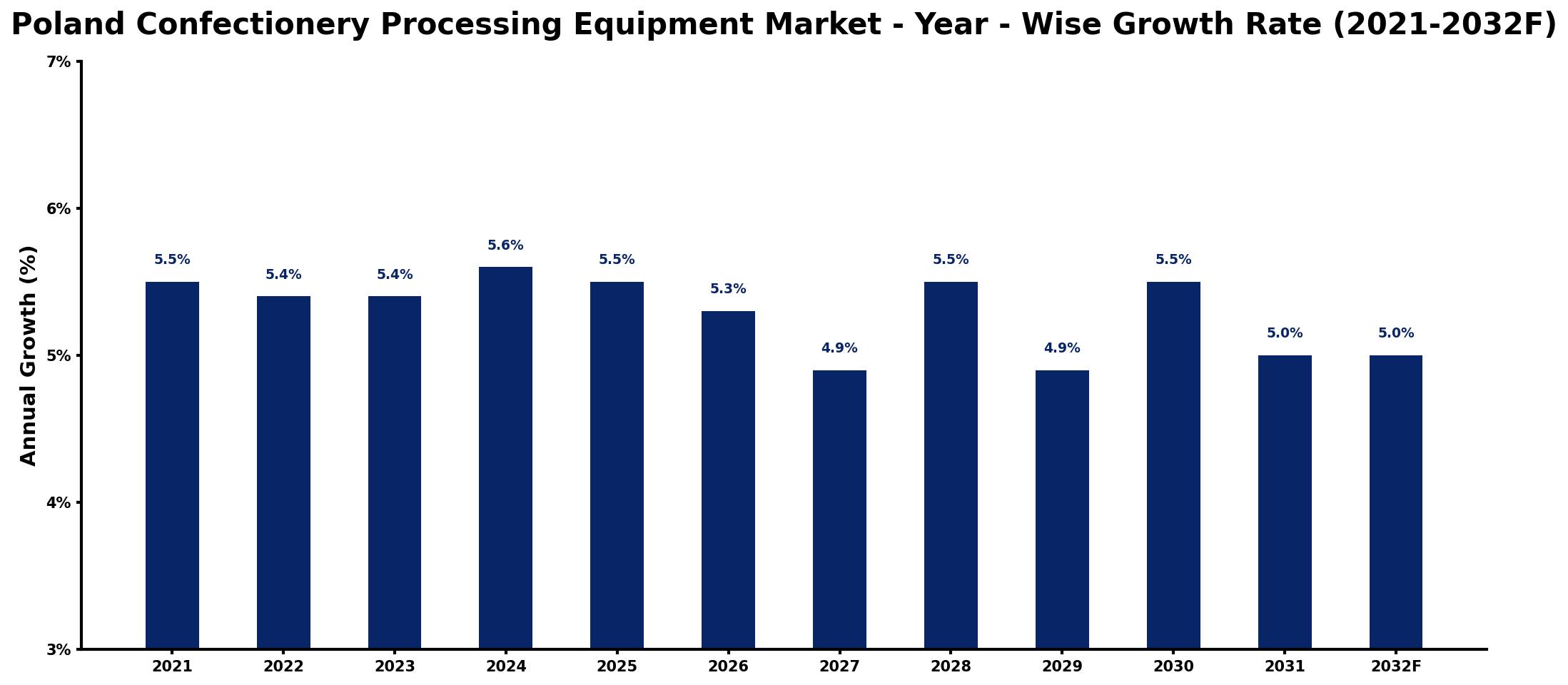
The table below presents the year‑wise growth rates along with the key drivers influencing the market
| Year | Growth Rate | Major Drivers |
| 2021 | 5.5% | Rising demand for sweet snacks |
| 2022 | 5.4% | Increased investment in automation |
| 2023 | 5.4% | Expansion of retail distribution channels |
| 2024 | 5.6% | Growing popularity of healthy options |
| 2025 | 5.5% | Surge in online purchasing trends |
| 2026 | 5.3% | Emergence of innovative flavor profiles |
| 2027 | 4.9% | Demand for sustainable packaging solutions |
| 2028 | 5.5% | Strengthening of regional supply chains |
| 2029 | 4.9% | Focus on artisanal product offerings |
| 2030 | 5.5% | Growth in private label brands |
| 2031 | 5.0% | Increase in export opportunities |
| 2032 | 5.0% | Development of new production technologies |
Note: Market size estimations and growth projections presented in this report are based on 6Wresearch's proprietary forecasting methodology, utilizing the latest available industry data, government publications, and primary research inputs.
Poland Confectionery Processing Equipment Market Synopsis
The strongest force shaping the Poland Confectionery Processing Equipment Market right now is the push for automation across manufacturing processes. This trend reflects a broader industry transformation, with manufacturers investing in advanced technologies to remain competitive. Automation not only increases efficiency but also enhances product consistency—key factors for maintaining market relevance.
Additionally, the focus on food safety and compliance with stringent regulatory standards serves as a driving factor for market growth. As consumer awareness around product quality intensifies, manufacturers are compelled to adopt advanced processing equipment to meet these expectations, further propelling the demand within this sector.
Poland Confectionery Processing Equipment Market Key Takeaways
- The market is set for steady growth due to rising automation and modern processing solutions.
- Consumer demand for high-quality confectionery products is driving investments in advanced machinery.
- Food safety compliance remains a critical factor influencing equipment procurement.
- Technological advancements are reshaping production methods and enhancing product consistency.
- Small manufacturers face challenges due to the high cost of cutting-edge machinery.
Evaluation of Restraints in Poland Confectionery Processing Equipment Market
Despite promising growth, the Poland Confectionery Processing Equipment Market grapples with significant constraints. One of the most pressing issues is the high initial cost of advanced machinery, which can deter smaller manufacturers from upgrading their equipment. Furthermore, the pace of technological advancement leads to rapid obsolescence, necessitating continuous investment in new technologies. Maintenance costs, combined with the requirement for specialized operator training, add to the financial burden on manufacturers, particularly those with limited budgets.
Poland Confectionery Processing Equipment Market Trends
Several trends are shaping the future of the Poland Confectionery Processing Equipment Market. One major trend is the integration of digital control systems that enhance production oversight and efficiency. Companies are increasingly leveraging data analytics to optimize manufacturing processes and improve product quality. Additionally, the growing emphasis on sustainability is pushing manufacturers to seek energy-efficient and eco-friendly processing solutions, aligning production methods with environmental standards.
Poland Confectionery Processing Equipment Market Opportunities
Significant opportunities lie ahead for stakeholders in the Poland Confectionery Processing Equipment Market. The ongoing modernization of production facilities, encouraged by government policies, creates fertile ground for investment in innovative technologies. Furthermore, as consumer preferences shift towards healthier and more diverse confectionery options, manufacturers can capitalize on this demand by adopting specialized equipment tailored to new product lines. The intersection of automation and quality improvement presents a promising landscape for growth.
Government Initiatives in the Poland Confectionery Processing Equipment Market
The Polish government actively supports the modernization of food processing technologies, which is pivotal for the confectionery sector. Various subsidies and incentives are offered to manufacturers that invest in advanced equipment aimed at improving efficiency and product quality. Such initiatives not only bolster the industry but also encourage sustainable practices, aligning with broader economic goals. The focus on enhancing food safety and compliance through technological advancements is also a key priority.
Future Insights of the Poland Confectionery Processing Equipment Market
Looking ahead to the years 2026-2032, the Poland Confectionery Processing Equipment Market is poised for continued expansion. As technological innovations accelerate, manufacturers will increasingly adopt advanced processing solutions to remain competitive. The combination of rising consumer expectations and government support for modernization efforts will further drive growth. In this evolving landscape, agility and adaptability will be essential for companies seeking to harness new opportunities and mitigate the challenges ahead.
Poland Confectionery Processing Equipment Market Latest Developments (2025 - 2026)
In recent months, the Poland Confectionery Processing Equipment Market has seen a notable shift towards increased automation and digitalization. Manufacturers are exploring advanced technologies to streamline production and enhance efficiency. Additionally, there is a growing focus on sustainability practices, with many companies investing in energy-efficient equipment to align with consumer preferences and regulatory requirements. The landscape is evolving, driven by a need for quality, efficiency, and safety.
Poland Confectionery Processing Equipment Market - Key Attractiveness of the Report
- 10 Years of Market Numbers
- Historical Data Starting from 2022 to 2025
- Base Year: 2025
- Forecast Data until 2032
- Key Performance Indicators Impacting the Market
- Major Upcoming Developments and Projects
Key Highlights of the Report:
- Poland Confectionery Processing Equipment Market Outlook
- Market Size of Poland Confectionery Processing Equipment Market, 2025
- Forecast of Poland Confectionery Processing Equipment Market, 2032
- Historical Data and Forecast of Poland Confectionery Processing Equipment Revenues & Volume for the Period 2022-2032F
- Poland Confectionery Processing Equipment Market Trend Evolution
- Poland Confectionery Processing Equipment Market Drivers and Challenges
- Poland Confectionery Processing Equipment Price Trends
- Poland Confectionery Processing Equipment Porter's Five Forces
- Poland Confectionery Processing Equipment Industry Life Cycle
- Historical Data and Forecast of Poland Confectionery Processing Equipment Market Revenues & Volume By Product for the Period 2022-2032F
- Historical Data and Forecast of Poland Confectionery Processing Equipment Market Revenues & Volume By Soft Confectionery for the Period 2022-2032F
- Historical Data and Forecast of Poland Confectionery Processing Equipment Market Revenues & Volume By Hard Candies for the Period 2022-2032F
- Historical Data and Forecast of Poland Confectionery Processing Equipment Market Revenues & Volume By Chewing Gums for the Period 2022-2032F
- Historical Data and Forecast of Poland Confectionery Processing Equipment Market Revenues & Volume By Gummies & Jellies for the Period 2022-2032F
- Historical Data and Forecast of Poland Confectionery Processing Equipment Market Revenues & Volume By Others for the Period 2022-2032F
- Historical Data and Forecast of Poland Confectionery Processing Equipment Market Revenues & Volume By Type for the Period 2022-2032F
- Historical Data and Forecast of Poland Confectionery Processing Equipment Market Revenues & Volume By Thermal for the Period 2022-2032F
- Historical Data and Forecast of Poland Confectionery Processing Equipment Market Revenues & Volume By Mixers for the Period 2022-2032F
- Historical Data and Forecast of Poland Confectionery Processing Equipment Market Revenues & Volume By Blenders And Cutters for the Period 2022-2032F
- Historical Data and Forecast of Poland Confectionery Processing Equipment Market Revenues & Volume By Extrusion for the Period 2022-2032F
- Historical Data and Forecast of Poland Confectionery Processing Equipment Market Revenues & Volume By Cooling for the Period 2022-2032F
- Historical Data and Forecast of Poland Confectionery Processing Equipment Market Revenues & Volume By Coating for the Period 2022-2032F
- Historical Data and Forecast of Poland Confectionery Processing Equipment Market Revenues & Volume By Others for the Period 2022-2032F
- Historical Data and Forecast of Poland Confectionery Processing Equipment Market Revenues & Volume By Mode Of Operation for the Period 2022-2032F
- Historical Data and Forecast of Poland Confectionery Processing Equipment Market Revenues & Volume By Automatic for the Period 2022-2032F
- Historical Data and Forecast of Poland Confectionery Processing Equipment Market Revenues & Volume By Semi-automatic for the Period 2022-2032F
- Poland Confectionery Processing Equipment Import Export Trade Statistics
- Market Opportunity Assessment By Product
- Market Opportunity Assessment By Type
- Market Opportunity Assessment By Mode Of Operation
- Poland Confectionery Processing Equipment Top Companies Market Share
- Poland Confectionery Processing Equipment Competitive Benchmarking By Technical and Operational Parameters
- Poland Confectionery Processing Equipment Company Profiles
- Poland Confectionery Processing Equipment Key Strategic Recommendations






































