Poland Construction Glass Market Size Growth Rate
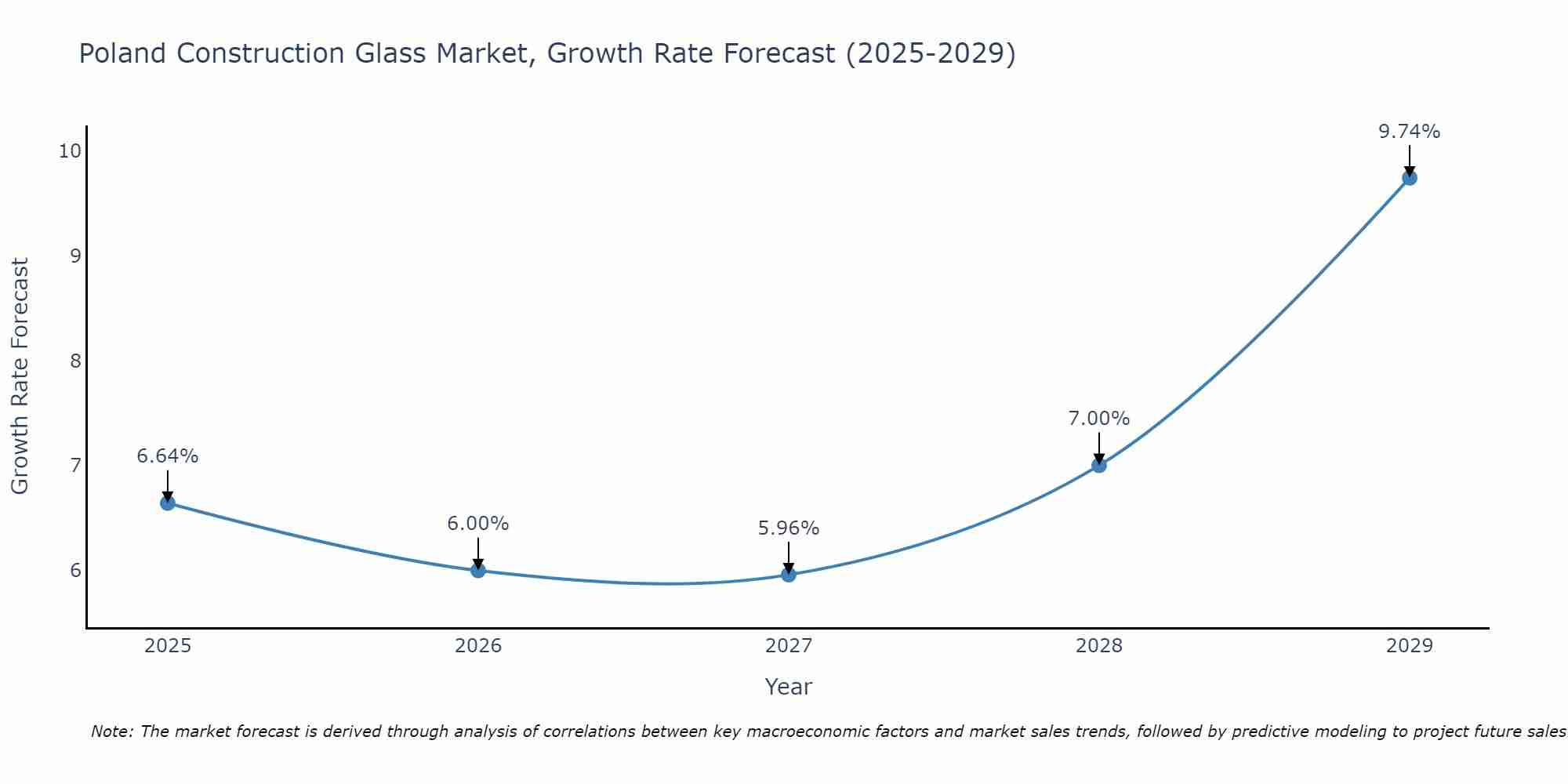
The Poland Construction Glass Market is projected to witness mixed growth rate patterns during 2025 to 2029. Commencing at 6.64% in 2025, growth builds up to 9.74% by 2029.
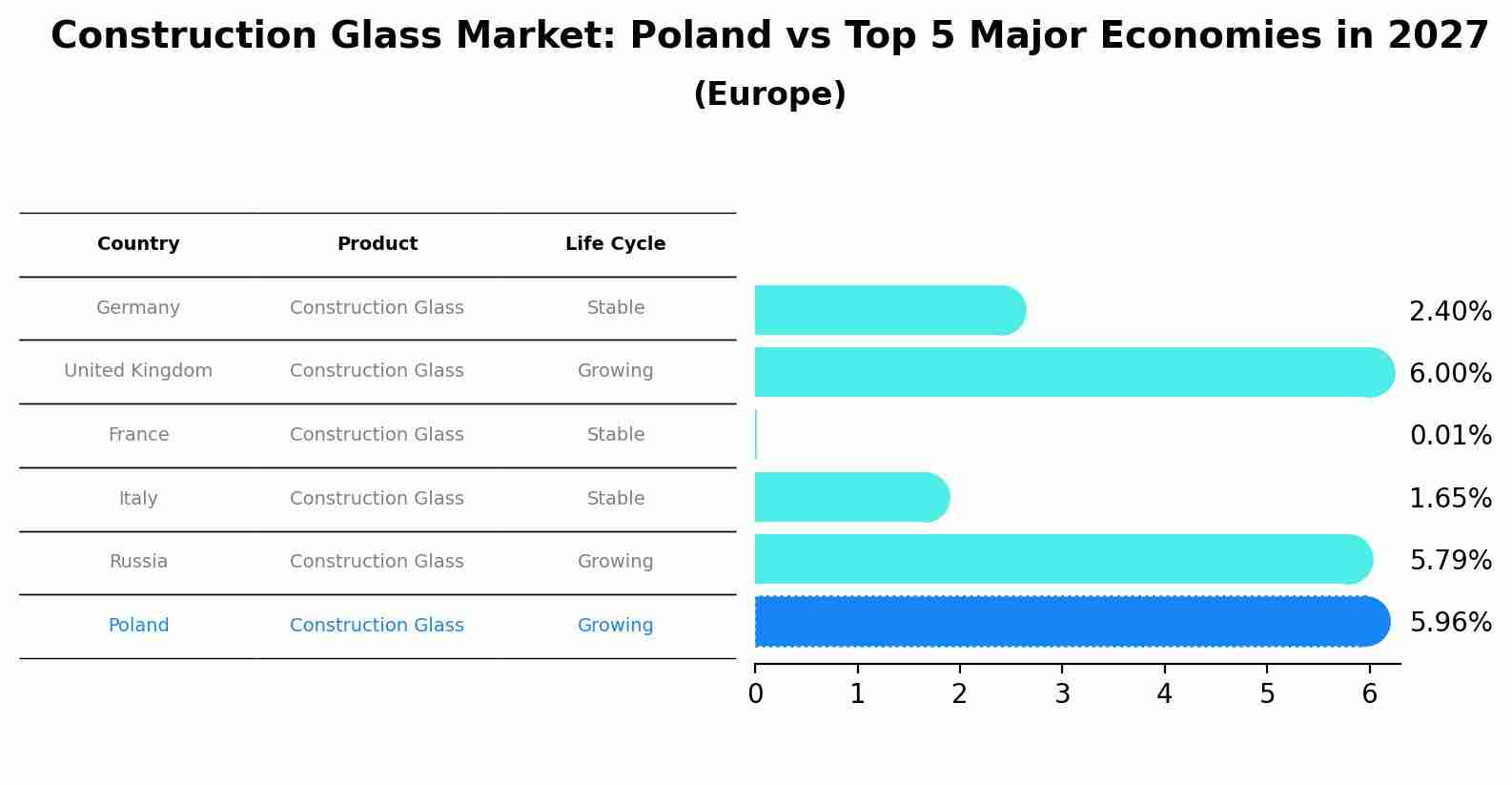
Construction Glass Market: Poland vs Top 5 Major Economies in 2027 (Europe)
Poland's Construction Glass market is anticipated to experience a growing growth rate of 5.96% by 2027, reflecting trends observed in the largest economy Germany, followed by United Kingdom, France, Italy and Russia.
Poland Construction Glass Market Overview
In the Poland Construction Glass Market, the demand for energy-efficient, high-performance glass is growing as builders look for materials that offer insulation, durability, and aesthetic appeal. Construction glass is essential for modern buildings, especially in commercial and residential real estate, and is increasingly used in green building projects.
Drivers of the market
The Poland Construction Glass market is driven by the increasing demand for glass products in building and architectural applications. Construction glass, including windows, facades, and glazing systems, provides aesthetic appeal, natural light, and thermal insulation. The growth of the construction and real estate sectors, advancements in glass technologies, and the rising focus on energy-efficient building solutions support market growth. Additionally, the increasing adoption of smart glass and innovative glazing solutions contributes to market expansion.
Challenges of the market
Polands construction glass market struggles with high production and installation costs, making it difficult for smaller projects to afford high-performance glass solutions. Energy efficiency standards necessitate continuous innovation, increasing operational costs. Additionally, market growth is impacted by fluctuations in the construction industry.
Government Policy of the market
In the Poland Construction Glass Market, the government enforces energy efficiency standards that drive the demand for high-performance glass in buildings. Poland aligns with EU directives that promote the use of glass that enhances insulation and energy efficiency in residential and commercial construction, supporting Poland`s climate goals.
Key Highlights of the Report:
- Poland Construction Glass Market Outlook
- Market Size of Poland Construction Glass Market, 2024
- Forecast of Poland Construction Glass Market, 2031
- Historical Data and Forecast of Poland Construction Glass Revenues & Volume for the Period 2018 - 2031
- Poland Construction Glass Market Trend Evolution
- Poland Construction Glass Market Drivers and Challenges
- Poland Construction Glass Price Trends
- Poland Construction Glass Porter's Five Forces
- Poland Construction Glass Industry Life Cycle
- Historical Data and Forecast of Poland Construction Glass Market Revenues & Volume By Chemical Composition for the Period 2018 - 2031
- Historical Data and Forecast of Poland Construction Glass Market Revenues & Volume By Soda-lime for the Period 2018 - 2031
- Historical Data and Forecast of Poland Construction Glass Market Revenues & Volume By Potash-lime for the Period 2018 - 2031
- Historical Data and Forecast of Poland Construction Glass Market Revenues & Volume By Potash-lead for the Period 2018 - 2031
- Historical Data and Forecast of Poland Construction Glass Market Revenues & Volume By Type for the Period 2018 - 2031
- Historical Data and Forecast of Poland Construction Glass Market Revenues & Volume By Low-e Glass for the Period 2018 - 2031
- Historical Data and Forecast of Poland Construction Glass Market Revenues & Volume By Special Glass for the Period 2018 - 2031
- Historical Data and Forecast of Poland Construction Glass Market Revenues & Volume By Manufacturing Process for the Period 2018 - 2031
- Historical Data and Forecast of Poland Construction Glass Market Revenues & Volume By Float Process for the Period 2018 - 2031
- Historical Data and Forecast of Poland Construction Glass Market Revenues & Volume By Rolled/sheet Process for the Period 2018 - 2031
- Historical Data and Forecast of Poland Construction Glass Market Revenues & Volume By Application for the Period 2018 - 2031
- Historical Data and Forecast of Poland Construction Glass Market Revenues & Volume By Residential for the Period 2018 - 2031
- Historical Data and Forecast of Poland Construction Glass Market Revenues & Volume By Commercial for the Period 2018 - 2031
- Historical Data and Forecast of Poland Construction Glass Market Revenues & Volume By Others for the Period 2018 - 2031
- Poland Construction Glass Import Export Trade Statistics
- Market Opportunity Assessment By Chemical Composition
- Market Opportunity Assessment By Type
- Market Opportunity Assessment By Manufacturing Process
- Market Opportunity Assessment By Application
- Poland Construction Glass Top Companies Market Share
- Poland Construction Glass Competitive Benchmarking By Technical and Operational Parameters
- Poland Construction Glass Company Profiles
- Poland Construction Glass Key Strategic Recommendations






































