Poland Content Services Platforms Market Size & Growth Rate (2026-2032)
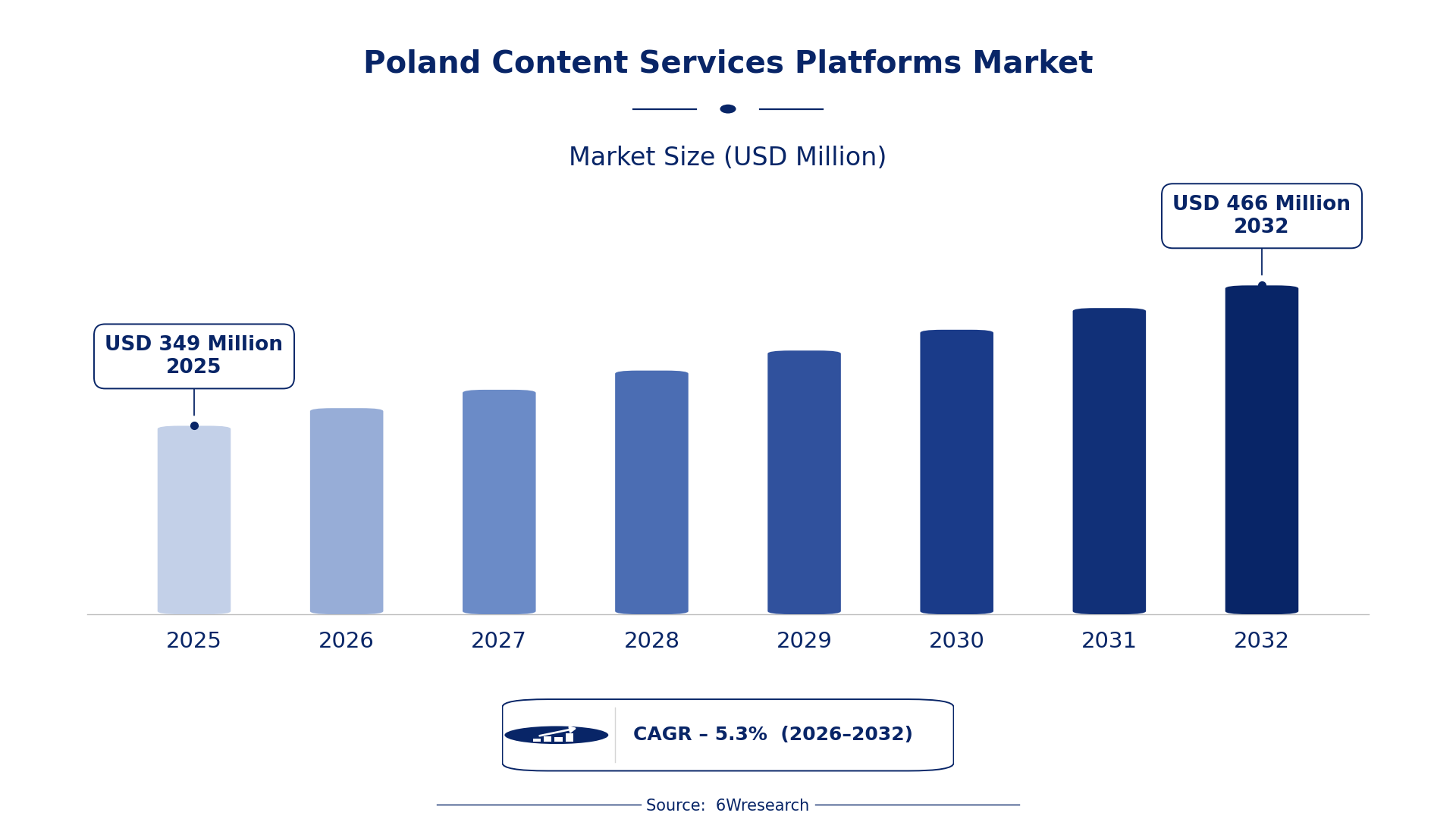
The Poland Content Services Platforms Market was estimated at USD 349 Million in 2025 and is projected to reach USD 466 Million by 2032, growing at a CAGR of 5.3% from 2026 to 2032.
Poland Content Services Platforms Market Synopsis
In Poland, the demand for content services platforms has escalated as organizations adapt to the digital age. Businesses are increasingly recognizing the necessity of these platforms to manage content efficiently, particularly in light of the rising trend toward remote work and digital collaboration.
As companies seek to streamline their operations, content services platforms have become essential tools. They facilitate the creation, storage, and sharing of content across diverse teams, allowing for enhanced productivity and effective management of digital assets.
Poland Content Services Platforms Market Year-wise Growth Rate and Key Drivers
This graph illustrates the annual growth rates of the Poland Content Services Platforms Market from 2021 to 2032, highlighting a steady upward trajectory and projected expansion over the forecast period.
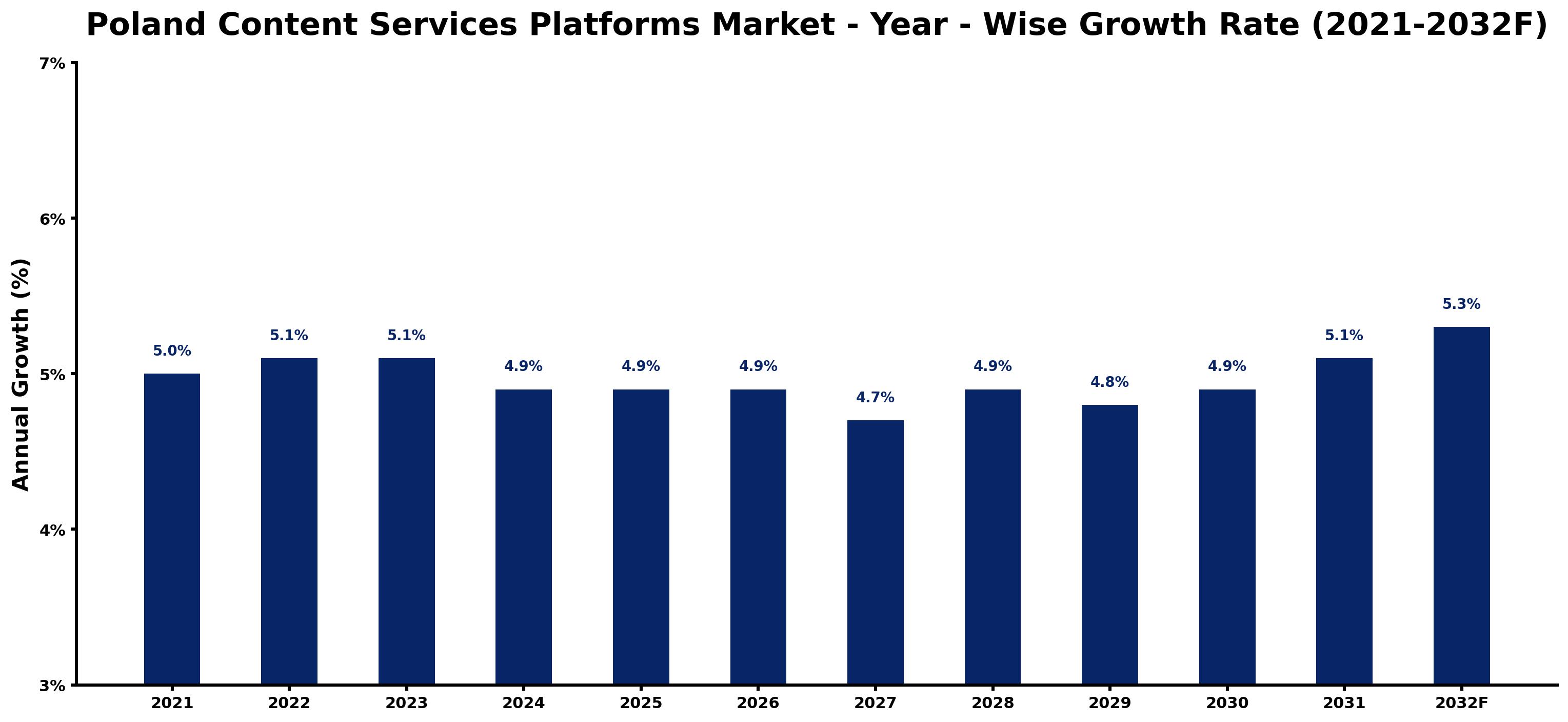
The table below presents the year‑wise growth rates along with the key drivers influencing the market
| Year | Growth Rate | Major Drivers |
| 2021 | 5.0% | Growing e-commerce adoption among Polish consumers |
| 2022 | 5.1% | Rise in remote work driving cloud content solutions |
| 2023 | 5.1% | Increased digital transformation investments by Polish enterprises |
| 2024 | 4.9% | Regulatory support for data privacy enhancing content services |
| 2025 | 4.9% | Surge in demand for localized content creation tools |
| 2026 | 4.9% | Government funding for digitalization in small businesses |
| 2027 | 4.7% | Mobile internet penetration encouraging content consumption growth |
| 2028 | 4.9% | Partnerships between tech firms and local content creators |
| 2029 | 4.8% | Cultural events driving multimedia content engagement |
| 2030 | 4.9% | Focus on AI-driven content curation in Poland |
| 2031 | 5.1% | Emergence of online educational platforms boosting content needs |
| 2032 | 5.3% | Public initiatives promoting digital literacy across age groups |
Note: Market size estimations and growth projections presented in this report are based on 6Wresearch's proprietary forecasting methodology, utilizing the latest available industry data, government publications, and primary research inputs.
Poland Content Services Platforms Market Key Takeaways
Below are some of the specific key takeaways from the market, including:
- The market is driven by the growing need for efficient content management solutions.
- Cloud-based and AI technologies are key enablers for market growth.
- Remote work dynamics are reshaping the demand for content services platforms.
- Data integration challenges remain a barrier for some organizations.
- Government initiatives are fostering digital transformation across sectors.
Evaluation of Restraints in Poland Content Services Platforms Market
The Poland Content Services Platforms Market faces several restraints that impact its growth trajectory. A notable challenge is the integration of data across various systems, particularly when dealing with unstructured data. Organizations often grapple with the complexity of these integrations, which can slow down adoption rates.
on top of that, high implementation and maintenance costs can deter smaller firms from investing in content services platforms. Coupled with growing concerns regarding data security and compliance with local regulations, these factors contribute to a cautious approach by many potential adopters.
Poland Content Services Platforms Market Trends
A shift towards cloud-based solutions is becoming increasingly prevalent, as organizations seek scalable and flexible content management options. The integration of artificial intelligence into content services platforms is also emerging as a game-changer, enabling automated workflows and smarter content handling.
on top of that, the demand for mobile access to content services is rising, driven by the need for remote work solutions. Companies are prioritizing platforms that allow teams to collaborate in real-time, regardless of their geographical locations.
Poland Content Services Platforms Market Opportunities
Significant opportunities exist for growth in the Poland Content Services Platforms Market, particularly as organizations continue to undergo digital transformation. The rising adoption of AI-driven solutions opens avenues for enhanced efficiency in content management processes.
Investments in training and development for employees to effectively utilize these platforms can further drive adoption rates. Additionally, as the government pushes for digital innovation, businesses can benefit from supportive policies aimed at enhancing their technological capabilities.
Government Initiatives in the Poland Content Services Platforms Market
The Polish government is actively promoting initiatives that bolster the digital transformation of businesses, thereby shaping the Content Services Platforms Market. With a focus on enhancing competitiveness and innovation, the government’s policies aim to facilitate the adoption of modern content management solutions.
- A national digital infrastructure upgrade programme was recently completed, improving access to high-speed internet across urban and rural areas.
- Current initiatives include funding for SMEs to adopt advanced content management systems that enhance operational efficiency.
- Planned public-private partnerships are expected to launch in 2026, aimed at developing cloud-based content services tailored for various industries.
- Regulatory frameworks being introduced focus on ensuring data security and compliance, thus providing a safer environment for digital content management.
Future Insights of the Poland Content Services Platforms Market
Looking ahead to 2026-2032, the Poland Content Services Platforms Market is expected to witness robust growth. As organizations continue to prioritize digital content management, the demand for integrated solutions will surge. The convergence of cloud technology and AI will likely redefine content workflows, making them more efficient and user-friendly.
Investments in user training and support services will play a crucial role in maximizing the value derived from these platforms. With the government’s ongoing commitment to digital innovation, businesses that embrace these changes early will position themselves advantageously in the competitive market.
Poland Content Services Platforms Market Latest Developments
In the past year, the Poland Content Services Platforms Market has seen considerable activity, reflecting a growing interest in digital solutions. Organizations are increasingly adopting content services platforms to support their operational needs and enhance collaboration among remote teams.
- A major technology vendor launched an AI-enhanced content management tool in Q2 2025, aimed at simplifying user experience and workflow automation.
- An initiative focused on improving mobile access to content services is currently underway, enhancing usability for remote workers.
- A collaborative project between tech firms to develop industry-specific content platforms is expected to commence in early 2026.
- One notable rollout involved integrating cloud storage solutions with existing content services, completed by late 2025, significantly boosting data accessibility.
Poland Content Services Platforms Market - Key Attractiveness of the Report
- 10 Years of Market Numbers
- Historical Data Starting from 2022 to 2025
- Base Year: 2025
- Forecast Data until 2032
- Key Performance Indicators Impacting the Market
- Major Upcoming Developments and Projects
Key Highlights of the Report:
- Poland Content Services Platforms Market Outlook
- Market Size of Poland Content Services Platforms Market, 2025
- Forecast of Poland Content Services Platforms Market, 2032
- Historical Data and Forecast of Poland Content Services Platforms Revenues & Volume for the Period 2022-2032F
- Poland Content Services Platforms Market Trend Evolution
- Poland Content Services Platforms Market Drivers and Challenges
- Poland Content Services Platforms Price Trends
- Poland Content Services Platforms Porter's Five Forces
- Poland Content Services Platforms Industry Life Cycle
- Historical Data and Forecast of Poland Content Services Platforms Market Revenues & Volume By Business Function for the Period 2022-2032F
- Historical Data and Forecast of Poland Content Services Platforms Market Revenues & Volume By Human Resource for the Period 2022-2032F
- Historical Data and Forecast of Poland Content Services Platforms Market Revenues & Volume By Sales and Marketing for the Period 2022-2032F
- Historical Data and Forecast of Poland Content Services Platforms Market Revenues & Volume By Accounting and Legal for the Period 2022-2032F
- Historical Data and Forecast of Poland Content Services Platforms Market Revenues & Volume By Procurement and Supply Chain Management for the Period 2022-2032F
- Historical Data and Forecast of Poland Content Services Platforms Market Revenues & Volume By Deployment Mode for the Period 2022-2032F
- Historical Data and Forecast of Poland Content Services Platforms Market Revenues & Volume By Cloud for the Period 2022-2032F
- Historical Data and Forecast of Poland Content Services Platforms Market Revenues & Volume By On-premises for the Period 2022-2032F
- Historical Data and Forecast of Poland Content Services Platforms Market Revenues & Volume By Enterprise Size for the Period 2022-2032F
- Historical Data and Forecast of Poland Content Services Platforms Market Revenues & Volume By Large Enterprises for the Period 2022-2032F
- Historical Data and Forecast of Poland Content Services Platforms Market Revenues & Volume By SMEs for the Period 2022-2032F
- Historical Data and Forecast of Poland Content Services Platforms Market Revenues & Volume By Vertical for the Period 2022-2032F
- Historical Data and Forecast of Poland Content Services Platforms Market Revenues & Volume By Banking, Financial Services, and Insurance for the Period 2022-2032F
- Historical Data and Forecast of Poland Content Services Platforms Market Revenues & Volume By Retail and Consumer Goods for the Period 2022-2032F
- Historical Data and Forecast of Poland Content Services Platforms Market Revenues & Volume By Energy and Utilities for the Period 2022-2032F
- Historical Data and Forecast of Poland Content Services Platforms Market Revenues & Volume By Government and Public Sector for the Period 2022-2032F
- Historical Data and Forecast of Poland Content Services Platforms Market Revenues & Volume By Healthcare and Life Sciences for the Period 2022-2032F
- Historical Data and Forecast of Poland Content Services Platforms Market Revenues & Volume By IT and ITeS for the Period 2022-2032F
- Historical Data and Forecast of Poland Content Services Platforms Market Revenues & Volume By Manufacturing for the Period 2022-2032F
- Poland Content Services Platforms Import Export Trade Statistics
- Market Opportunity Assessment By Business Function
- Market Opportunity Assessment By Deployment Mode
- Market Opportunity Assessment By Enterprise Size
- Market Opportunity Assessment By Vertical
- Poland Content Services Platforms Top Companies Market Share
- Poland Content Services Platforms Competitive Benchmarking By Technical and Operational Parameters
- Poland Content Services Platforms Company Profiles
- Poland Content Services Platforms Key Strategic Recommendations






































