Poland Digital Signature Market Size & Growth Rate (2026-2032)
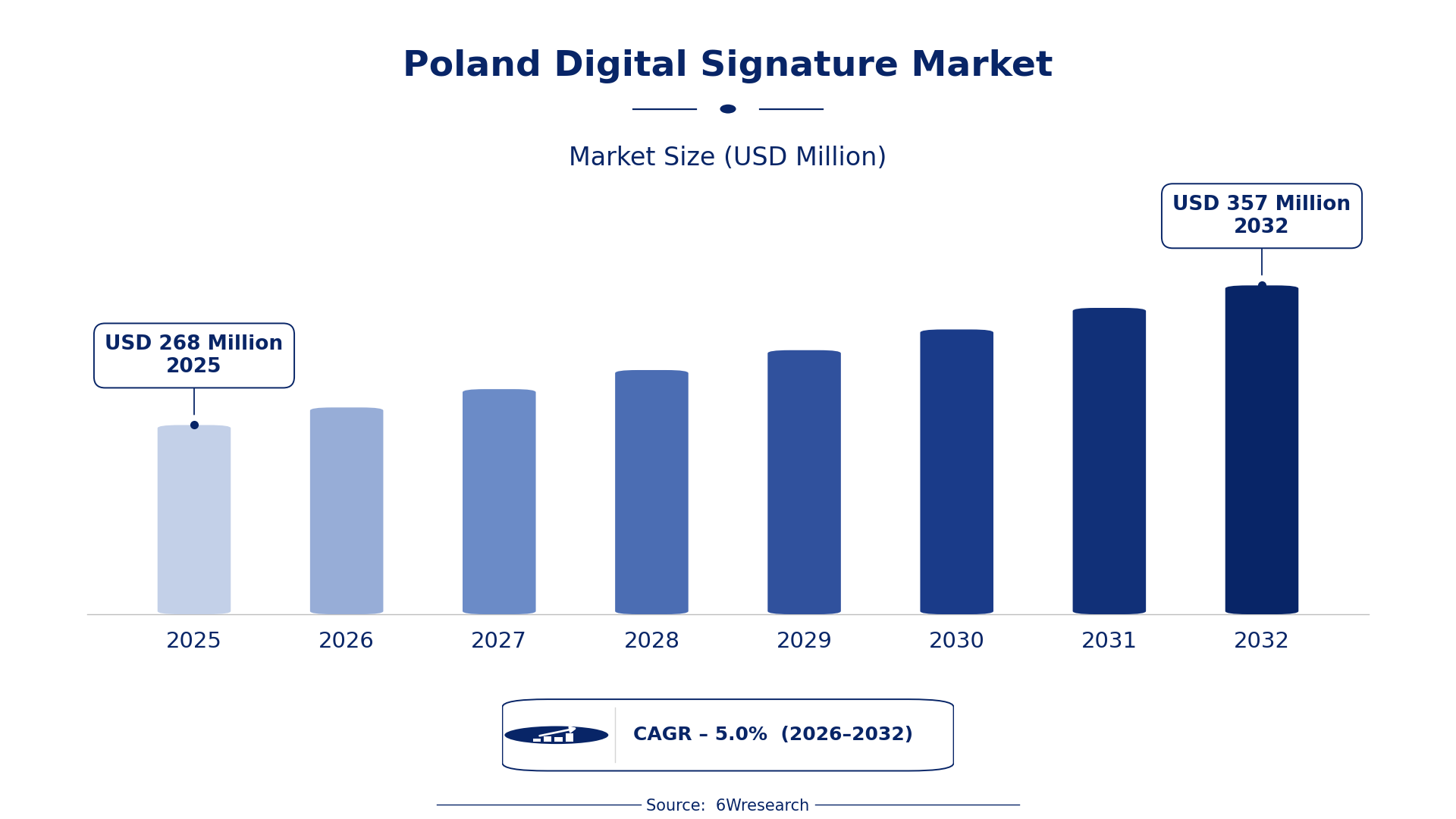
The Poland Digital Signature Market was estimated at USD 268 Million in 2025 and is projected to reach USD 357 Million by 2032, growing at a CAGR of 5.0% from 2026 to 2032.
Poland Digital Signature Market Synopsis
The driving force behind the Poland Digital Signature Market is the increasing demand for secure and legally binding electronic signatures. This need arises from various sectors, including business and government, which are embracing digital solutions to streamline their documentation processes while ensuring enhanced security.
Technological advancements are also significantly contributing to market growth. Improved digital signature technologies are facilitating seamless integration into existing systems, making electronic transactions not only efficient but also legally compliant. Businesses are keenly aware that the integrity of their documents relies on the security of the signatures attached.
Poland Digital Signature Market Year-wise Growth Rate and Key Drivers
This graph illustrates the annual growth rates of the Poland Digital Signature Market from 2021 to 2032, highlighting a steady upward trajectory and projected expansion over the forecast period.
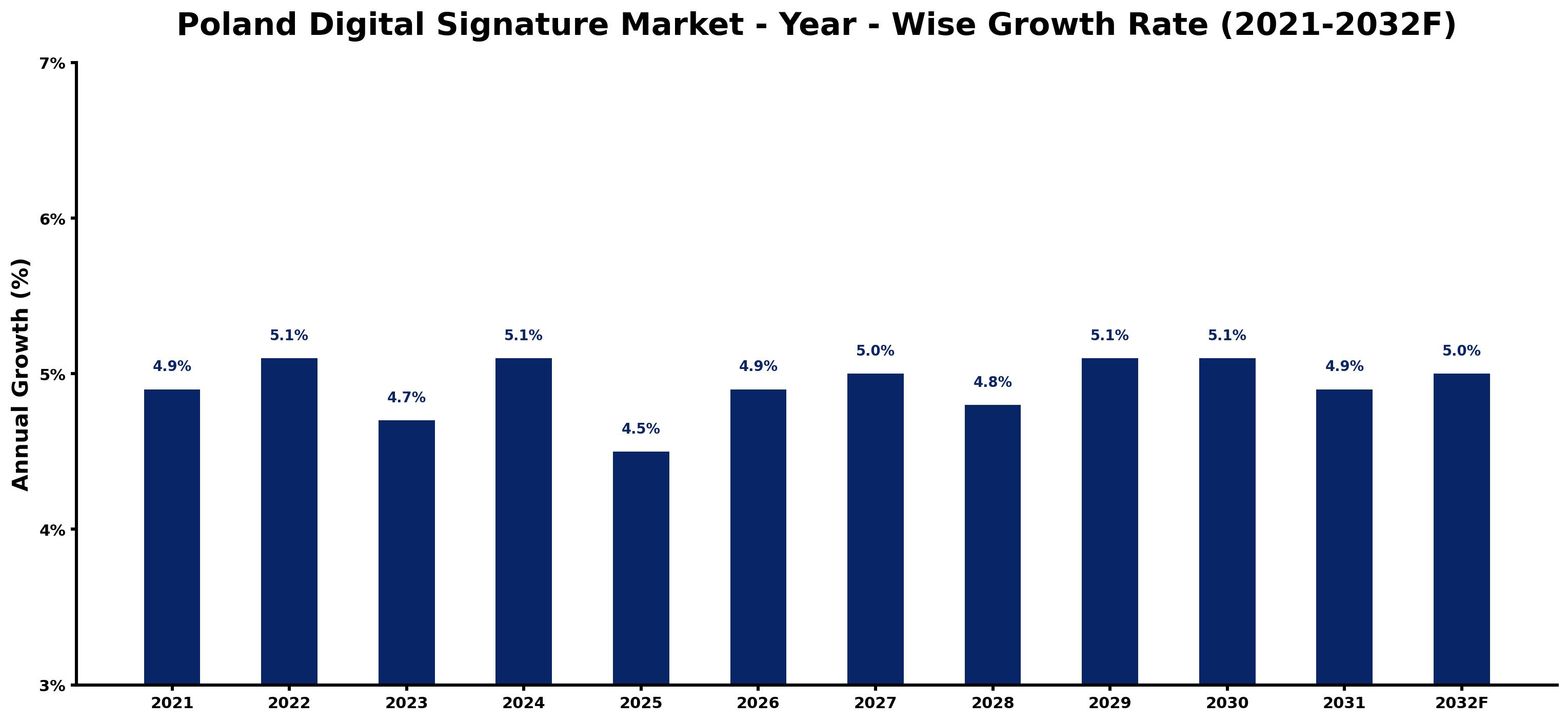
The table below presents the year‑wise growth rates along with the key drivers influencing the market
| Year | Growth Rate | Major Drivers |
| 2021 | 4.9% | Increased adoption of e-signatures in remote work. |
| 2022 | 5.1% | EU eIDAS regulation boosting trust in digital signatures. |
| 2023 | 4.7% | Government initiatives promoting paperless transactions nationwide. |
| 2024 | 5.1% | Rising compliance requirements for secure digital transactions. |
| 2025 | 4.5% | Growing privacy regulations enhancing need for digital identity. |
| 2026 | 4.9% | Financial sector digitalization driving demand for secure signatures. |
| 2027 | 5.0% | Increased online service offerings requiring digital authentication. |
| 2028 | 4.8% | Robust growth in e-commerce necessitating secure checkout options. |
| 2029 | 5.1% | Public sector digitalization mandates supporting e-signature usage. |
| 2030 | 5.1% | Surge in remote healthcare services requiring digital approvals. |
| 2031 | 4.9% | Emerging fintech solutions demanding advanced signature technologies. |
| 2032 | 5.0% | Continuing shift towards digital transformation among businesses. |
Note: Market size estimations and growth projections presented in this report are based on 6Wresearch's proprietary forecasting methodology, utilizing the latest available industry data, government publications, and primary research inputs.
Poland Digital Signature Market Key Takeaways
Below are some of the specific key takeaways from the market, including:
- The growing acceptance of digital signatures in business processes is a major factor driving the market.
- Regulatory mandates for electronic transactions are pushing organizations to adopt digital signatures.
- Technological innovations are enhancing the efficiency and security of digital signature solutions.
- Challenges related to compliance and security remain crucial for stakeholders to address.
- The government’s proactive policies favoring digital transformation are shaping the market dynamics.
Evaluation of Restraints in Poland Digital Signature Market
While the Poland Digital Signature Market is on an upward trajectory, certain limitations hinder its potential. One of the primary concerns is the complexity surrounding regulatory compliance. Businesses often grapple with the intricacies of various regulations, which can create hesitation in adopting digital signatures. Additionally, security threats continue to loom large, as ensuring the authenticity of digital signatures is paramount. Any breaches can undermine trust in electronic transactions, which is essential for widespread market acceptance.
Poland Digital Signature Market Trends
There are several notable trends shaping the Poland Digital Signature Market. The first is the rising prevalence of cloud-based solutions, which offer flexibility and scalability for businesses. Increasingly, organizations are opting for digital signature solutions that are integrated within cloud platforms, allowing for seamless collaboration.
Additionally, the push towards remote work has accelerated the adoption of digital signatures. Companies are recognizing the necessity of secure electronic signing processes to maintain workflow continuity, especially as remote collaboration becomes the norm.
Poland Digital Signature Market Opportunities
The market holds substantial growth opportunities, particularly in sectors like finance and healthcare, which have stringent compliance requirements. Organizations within these industries are looking to implement digital signatures to ensure secure transactions and meet regulatory standards. Furthermore, as more businesses digitize their operations, the need for efficient electronic signing solutions will only increase. Emerging technologies, such as blockchain, also present opportunities to enhance the security of digital signatures, potentially attracting investments and innovations.
Government Initiatives in the Poland Digital Signature Market
Government policies are playing a crucial role in the evolution of the Poland Digital Signature Market. A robust regulatory framework is now in place, aimed at promoting the use of digital signatures in both public and private sectors. This policy direction is essential for fostering trust and ensuring the security of electronic transactions.
- A regulatory framework established in 2023 mandates the use of digital signatures for secure document verification in public sector transactions.
- An initiative launched in mid-2024 focuses on enhancing public awareness regarding the benefits and use of digital signatures among citizens and businesses.
- Currently, the government is in the process of implementing a digital infrastructure upgrade program aimed at improving accessibility to digital signature solutions across various industries.
- A planned public-private partnership set to commence in 2026 aims to develop standards for digital signature technologies to enhance interoperability.
Future Insights of the Poland Digital Signature Market
Looking ahead, the Poland Digital Signature Market is expected to continue its upward trajectory through 2032. The interplay between regulatory support and technological advancements will be crucial in shaping future developments. As industries evolve and adapt to increasingly digital operations, the demand for secure and efficient electronic signing solutions will become ever more pronounced. Additionally, ongoing investments in cybersecurity will likely bolster confidence among users, further driving market adoption.
Poland Digital Signature Market Latest Developments
Recent activity in the Poland Digital Signature Market highlights a vibrant sector responding to technological advancements and regulatory changes. Over the past year, there has been a marked increase in collaborative efforts between government entities and technology providers, aimed at enhancing digital signatures' adoption and integration.
- A leading regional technology firm launched a new digital signature platform in early 2023, aimed at small to medium-sized enterprises seeking compliance with recent regulatory standards.
- An initiative that began in late 2022, focusing on the digital transformation of government services, is currently underway and includes the widespread implementation of digital signatures.
- A major technology vendor is set to roll out an upgraded version of its digital signature software by mid-2024, incorporating advanced encryption features to bolster security.
- A partnership established in Q1 2023 between a government agency and a private sector player aims to create educational resources for businesses regarding the implementation of digital signatures, currently ongoing.
Poland Digital Signature Market - Key Attractiveness of the Report
- 10 Years of Market Numbers
- Historical Data Starting from 2022 to 2025
- Base Year: 2025
- Forecast Data until 2032
- Key Performance Indicators Impacting the Market
- Major Upcoming Developments and Projects
Key Highlights of the Report:
- Poland Digital Signature Market Outlook
- Market Size of Poland Digital Signature Market, 2025
- Forecast of Poland Digital Signature Market, 2032
- Historical Data and Forecast of Poland Digital Signature Revenues & Volume for the Period 2022-2032F
- Poland Digital Signature Market Trend Evolution
- Poland Digital Signature Market Drivers and Challenges
- Poland Digital Signature Price Trends
- Poland Digital Signature Porter's Five Forces
- Poland Digital Signature Industry Life Cycle
- Historical Data and Forecast of Poland Digital Signature Market Revenues & Volume By Component for the Period 2022-2032F
- Historical Data and Forecast of Poland Digital Signature Market Revenues & Volume By Solutions for the Period 2022-2032F
- Historical Data and Forecast of Poland Digital Signature Market Revenues & Volume By Services for the Period 2022-2032F
- Historical Data and Forecast of Poland Digital Signature Market Revenues & Volume By Solution for the Period 2022-2032F
- Historical Data and Forecast of Poland Digital Signature Market Revenues & Volume By Software for the Period 2022-2032F
- Historical Data and Forecast of Poland Digital Signature Market Revenues & Volume By Hardware for the Period 2022-2032F
- Historical Data and Forecast of Poland Digital Signature Market Revenues & Volume By Vertical for the Period 2022-2032F
- Historical Data and Forecast of Poland Digital Signature Market Revenues & Volume By BFSI for the Period 2022-2032F
- Historical Data and Forecast of Poland Digital Signature Market Revenues & Volume By Government for the Period 2022-2032F
- Historical Data and Forecast of Poland Digital Signature Market Revenues & Volume By Defense for the Period 2022-2032F
- Historical Data and Forecast of Poland Digital Signature Market Revenues & Volume By Legal for the Period 2022-2032F
- Historical Data and Forecast of Poland Digital Signature Market Revenues & Volume By Real Estate for the Period 2022-2032F
- Historical Data and Forecast of Poland Digital Signature Market Revenues & Volume By Organization Size for the Period 2022-2032F
- Historical Data and Forecast of Poland Digital Signature Market Revenues & Volume By Large Enterprises for the Period 2022-2032F
- Historical Data and Forecast of Poland Digital Signature Market Revenues & Volume By Small and Medium-Sized Enterprises (SMEs) for the Period 2022-2032F
- Historical Data and Forecast of Poland Digital Signature Market Revenues & Volume By Deployment Mode for the Period 2022-2032F
- Historical Data and Forecast of Poland Digital Signature Market Revenues & Volume By Cloud for the Period 2022-2032F
- Historical Data and Forecast of Poland Digital Signature Market Revenues & Volume By On-Premises for the Period 2022-2032F
- Poland Digital Signature Import Export Trade Statistics
- Market Opportunity Assessment By Component
- Market Opportunity Assessment By Solution
- Market Opportunity Assessment By Vertical
- Market Opportunity Assessment By Organization Size
- Market Opportunity Assessment By Deployment Mode
- Poland Digital Signature Top Companies Market Share
- Poland Digital Signature Competitive Benchmarking By Technical and Operational Parameters
- Poland Digital Signature Company Profiles
- Poland Digital Signature Key Strategic Recommendations






































