Poland Dill Seed Oil Market Size, Share & Growth Rate
The Poland Dill Seed Oil Market was estimated at USD 228 Million in 2025 and is projected to reach USD 321 Million by 2032, growing at a CAGR of 5.0% from 2026 to 2032. This growth is largely fueled by the escalating demand for natural and organic ingredients in food and beverage applications, as consumers increasingly prefer clean-label products. Furthermore, the favorable climate conditions in Poland are enhancing dill cultivation, ultimately boosting both production and export capabilities.
Poland Dill Seed Oil Market Year-wise Growth Rate and Key Drivers
This graph highlights how the Poland Dill Seed Oil Market has steadily grown over the years, supported by major growth factors.
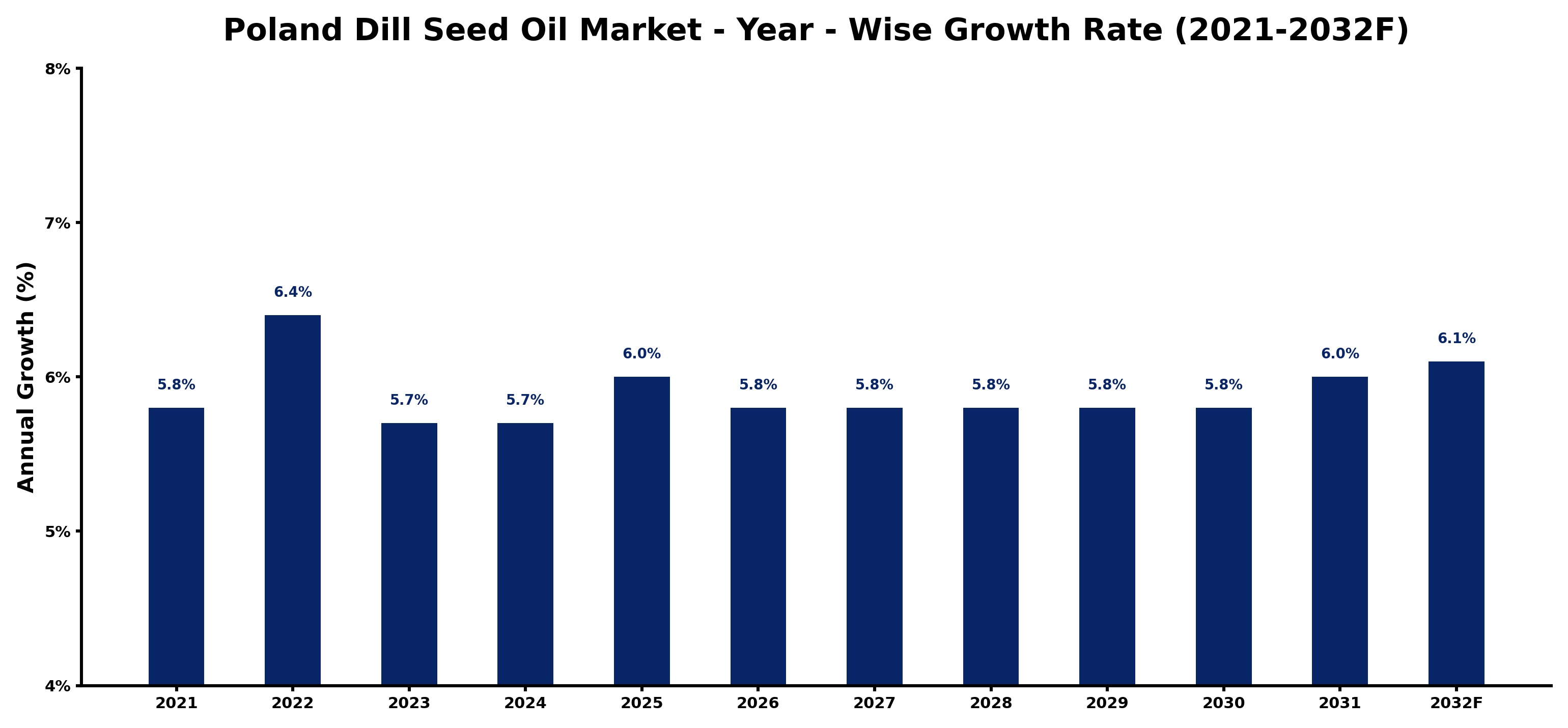
The table below presents the year‑wise growth rates along with the key drivers influencing the market
| Year | Growth Rate | Major Drivers |
| 2021 | 5.8% | Government infrastructure modernization initiatives |
| 2022 | 6.4% | Rapid growth in telecom and data center sectors |
| 2023 | 5.7% | Growing urbanization and commercial development |
| 2024 | 5.7% | Increasing adoption of advanced technologies |
| 2025 | 6.0% | Government infrastructure modernization initiatives |
| 2026 | 5.8% | Growing renewable energy integration projects |
| 2027 | 5.8% | Expansion of commercial construction activities |
| 2028 | 5.8% | Expansion of transportation and logistics networks |
| 2029 | 5.8% | Increasing industrial automation investments |
| 2030 | 5.8% | Rising electricity demand across industries |
| 2031 | 6.0% | Increasing industrial infrastructure investments |
| 2032 | 6.1% | Increasing smart city development projects |
Note - Market size estimations and growth projections presented in this report are based on 6Wresearch's advanced forecasting approach, validated with industry datasets as of June 2026.
Poland Dill Seed Oil Market Synopsis
In recent years, the Poland Dill Seed Oil Market has exhibited robust momentum, propelled by rising consumer awareness of natural health benefits and culinary applications. However, as the market matures, it is expected to transition toward more specialized applications within the pharmaceutical and personal care sectors.
Moving forward, innovation in product formulations and extraction techniques will become critical. The industry's future will hinge not just on maintaining quality standards, but also on meeting the evolving preferences of an increasingly health-conscious consumer base, ensuring continued growth in this dynamic market.
Poland Dill Seed Oil Market Key Takeaways
- The market is supported by increasing consumer preference for organic and natural products across various sectors.
- Poland's climatic advantages facilitate optimal dill cultivation, enhancing production and export prospects.
- Innovations in product development are crucial for companies to maintain competitive advantages in a crowded market.
- Health benefits attributed to dill seed oil are driving demand in both culinary and therapeutic applications.
- Regulatory frameworks support sustainable agricultural practices, promoting long-term growth for the market.
Evaluation of Restraints in Poland Dill Seed Oil Market
Despite its promising trajectory, the Poland Dill Seed Oil Market faces notable restraints that could impede growth. Chief among these is the intense competition from other essential oils and plant extracts that offer similar health and sensory benefits, making it challenging for dill seed oil to carve out a unique identity. Additionally, fluctuations in raw material prices can disrupt supply chains, posing a risk to price stability. Lastly, producers must adapt to the increasing demand for organic certification, which may necessitate adjustments in farming and production methods, adding to operational costs.
Poland Dill Seed Oil Market Trends
Several key trends are shaping the Poland Dill Seed Oil Market. The escalating incorporation of dill seed oil in culinary practices for flavoring and seasoning is gaining traction, while its therapeutic attributes are increasingly recognized in the pharmaceutical and cosmetic industries. The focus on natural remedies is driving consumers towards essential oils for aromatherapy and personal care, further catalyzing market demand. Additionally, the clean-label movement is encouraging manufacturers to utilize high-quality, organic ingredients, positioning dill seed oil favorably in health-oriented product lines.
Poland Dill Seed Oil Market Opportunities
Investment opportunities in the Poland Dill Seed Oil Market are abundant, particularly for businesses focusing on production and distribution. The rising consumer shift towards natural ingredients creates a fertile ground for new entrants and established companies alike. Additionally, exploring novel extraction methods and applications—such as in functional foods or wellness products—could significantly enhance market appeal. Furthermore, initiatives aimed at expanding export capabilities could open new revenue streams, capitalizing on Poland's strategic location within Europe.
Government Initiatives in the Poland Dill Seed Oil Market
The Polish government actively supports the dill seed oil market through various initiatives aimed at bolstering the agricultural sector. Policies promoting sustainable farming practices ensure compliance with food safety standards, while financial aid for farmers facilitates investment in dill cultivation and oil extraction processes. Regulatory frameworks are also in place to guarantee quality control and improve the overall reputation of Polish dill seed oil in both domestic and international markets. Research initiatives further enhance agricultural techniques, ultimately benefiting producers and consumers alike.
Future Insights of the Poland Dill Seed Oil Market
Looking ahead to 2026-2032, the Poland Dill Seed Oil Market is poised for sustained growth driven by continued consumer interest in natural health solutions. The increasing prevalence of dill seed oil in food and cosmetic applications underscores its versatility, creating a wealth of opportunities for product innovation. However, producers must navigate challenges such as raw material price fluctuations and evolving regulatory landscapes. By prioritizing quality and adapting to consumer preferences, the market is likely to flourish in the coming years.
Poland Dill Seed Oil Market Latest Developments (May 2025 - June 2026)
In the most recent period, industry players have been focusing on enhancing production techniques and exploring new markets for dill seed oil exports. There has been a noticeable uptick in research and development activities aimed at discovering innovative uses for dill seed oil in functional foods and beauty products. Additionally, the growing emphasis on sustainability has prompted many companies to adopt eco-friendly practices in their operations, which aligns with consumer preferences for greener products.
Poland Dill Seed Oil Market - Key Attractiveness of the Report
- 10 Years of Market Numbers
- Historical Data Starting from 2022 to 2025
- Base Year: 2025
- Forecast Data until 2032
- Key Performance Indicators Impacting the Market
- Major Upcoming Developments and Projects
Key Highlights of the Report:
- Poland Dill Seed Oil Market Outlook
- Market Size of Poland Dill Seed Oil Market, 2025
- Forecast of Poland Dill Seed Oil Market, 2032
- Historical Data and Forecast of Poland Dill Seed Oil Revenues & Volume for the Period 2022-2032F
- Poland Dill Seed Oil Market Trend Evolution
- Poland Dill Seed Oil Market Drivers and Challenges
- Poland Dill Seed Oil Price Trends
- Poland Dill Seed Oil Porter's Five Forces
- Poland Dill Seed Oil Industry Life Cycle
- Historical Data and Forecast of Poland Dill Seed Oil Market Revenues & Volume By Type for the Period 2022-2032F
- Historical Data and Forecast of Poland Dill Seed Oil Market Revenues & Volume By Anethum Graveolens Seed Oil for the Period 2022-2032F
- Historical Data and Forecast of Poland Dill Seed Oil Market Revenues & Volume By Anethum Sowa Seed Oil for the Period 2022-2032F
- Historical Data and Forecast of Poland Dill Seed Oil Market Revenues & Volume By Application for the Period 2022-2032F
- Historical Data and Forecast of Poland Dill Seed Oil Market Revenues & Volume By Flavor for the Period 2022-2032F
- Historical Data and Forecast of Poland Dill Seed Oil Market Revenues & Volume By Fragrance for the Period 2022-2032F
- Historical Data and Forecast of Poland Dill Seed Oil Market Revenues & Volume By Pharmaceutical for the Period 2022-2032F
- Historical Data and Forecast of Poland Dill Seed Oil Market Revenues & Volume By Skincare for the Period 2022-2032F
- Historical Data and Forecast of Poland Dill Seed Oil Market Revenues & Volume By Aromatherapy for the Period 2022-2032F
- Poland Dill Seed Oil Import Export Trade Statistics
- Market Opportunity Assessment By Type
- Market Opportunity Assessment By Application
- Poland Dill Seed Oil Top Companies Market Share
- Poland Dill Seed Oil Competitive Benchmarking By Technical and Operational Parameters
- Poland Dill Seed Oil Company Profiles
- Poland Dill Seed Oil Key Strategic Recommendations






































