Poland EdTech and Smart Classrooms Market Size & Growth Rate (2026-2032)
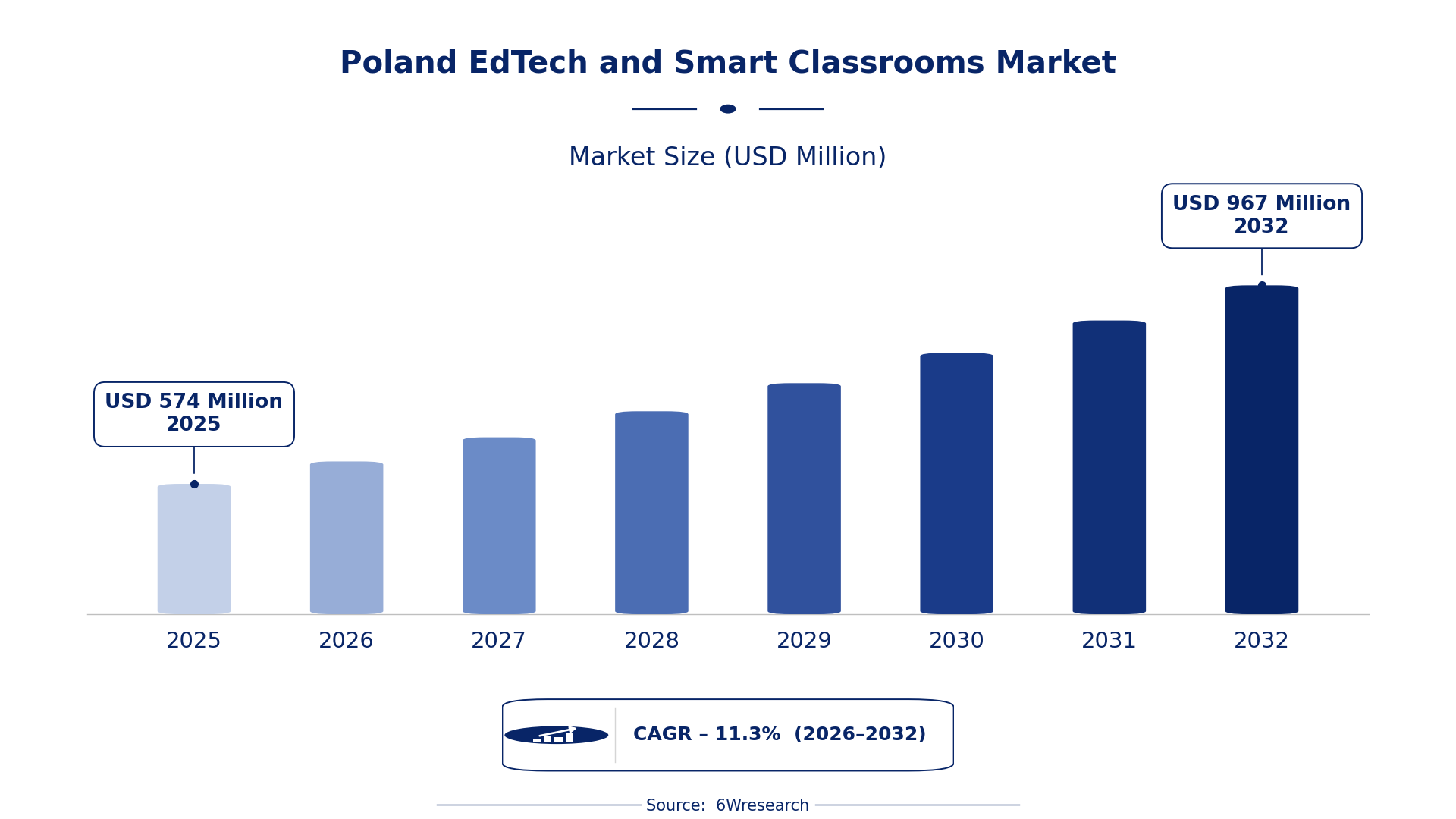
The Poland EdTech and Smart Classrooms Market was estimated at USD 574 Million in 2025 and is projected to reach USD 967 Million by 2032, growing at a CAGR of 11.3% from 2026 to 2032.
Poland EdTech and Smart Classrooms Market Synopsis
The Poland EdTech and Smart Classrooms market is on an upward trajectory, significantly influenced by a robust shift towards digital learning solutions. The Polish education sector is rapidly embracing technology, driven by a combination of governmental initiatives and a growing demand for personalized learning experiences.
Interactive whiteboards, educational apps, and virtual reality tools are becoming commonplace in classrooms. This transformation is further catalyzed by the COVID-19 pandemic, which has exposed the necessity for innovative educational strategies and tools that foster effective remote learning.
Poland EdTech and Smart Classrooms Market Year-wise Growth Rate and Key Drivers
This graph illustrates the annual growth rates of the Poland EdTech and Smart Classrooms Market from 2021 to 2032, highlighting a steady upward trajectory and projected expansion over the forecast period.
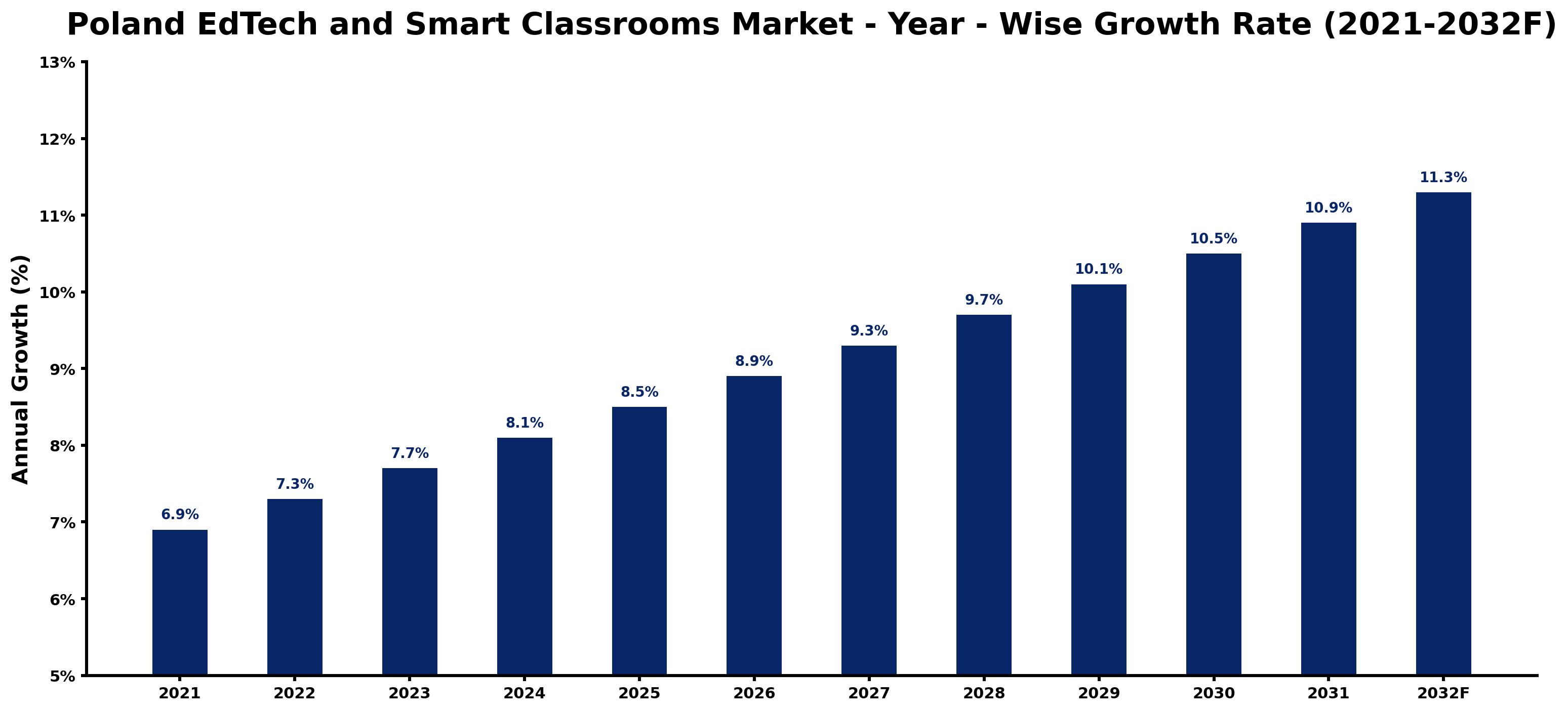
The table below presents the year‑wise growth rates along with the key drivers influencing the market
| Year | Growth Rate | Major Drivers |
| 2021 | 6.9% | Government grants for digital education initiatives boost adoption. |
| 2022 | 7.3% | Increased investments in IT infrastructure for schools. |
| 2023 | 7.7% | National Strategy for Digital Education supports smart classrooms. |
| 2024 | 8.1% | Rise in remote learning needs fosters EdTech innovations. |
| 2025 | 8.5% | Integration of STEM programs in schools drives technology use. |
| 2026 | 8.9% | Polish Ministry of Education endorses digital learning tools. |
| 2027 | 9.3% | Growing private sector partnerships funding educational technology. |
| 2028 | 9.7% | Demographic shifts favoring tech-savvy younger generations. |
| 2029 | 10.1% | Improved cybersecurity regulations enhancing digital platform confidence. |
| 2030 | 10.5% | Expanded international collaborations promoting educational technology. |
| 2031 | 10.9% | Local startups innovating in personalized learning solutions. |
| 2032 | 11.3% | Government emphasis on digital literacy advancing smart classrooms. |
Note: Market size estimations and growth projections presented in this report are based on 6Wresearch's proprietary forecasting methodology, utilizing the latest available industry data, government publications, and primary research inputs.
Poland EdTech and Smart Classrooms Market Key Takeaways
Below are some of the specific key takeaways from the market, including:
- The market is heavily driven by government initiatives aimed at enhancing digital education.
- There is a notable rise in the demand for personalized learning experiences among students and educators.
- Interactive tools and platforms are reshaping traditional teaching methods and classroom dynamics.
- The COVID-19 pandemic has accelerated the adoption of online and remote learning solutions.
- Investment in technology and infrastructure is critical to overcoming existing challenges in digital education.
Evaluation of Restraints in Poland EdTech and Smart Classrooms Market
Despite its growth, the Poland EdTech and Smart Classrooms market faces several challenges. Limited access to technology and inadequate internet infrastructure in various regions hinder the widespread implementation of digital learning solutions. Additionally, a shortage of skilled educators capable of effectively integrating technology into their teaching remains a pressing concern. Resistance to changing established teaching methods also complicates the adoption of new tools. Schools with constrained budgets may struggle to invest in smart classroom setups and necessary training, thereby stifling broader market growth.
Poland EdTech and Smart Classrooms Market Trends
Several trends are currently shaping the Poland EdTech and Smart Classrooms market. The integration of artificial intelligence and augmented reality into educational tools is gaining traction, enhancing student engagement and interaction. Schools are increasingly adopting blended learning models, combining in-person and online instruction. on top of that, partnerships between educational institutions and EdTech providers are on the rise, fostering innovation and resource sharing. This collaborative approach is likely to drive further advancements in educational technology.
Poland EdTech and Smart Classrooms Market Opportunities
The opportunities in the Poland EdTech and Smart Classrooms market are substantial. As the government prioritizes digital education, investments in infrastructure and technology are set to increase. Companies specializing in e-learning platforms, educational apps, and interactive tools have fertile ground for growth. on top of that, expanding digital literacy programs can create a more skilled workforce of educators, capable of harnessing technology to enhance learning experiences. The potential for growth in remote and underserved areas presents an attractive opportunity for market entrants.
Government Initiatives in the Poland EdTech and Smart Classrooms Market
Government policy is playing a crucial role in shaping the EdTech and Smart Classrooms market in Poland. With a clear focus on enhancing digitalization within education, the Ministry of National Education has implemented several initiatives aimed at equipping schools with modern technology. These efforts underscore the commitment to improving educational outcomes and preparing students for a digital future.
- A recently completed initiative, the Digital School program, aimed to equip schools with essential technology and enhance digital competencies among students.
- Currently underway is a national strategy to improve internet access in rural areas, ensuring that all students can benefit from digital learning tools.
- A planned public-private partnership will develop smart classroom infrastructure, set to roll out by 2026.
- Funding allocations have been made to support teacher training programs focused on integrating technology into the classroom.
- Future initiatives include a comprehensive review of the curriculum to better incorporate digital skills across all educational levels.
Future Insights of the Poland EdTech and Smart Classrooms Market
Looking ahead to 2026-2032, the Poland EdTech and Smart Classrooms market is poised for remarkable growth. The ongoing integration of advanced technologies such as AI, AR, and IoT in educational settings will redefine learning experiences and foster deeper engagement among students. As educational institutions continue to adapt to new teaching methodologies, the demand for innovative EdTech solutions is likely to rise. on top of that, the focus on improving educational accessibility and quality will drive further investment and development within this sector.
Poland EdTech and Smart Classrooms Market Latest Developments
Recent developments in the Poland EdTech and Smart Classrooms market highlight a strong momentum towards innovation and digital integration. Over the past year, numerous initiatives and partnerships have emerged, signaling an active interest in enhancing educational technology.
- A major technology vendor launched a new interactive learning platform in early 2025, designed to facilitate remote and hybrid learning environments.
- Ongoing collaboration between regional educational institutions and EdTech startups aims to develop tailored educational tools for local needs.
- A rollout of an advanced digital classroom solution is expected to begin in mid-2026, focusing on interactive and immersive learning experiences.
- In late 2025, a pilot program was completed, demonstrating the effectiveness of VR tools in enhancing student engagement.
- Upcoming initiatives include a nationwide teacher training campaign scheduled for late 2026, aimed at increasing digital competencies among educators.
Poland EdTech and Smart Classrooms Market - Key Attractiveness of the Report
- 10 Years of Market Numbers
- Historical Data Starting from 2022 to 2025
- Base Year: 2025
- Forecast Data until 2032
- Key Performance Indicators Impacting the Market
- Major Upcoming Developments and Projects
Key Highlights of the Report:
- Poland EdTech and Smart Classrooms Market Outlook
- Market Size of Poland EdTech and Smart Classrooms Market, 2025
- Forecast of Poland EdTech and Smart Classrooms Market, 2032
- Historical Data and Forecast of Poland EdTech and Smart Classrooms Revenues & Volume for the Period 2022-2032F
- Poland EdTech and Smart Classrooms Market Trend Evolution
- Poland EdTech and Smart Classrooms Market Drivers and Challenges
- Poland EdTech and Smart Classrooms Price Trends
- Poland EdTech and Smart Classrooms Porter's Five Forces
- Poland EdTech and Smart Classrooms Industry Life Cycle
- Historical Data and Forecast of Poland EdTech and Smart Classrooms Market Revenues & Volume By Hardware for the Period 2022-2032F
- Historical Data and Forecast of Poland EdTech and Smart Classrooms Market Revenues & Volume By Interactive Displays for the Period 2022-2032F
- Historical Data and Forecast of Poland EdTech and Smart Classrooms Market Revenues & Volume By Interactive Projectors for the Period 2022-2032F
- Historical Data and Forecast of Poland EdTech and Smart Classrooms Market Revenues & Volume By Education System Solution for the Period 2022-2032F
- Historical Data and Forecast of Poland EdTech and Smart Classrooms Market Revenues & Volume By Learning Management System for the Period 2022-2032F
- Historical Data and Forecast of Poland EdTech and Smart Classrooms Market Revenues & Volume By Student Information and Administration System for the Period 2022-2032F
- Historical Data and Forecast of Poland EdTech and Smart Classrooms Market Revenues & Volume By Student Collaboration System for the Period 2022-2032F
- Historical Data and Forecast of Poland EdTech and Smart Classrooms Market Revenues & Volume By Student Response System for the Period 2022-2032F
- Historical Data and Forecast of Poland EdTech and Smart Classrooms Market Revenues & Volume By Learning and Gamification for the Period 2022-2032F
- Historical Data and Forecast of Poland EdTech and Smart Classrooms Market Revenues & Volume By Test Preparation for the Period 2022-2032F
- Historical Data and Forecast of Poland EdTech and Smart Classrooms Market Revenues & Volume By Classroom Management System for the Period 2022-2032F
- Historical Data and Forecast of Poland EdTech and Smart Classrooms Market Revenues & Volume By Document Management System for the Period 2022-2032F
- Historical Data and Forecast of Poland EdTech and Smart Classrooms Market Revenues & Volume By Deployment Type for the Period 2022-2032F
- Historical Data and Forecast of Poland EdTech and Smart Classrooms Market Revenues & Volume By Cloud for the Period 2022-2032F
- Historical Data and Forecast of Poland EdTech and Smart Classrooms Market Revenues & Volume By On-Premises for the Period 2022-2032F
- Historical Data and Forecast of Poland EdTech and Smart Classrooms Market Revenues & Volume By End User for the Period 2022-2032F
- Historical Data and Forecast of Poland EdTech and Smart Classrooms Market Revenues & Volume By K-12 for the Period 2022-2032F
- Historical Data and Forecast of Poland EdTech and Smart Classrooms Market Revenues & Volume By Higher Education for the Period 2022-2032F
- Poland EdTech and Smart Classrooms Import Export Trade Statistics
- Market Opportunity Assessment By Hardware
- Market Opportunity Assessment By Education System Solution
- Market Opportunity Assessment By Deployment Type
- Market Opportunity Assessment By End User
- Poland EdTech and Smart Classrooms Top Companies Market Share
- Poland EdTech and Smart Classrooms Competitive Benchmarking By Technical and Operational Parameters
- Poland EdTech and Smart Classrooms Company Profiles
- Poland EdTech and Smart Classrooms Key Strategic Recommendations






































