Poland Food Processing & Handling Equipment Market Summary
The poland food processing & handling equipment market was estimated at USD 1475 Million in 2025 and is projected to reach USD 2106 Million by 2032, growing at a CAGR of 5.8% from 2026 to 2032.
Poland Food Processing & Handling Equipment Market Year-wise Growth Rate and Key Drivers
This graph highlights how the Poland Food Processing & Handling Equipment Market has steadily grown over the past five years, supported by major growth factors.
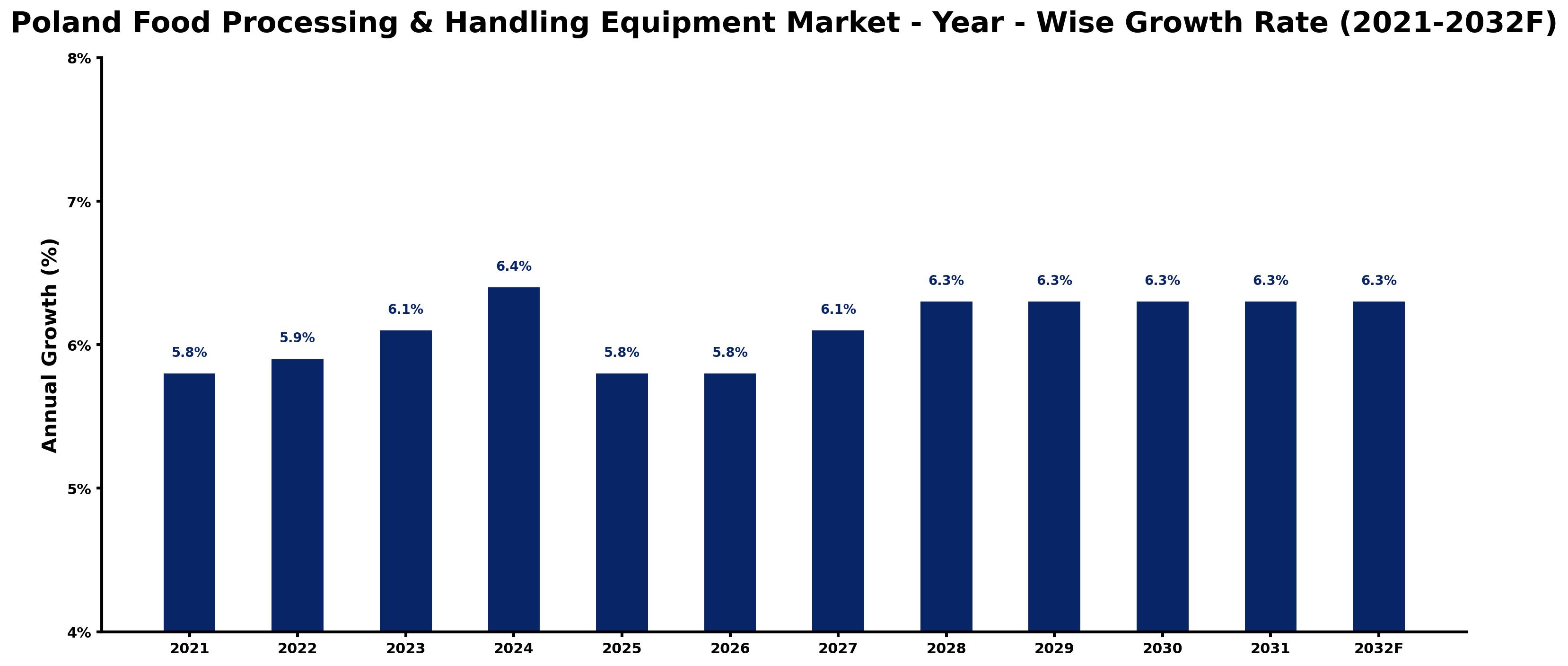
The table below presents the year wise growth rates along with the key drivers influencing the market
| Year | Growth Rate | Major Drivers |
| 2021 | 5.8% | Industry recovery post-pandemic encouraged investments in food processing technologies and infrastructure. |
| 2022 | 5.9% | Consumer preferences shifted towards sustainable packaging solutions, boosting related equipment demand. |
| 2023 | 6.1% | Local manufacturers began prioritizing automation in response to labor shortages and cost pressures. |
| 2024 | 6.4% | Emerging food trends led to increased processing capabilities for organic and plant-based products. |
| 2025 | 5.8% | E-commerce expansion required innovative logistics solutions for food handling and distribution. |
| 2026 | 5.8% | Technological upgrades in processing equipment enhanced productivity and reduced operational costs significantly. |
| 2027 | 6.1% | Rising health consciousness influenced food safety regulations, pushing equipment innovation and compliance. |
| 2028 | 6.3% | Partnerships between equipment suppliers and food brands fostered tailored solutions for market needs. |
| 2029 | 6.3% | Investments in smart technologies integrated predictive maintenance in food processing operations. |
| 2030 | 6.3% | Increased exports from Poland prompted upgrades to meet international food safety standards. |
| 2031 | 6.3% | The focus on plant-based alternatives necessitated specialized processing equipment and techniques. |
| 2032 | 6.3% | Sustainability initiatives encouraged investments in energy-efficient and eco-friendly food handling equipment. |
Note - Market size estimations and growth projections presented in this report are based on 6Wresearch's advanced forecasting approach, validated with industry datasets as of June 2026.
Poland Food Processing & Handling Equipment Market Synopsis
The Poland Food Processing Handling Equipment Market is projected to reach 5.8% and witness significant growth during the forecast period (2026-2032). The market is being propelled by an increasing consumer preference for processed food products, innovations in equipment technology, and a heightened focus on efficiency and automation within the food processing sector. These dynamics reflect a robust transformation that underscores the necessity for manufacturers to adapt to evolving consumer needs and regulatory standards.
Poland Food Processing & Handling Equipment Market Growth Drivers
Several factors are driving the expansion of the Poland Food Processing & Handling Equipment Market. The primary growth drivers include:
- The rising consumer demand for processed and packaged foods, which is spurring manufacturers to invest in advanced processing technologies.
- Technological advancements in food processing equipment, enhancing efficiency and operational effectiveness while meeting industry standards.
- A growing emphasis on sustainability, prompting companies to develop energy-efficient and environmentally friendly equipment to align with consumer expectations.
- Increased automation within manufacturing facilities, integrating robotics and intelligent systems to streamline processes and ensure consistent product quality.
- The Polish government's initiatives to modernize the food processing industry, reinforcing the need for upgraded processing and handling equipment.
Poland Food Processing & Handling Equipment Market Trends and Opportunities
The current landscape of the Poland Food Processing & Handling Equipment Market is marked by several noteworthy trends that offer opportunities for growth and innovation. Key trends include:
- Heightened adoption of smart technologies, including Internet of Things (IoT) solutions, which enable more precise monitoring and control of food processing operations.
- The shift towards eco-friendly manufacturing practices is compelling companies to design equipment that minimizes environmental impact and adheres to sustainability regulations.
- Increased emphasis on food safety and hygiene, driving the development of equipment with advanced sanitation features to comply with stringent regulatory standards.
- Growing consumer preferences for convenience foods, including ready-to-eat meals, which necessitate more sophisticated food processing equipment to handle diverse production needs.
- The emergence of innovative packaging solutions that not only preserve food quality but also meet consumer desires for sustainability and recyclability.
Poland Food Processing & Handling Equipment Market Challenges and Restraints
While the Poland Food Processing & Handling Equipment Market is on an upward trajectory, it faces several challenges that can hinder growth. These challenges include:
- Intense competition from domestic and international manufacturers, making it difficult for companies to differentiate their offerings.
- Rising production costs driven by inflation and fluctuating prices of raw materials, posing a challenge to maintaining profit margins.
- The need for continuous technological upgrades to comply with evolving industry standards, which demands substantial investment in research and development.
- Maintaining consistent quality and ensuring food safety standards, requiring manufacturers to invest in robust quality control systems.
- The fragmented nature of the market, characterized by numerous small and medium-sized enterprises, complicating the landscape for strategic positioning.
Poland Food Processing & Handling Equipment Market Investment Opportunities
The Poland Food Processing & Handling Equipment Market offers attractive investment opportunities, driven by the growing food industry and the rising demand for innovative processing solutions. Areas ripe for investment include:
- Advanced food processing machinery that enhances productivity and quality, responding to the increasing consumer appetite for processed foods.
- Automation technologies that streamline production processes, enabling manufacturers to improve efficiency and reduce operational costs.
- Development of sustainable and eco-friendly equipment that aligns with regulatory requirements and consumer preferences for environmentally responsible products.
- Research and development initiatives focused on new technologies that improve processing capabilities and product quality within the food sector.
- Partnerships and collaborations aimed at integrating cutting-edge technologies into existing manufacturing processes, enhancing competitiveness in the market.
Poland Food Processing & Handling Equipment Market Government Investment and Initiatives
Government policies play a crucial role in shaping the Poland Food Processing & Handling Equipment Market. Several initiatives and regulations are in place to support the development of this sector. The Ministry of Agriculture and Rural Development oversees standards that ensure food safety and quality, contributing to the overall operation of food processing equipment. Moreover, the Polish government offers grants and subsidies aimed at encouraging innovation and modernization within the food processing industry. These investments promote sustainable practices, ensuring that manufacturers are equipped to meet both domestic and EU regulatory standards. As a member of the European Union, Poland also adheres to EU regulations that govern food processing equipment, further enhancing the competitiveness of its food processing sector.
Poland Food Processing & Handling Equipment Market Latest Developments (May 2025 - June 2026)
Between May 2025 and June 2026, the Poland Food Processing & Handling Equipment Market has experienced notable developments, reflecting the industry's evolving dynamics. A significant focus has been placed on the integration of smart technologies to enhance operational efficiency. Manufacturers are increasingly investing in automation and robotics to streamline production processes. Additionally, sustainability has emerged as a key theme, with companies prioritizing eco-friendly equipment design to meet growing consumer demands for environmentally responsible products. The industry has also seen collaborative efforts between public and private sectors to advance technological innovations aimed at improving food safety standards and overall equipment effectiveness.
Poland Food Processing & Handling Equipment Market - Key Attractiveness of the Report
- 10 Years of Market Numbers
- Historical Data Starting from 2022 to 2025
- Base Year: 2025
- Forecast Data until 2032
- Key Performance Indicators Impacting the Market
- Major Upcoming Developments and Projects
Key Highlights of the Report:
- Poland Food Processing & Handling Equipment Market Outlook
- Market Size of Poland Food Processing & Handling Equipment Market, 2025
- Forecast of Poland Food Processing & Handling Equipment Market, 2032F
- Historical Data and Forecast of Poland Food Processing & Handling Equipment Revenues & Volume for the Period 2022-2032F
- Poland Food Processing & Handling Equipment Market Trend Evolution
- Poland Food Processing & Handling Equipment Market Drivers and Challenges
- Poland Food Processing & Handling Equipment Price Trends
- Poland Food Processing & Handling Equipment Porter's Five Forces
- Poland Food Processing & Handling Equipment Industry Life Cycle
- Historical Data and Forecast of Poland Food Processing & Handling Equipment Market Revenues & Volume By Equipment Type for the Period 2022-2032F
- Historical Data and Forecast of Poland Food Processing & Handling Equipment Market Revenues & Volume By Food Processing equipment for the Period 2022-2032F
- Historical Data and Forecast of Poland Food Processing & Handling Equipment Market Revenues & Volume By Foodservice equipment for the Period 2022-2032F
- Historical Data and Forecast of Poland Food Processing & Handling Equipment Market Revenues & Volume By Food Packaging equipment for the Period 2022-2032F
- Historical Data and Forecast of Poland Food Processing & Handling Equipment Market Revenues & Volume By Application for the Period 2022-2032F
- Historical Data and Forecast of Poland Food Processing & Handling Equipment Market Revenues & Volume By Bakery & confectionery products for the Period 2022-2032F
- Historical Data and Forecast of Poland Food Processing & Handling Equipment Market Revenues & Volume By Meat & poultry products for the Period 2022-2032F
- Historical Data and Forecast of Poland Food Processing & Handling Equipment Market Revenues & Volume By Dairy products for the Period 2022-2032F
- Historical Data and Forecast of Poland Food Processing & Handling Equipment Market Revenues & Volume By Alcoholic beverages for the Period 2022-2032F
- Historical Data and Forecast of Poland Food Processing & Handling Equipment Market Revenues & Volume By Non-alcoholic beverages for the Period 2022-2032F
- Historical Data and Forecast of Poland Food Processing & Handling Equipment Market Revenues & Volume By Fish & seafood products for the Period 2022-2032F
- Historical Data and Forecast of Poland Food Processing & Handling Equipment Market Revenues & Volume By Others? for the Period 2022-2032F
- Historical Data and Forecast of Poland Food Processing & Handling Equipment Market Revenues & Volume By Form for the Period 2022-2032F
- Historical Data and Forecast of Poland Food Processing & Handling Equipment Market Revenues & Volume By Solid for the Period 2022-2032F
- Historical Data and Forecast of Poland Food Processing & Handling Equipment Market Revenues & Volume By Liquid for the Period 2022-2032F
- Historical Data and Forecast of Poland Food Processing & Handling Equipment Market Revenues & Volume By Semi-solid for the Period 2022-2032F
- Poland Food Processing & Handling Equipment Import Export Trade Statistics
- Market Opportunity Assessment By Equipment Type
- Market Opportunity Assessment By Application
- Market Opportunity Assessment By Form
- Poland Food Processing & Handling Equipment Top Companies Market Share
- Poland Food Processing & Handling Equipment Competitive Benchmarking By Technical and Operational Parameters
- Poland Food Processing & Handling Equipment Company Profiles
- Poland Food Processing & Handling Equipment Key Strategic Recommendations






































