Poland Food Retail Market Summary
The poland food retail market was estimated at USD 717 Million in 2025 and is projected to reach USD 1249 Million by 2032, growing at a CAGR of 9.5% from 2026 to 2032.
Poland Food Retail Market Year-wise Growth Rate and Key Drivers
This graph highlights how the Poland Food Retail Market has steadily grown over the past five years, supported by major growth factors.
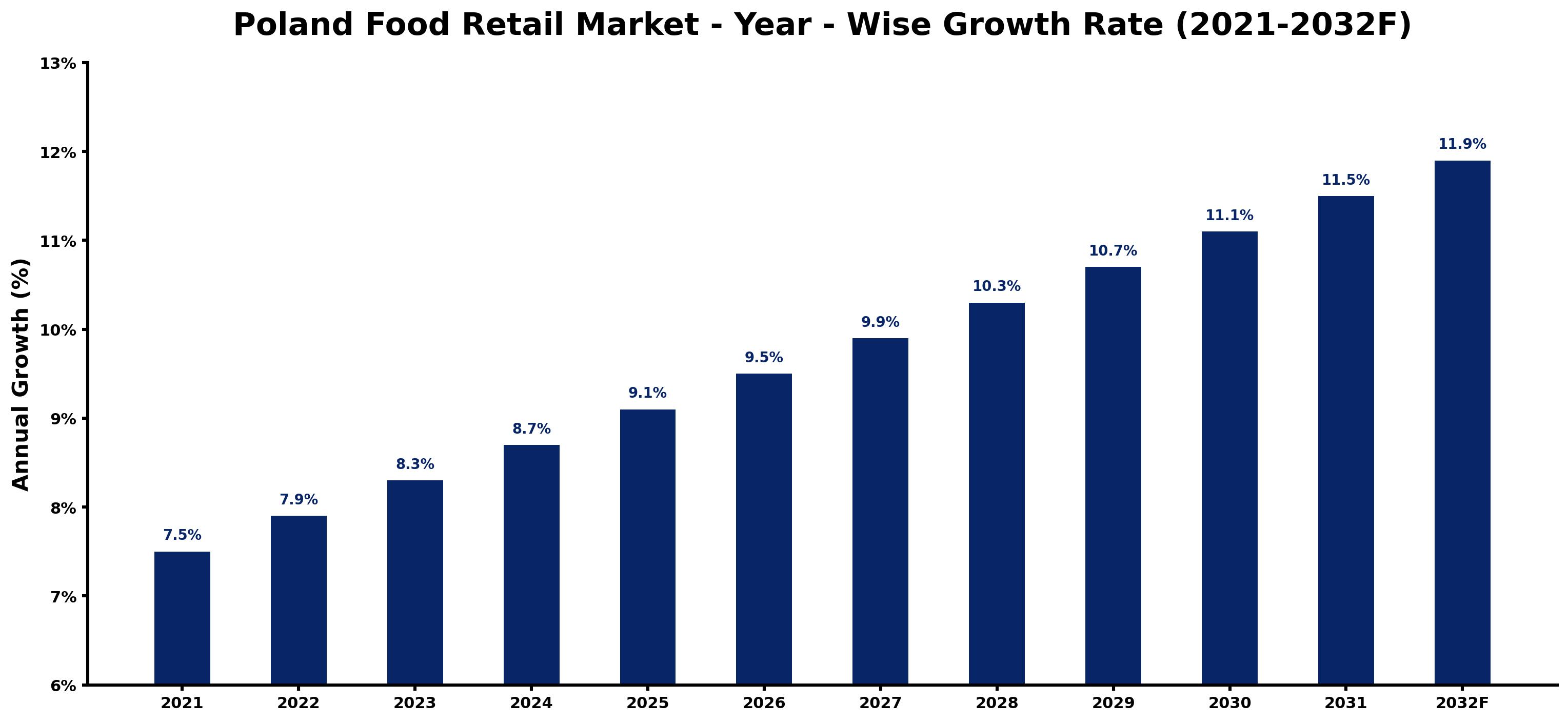
The table below presents the year wise growth rates along with the key drivers influencing the market
| Year | Growth Rate | Major Drivers |
| 2021 | 7.5% | Consumer preferences shifted towards online grocery shopping during pandemic restrictions. |
| 2022 | 7.9% | Investments in supply chain technology improved efficiency across food retail operations. |
| 2023 | 8.3% | Sustainability trends influenced retailers to adopt eco-friendly packaging solutions. |
| 2024 | 8.7% | Local sourcing gains traction as consumers prioritize fresh, regional products. |
| 2025 | 9.1% | Expansion of discount retailers increases competition and drives down prices. |
| 2026 | 9.5% | Digital wallet adoption enhances convenience in grocery transactions significantly. |
| 2027 | 9.9% | Health-conscious consumers propel demand for organic and functional food items. |
| 2028 | 10.3% | Emergence of virtual marketplaces reshapes traditional retail landscapes profoundly. |
| 2029 | 10.7% | Innovative marketing techniques attract younger demographics to food retail sectors. |
| 2030 | 11.1% | Diverse product assortments cater to evolving dietary restrictions and preferences. |
| 2031 | 11.5% | Urbanization trends create opportunities for convenience store proliferation in cities. |
| 2032 | 11.9% | Investment in logistics infrastructure supports faster delivery times across the market. |
Note - Market size estimations and growth projections presented in this report are based on 6Wresearch's advanced forecasting approach, validated with industry datasets as of June 2026.
Poland Food Retail Market Synopsis
The Poland Food Retail Market is projected to reach 9.5% and witness significant growth during the forecast period (2026-2032). The expected compound annual growth rate (CAGR) of 3.9% is driven by several key factors including rising disposable income, evolving consumer lifestyles, and the expansion of hypermarkets and supermarkets throughout the region. Additionally, an increased health awareness among Polish consumers has led to a surge in demand for organic products, further propelling market growth. Furthermore, various initiatives undertaken by Polish government organizations aimed at enhancing modern retail infrastructure present additional opportunities for retailers operating in this dynamic landscape. The market is also witnessing a shift towards e-commerce, as technological advancements enable many businesses to adopt online shopping models, providing convenience and accessibility to consumers.
Poland Food Retail Market Growth Drivers
The growth of the Poland Food Retail Market is underpinned by several vital drivers:
- Increasing disposable income among Polish consumers has created a more substantial purchasing power, leading to higher spending on food products, thereby stimulating market growth.
- Changing lifestyles, particularly in urban areas, shape consumer behavior, with a noticeable shift towards convenience foods and ready-to-eat products influencing retail strategies.
- The rise in the number of hypermarkets and supermarkets facilitates easier access to a diverse range of food products, enhancing consumer choices and promoting spending.
- Growing health consciousness among consumers is driving demand for organic and health-oriented products, encouraging retailers to diversify their offerings.
- Technological developments in retail, particularly in e-commerce and logistics, have transformed the shopping experience, allowing for greater convenience and efficiency in food retailing.
Poland Food Retail Market Trends and Opportunities
As the Poland Food Retail Market evolves, several trends and opportunities present themselves:
- The rise of e-commerce platforms provides an essential growth avenue, with more retailers adopting online models to cater to changing consumer preferences.
- Sustainability is increasingly influencing purchase decisions, leading retailers to implement eco-friendly practices in sourcing, packaging, and logistics.
- Private label products continue to gain popularity due to their affordability and perceived quality, prompting retailers to expand their private brand offerings.
- The integration of technology in retail operations, such as self-checkout kiosks and mobile payment solutions, enhances customer experience and operational efficiency.
- Health and wellness trends are driving retailers to develop and promote a broader range of organic, gluten-free, and health-focused food products in their inventories.
Poland Food Retail Market Challenges and Restraints
Despite the positive growth trajectory, the Poland Food Retail Market faces several challenges:
- Intense competition among local and international retailers can lead to price wars, affecting profit margins and overall market stability.
- Supply chain disruptions, particularly in the wake of economic events, can lead to product shortages and affect consumer satisfaction.
- Fluctuating food prices due to external factors such as climate change and international trade dynamics can impact purchasing behaviors.
- Regulatory challenges related to food safety and labeling can increase operational costs for retailers, affecting their market strategies.
- Changing consumer preferences necessitate continuous adaptation and innovation from retailers, requiring significant investment in research and development.
Poland Food Retail Market Government Investment and Initiatives
The Polish government has been proactive in implementing policies that foster a conducive environment for the food retail market. Initiatives aimed at enhancing modern retail infrastructure are critical in this regard:
- Investment in transportation and logistics infrastructure is essential for improving supply chain efficiencies, enabling retailers to manage costs and enhance service delivery.
- Public spending on digitalization initiatives for retail operations supports the integration of e-commerce platforms and digital solutions into traditional retail frameworks.
- Government support for organic farming initiatives enhances the supply of organic products, aligning with the growing consumer preference for health-conscious choices.
- Incentives for sustainable practices encourage retailers to adopt environmentally friendly measures, benefiting both the economy and the ecological landscape.
- Regulatory frameworks established by government entities ensure food safety and quality, promoting consumer confidence in the market.
Poland Food Retail Market Latest Developments (May 2025 - June 2026)
Recent developments in the Poland Food Retail Market indicate a notable shift towards digital transformation and sustainability. Retailers have increasingly adopted online sales platforms, enhancing consumer engagement and convenience. Moreover, a heightened focus on health and wellness has led to greater product diversification, with more organic and natural products becoming available. Industry innovations have also focused on improving supply chain efficiencies, addressing the challenges posed by previous disruptions. Additionally, consumer trends indicate a growing preference for local products, prompting retailers to source from local suppliers whenever possible. These trends collectively highlight a dynamic and evolving food retail landscape, poised for sustained growth.
Poland Food Retail Market - Key Attractiveness of the Report
- 10 Years of Market Numbers
- Historical Data Starting from 2022 to 2025
- Base Year: 2025
- Forecast Data until 2032
- Key Performance Indicators Impacting the Market
- Major Upcoming Developments and Projects
Key Highlights of the Report:
- Poland Food Retail Market Outlook
- Market Size of Poland Food Retail Market, 2025
- Forecast of Poland Food Retail Market, 2032F
- Historical Data and Forecast of Poland Food Retail Revenues & Volume for the Period 2022-2032F
- Poland Food Retail Market Trend Evolution
- Poland Food Retail Market Drivers and Challenges
- Poland Food Retail Price Trends
- Poland Food Retail Porter's Five Forces
- Poland Food Retail Industry Life Cycle
- Historical Data and Forecast of Poland Food Retail Market Revenues & Volume By Product Types for the Period 2022-2032F
- Historical Data and Forecast of Poland Food Retail Market Revenues & Volume By Unpackaged Food for the Period 2022-2032F
- Historical Data and Forecast of Poland Food Retail Market Revenues & Volume By Packaged Food for the Period 2022-2032F
- Historical Data and Forecast of Poland Food Retail Market Revenues & Volume By Drinks for the Period 2022-2032F
- Historical Data and Forecast of Poland Food Retail Market Revenues & Volume By Household Products for the Period 2022-2032F
- Historical Data and Forecast of Poland Food Retail Market Revenues & Volume By Packaging Types for the Period 2022-2032F
- Historical Data and Forecast of Poland Food Retail Market Revenues & Volume By Boxes for the Period 2022-2032F
- Historical Data and Forecast of Poland Food Retail Market Revenues & Volume By Cans for the Period 2022-2032F
- Historical Data and Forecast of Poland Food Retail Market Revenues & Volume By Cellophane Wrapping for the Period 2022-2032F
- Historical Data and Forecast of Poland Food Retail Market Revenues & Volume By Cylindrical Cardboard for the Period 2022-2032F
- Poland Food Retail Import Export Trade Statistics
- Market Opportunity Assessment By Product Types
- Market Opportunity Assessment By Packaging Types
- Poland Food Retail Top Companies Market Share
- Poland Food Retail Competitive Benchmarking By Technical and Operational Parameters
- Poland Food Retail Company Profiles
- Poland Food Retail Key Strategic Recommendations






































