Poland Furniture Market: Import Trend Analysis
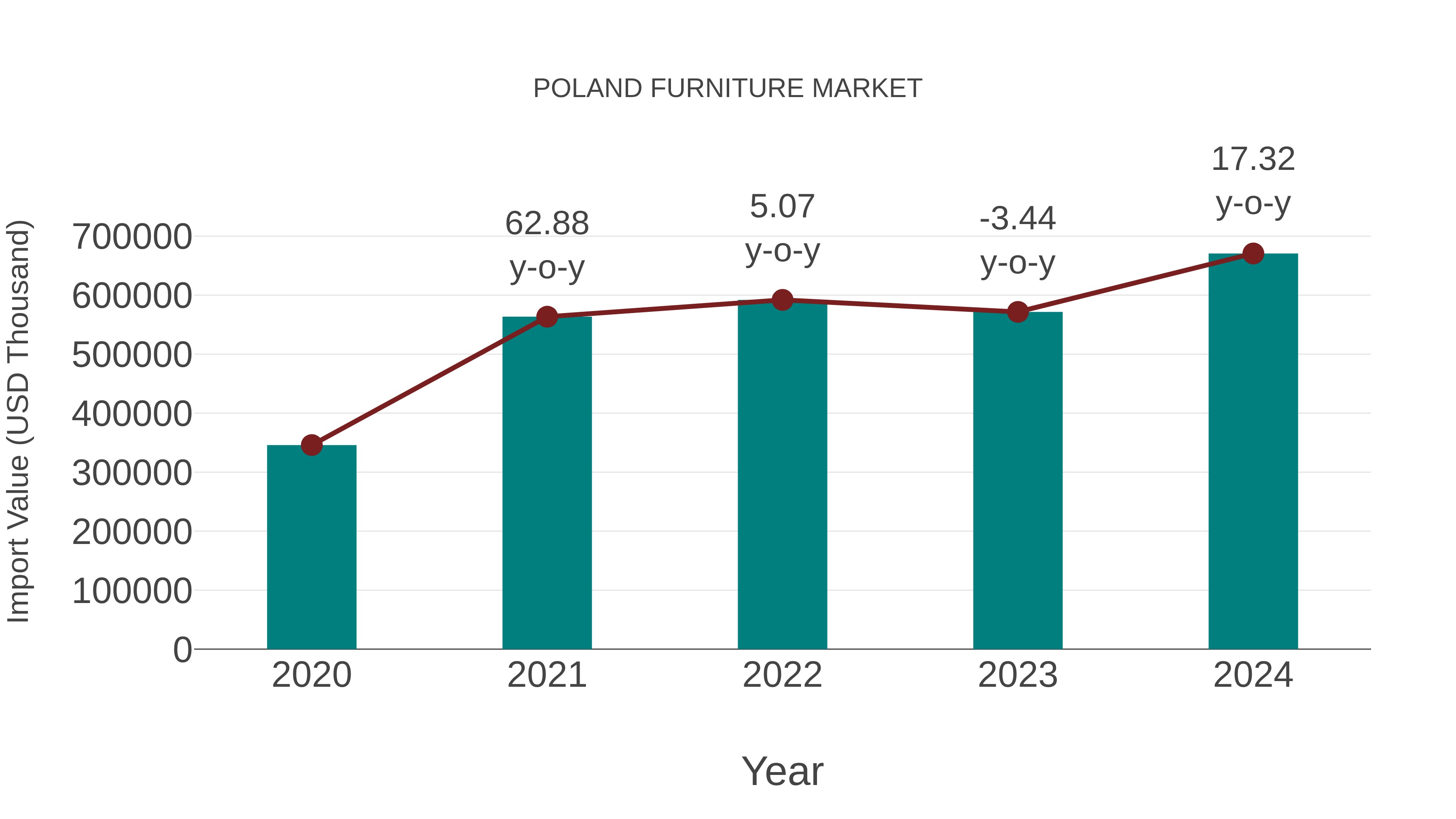
In the Poland furniture market, the import trend showed a notable growth rate of 17.32% from 2023 to 2024, with a compound annual growth rate (CAGR) of 18.0% for the period 2020-2024. This import momentum can be attributed to the increasing demand for high-quality furniture products and the market`s stability, indicating a positive shift in consumer preferences towards imported furniture goods during this period.
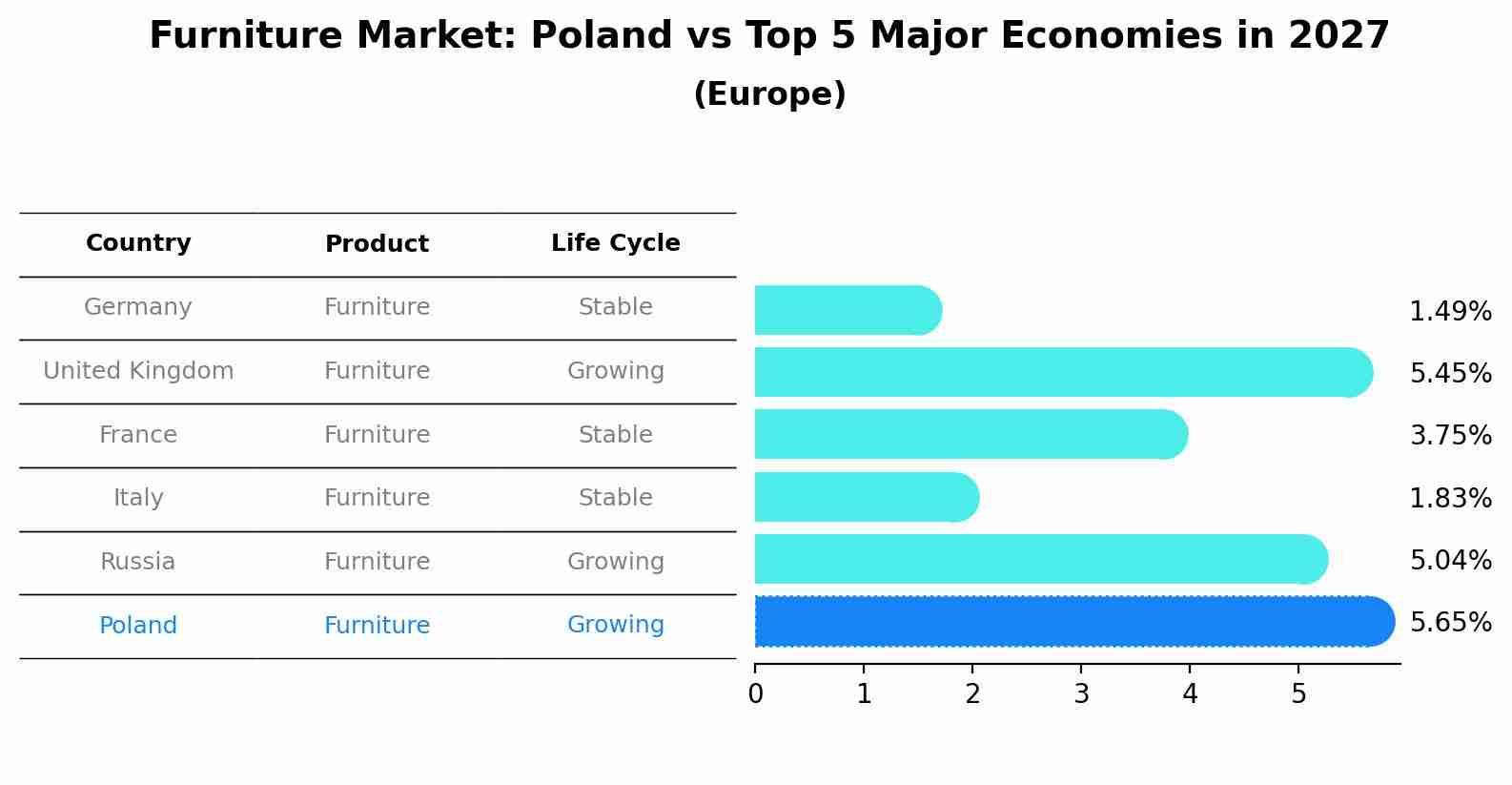
Furniture Market: Poland vs Top 5 Major Economies in 2027 (Europe)
In the Europe region, the Furniture market in Poland is projected to expand at a growing growth rate of 5.65% by 2027. The largest economy is Germany, followed by United Kingdom, France, Italy and Russia.
poland furniture market Synopsis
The Polish furniture market is estimated to reach USD 5.52 billion by 2026, growing at a CAGR of 4.8% during the forecast period (2020?2026). The growth of this market can be attributed to factors such as increasing urbanization and rising disposable incomes. Additionally, an increase in the number of renovation projects and high demand for customized furniture products are expected to drive the growth of this industry over the forecast period. Moreover, increased focus on technological advancements in furniture production is also acting as one of the major drivers for industrial development.
On the flip side, however, high cost of raw materials used for manufacturing various types of contemporary furniture may hamper market growth over the forecast period 2020 ? 2026. Nevertheless technological advancements being made in order to produce new varieties of contemporary designs are expected to offer potential sources of revenue generation over this period.
Key Highlights of the Report:
- Poland Furniture Market Outlook
- Market Size of Poland Furniture Market, 2019
- Forecast of Poland Furniture Market, 2026
- Historical Data and Forecast of Poland Furniture Revenues & Volume for the Period 2016 - 2026
- Poland Furniture Market Trend Evolution
- Poland Furniture Market Drivers and Challenges
- Poland Furniture Price Trends
- Poland Furniture Porter's Five Forces
- Poland Furniture Industry Life Cycle
- Historical Data and Forecast of Poland Furniture Market Revenues & Volume By Material Types for the Period 2016 - 2026
- Historical Data and Forecast of Poland Furniture Market Revenues & Volume By Plastic for the Period 2016 - 2026
- Historical Data and Forecast of Poland Furniture Market Revenues & Volume By Wood for the Period 2016 - 2026
- Historical Data and Forecast of Poland Furniture Market Revenues & Volume By Metal for the Period 2016 - 2026
- Historical Data and Forecast of Poland Furniture Market Revenues & Volume By Other for the Period 2016 - 2026
- Historical Data and Forecast of Poland Furniture Market Revenues & Volume By Applications for the Period 2016 - 2026
- Historical Data and Forecast of Poland Furniture Market Revenues & Volume By Residential for the Period 2016 - 2026
- Historical Data and Forecast of Poland Furniture Market Revenues & Volume By Commercial for the Period 2016 - 2026
- Poland Furniture Import Export Trade Statistics
- Market Opportunity Assessment By Material Types
- Market Opportunity Assessment By Applications
- Poland Furniture Top Companies Market Share
- Poland Furniture Competitive Benchmarking By Technical and Operational Parameters
- Poland Furniture Company Profiles
- Poland Furniture Key Strategic Recommendations






































