Poland Grape Juice Market Size, Share & Growth Rate
The Poland Grape Juice Market was estimated at USD 332 Million in 2025 and is projected to reach USD 433 Million by 2032, growing at a CAGR of 3.9% from 2026 to 2032. This upward trajectory is primarily driven by the increasing consumer preference for healthier, more nutritious beverages, as well as a growing awareness of the health benefits associated with grape juice, such as its antioxidant properties. Furthermore, the diversification of grape juice products, including organic and low-sugar options, is further propelling market growth in Poland.
Poland Grape Juice Market Year-wise Growth Rate and Key Drivers
This graph highlights how the Poland Grape Juice Market has steadily grown over the years, supported by major growth factors.
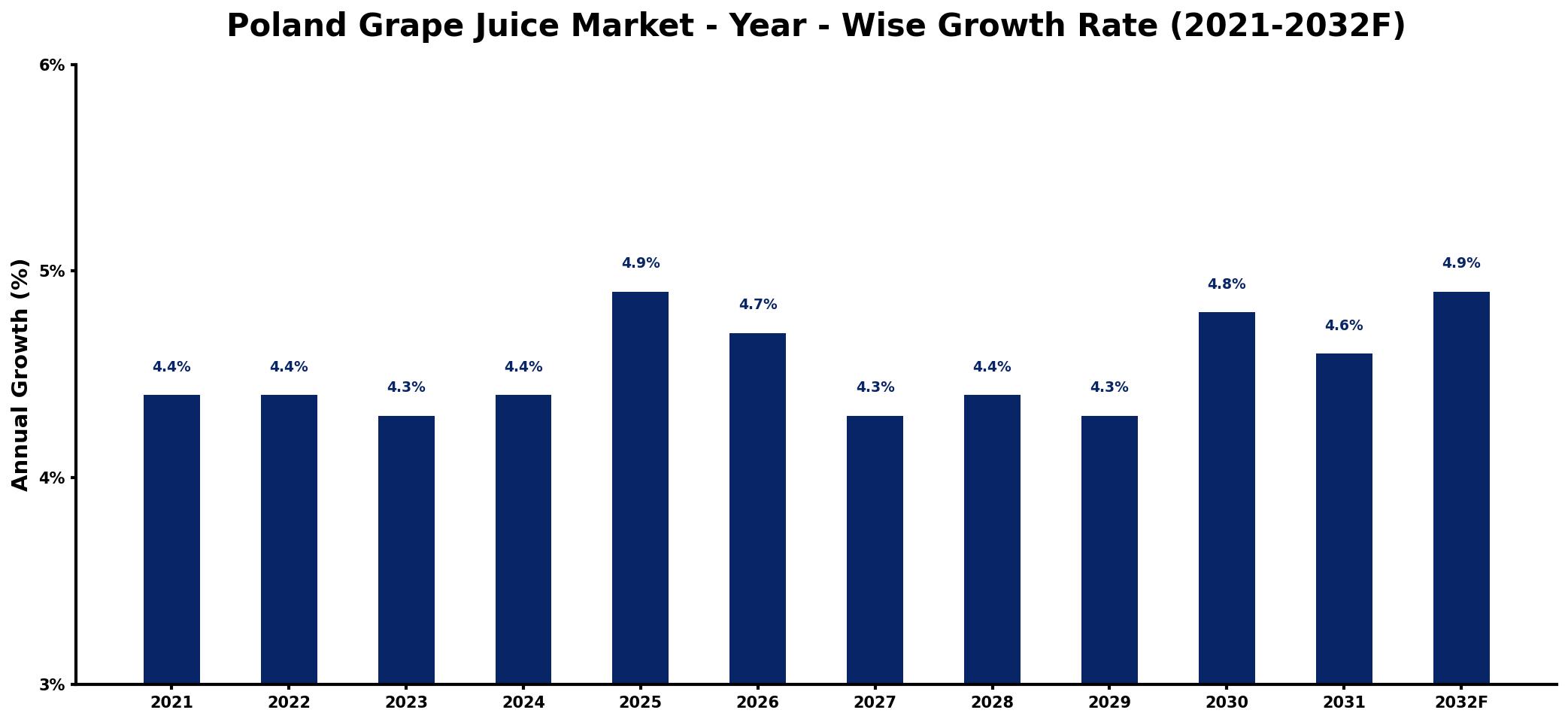
The table below presents the year‑wise growth rates along with the key drivers influencing the market
| Year | Growth Rate | Major Drivers |
| 2021 | 4.4% | Increased consumer health awareness |
| 2022 | 4.4% | Rising demand for natural beverages |
| 2023 | 4.3% | Growing popularity of organic options |
| 2024 | 4.4% | Expansion of retail distribution channels |
| 2025 | 4.9% | Innovative packaging attracting consumers |
| 2026 | 4.7% | Enhanced marketing strategies implemented |
| 2027 | 4.3% | Emerging trends in wellness drinks |
| 2028 | 4.4% | Investment in local production facilities |
| 2029 | 4.3% | Rising interest in functional beverages |
| 2030 | 4.8% | Strengthened supply chain efficiencies |
| 2031 | 4.6% | Increased focus on sustainability practices |
| 2032 | 4.9% | Collaborations with health-focused brands |
Note: Market size estimations and growth projections presented in this report are based on 6Wresearch's proprietary forecasting methodology, utilizing the latest available industry data, government publications, and primary research inputs.
Poland Grape Juice Market Synopsis
A significant force shaping the Poland Grape Juice Market is the rising consumer demand for health-oriented beverage choices. This shift is characterized by consumers actively seeking products with clean labels and natural ingredients, which reinforces the market's focus on health benefits.
Moreover, the competitive landscape is intensifying as manufacturers innovate to cater to changing consumer preferences. This includes introducing blended juices and fortified options, which positions grape juice as not only a refreshing drink but also a functional beverage that supports overall wellness.
Poland Grape Juice Market Key Takeaways
- The market is driven by a rising health-conscious consumer base seeking natural and organic products.
- Product innovation, including low-sugar and fortified options, is critical for sustaining growth.
- Distribution through supermarkets, hypermarkets, and online channels is increasingly important.
- Consumer awareness of grape juice's health benefits is a key driver of market expansion.
- Regulatory frameworks under EU policies continue to shape market dynamics and product offerings.
Evaluation of Restraints in Poland Grape Juice Market
Despite the growth prospects, several restraints hinder the Poland Grape Juice Market. The increasing competition from other fruit juices poses a significant challenge, as consumers may shift towards alternatives perceived as healthier or more appealing. Additionally, fluctuating grape prices due to unpredictable weather and harvest conditions can affect production costs and pricing strategies. Furthermore, health-conscious consumers are increasingly scrutinizing sugar content, prompting manufacturers to innovate and reformulate their products to meet these demands. As such, maintaining product differentiation and quality is essential for market players to navigate these challenges successfully.
Poland Grape Juice Market Trends
The trend towards healthier and more natural beverage options continues to gain momentum in the Poland Grape Juice Market. Increasing demand for 100% natural grape juices without artificial additives is prompting manufacturers to develop products that align with consumer expectations for clean-label options. Additionally, a growing interest in organic grape juices reflects a desire for higher quality and sustainably sourced ingredients. These trends are pushing companies to explore innovative flavor combinations and alternative ingredient sourcing, enhancing product appeal among health-conscious shoppers.
Poland Grape Juice Market Opportunities
There are significant investment opportunities within the Poland Grape Juice Market, particularly in the realm of product innovation. As consumers increasingly gravitate towards health-oriented beverages, opportunities exist for fortified grape juices that include added nutrients or adaptogenic properties. Moreover, expanding distribution channels—especially through online platforms—can tap into the growing demand for convenience among consumers. Collaborating with local grape growers can further enhance supply chain reliability, ensuring a consistent, high-quality product that meets market demands.
Government Initiatives in the Poland Grape Juice Market
The Poland Grape Juice Market operates under the auspices of European Union agricultural policies, which support sustainable practices and healthy food choices. The Polish government enforces regulations regarding food quality, labeling, and health claims, in alignment with EU directives. Additionally, there may be government initiatives that promote innovation and competitiveness among grape juice producers, including subsidies aimed at enhancing production efficiency and sustainability in the market.
Future Insights of the Poland Grape Juice Market
Looking ahead to 2026-2032, the Poland Grape Juice Market is anticipated to continue its moderate growth trajectory. The increasing focus on health benefits, particularly regarding antioxidants and cardiovascular advantages, will likely fuel further demand. The expanding portfolio of grape juice products catering to health-conscious consumers will play a pivotal role in sustaining this growth. However, market players must remain vigilant about shifting consumer preferences and competitive pressures from other beverage categories to ensure they adapt successfully.
Poland Grape Juice Market Latest Developments (2025 - 2026)
Recent developments in the Poland Grape Juice Market indicate a strong movement towards sustainability and natural ingredients. Manufacturers are increasingly emphasizing their use of locally sourced grapes and environmentally friendly packaging solutions. Innovations in product formulations, such as the introduction of herbal infusions and functional beverages targeting specific health benefits, are also gaining traction. Moreover, online retail has become a critical channel for distribution as companies adapt to changing consumer shopping behaviors.
Poland Grape Juice Market - Key Attractiveness of the Report
- 10 Years of Market Numbers
- Historical Data Starting from 2022 to 2025
- Base Year: 2025
- Forecast Data until 2032
- Key Performance Indicators Impacting the Market
- Major Upcoming Developments and Projects
Key Highlights of the Report:
- Poland Grape Juice Market Outlook
- Market Size of Poland Grape Juice Market, 2025
- Forecast of Poland Grape Juice Market, 2032
- Historical Data and Forecast of Poland Grape Juice Revenues & Volume for the Period 2022-2032F
- Poland Grape Juice Market Trend Evolution
- Poland Grape Juice Market Drivers and Challenges
- Poland Grape Juice Price Trends
- Poland Grape Juice Porter's Five Forces
- Poland Grape Juice Industry Life Cycle
- Historical Data and Forecast of Poland Grape Juice Market Revenues & Volume By Type for the Period 2022-2032F
- Historical Data and Forecast of Poland Grape Juice Market Revenues & Volume By Pure Juice for the Period 2022-2032F
- Historical Data and Forecast of Poland Grape Juice Market Revenues & Volume By Mixed Juice for the Period 2022-2032F
- Historical Data and Forecast of Poland Grape Juice Market Revenues & Volume By Application for the Period 2022-2032F
- Historical Data and Forecast of Poland Grape Juice Market Revenues & Volume By 0-14 yrs for the Period 2022-2032F
- Historical Data and Forecast of Poland Grape Juice Market Revenues & Volume By 15-34 yrs for the Period 2022-2032F
- Historical Data and Forecast of Poland Grape Juice Market Revenues & Volume By 35-54 yrs for the Period 2022-2032F
- Historical Data and Forecast of Poland Grape Juice Market Revenues & Volume By 55 yrs up for the Period 2022-2032F
- Poland Grape Juice Import Export Trade Statistics
- Market Opportunity Assessment By Type
- Market Opportunity Assessment By Application
- Poland Grape Juice Top Companies Market Share
- Poland Grape Juice Competitive Benchmarking By Technical and Operational Parameters
- Poland Grape Juice Company Profiles
- Poland Grape Juice Key Strategic Recommendations






































