Poland Home Appliances Market: Import Trend Analysis
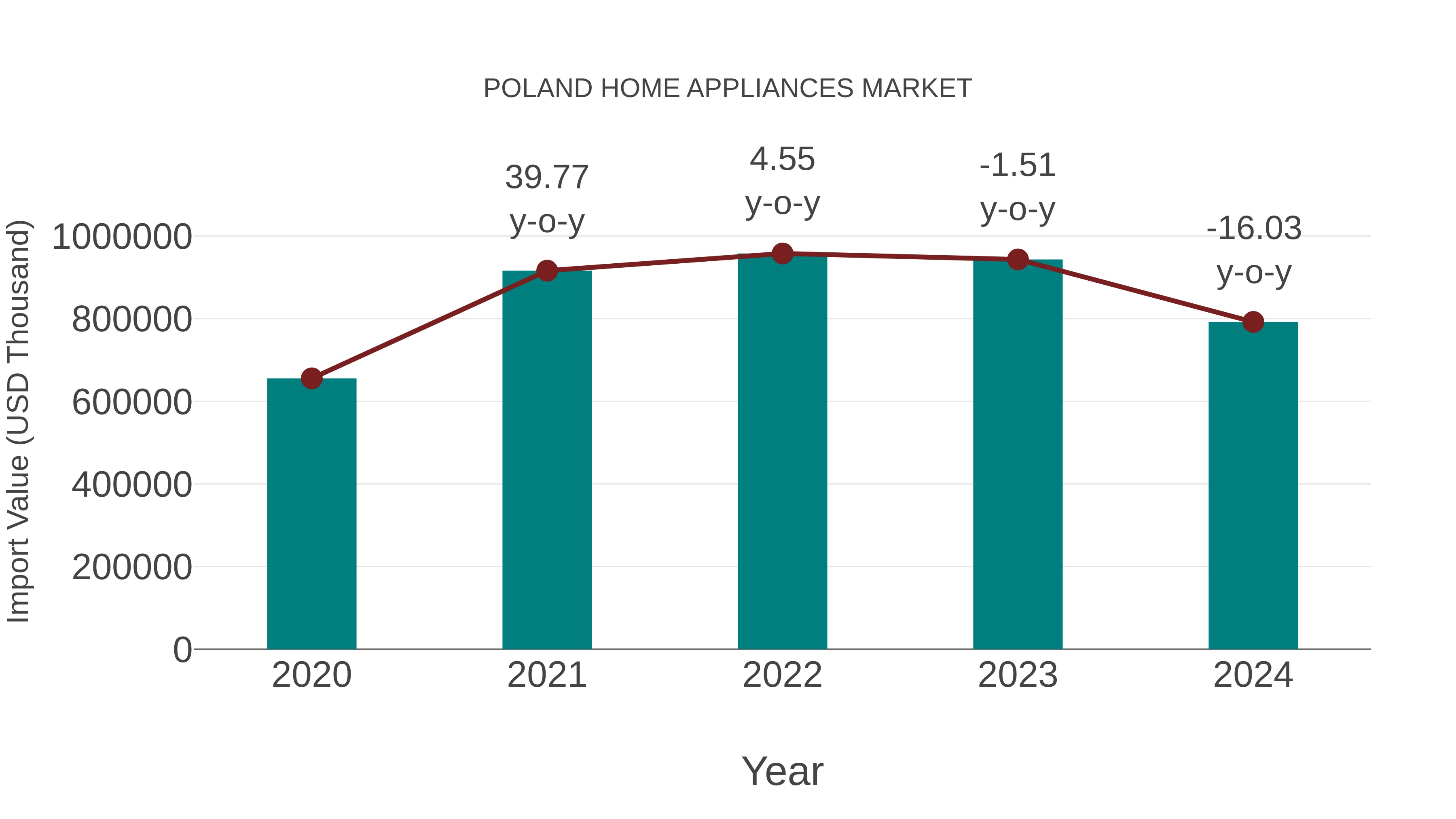
In the Poland home appliances market, the import trend experienced a decline from 2023 to 2024, with a growth rate of -16.03%. However, the compound annual growth rate (CAGR) for 2020-2024 stood at a positive 4.85%. This dip in import momentum could be attributed to shifting demand patterns or changes in trade policies impacting market stability.
Poland Home Appliances Market Highlights
| Report Name | Poland Home Appliances Market |
| Forecast period | 2026-2032 |
| CAGR | 5.3% |
| Growing Sector | Small Appliances |
Poland Home Appliances Market Synopsis
The market growth has been mainly driven by a rising demand from urban middle class households and a growing number of online sales. Over the past five years the market has seen an increase in sales of premium products with advanced features as well as energy-efficient options. Furthermore brands such as Samsung and LG have gained considerable share due to their quality offerings and competitive pricing. With increasing disposable incomes, consumers are more willing to invest in higher end models which offer additional features like Wi-Fi connectivity or voice control capabilities. The government plans to introduce incentives for electric vehicles could also create opportunities for manufacturers of home appliances such as air conditioners and refrigerators that can run on electricity generated from these sources.
According to 6Wresearch internal database and industry insights, the Poland Home Appliances Market Synopsis is projected to grow at a compound annual growth rate (CAGR) of 5.3% during the forecast period (2026–2032). The market expansion is driven by technological advancements, increased consumer awareness and strong retail penetration. Growing preference for energy-efficient and smart appliances is expected to further boost demand across both urban and semi-urban regions.
Key Attractiveness of the Report
- 10 Years of Market Numbers.
- Historical Data Starting from 2022 to 2025.
- Base Year: 2025
- Forecast Data until 2032.
- Key Performance Indicators Impacting the market.
- Major Upcoming Developments and Projects.
Key Highlights of the Report:
- Poland Home Appliances Market Outlook
- Market Size of Poland Home Appliances Market, 2025
- Forecast of Poland Home Appliances Market, 2032
- Historical Data and Forecast of Poland Home Appliances Revenues & Volume for the Period 2026-2032
- Poland Home Appliances Market Trend Evolution
- Poland Home Appliances Market Drivers and Challenges
- Poland Home Appliances Price Trends
- Poland Home Appliances Porter's Five Forces
- Poland Home Appliances Industry Life Cycle
- Historical Data and Forecast of Poland Home Appliances Market Revenues & Volume By Product Types for the Period 2026-2032
- Historical Data and Forecast of Poland Home Appliances Market Revenues & Volume By Kitchen Appliances for the Period 2026-2032
- Historical Data and Forecast of Poland Home Appliances Market Revenues & Volume By Washing Appliances for the Period 2026-2032
- Historical Data and Forecast of Poland Home Appliances Market Revenues & Volume By Entertainment Appliances for the Period 2026-2032
- Historical Data and Forecast of Poland Home Appliances Market Revenues & Volume By Air Conditioner for the Period 2026-2032
- Historical Data and Forecast of Poland Home Appliances Market Revenues & Volume By Others for the Period 2026-2032
- Historical Data and Forecast of Poland Home Appliances Market Revenues & Volume By Technology for the Period 2026-2032
- Historical Data and Forecast of Poland Home Appliances Market Revenues & Volume By Wi-Fi for the Period 2026-2032
- Historical Data and Forecast of Poland Home Appliances Market Revenues & Volume By Bluetooth for the Period 2026-2032
- Historical Data and Forecast of Poland Home Appliances Market Revenues & Volume By ZigBee for the Period 2026-2032
- Historical Data and Forecast of Poland Home Appliances Market Revenues & Volume By Radio Frequency Identification for the Period 2026-2032
- Historical Data and Forecast of Poland Home Appliances Market Revenues & Volume By Cellular Technology for the Period 2026-2032
- Historical Data and Forecast of Poland Home Appliances Market Revenues & Volume By IoT for the Period 2026-2032
- Historical Data and Forecast of Poland Home Appliances Market Revenues & Volume By Distribution Channel for the Period 2026-2032
- Historical Data and Forecast of Poland Home Appliances Market Revenues & Volume By Retail for the Period 2026-2032
- Historical Data and Forecast of Poland Home Appliances Market Revenues & Volume By E-commerce for the Period 2026-2032
- Historical Data and Forecast of Poland Home Appliances Market Revenues & Volume By Others for the Period 2026-2032
- Poland Home Appliances Import Export Trade Statistics
- Market Opportunity Assessment By Product Types
- Market Opportunity Assessment By Technology
- Market Opportunity Assessment By Distribution Channel
- Poland Home Appliances Top Companies Market Share
- Poland Home Appliances Competitive Benchmarking By Technical and Operational Parameters
- Poland Home Appliances Company Profiles
- Poland Home Appliances Key Strategic Recommendations
By Product Types
- Kitchen Appliances
- Washing Appliances
- Entertainment Appliances
- Air Conditioner
- Others
By Technology
- Wi-Fi
- Bluetooth
- ZigBee
- Radio Frequency Identification
- Cellular Technology
- IoT
By Distribution Channel
- Retail
- E-commerce
- Others






































