Poland Interior Design Market Size, Share & Growth Rate
The Poland Interior Design Market was estimated at USD 494 Million in 2025 and is projected to reach USD 663 Million by 2032, growing at a CAGR of 4.3% from 2026 to 2032. This growth trajectory is primarily driven by increasing urbanization, rising disposable incomes, and a burgeoning demand for aesthetically pleasing residential and commercial spaces. As Polish consumers become more design-conscious, the market is seeing a shift towards personalized and sustainable interior design solutions.
Poland Interior Design Market Year-wise Growth Rate and Key Drivers
This graph highlights how the Poland Interior Design Market has steadily grown over the years, supported by major growth factors.
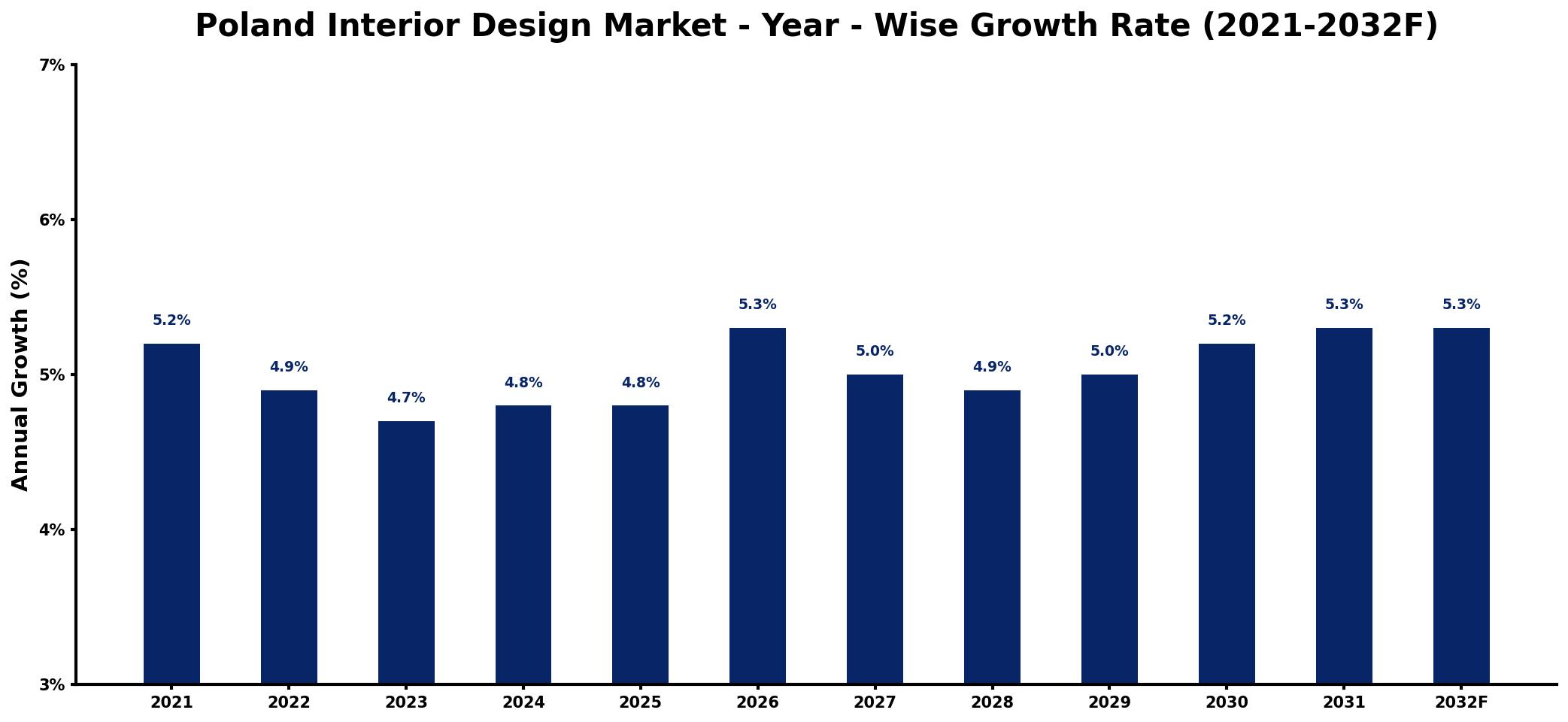
The table below presents the year‑wise growth rates along with the key drivers influencing the market
| Year | Growth Rate | Major Drivers |
| 2021 | 5.2% | Increased consumer spending on renovations |
| 2022 | 4.9% | Surge in sustainable living trends |
| 2023 | 4.7% | Growing popularity of remote workspaces |
| 2024 | 4.8% | Rise in urban housing developments |
| 2025 | 4.8% | Expansion of e-commerce home goods |
| 2026 | 5.3% | Increased investments in property development |
| 2027 | 5.0% | Boost in home improvement projects |
| 2028 | 4.9% | Growth in luxury home markets |
| 2029 | 5.0% | Increase in DIY renovation activities |
| 2030 | 5.2% | Rising demand for multifunctional spaces |
| 2031 | 5.3% | strengthening international trade flows |
| 2032 | 5.3% | Growing interest in wellness environments |
Note: Market size estimations and growth projections presented in this report are based on 6Wresearch's proprietary forecasting methodology, utilizing the latest available industry data, government publications, and primary research inputs.
Poland Interior Design Market Synopsis
The Poland Interior Design Market is thriving, reflecting a vibrant blend of traditional craftsmanship and modern aesthetics. Designers in Poland are increasingly celebrated for their attention to detail and ability to create spaces that resonate with individual style, enhancing both form and function.
A noteworthy shift towards sustainability is evident, with designers opting for eco-friendly materials and practices. This trend, coupled with the popularity of minimalist aesthetics and smart technology integration, is reshaping the landscape of interior design across the country, catering to the evolving preferences of the Polish populace.
Poland Interior Design Market Key Takeaways
- Growing emphasis on sustainable design practices and materials.
- Increasing demand for personalization and bespoke interior solutions.
- Significant influence of urbanization and rising disposable incomes on market growth.
- Integration of smart technology and multi-functional furniture in design projects.
- Competitive landscape featuring both established firms and emerging designers.
Evaluation of Restraints in Poland Interior Design Market
The Poland Interior Design Market faces several restraints that could limit its growth. One significant challenge is the increasing competition from a rising number of design firms, which can dilute market share and put pressure on pricing strategies. Additionally, varying client preferences can complicate project execution, requiring designers to constantly adapt and stay ahead of trends. Economic fluctuations may also affect consumer spending, causing volatility in demand for design services. Balancing creativity with practical budget considerations while adhering to sustainable practices further adds complexity for designers in this dynamic market.
Poland Interior Design Market Trends
A key trend in the Poland Interior Design Market is the increasing adoption of sustainable practices. Designers are prioritizing the use of natural materials, energy-efficient appliances, and eco-friendly solutions. Moreover, Scandinavian minimalism remains influential, with its clean lines and functionality appealing to consumers looking for simplicity and elegance in their spaces.
Customization is rising as well, with more clients seeking unique designs that reflect their personalities. This desire for individual expression is complemented by a growing trend towards multi-functional furniture, catering to urban dwellers needing to optimize limited living areas. The integration of technology, such as smart home systems, is also reshaping how spaces are designed and experienced.
Poland Interior Design Market Opportunities
The Poland Interior Design Market presents numerous growth and investment opportunities. The accelerating urbanization, along with increasing disposable incomes, is driving demand for both residential and commercial design services. Investors can explore potential in interior design firms, as well as retail outlets focusing on home decor and furniture tailored to this sector.
Moreover, specializing in sustainable design solutions or smart home technology integration can distinguish companies in a crowded market. Virtual reality experiences in design consultations also represent an innovative avenue for firms looking to capture the attention of tech-savvy consumers.
Government Initiatives in the Poland Interior Design Market
Government policies in Poland are actively supporting the growth of the interior design industry through various initiatives. These include regulations promoting sustainable design practices, which ensure compliance with environmental standards. Financial incentives, such as grants and subsidies, encourage businesses to innovate and adopt eco-friendly materials and technologies.
Additionally, the government is committed to establishing quality and safety standards for interior design products and services, thereby enhancing consumer confidence and trust in the market. These initiatives create a supportive environment for designers to thrive and align with the broader goal of sustainability.
Future Insights of the Poland Interior Design Market
Looking ahead to the period from 2026 to 2032, the Poland Interior Design Market is set to flourish. Factors such as increasing disposable income and a burgeoning middle class are expected to fuel demand for professional design services. Furthermore, the ongoing trend towards personalization in design and the integration of technology will likely shape consumer expectations, pushing the industry towards innovative solutions that balance style and functionality.
Sustainability will continue to be a paramount focus, influencing designers to explore new materials and methodologies that reduce environmental impact. As the market evolves, opportunities for both established firms and newcomers will abound, underlining the potential for growth in this dynamic sector.
Poland Interior Design Market Latest Developments (2025 - 2026)
Recent developments within the Poland Interior Design Market showcase a trend towards greater collaboration between designers and technology firms. An increasing number of design studios are integrating advanced software solutions to enhance visual presentations, allowing clients to better visualize their spaces. This trend is making the design process more interactive and engaging.
Moreover, industry events and exhibitions are increasingly focusing on sustainability and innovation, reflecting the market's response to consumer demand for eco-conscious solutions. Designers are also exploring partnerships with local artisans to incorporate unique, handcrafted elements into their projects, further enriching the design landscape in Poland.
Poland Interior Design Market - Key Attractiveness of the Report
- 10 Years of Market Numbers
- Historical Data Starting from 2022 to 2025
- Base Year: 2025
- Forecast Data until 2032
- Key Performance Indicators Impacting the Market
- Major Upcoming Developments and Projects
Key Highlights of the Report:
- Poland Interior Design Market Outlook
- Market Size of Poland Interior Design Market, 2025
- Forecast of Poland Interior Design Market, 2032
- Historical Data and Forecast of Poland Interior Design Revenues & Volume for the Period 2022-2032F
- Poland Interior Design Market Trend Evolution
- Poland Interior Design Market Drivers and Challenges
- Poland Interior Design Price Trends
- Poland Interior Design Porter's Five Forces
- Poland Interior Design Industry Life Cycle
- Historical Data and Forecast of Poland Interior Design Market Revenues & Volume By End Use for the Period 2022-2032F
- Historical Data and Forecast of Poland Interior Design Market Revenues & Volume By Commercial for the Period 2022-2032F
- Historical Data and Forecast of Poland Interior Design Market Revenues & Volume By Residential for the Period 2022-2032F
- Historical Data and Forecast of Poland Interior Design Market Revenues & Volume By Decoration Type for the Period 2022-2032F
- Historical Data and Forecast of Poland Interior Design Market Revenues & Volume By New for the Period 2022-2032F
- Historical Data and Forecast of Poland Interior Design Market Revenues & Volume By Renovations for the Period 2022-2032F
- Poland Interior Design Import Export Trade Statistics
- Market Opportunity Assessment By End Use
- Market Opportunity Assessment By Decoration Type
- Poland Interior Design Top Companies Market Share
- Poland Interior Design Competitive Benchmarking By Technical and Operational Parameters
- Poland Interior Design Company Profiles
- Poland Interior Design Key Strategic Recommendations






































