Poland IoT Connectivity Market Size & Growth Rate (2026-2032)
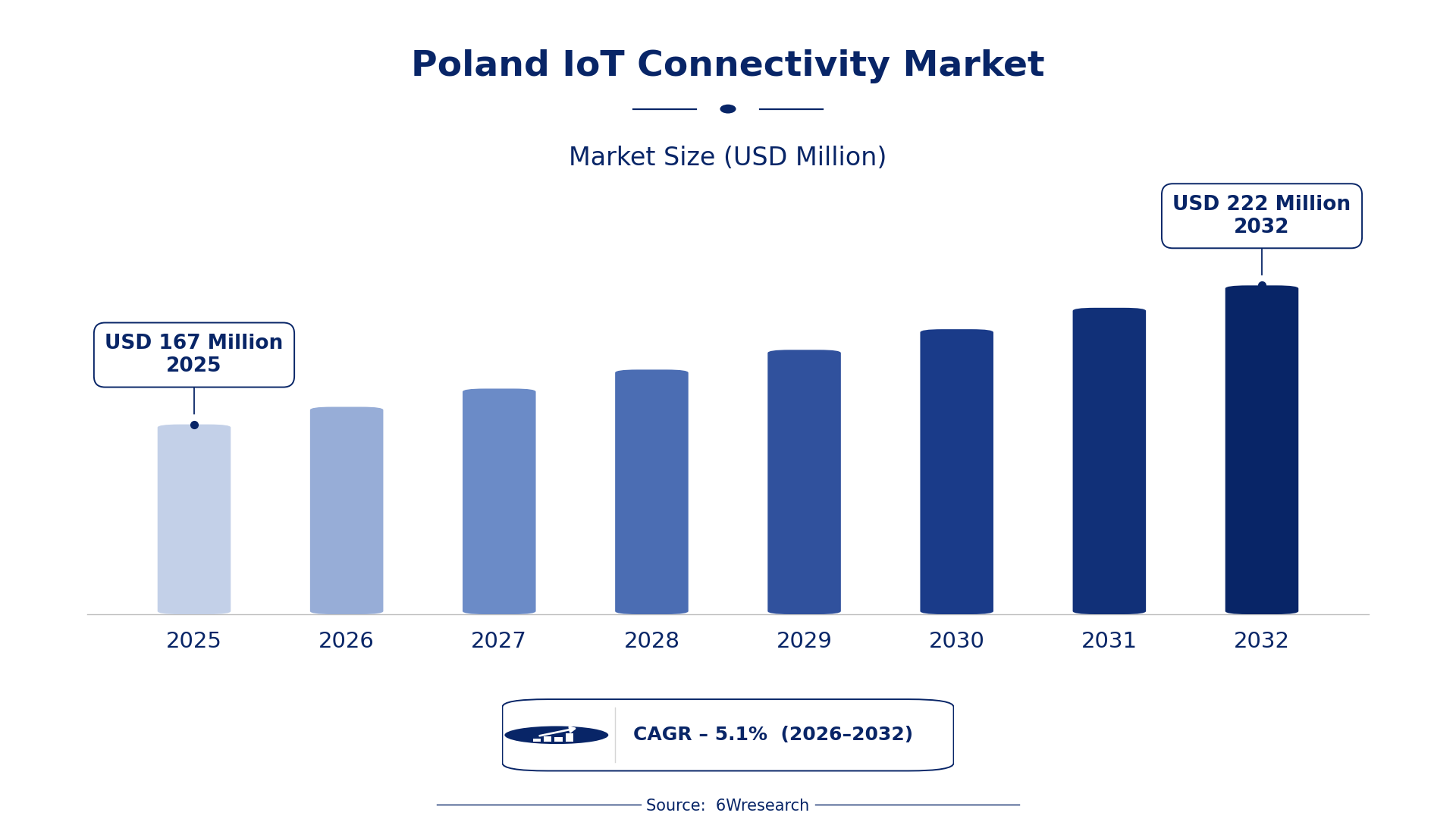
The Poland IoT Connectivity Market was estimated at USD 167 Million in 2025 and is projected to reach USD 222 Million by 2032, growing at a CAGR of 5.1% from 2026 to 2032.
Poland IoT Connectivity Market Synopsis
The demand for reliable and high-speed network connections for IoT devices in Poland is rising sharply. As the number of connected devices increases, the need for effective connectivity solutions becomes critical, particularly in sectors like smart cities and industrial IoT.
Technological advancements are driving the growth of cellular, Wi-Fi, and LPWAN solutions, which serve as the backbone of IoT communications. Polish enterprises are increasingly recognizing the importance of stable connectivity to enhance operational efficiency and customer engagement.
Poland IoT Connectivity Market Year-wise Growth Rate and Key Drivers
This graph illustrates the annual growth rates of the Poland IoT Connectivity Market from 2021 to 2032, highlighting a steady upward trajectory and projected expansion over the forecast period.
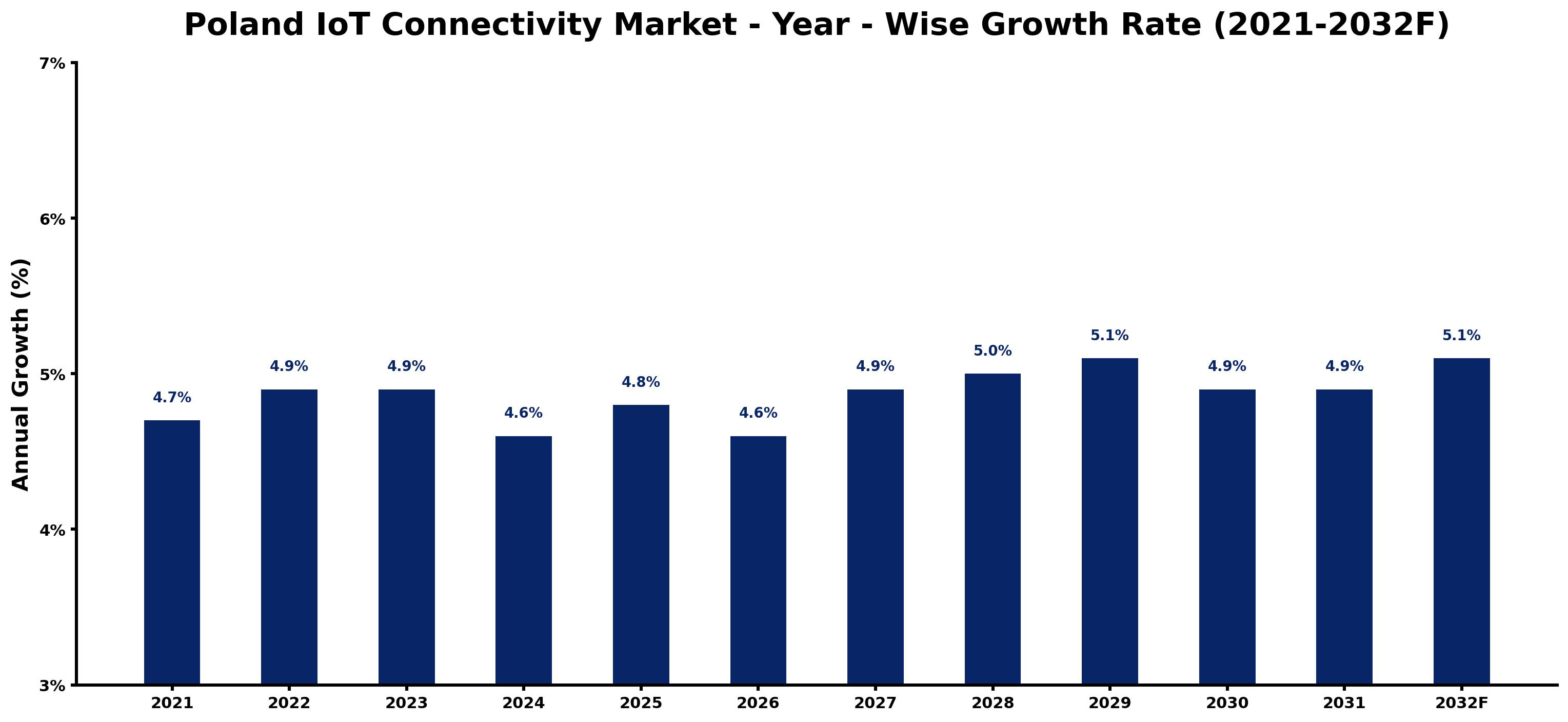
The table below presents the year‑wise growth rates along with the key drivers influencing the market
| Year | Growth Rate | Major Drivers |
| 2021 | 4.7% | Increased investment in Smart City initiatives by Warsaw |
| 2022 | 4.9% | Poland's 5G rollout enhances IoT device capabilities |
| 2023 | 4.9% | EU funding boosts IoT infrastructure development projects |
| 2024 | 4.6% | Growth in automotive tech adoption drives connectivity demand |
| 2025 | 4.8% | Rising telehealth services increase IoT application needs |
| 2026 | 4.6% | Energy efficiency mandates encourage smart grid solutions |
| 2027 | 4.9% | Agritech innovation spurs IoT usage in farming |
| 2028 | 5.0% | Government support for IoT startups accelerates growth |
| 2029 | 5.1% | Retail digitization leads to IoT expansion in commerce |
| 2030 | 4.9% | Sustainability drives demand for IoT in resource management |
| 2031 | 4.9% | Cybersecurity regulations push for secure connectivity solutions |
| 2032 | 5.1% | Consumer IoT adoption rises with smart home trends |
Note: Market size estimations and growth projections presented in this report are based on 6Wresearch's proprietary forecasting methodology, utilizing the latest available industry data, government publications, and primary research inputs.
Poland IoT Connectivity Market Key Takeaways
Below are some of the specific key takeaways from the market, including:
- The market is characterized by a diverse range of connectivity solutions tailored to various applications.
- Cellular technology continues to dominate, although LPWAN is gaining traction in specific use cases.
- Government initiatives are actively supporting infrastructure development and IoT adoption.
- Key industries driving demand include manufacturing, transportation, and healthcare.
- Challenges in regulatory compliance and technological integration persist but are being addressed.
Evaluation of Restraints in Poland IoT Connectivity Market
The IoT connectivity market in Poland faces several restraints that hinder its full potential. One major concern is the rapid pace of technological change, which requires continuous investment in new infrastructure and solutions. Companies must also navigate a complex regulatory landscape, ensuring compliance with evolving standards while managing costs. Additionally, the competitive nature of the market necessitates differentiation through unique features and services, which can strain resources for many players. These factors create a challenging environment for market participants looking to capture growth opportunities.
Poland IoT Connectivity Market Trends
Current trends reflect a growing interest in integrating IoT with existing technologies. The adoption of edge computing is becoming more prevalent, allowing for quicker data processing and reduced latency. on top of that, there’s a noticeable shift towards environmentally sustainable solutions, with businesses seeking energy-efficient connectivity options. As enterprises embrace smart technologies, the focus on interoperability between different IoT devices is also intensifying, driving demand for advanced connectivity solutions.
Poland IoT Connectivity Market Opportunities
Opportunities in the Poland IoT Connectivity Market are abundant, particularly in sectors like agriculture, where IoT can enhance productivity through smart farming solutions. The push for smart city initiatives also presents significant growth potential, as municipalities invest in infrastructure to improve urban living conditions. Additionally, the healthcare sector is increasingly turning to IoT for patient monitoring and telemedicine, creating new avenues for connectivity solutions. With the right investments in technology and infrastructure, companies can capitalize on these emerging trends.
Government Initiatives in the Poland IoT Connectivity Market
The Polish government is actively involved in fostering the growth of the IoT connectivity market, recognizing its importance for national development. Regulatory frameworks are being established to promote advanced connectivity solutions, which enhance data communication across various sectors. By prioritizing IoT infrastructure improvements, the government aims to boost overall economic performance while ensuring that Poland remains competitive on the global stage.
- A national digital infrastructure upgrade programme that began in early 2025 is currently underway, focusing on enhancing connectivity across urban and rural areas.
- The Ministry of Digital Affairs has launched a public initiative aimed at increasing funding for IoT research projects to stimulate innovation in connectivity technologies.
- A regulatory framework for IoT device certification was introduced in mid-2025, ensuring compliance with international standards.
- Plans for a collaborative project between government and private sectors are in place, expected to expand telecom infrastructure access by 2028.
- Ongoing consultations with industry stakeholders are aimed at refining policies that encourage investment in IoT solutions and infrastructure.
Future Insights of the Poland IoT Connectivity Market
Looking ahead to 2026-2032, the Poland IoT Connectivity Market is set to experience steady growth driven by technological advancements and increased adoption of IoT solutions across various industries. As businesses continue to integrate IoT into their operations, the demand for high-speed, reliable connectivity will remain a priority. Additionally, government support and investment in infrastructure will further enhance the market's potential, positioning Poland as a leader in IoT connectivity in the region.
Poland IoT Connectivity Market Latest Developments
Recent industry activity in the Poland IoT Connectivity Market has focused on expanding network capabilities and enhancing service offerings. Companies are investing in new technologies to improve connectivity solutions and meet the growing demand from various sectors. Collaborative efforts between private firms and the government are becoming more common, reflecting a unified approach to tackling challenges and seizing opportunities.
- A major technology vendor launched a new LPWAN solution in early 2025, aimed at improving connectivity for remote IoT applications.
- An initiative that began in mid-2025 is focused on upgrading existing cellular infrastructure to support 5G connectivity for IoT devices.
- In Q3 2025, a regional operator announced a partnership with a leading tech firm to enhance IoT security measures across its networks.
- Plans for a new smart city pilot program are expected to kick off in early 2026, aimed at integrating IoT solutions into urban infrastructure.
- A service upgrade by a prominent telecom provider is currently ongoing, which includes enhancements to data transfer speeds for IoT applications.
Poland IoT Connectivity Market - Key Attractiveness of the Report
- 10 Years of Market Numbers
- Historical Data Starting from 2022 to 2025
- Base Year: 2025
- Forecast Data until 2032
- Key Performance Indicators Impacting the Market
- Major Upcoming Developments and Projects
Key Highlights of the Report:
- Poland IoT Connectivity Market Outlook
- Market Size of Poland IoT Connectivity Market, 2025
- Forecast of Poland IoT Connectivity Market, 2032
- Historical Data and Forecast of Poland IoT Connectivity Revenues & Volume for the Period 2022-2032F
- Poland IoT Connectivity Market Trend Evolution
- Poland IoT Connectivity Market Drivers and Challenges
- Poland IoT Connectivity Price Trends
- Poland IoT Connectivity Porter's Five Forces
- Poland IoT Connectivity Industry Life Cycle
- Historical Data and Forecast of Poland IoT Connectivity Market Revenues & Volume By Component for the Period 2022-2032F
- Historical Data and Forecast of Poland IoT Connectivity Market Revenues & Volume By Platform for the Period 2022-2032F
- Historical Data and Forecast of Poland IoT Connectivity Market Revenues & Volume By Services for the Period 2022-2032F
- Historical Data and Forecast of Poland IoT Connectivity Market Revenues & Volume By Application Areas for the Period 2022-2032F
- Historical Data and Forecast of Poland IoT Connectivity Market Revenues & Volume By Building & Home Automation for the Period 2022-2032F
- Historical Data and Forecast of Poland IoT Connectivity Market Revenues & Volume By Smart Energy & Utility for the Period 2022-2032F
- Historical Data and Forecast of Poland IoT Connectivity Market Revenues & Volume By Smart Manufacturing for the Period 2022-2032F
- Historical Data and Forecast of Poland IoT Connectivity Market Revenues & Volume By Connected Health for the Period 2022-2032F
- Historical Data and Forecast of Poland IoT Connectivity Market Revenues & Volume By Smart Retail for the Period 2022-2032F
- Historical Data and Forecast of Poland IoT Connectivity Market Revenues & Volume By Smart Transportation for the Period 2022-2032F
- Historical Data and Forecast of Poland IoT Connectivity Market Revenues & Volume By Others (Education and Agriculture) for the Period 2022-2032F
- Historical Data and Forecast of Poland IoT Connectivity Market Revenues & Volume By Organization Size for the Period 2022-2032F
- Historical Data and Forecast of Poland IoT Connectivity Market Revenues & Volume By Large Enterprises for the Period 2022-2032F
- Historical Data and Forecast of Poland IoT Connectivity Market Revenues & Volume By SMEs for the Period 2022-2032F
- Poland IoT Connectivity Import Export Trade Statistics
- Market Opportunity Assessment By Component
- Market Opportunity Assessment By Application Areas
- Market Opportunity Assessment By Organization Size
- Poland IoT Connectivity Top Companies Market Share
- Poland IoT Connectivity Competitive Benchmarking By Technical and Operational Parameters
- Poland IoT Connectivity Company Profiles
- Poland IoT Connectivity Key Strategic Recommendations






































