Poland Laboratory Equipment Market: Import Trend Analysis
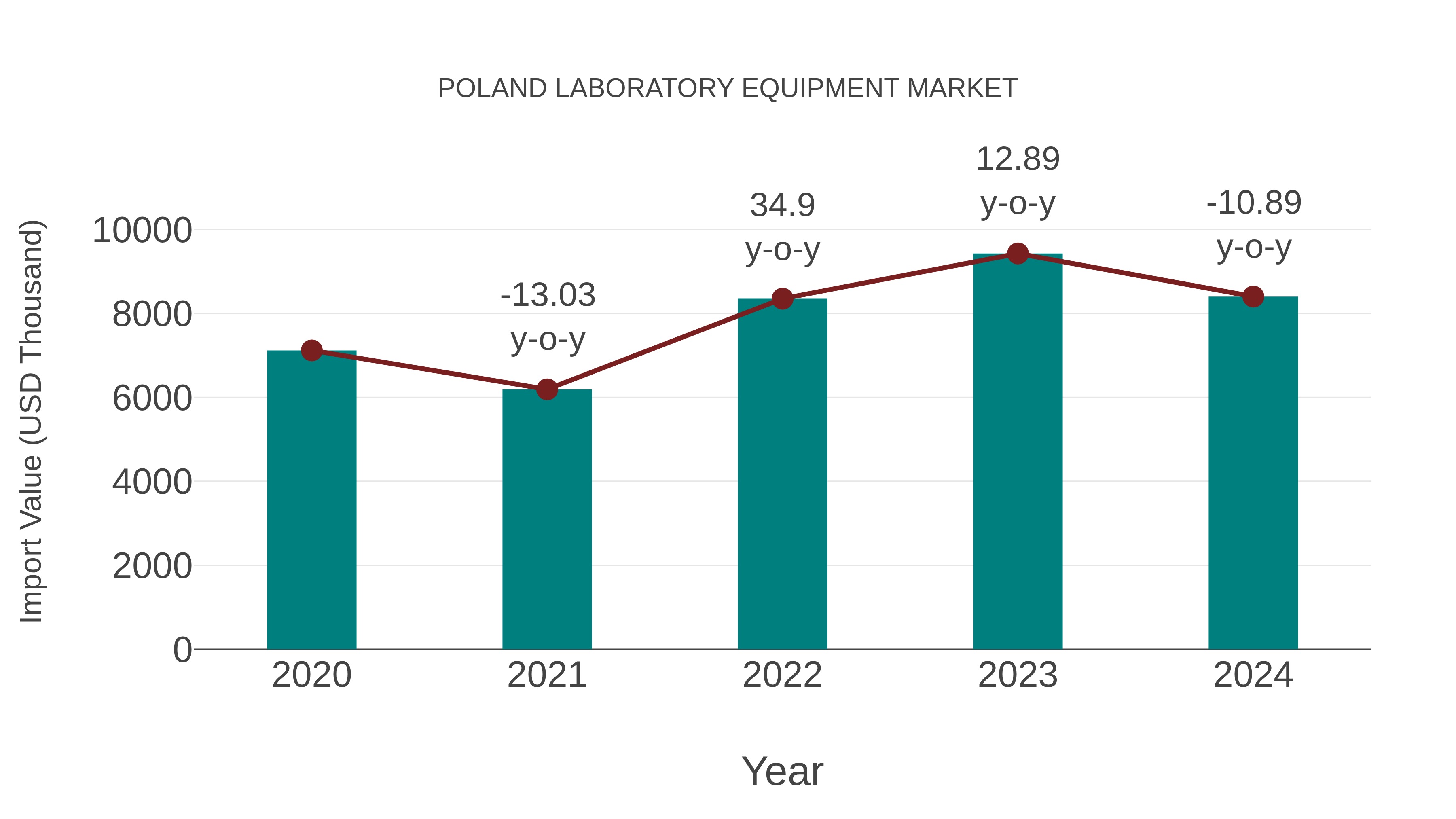
In the Poland laboratory equipment market, the import trend experienced a decline from 2023 to 2024, with a growth rate of -10.89%. However, the compound annual growth rate (CAGR) for the period of 2020-2024 stood at 4.23%. This fluctuation may be attributed to shifts in demand dynamics or changes in trade policies impacting market stability.
Poland Laboratory Equipment Market Highlights
| Report Name | Poland Laboratory Equipment Market |
| Forecast period | 2025-2031 |
| CAGR | 6.3% |
| Growing Sector | Pharmaceutical |
Topics Covered in the Poland Laboratory Equipment Market Report
Poland Laboratory Equipment Market Report thoroughly covers the market By Product type, By Application and by End-Users. The market report provides an unbiased and detailed analysis of the ongoing market trends, opportunities/high growth areas, and market drivers which would help the stakeholders to devise and align their market strategies according to the current and future market dynamics.
Poland Laboratory Equipment Market Synopsis
Poland laboratory equipment market has experienced substantial growth, propelled by advancements in research and development within the pharmaceutical, biotechnology, and educational sectors. A heightened emphasis on scientific innovation, coupled with the demand for precise analytical tools, has significantly increased the need for high-quality laboratory equipment. The market comprises a diverse range of products, including diagnostic instruments, clinical laboratory devices, and automation systems, all of which enhance research capabilities and improve operational efficiency.
According to 6Wresearch, the Poland Laboratory Equipment Market is projected to grow at CAGR of 6.3 % during the forecast period 2025-2031. This anticipated growth is driven by several pivotal factors, including heightened investments in research and development across various sectors, particularly in pharmaceuticals and biotechnology, which significantly boost the demand for advanced laboratory equipment. Additionally, the increasing emphasis on scientific innovation and the necessity for high-quality analytical tools are propelling market expansion.
However, the market is also confronted with challenges, such as stringent regulatory requirements that may pose obstacles for new entrants, alongside the elevated costs associated with acquiring state-of-the-art laboratory technologies, which could restrict access for smaller institutions. Nevertheless, the continuous evolution of research facilities and the integration of automation technologies are expected to further facilitate the Poland laboratory equipment market growth.
Poland Laboratory Equipment Market Trends
Poland Laboratory Equipment Industry is poised for growth, driven by rising demand in diagnostics and research sectors. Poland laboratory equipment market is being shaped by several emerging trends. A significant trend is the swift adoption of automation and smart technologies, which enhance laboratory workflows and decrease the likelihood of human error. Additionally, there is a marked shift towards environmentally sustainable and energy-efficient equipment, as organizations aim to reduce their ecological impact. Furthermore, the integration of cloud computing and advanced analytics is revolutionizing data management and interpretation within laboratory settings.
Investment Opportunities in the Poland Laboratory Equipment Market
The Poland laboratory equipment market presents a dynamic landscape for investment opportunities driven by advancements in technology and increased demand in sectors such as healthcare, pharmaceuticals, and education. Investors can capitalize on the growing need for state-of-the-art laboratory instruments that support research and development initiatives.
With Poland's strategic position in Central Europe, the market benefits from favorable trade conditions and a skilled workforce, making it an attractive destination for both domestic and international investors. Furthermore, government support for scientific innovation and funding for research institutions paves the way for significant growth potential. Engaging in this market not only promises financial returns but also contributes to the enhancement of Poland's scientific infrastructure and global competitiveness.
Leading Players in the Poland Laboratory Equipment Market
Poland laboratory equipment market is characterized by the presence of leading industry players, encompassing both international and domestic firms. Notable companies such as PerkinElmer, Siemens Healthineers, and Roche Diagnostics play a significant role, providing a diverse array of products tailored to meet various scientific and industrial needs. These organizations are recognized for their dedication to innovation, consistently improving their product offerings to align with evolving market demands and technological progress.
Government Regulations
Government regulations play a crucial role in shaping the laboratory equipment market in Poland. The Polish government has implemented policies that ensure high-quality standards and compliance with international norms, which is essential for maintaining competitiveness in the global arena. These regulations affect various aspects, including product safety, environmental impact, and the ethical use of laboratory instruments. Additionally, the government often provides incentives and tax breaks for companies engaging in research and development, further promoting innovation within the industry. By fostering a regulatory environment that supports quality and innovation, Poland can attract foreign investment and enhance the development of its scientific community.
Future Insights of the Poland Laboratory Equipment Market
Poland laboratory equipment market is poised for transformative growth, fueled by advancements in technology and increased demand across various sectors. The integration of artificial intelligence and machine learning into laboratory processes is expected to revolutionize data analysis and operational efficiency, offering unprecedented accuracy and speed. Additionally, the shift towards automation will drive the need for equipment that can support high-throughput procedures, further enhancing productivity. As digitalization continues to penetrate the market, there is also a growing emphasis on the importance of data security and integrity.
Investments in cutting-edge technologies and sustainable practices are anticipated to play a significant role in shaping the future landscape. Moreover, with Poland's commitment to fostering a robust research environment through supportive policies and funding, the country is well-positioned to become a leader in laboratory innovation within the region. This progressive trajectory promises not only economic benefits but also contributes to the global scientific community by pushing the frontiers of research and discovery.
Market Segmentation Analysis
The report offers a comprehensive study of the subsequent market segments and their leading categories.
Autoclaves to Dominate the Market-By Product type
Autoclaves are anticipated to lead the Poland laboratory equipment market share due to their critical role in sterilization processes across various applications, particularly in healthcare and research laboratories.
Genetic testing to Dominate the Market-By Application
In the Poland laboratory equipment market, genetic testing is projected to lead the application category. This growth is driven by the increasing prevalence of genetic disorders, advancements in genomics research, and a rising demand for personalized medicine.
Diagnostic laboratories to Dominate the Market -By End-User
According to Saurabh, Senior Research Analyst, 6Wresearch, diagnostic laboratories are anticipated to lead the market share. This is largely due to the growing demand for accurate and timely diagnostics, fueled by an increase in healthcare awareness and the prevalence of chronic diseases.
Key Attractiveness of the Report
- 10 Years of Market Numbers.
- Historical Data Starting from 2021 to 2024.
- Base Year: 2024.
- Forecast Data until 2031.
- Key Performance Indicators Impacting the market.
- Major Upcoming Developments and Project.
Key Highlights of the Report:
- Poland Laboratory Equipment Market Outlook
- Market Size of Poland Laboratory Equipment Market, 2025
- Forecast of Poland Laboratory Equipment Market, 2032
- Historical Data and Forecast of Poland Laboratory Equipment Revenues & Volume for the Period 2022 - 2032F
- Poland Laboratory Equipment Market Trend Evolution
- Poland Laboratory Equipment Market Drivers and Challenges
- Poland Laboratory Equipment Price Trends
- Poland Laboratory Equipment Porter's Five Forces
- Poland Laboratory Equipment Industry Life Cycle
- Historical Data and Forecast of Poland Laboratory Equipment Market Revenues & Volume By Product Type for the Period 2022 - 2032F
- Historical Data and Forecast of Poland Laboratory Equipment Market Revenues & Volume By Autoclaves for the Period 2022 - 2032F
- Historical Data and Forecast of Poland Laboratory Equipment Market Revenues & Volume By Incubators for the Period 2022 - 2032F
- Historical Data and Forecast of Poland Laboratory Equipment Market Revenues & Volume By Centrifuges for the Period 2022 - 2032F
- Historical Data and Forecast of Poland Laboratory Equipment Market Revenues & Volume By Spectrometers for the Period 2022 - 2032F
- Historical Data and Forecast of Poland Laboratory Equipment Market Revenues & Volume By Sonicators for the Period 2022 - 2032F
- Historical Data and Forecast of Poland Laboratory Equipment Market Revenues & Volume By Scopes for the Period 2022 - 2032F
- Historical Data and Forecast of Poland Laboratory Equipment Market Revenues & Volume By Others for the Period 2022 - 2032F
- Historical Data and Forecast of Poland Laboratory Equipment Market Revenues & Volume By Application for the Period 2022 - 2032F
- Historical Data and Forecast of Poland Laboratory Equipment Market Revenues & Volume By Genetic Testing for the Period 2022 - 2032F
- Historical Data and Forecast of Poland Laboratory Equipment Market Revenues & Volume By Endocrinology for the Period 2022 - 2032F
- Historical Data and Forecast of Poland Laboratory Equipment Market Revenues & Volume By Hematology for the Period 2022 - 2032F
- Historical Data and Forecast of Poland Laboratory Equipment Market Revenues & Volume By Microbiology for the Period 2022 - 2032F
- Historical Data and Forecast of Poland Laboratory Equipment Market Revenues & Volume By Biochemistry for the Period 2022 - 2032F
- Historical Data and Forecast of Poland Laboratory Equipment Market Revenues & Volume By Others for the Period 2022 - 2032F
- Historical Data and Forecast of Poland Laboratory Equipment Market Revenues & Volume By End-users for the Period 2022 - 2032F
- Historical Data and Forecast of Poland Laboratory Equipment Market Revenues & Volume By Diagnostic Laboratories for the Period 2022 - 2032F
- Historical Data and Forecast of Poland Laboratory Equipment Market Revenues & Volume By Hospitals and Clinics for the Period 2022 - 2032F
- Historical Data and Forecast of Poland Laboratory Equipment Market Revenues & Volume By Others for the Period 2022 - 2032F
- Poland Laboratory Equipment Import Export Trade Statistics
- Market Opportunity Assessment By Product Type
- Market Opportunity Assessment By Application
- Market Opportunity Assessment By End-users
- Poland Laboratory Equipment Top Companies Market Share
- Poland Laboratory Equipment Competitive Benchmarking By Technical and Operational Parameters
- Poland Laboratory Equipment Company Profiles
- Poland Laboratory Equipment Key Strategic Recommendations
Market Covered
The market report has been segmented and sub segmented into the following categories:
By Product Type
- Autoclaves
- Incubators
- Centrifuges
- Spectrometers
- Sonicators
- Scopes
- Others
By Application
- Genetic Testing
- Endocrinology
- Hematology
- Microbiology
- Biochemistry
- Others
By End-users
- Diagnostic Laboratories
- Hospitals and Clinics
- Others






































