Poland Licensed Merchandise Market Size, Share & Growth Rate
The Poland Licensed Merchandise Market was estimated at USD 349 Million in 2025 and is projected to reach USD 455 Million by 2032, growing at a CAGR of 3.9% from 2026 to 2032. This growth is being driven by a surge in consumer enthusiasm for products tied to beloved franchises in entertainment, sports, and fashion. As fans increasingly seek to express their identities through branded merchandise, the market is seeing a vibrant diversification of product offerings that cater to this evolving demand.
Poland Licensed Merchandise Market Year-wise Growth Rate and Key Drivers
This graph highlights how the Poland Licensed Merchandise Market has steadily grown over the years, supported by major growth factors.
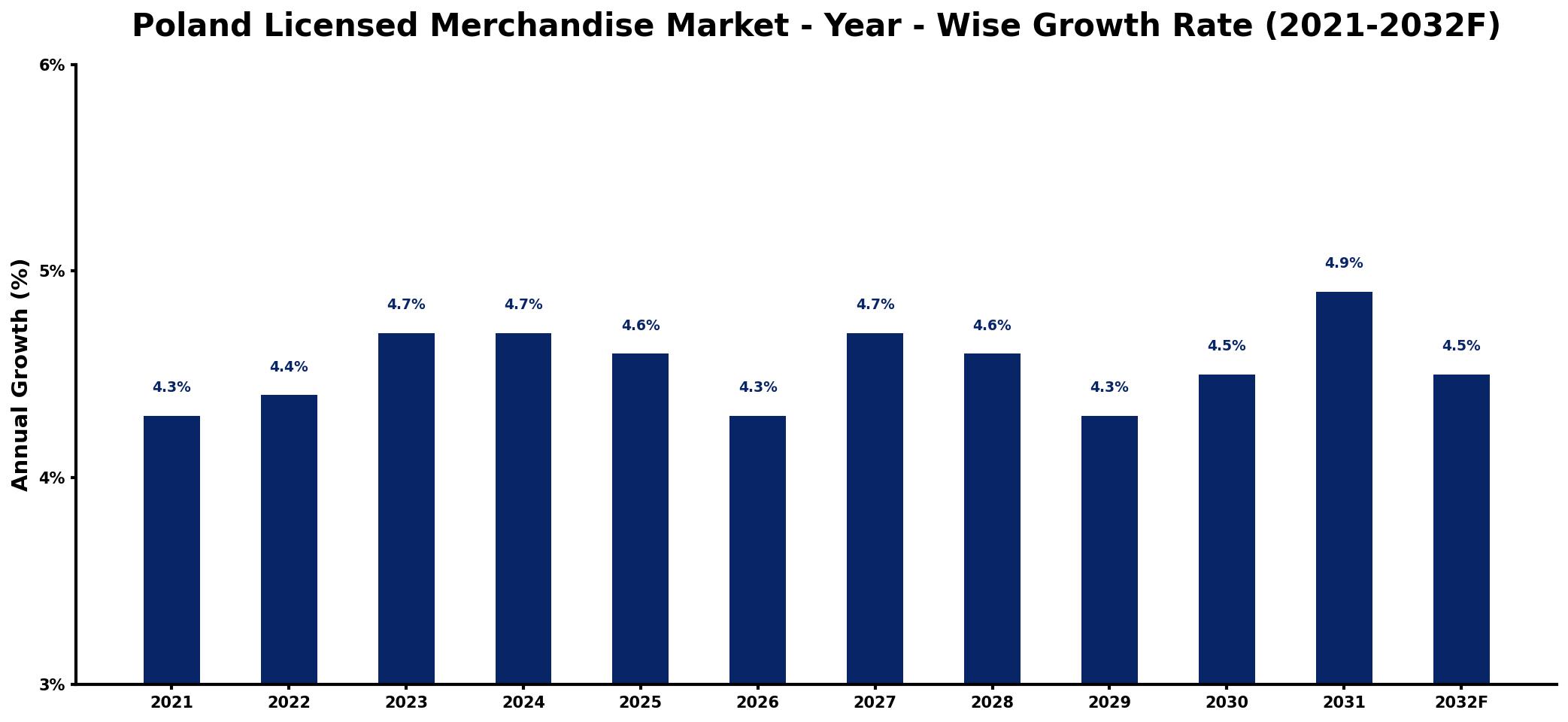
The table below presents the year‑wise growth rates along with the key drivers influencing the market
| Year | Growth Rate | Major Drivers |
| 2021 | 4.3% | Rising consumer brand engagement |
| 2022 | 4.4% | Expansion of retail partnerships |
| 2023 | 4.7% | Increased digital marketing investments |
| 2024 | 4.7% | Growth in e-commerce platforms |
| 2025 | 4.6% | Emerging trends in pop culture |
| 2026 | 4.3% | Strengthening youth consumer demographics |
| 2027 | 4.7% | Enhanced collaborative brand initiatives |
| 2028 | 4.6% | Diversification of fan engagement strategies |
| 2029 | 4.3% | Boost in international collaborations |
| 2030 | 4.5% | Growing interest in nostalgia products |
| 2031 | 4.9% | Development of innovative promotional campaigns |
| 2032 | 4.5% | growing downstream application demand |
Note: Market size estimations and growth projections presented in this report are based on 6Wresearch's proprietary forecasting methodology, utilizing the latest available industry data, government publications, and primary research inputs.
Poland Licensed Merchandise Market Synopsis
A primary force currently shaping the Poland Licensed Merchandise Market is the rising demand for products linked to popular entertainment properties. Consumers are increasingly gravitating toward merchandise that allows them to showcase their favorite characters and franchises, particularly in sectors such as gaming and films. This trend is further augmented by the rise of social media, which fosters connections between consumers and their beloved brands.
Simultaneously, a growing consumer awareness surrounding sustainability is influencing purchasing behaviors. Eco-friendly licensed merchandise is becoming more sought-after, prompting brands to adapt their offerings to meet these new consumer preferences. This intersection of fandom and environmental consciousness is reshaping product lines and marketing strategies across the market.
Poland Licensed Merchandise Market Key Takeaways
- The market is fueled by a growing interest in branded merchandise linked to entertainment and sports.
- Consumer demand for sustainable and eco-friendly licensed products is on the rise.
- Online sales channels are increasingly preferred for purchasing licensed merchandise.
- Limited-edition collaborations are creating excitement and exclusivity in the market.
- The Polish government is enhancing protections for intellectual property rights, positively impacting the market.
Evaluation of Restraints in Poland Licensed Merchandise Market
Despite the promising growth trajectory, the Poland Licensed Merchandise Market faces significant challenges, notably from counterfeit products. The prevalence of these illicit items not only affects legitimate businesses financially but also undermines consumer trust and brand integrity. Furthermore, the competitive landscape is intensifying, with numerous new entrants vying for market share, thereby placing pressure on pricing and necessitating unique differentiation strategies. Economic fluctuations and shifting consumer preferences can also introduce uncertainties that companies must navigate with agility and foresight.
Poland Licensed Merchandise Market Trends
Key trends emerging in the Poland Licensed Merchandise Market include an increasing shift towards digital commerce, allowing brands to expand their reach effectively. The convenience of online shopping is driving sales, with social media channels playing a crucial role in promotion and engagement. Furthermore, the rising popularity of limited-edition releases and collaborations is fostering a sense of urgency among consumers, effectively driving higher sales volumes. Lastly, the market is witnessing a notable inclination toward personalization and customization, where consumers seek unique offerings that resonate with their individual identities.
Poland Licensed Merchandise Market Opportunities
There are abundant opportunities for growth in the Poland Licensed Merchandise Market, particularly for companies willing to innovate and collaborate. Partnerships with emerging entertainment franchises and local artists can yield unique and appealing licensed products that stand out in the marketplace. Additionally, leveraging e-commerce for targeted marketing initiatives allows for better engagement with consumers, driving both sales and brand loyalty. Investing in sustainability-focused merchandise also positions brands favorably within a socially conscious consumer base, thus unlocking additional avenues for revenue growth.
Government Initiatives in the Poland Licensed Merchandise Market
The Polish government has implemented robust policies aimed at reinforcing intellectual property rights, crucial for fostering a healthy licensed merchandise ecosystem. Strengthening laws against counterfeiting helps protect legitimate businesses and ensures fair competition. Furthermore, the government encourages domestic companies to engage in licensing agreements, which aids in promoting innovation while stimulating economic growth within this sector. Support initiatives are tailored to enhance the market's overall vibrancy, contributing to a fair and transparent operational environment.
Future Insights of the Poland Licensed Merchandise Market
Looking ahead to 2026-2032, the Poland Licensed Merchandise Market is positioned for sustained growth, driven by the increasing popularity of branded merchandise across diverse consumer segments. As e-commerce platforms continue to evolve, they will play a pivotal role in market expansion, providing consumers with easier access to a wide array of licensed products. Collaborations between licensors and manufacturers to create innovative, desirable merchandise will further propel growth. Overall, a strong emphasis on consumer engagement and evolving product offerings will define the trajectory of this dynamic market.
Poland Licensed Merchandise Market Latest Developments (2025 - 2026)
Recent developments in the Poland Licensed Merchandise Market indicate a steady increase in partnerships between local brands and international licensors, aimed at producing unique merchandise tailored to Polish consumers. Additionally, a noticeable rise in online sales is prompting businesses to enhance their digital marketing strategies. The focus on sustainability is also intensifying, with more brands committing to eco-friendly practices in product development and packaging. This commitment is resonating well with consumers, leading to improved brand loyalty and sales growth.
Poland Licensed Merchandise Market - Key Attractiveness of the Report
- 10 Years of Market Numbers
- Historical Data Starting from 2022 to 2025
- Base Year: 2025
- Forecast Data until 2032
- Key Performance Indicators Impacting the Market
- Major Upcoming Developments and Projects
Key Highlights of the Report:
- Poland Licensed Merchandise Market Outlook
- Market Size of Poland Licensed Merchandise Market, 2025
- Forecast of Poland Licensed Merchandise Market, 2032
- Historical Data and Forecast of Poland Licensed Merchandise Revenues & Volume for the Period 2022-2032F
- Poland Licensed Merchandise Market Trend Evolution
- Poland Licensed Merchandise Market Drivers and Challenges
- Poland Licensed Merchandise Price Trends
- Poland Licensed Merchandise Porter's Five Forces
- Poland Licensed Merchandise Industry Life Cycle
- Historical Data and Forecast of Poland Licensed Merchandise Market Revenues & Volume By Product Type for the Period 2022-2032F
- Historical Data and Forecast of Poland Licensed Merchandise Market Revenues & Volume By Apparel and Footwear for the Period 2022-2032F
- Historical Data and Forecast of Poland Licensed Merchandise Market Revenues & Volume By Accessories and Gifts for the Period 2022-2032F
- Historical Data and Forecast of Poland Licensed Merchandise Market Revenues & Volume By Toys and Games for the Period 2022-2032F
- Historical Data and Forecast of Poland Licensed Merchandise Market Revenues & Volume By Others for the Period 2022-2032F
- Historical Data and Forecast of Poland Licensed Merchandise Market Revenues & Volume By for the Period 2022-2032F
- Historical Data and Forecast of Poland Licensed Merchandise Market Revenues & Volume By Distribution Channel for the Period 2022-2032F
- Historical Data and Forecast of Poland Licensed Merchandise Market Revenues & Volume By Online Stores for the Period 2022-2032F
- Historical Data and Forecast of Poland Licensed Merchandise Market Revenues & Volume By Supermarkets and Hypermarkets for the Period 2022-2032F
- Historical Data and Forecast of Poland Licensed Merchandise Market Revenues & Volume By Departmental Stores for the Period 2022-2032F
- Historical Data and Forecast of Poland Licensed Merchandise Market Revenues & Volume By Specialty Stores for the Period 2022-2032F
- Historical Data and Forecast of Poland Licensed Merchandise Market Revenues & Volume By Others for the Period 2022-2032F
- Historical Data and Forecast of Poland Licensed Merchandise Market Revenues & Volume By for the Period 2022-2032F
- Historical Data and Forecast of Poland Licensed Merchandise Market Revenues & Volume By Price Range for the Period 2022-2032F
- Historical Data and Forecast of Poland Licensed Merchandise Market Revenues & Volume By Premium for the Period 2022-2032F
- Historical Data and Forecast of Poland Licensed Merchandise Market Revenues & Volume By Economic for the Period 2022-2032F
- Historical Data and Forecast of Poland Licensed Merchandise Market Revenues & Volume By for the Period 2022-2032F
- Historical Data and Forecast of Poland Licensed Merchandise Market Revenues & Volume By End-User for the Period 2022-2032F
- Historical Data and Forecast of Poland Licensed Merchandise Market Revenues & Volume By Men for the Period 2022-2032F
- Historical Data and Forecast of Poland Licensed Merchandise Market Revenues & Volume By Women for the Period 2022-2032F
- Historical Data and Forecast of Poland Licensed Merchandise Market Revenues & Volume By Children for the Period 2022-2032F
- Poland Licensed Merchandise Import Export Trade Statistics
- Market Opportunity Assessment By Product Type
- Market Opportunity Assessment By Distribution Channel
- Market Opportunity Assessment By Price Range
- Market Opportunity Assessment By End-User
- Poland Licensed Merchandise Top Companies Market Share
- Poland Licensed Merchandise Competitive Benchmarking By Technical and Operational Parameters
- Poland Licensed Merchandise Company Profiles
- Poland Licensed Merchandise Key Strategic Recommendations






































