Poland Managed Mobility Services Market Size & Growth Rate (2026-2032)
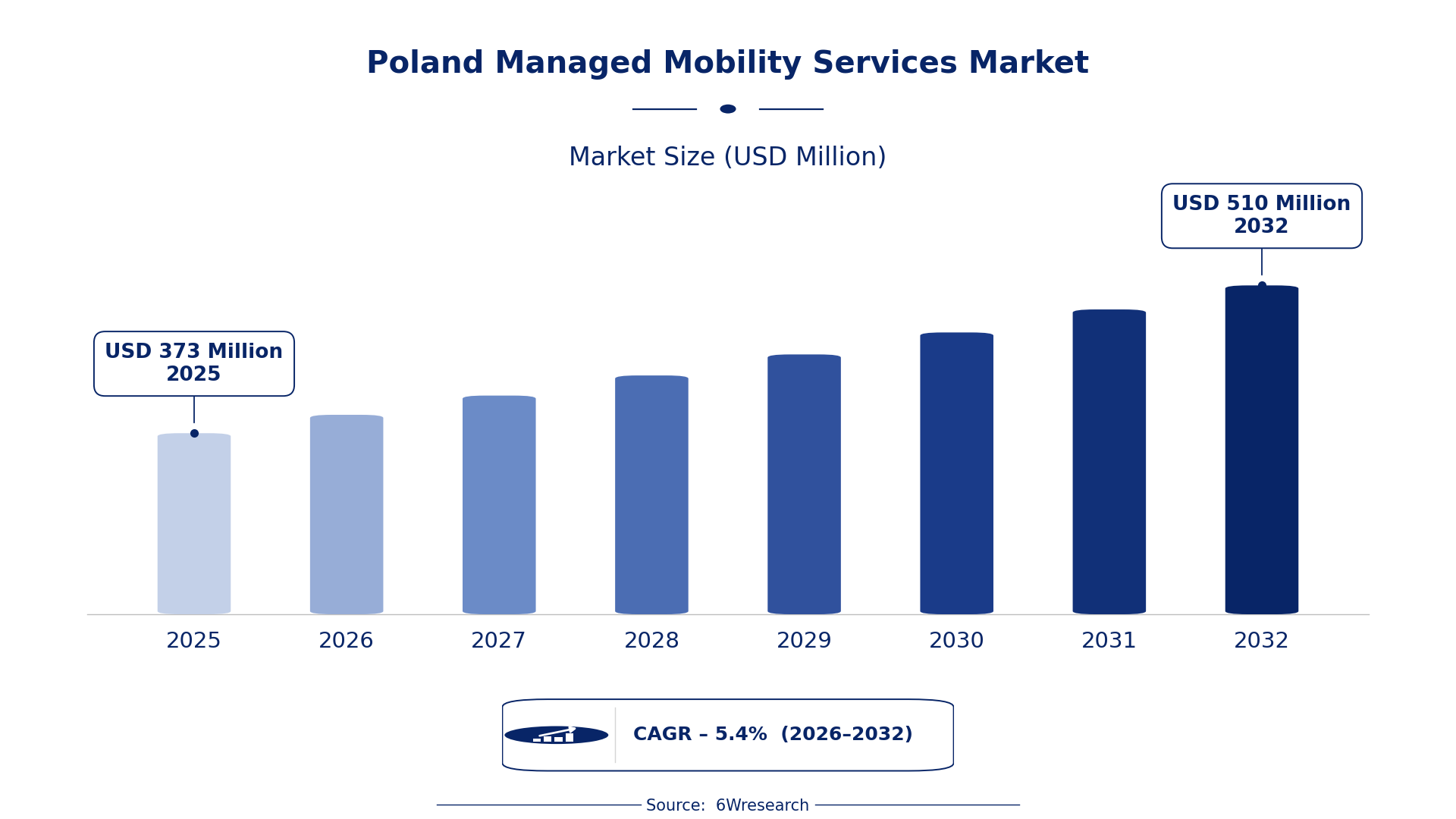
The Poland Managed Mobility Services Market was estimated at USD 373 Million in 2025 and is projected to reach USD 510 Million by 2032, growing at a CAGR of 5.4% from 2026 to 2032.
Poland Managed Mobility Services Market Synopsis
The demand for managed mobility services in Poland is rising as companies aim to enhance efficiency and productivity through smart mobile solutions. With an increasing reliance on mobile devices for daily operations, organizations are recognizing the value of outsourcing their mobility management to focus on core business strategies.
The complexities of mobile ecosystems are a major driver of growth in this sector. Companies face challenges such as managing a diverse array of devices and applications, maintaining data security, and adapting to the increasing trend of remote work. These factors are prompting many businesses to seek managed mobility services to optimize their mobile operations.
Poland Managed Mobility Services Market Year-wise Growth Rate and Key Drivers
This graph illustrates the annual growth rates of the Poland Managed Mobility Services Market from 2021 to 2032, highlighting a steady upward trajectory and projected expansion over the forecast period.
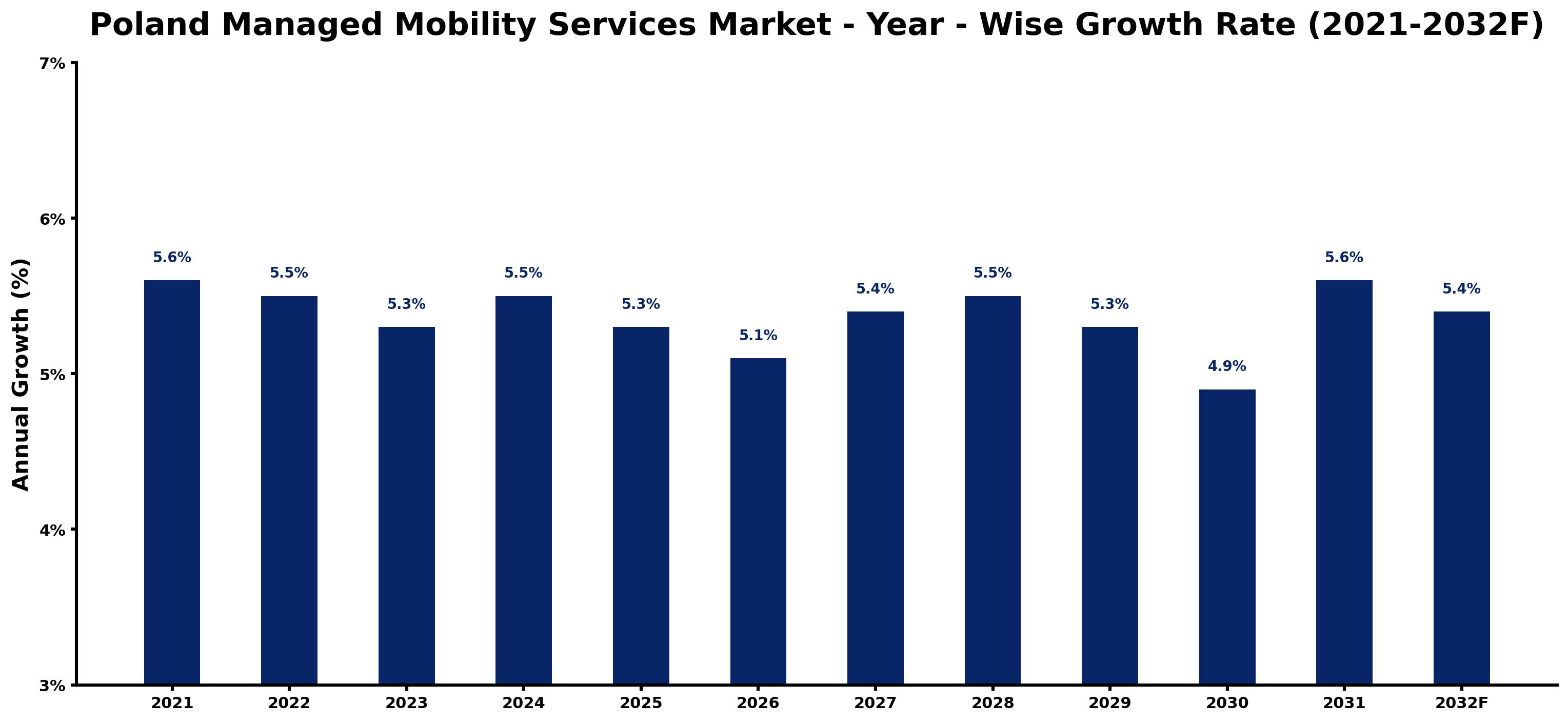
The table below presents the year‑wise growth rates along with the key drivers influencing the market
| Year | Growth Rate | Major Drivers |
| 2021 | 5.6% | Rise in smartphone penetration among Polish users. |
| 2022 | 5.5% | Increased focus on cybersecurity regulations by UODO. |
| 2023 | 5.3% | Growing adoption of IoT devices in urban environments. |
| 2024 | 5.5% | National digital transformation strategy boosts managed services. |
| 2025 | 5.3% | Enhancement of 5G networks across major Polish cities. |
| 2026 | 5.1% | Tax incentives for businesses adopting digital workplace tools. |
| 2027 | 5.4% | Increase in mobile workforce driven by tech startups. |
| 2028 | 5.5% | Support from EU funding for digital infrastructure projects. |
| 2029 | 5.3% | Growing emphasis on data privacy by national agencies. |
| 2030 | 4.9% | Emergence of remote patient monitoring solutions in healthcare. |
| 2031 | 5.6% | Adoption of hybrid work models among Polish corporations. |
| 2032 | 5.4% | Partnerships between telecoms and enterprises for mobile solutions. |
Note: Market size estimations and growth projections presented in this report are based on 6Wresearch's proprietary forecasting methodology, utilizing the latest available industry data, government publications, and primary research inputs.
Poland Managed Mobility Services Market Key Takeaways
Below are some of the specific key takeaways from the market, including:
- Businesses are increasingly outsourcing mobile device management to enhance efficiency.
- The complexity of mobile ecosystems is a primary growth factor in the market.
- Data security concerns are driving organizations to invest in managed mobility services.
- The rising trend of remote work is influencing service demands in this sector.
- Government policies promoting digital transformation are positively impacting market growth.
Evaluation of Restraints in Poland Managed Mobility Services Market
The managed mobility services market in Poland faces several restraints that could hinder its growth trajectory. Rapid advancements in mobile technology create a moving target for service providers, necessitating constant adaptation to stay competitive. Businesses must also grapple with ensuring robust data security and compliance with evolving regulations. Furthermore, there is fierce competition among IT service providers, making it essential for companies to deliver high-quality service while integrating seamlessly with existing systems. These challenges require strategic planning and investment to overcome.
Poland Managed Mobility Services Market Trends
Currently, several trends are shaping the managed mobility services market in Poland. The growth of BYOD (Bring Your Own Device) policies is prompting organizations to adopt more flexible mobility management strategies. There's also an increasing focus on integrating Artificial Intelligence and machine learning solutions to enhance device management and analytics capabilities. These technologies enable businesses to predict usage patterns and optimize their mobile fleets. Additionally, as the importance of cybersecurity heightens, businesses are investing more in comprehensive security management solutions as part of their mobility services.
Poland Managed Mobility Services Market Opportunities
The opportunities for growth in the Poland Managed Mobility Services Market are substantial. There’s a clear trend towards digital transformation within industries, creating a demand for efficient mobile solutions. Companies that can offer tailored managed services catering to specific sector needs—such as healthcare, finance, or logistics—are likely to find significant market potential. Additionally, firms that can integrate emerging technologies, like 5G and IoT, into their service offerings will be well-positioned to capture a larger share of this expanding market. The government’s push for technological advancements also opens up avenues for public-private partnerships, enhancing service delivery.
Government Initiatives in the Poland Managed Mobility Services Market
Government policy in Poland is increasingly favoring the growth of managed mobility services, focusing on digital transformation and improved telecommunications infrastructure. Initiatives to support mobile technology adoption in businesses and adherence to data privacy regulations are critical in shaping the current market landscape. This supportive environment is vital as firms navigate the complexities of mobility management.
- A national digital infrastructure upgrade programme that is currently in its rollout phase, aimed at enhancing connectivity and service delivery.
- A regulatory framework introduced in 2025 mandating billing transparency in managed mobility services to protect consumer interests.
- Currently ongoing workshops to promote best practices in cybersecurity among businesses implementing managed mobility solutions.
- A planned public-private initiative expected to expand access to secure mobile services in rural areas by 2028.
- Recent collaborations between government bodies and technology providers to develop a framework for mobile application security standards.
Future Insights of the Poland Managed Mobility Services Market
Looking forward to 2026-2032, the Poland Managed Mobility Services Market is on a trajectory of steady growth. As organizations increasingly recognize the importance of mobility in driving productivity, the demand for managed services is anticipated to rise. Companies that adapt to technological changes, while prioritizing security and compliance, will likely emerge as leaders in the sector. Integration with advanced technologies such as AI and machine learning will also play a significant role in shaping the future of mobility management.
Poland Managed Mobility Services Market Latest Developments
In recent months, the Poland Managed Mobility Services Market has seen a flurry of activity indicative of an industry on the rise. Organizations are actively seeking innovative solutions to enhance their mobile operations, and new partnerships are emerging to facilitate this shift. The emphasis on security and effective management remains central to these developments.
- A leading regional operator launched a new mobile device management solution in early 2025, aimed at simplifying enterprise mobility.
- In mid-2025, a major technology vendor initiated an ongoing collaboration with a local telecom provider to enhance security features in managed mobility services.
- A service upgrade focused on integrating AI-driven analytics was rolled out by a prominent service provider in late 2025 to improve user experience and operational efficiency.
- A rollout expected to begin in the second half of 2026 will introduce comprehensive data compliance solutions for enterprises.
- Recently completed pilot projects showcasing 5G integration into managed mobility services have garnered positive feedback and are expected to influence broader adoption.
Poland Managed Mobility Services Market - Key Attractiveness of the Report
- 10 Years of Market Numbers
- Historical Data Starting from 2022 to 2025
- Base Year: 2025
- Forecast Data until 2032
- Key Performance Indicators Impacting the Market
- Major Upcoming Developments and Projects
Key Highlights of the Report:
- Poland Managed Mobility Services Market Outlook
- Market Size of Poland Managed Mobility Services Market, 2025
- Forecast of Poland Managed Mobility Services Market, 2032
- Historical Data and Forecast of Poland Managed Mobility Services Revenues & Volume for the Period 2022-2032F
- Poland Managed Mobility Services Market Trend Evolution
- Poland Managed Mobility Services Market Drivers and Challenges
- Poland Managed Mobility Services Price Trends
- Poland Managed Mobility Services Porter's Five Forces
- Poland Managed Mobility Services Industry Life Cycle
- Historical Data and Forecast of Poland Managed Mobility Services Market Revenues & Volume By Function for the Period 2022-2032F
- Historical Data and Forecast of Poland Managed Mobility Services Market Revenues & Volume By Device Management for the Period 2022-2032F
- Historical Data and Forecast of Poland Managed Mobility Services Market Revenues & Volume By Application Management for the Period 2022-2032F
- Historical Data and Forecast of Poland Managed Mobility Services Market Revenues & Volume By Security Management for the Period 2022-2032F
- Historical Data and Forecast of Poland Managed Mobility Services Market Revenues & Volume By Maintenance & Support for the Period 2022-2032F
- Historical Data and Forecast of Poland Managed Mobility Services Market Revenues & Volume By Organization Size for the Period 2022-2032F
- Historical Data and Forecast of Poland Managed Mobility Services Market Revenues & Volume By SMEs for the Period 2022-2032F
- Historical Data and Forecast of Poland Managed Mobility Services Market Revenues & Volume By Large Enterprises for the Period 2022-2032F
- Historical Data and Forecast of Poland Managed Mobility Services Market Revenues & Volume By Industry Vertical for the Period 2022-2032F
- Historical Data and Forecast of Poland Managed Mobility Services Market Revenues & Volume By Healthcare for the Period 2022-2032F
- Historical Data and Forecast of Poland Managed Mobility Services Market Revenues & Volume By Manufacturing for the Period 2022-2032F
- Historical Data and Forecast of Poland Managed Mobility Services Market Revenues & Volume By Logistics and Transportation for the Period 2022-2032F
- Historical Data and Forecast of Poland Managed Mobility Services Market Revenues & Volume By Retail for the Period 2022-2032F
- Historical Data and Forecast of Poland Managed Mobility Services Market Revenues & Volume By Financial Services for the Period 2022-2032F
- Historical Data and Forecast of Poland Managed Mobility Services Market Revenues & Volume By Telecom and IT for the Period 2022-2032F
- Historical Data and Forecast of Poland Managed Mobility Services Market Revenues & Volume By Media and Entertainment for the Period 2022-2032F
- Historical Data and Forecast of Poland Managed Mobility Services Market Revenues & Volume By Travel and Hospitality for the Period 2022-2032F
- Poland Managed Mobility Services Import Export Trade Statistics
- Market Opportunity Assessment By Function
- Market Opportunity Assessment By Organization Size
- Market Opportunity Assessment By Industry Vertical
- Poland Managed Mobility Services Top Companies Market Share
- Poland Managed Mobility Services Competitive Benchmarking By Technical and Operational Parameters
- Poland Managed Mobility Services Company Profiles
- Poland Managed Mobility Services Key Strategic Recommendations






































