Poland Meat Packaging Market Summary
The poland meat packaging market was estimated at USD 670 Million in 2025 and is projected to reach USD 961 Million by 2032, growing at a CAGR of 6.3% from 2026 to 2032.
Poland Meat Packaging Market Year-wise Growth Rate and Key Drivers
This graph highlights how the Poland Meat Packaging Market has steadily grown over the past five years, supported by major growth factors.
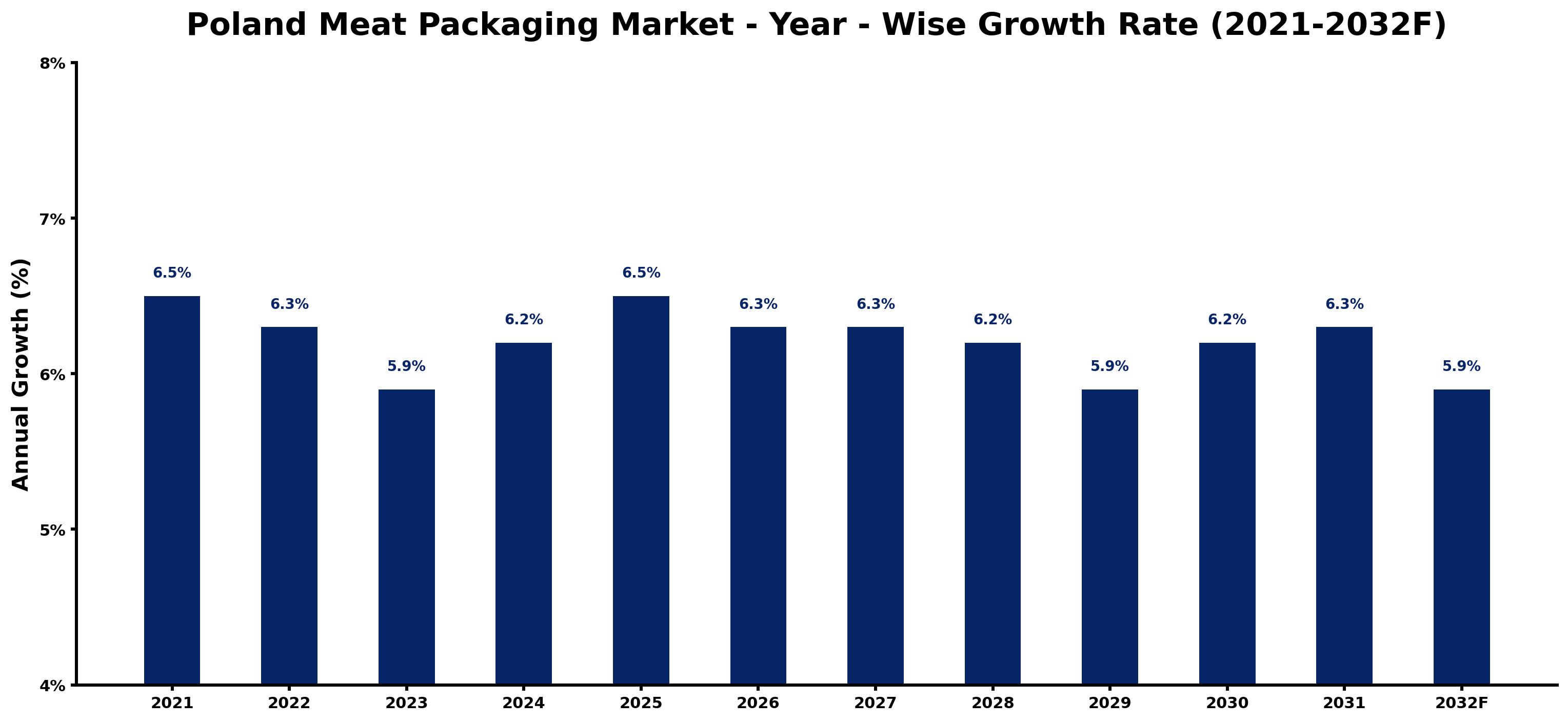
The table below presents the year wise growth rates along with the key drivers influencing the market
| Year | Growth Rate | Major Drivers |
| 2021 | 6.5% | Post-lockdown retail projects stimulate meat packaging innovations across various sectors. |
| 2022 | 6.3% | Demand for sustainable packaging materials becomes critical among eco-conscious consumers. |
| 2023 | 5.9% | Corporate budgets emphasize automation, leading to enhanced efficiency in meat processing. |
| 2024 | 6.2% | Increased consumer health awareness shifts focus to premium, organic meat products. |
| 2025 | 6.5% | Emerging technology advancements improve production processes and reduce waste significantly. |
| 2026 | 6.3% | International trade agreements create new export opportunities for Polish meat products. |
| 2027 | 6.3% | Rising livestock production enhances the availability of raw materials for packaging. |
| 2028 | 6.2% | Shifts in consumer behavior prioritize convenience and ready-to-eat meat solutions. |
| 2029 | 5.9% | Collaboration with local farmers supports sustainable sourcing and strengthens supply chains. |
| 2030 | 6.2% | Technological integration in logistics improves distribution efficiency and reduces costs. |
| 2031 | 6.3% | Increased urbanization drives demand for packaged meat in metropolitan areas. |
| 2032 | 5.9% | Focus on traceability boosts consumer confidence in meat product sourcing and quality. |
Note - Market size estimations and growth projections presented in this report are based on 6Wresearch's advanced forecasting approach, validated with industry datasets as of June 2026.
Poland Meat Packaging Market Synopsis
The Poland Meat Packaging Market is projected to reach 6.3% and witness significant growth during the forecast period (2026-2032). The market's expansion is fueled by a shift in consumer behavior towards convenience and sustainability, alongside a rise in disposable income. This growth is characterized by an increasing need for innovative and efficient packaging solutions that ensure the safety and quality of meat products, meeting the evolving demands of both consumers and industry stakeholders.
Poland Meat Packaging Market Growth Drivers
The driving forces behind the Poland Meat Packaging Market are multifaceted and closely linked to current consumer behaviors and industry trends.
- Enhanced consumer demand for convenience food has prompted the meat packaging sector to innovate with easier-to-use packaging formats such as vacuum-sealed and ready-to-eat options.
- The rising disposable income levels among Polish consumers are enabling them to spend more on quality meat products, necessitating better packaging solutions to ensure freshness and longevity.
- The surge in online food delivery services has amplified the need for packaging that not only preserves the quality of meat but also is visually appealing to attract customers.
- Growing awareness among consumers regarding food safety is driving the adoption of advanced packaging technologies like modified atmosphere packaging, which extends the shelf life of meat products.
- The increasing emphasis on sustainability is steering both consumers and producers towards eco-friendly packaging materials, pushing the market towards greener solutions.
Poland Meat Packaging Market Trends and Opportunities
The Poland Meat Packaging Market exhibits several prevalent trends that reflect its dynamic nature, creating numerous opportunities for growth.
- There is a notable shift towards sustainable packaging practices, with manufacturers adopting biodegradable and recyclable materials in response to consumer demand for environmentally friendly products.
- Convenience remains a key theme, leading to increased investment in portion-controlled packaging that caters to smaller households and busy lifestyles.
- Technological advancements, particularly in packaging technology like modified atmosphere packaging, are gaining traction, offering extended product freshness and enhanced shelf life.
- Innovative designs and labeling practices are being embraced to improve product visibility and consumer engagement at retail points, reflecting a strong focus on branding.
- The market also shows an inclination towards customization, enabling manufacturers to provide tailored packaging solutions that meet specific client needs and preferences.
Poland Meat Packaging Market Challenges and Restraints
Despite the promising growth outlook, the Poland Meat Packaging Market faces several challenges that require strategic navigation by industry players.
- Intense competition among manufacturers is leading to pricing pressures, which may affect profit margins and the ability to invest in innovative packaging solutions.
- The stringent regulations regarding food safety and hygiene standards demand compliance, requiring continual investment in quality control and process improvements.
- There is an increasing consumer demand for sustainable packaging, which poses a challenge for companies to transition from traditional materials to eco-friendly alternatives.
- Fluctuating raw material prices present a risk to manufacturers, potentially impacting their ability to maintain consistent product pricing and quality.
- Shifts in consumer preferences towards healthier and convenience-oriented packaging dictate that packaging solutions must continuously evolve to meet these demands.
Poland Meat Packaging Market Government Investment and Initiatives
Government policies play a critical role in shaping the landscape of the Poland Meat Packaging Market, emphasizing food safety, consumer health, and environmental sustainability.
- The Polish government, in alignment with European Union directives, has implemented stringent regulations concerning food safety and quality assurance in the meat packaging sector, ensuring high standards are maintained throughout the production process.
- Public spending initiatives focus on enhancing infrastructure for meat processing and packaging, aimed at boosting overall efficiency and competitiveness in the market.
- Development plans promote research and innovation in packaging technologies, aiming to create smarter and more sustainable solutions that meet industry demands.
- Incentives are provided for companies adopting eco-friendly materials and practices, showcasing the government's commitment to fostering a sustainable packaging industry.
- Collaboration between governmental bodies and industry stakeholders is encouraged to develop best practices for labeling and hygiene, ensuring consumer trust and safety are prioritized.
Poland Meat Packaging Market Latest Developments (May 2025 - June 2026)
The Poland Meat Packaging Market has seen significant advancements during the period from May 2025 to June 2026, reflecting ongoing trends and shifts in consumer expectations.
- There has been a marked increase in investments in research and development aimed at creating innovative packaging solutions that enhance meat product longevity and safety.
- Moreover, a growing emphasis on digital technologies within the packaging processes is evident, with manufacturers increasingly adopting automation and data analytics to streamline operations.
- The market has also witnessed greater collaboration among industry stakeholders aimed at addressing sustainability challenges, leading to shared initiatives focused on eco-friendly practices.
- Consumer education campaigns regarding the benefits of advanced packaging technologies have gained traction, contributing to heightened awareness and demand for these solutions.
- In response to ongoing economic fluctuations, companies have been adjusting their strategies to focus on cost-effective packaging solutions while maintaining quality and compliance standards.
Poland Meat Packaging Market - Key Attractiveness of the Report
- 10 Years of Market Numbers
- Historical Data Starting from 2022 to 2025
- Base Year: 2025
- Forecast Data until 2032
- Key Performance Indicators Impacting the Market
- Major Upcoming Developments and Projects
Key Highlights of the Report:
- Poland Meat Packaging Market Outlook
- Market Size of Poland Meat Packaging Market, 2025
- Forecast of Poland Meat Packaging Market, 2032F
- Historical Data and Forecast of Poland Meat Packaging Revenues & Volume for the Period 2022-2032F
- Poland Meat Packaging Market Trend Evolution
- Poland Meat Packaging Market Drivers and Challenges
- Poland Meat Packaging Price Trends
- Poland Meat Packaging Porter's Five Forces
- Poland Meat Packaging Industry Life Cycle
- Historical Data and Forecast of Poland Meat Packaging Market Revenues & Volume By Material Type for the Period 2022-2032F
- Historical Data and Forecast of Poland Meat Packaging Market Revenues & Volume By Plastic for the Period 2022-2032F
- Historical Data and Forecast of Poland Meat Packaging Market Revenues & Volume By Rigid? for the Period 2022-2032F
- Historical Data and Forecast of Poland Meat Packaging Market Revenues & Volume By Metal for the Period 2022-2032F
- Historical Data and Forecast of Poland Meat Packaging Market Revenues & Volume By Meat Type for the Period 2022-2032F
- Historical Data and Forecast of Poland Meat Packaging Market Revenues & Volume By Fresh and Frozen for the Period 2022-2032F
- Historical Data and Forecast of Poland Meat Packaging Market Revenues & Volume By Processed for the Period 2022-2032F
- Historical Data and Forecast of Poland Meat Packaging Market Revenues & Volume By Ready to Eat for the Period 2022-2032F
- Poland Meat Packaging Import Export Trade Statistics
- Market Opportunity Assessment By Material Type
- Market Opportunity Assessment By Meat Type
- Poland Meat Packaging Top Companies Market Share
- Poland Meat Packaging Competitive Benchmarking By Technical and Operational Parameters
- Poland Meat Packaging Company Profiles
- Poland Meat Packaging Key Strategic Recommendations






































