Poland Mineral Processing Equipment Market Size, Share & Growth Rate
The Poland Mineral Processing Equipment Market was estimated at USD 159 Million in 2025 and is projected to reach USD 219 Million by 2032, growing at a CAGR of 4.7% from 2026 to 2032. This growth trajectory is propelled by the rising demand for minerals and metals across diverse industries such as mining and construction. Furthermore, significant investments in advanced processing technologies are enhancing operational efficiencies, allowing companies to better meet market demands while adhering to increasing environmental regulations.
Poland Mineral Processing Equipment Market Year-wise Growth Rate and Key Drivers
This graph highlights how the Poland Mineral Processing Equipment Market has steadily grown over the years, supported by major growth factors.
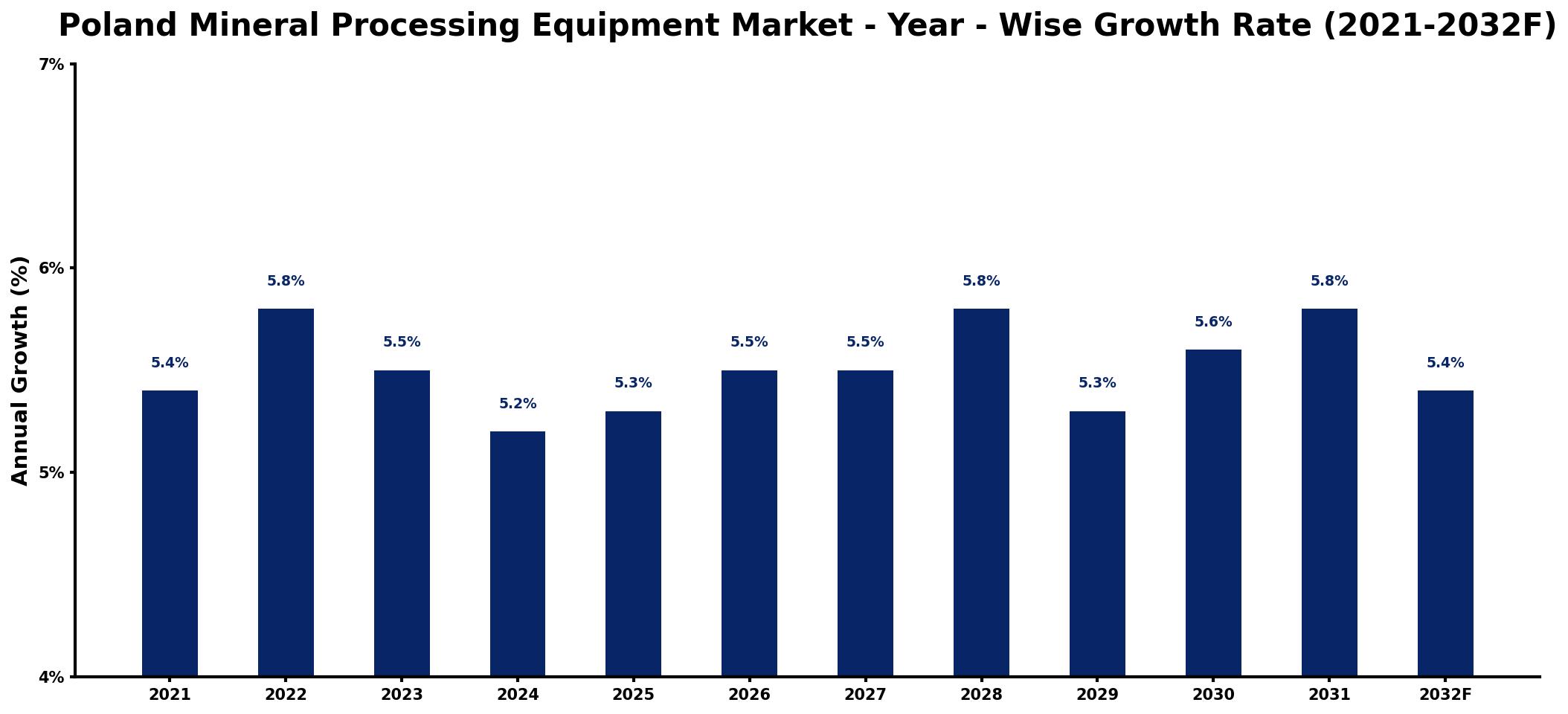
The table below presents the year‑wise growth rates along with the key drivers influencing the market
| Year | Growth Rate | Major Drivers |
| 2021 | 5.4% | Rising demand from construction sector |
| 2022 | 5.8% | Increased investments in infrastructure projects |
| 2023 | 5.5% | Expansion of renewable energy initiatives |
| 2024 | 5.2% | Growing focus on sustainable practices |
| 2025 | 5.3% | Enhanced adoption of automation technologies |
| 2026 | 5.5% | Boost in mining exploration activities |
| 2027 | 5.5% | Strengthening of regional trade partnerships |
| 2028 | 5.8% | rising infrastructure development spending |
| 2029 | 5.3% | Development of new extraction techniques |
| 2030 | 5.6% | Increase in foreign direct investments |
| 2031 | 5.8% | Growth in urbanization trends |
| 2032 | 5.4% | Rising focus on efficiency improvements |
Note: Market size estimations and growth projections presented in this report are based on 6Wresearch's proprietary forecasting methodology, utilizing the latest available industry data, government publications, and primary research inputs.
Poland Mineral Processing Equipment Market Synopsis
Innovation and sustainability are the strongest forces shaping the Poland Mineral Processing Equipment Market today. As industries demand more efficient processing solutions, players in this sector are rapidly adopting advanced technologies such as automation and IoT integration.
Additionally, a growing emphasis on eco-friendly practices is driving investment in energy-efficient equipment. The markets competitive landscape is characterized by strategic partnerships and a focus on product development to address evolving industry requirements.
Poland Mineral Processing Equipment Market Key Takeaways
- Steady market growth driven by increased demand from mining, construction, and manufacturing sectors.
- Technological advancements like automation and digitalization are transforming mineral processing operations.
- There is a strong shift towards sustainable and eco-friendly processing technologies.
- Investment in R&D is critical for companies to remain competitive and compliant with evolving regulations.
- Government initiatives are fostering a supportive environment for market expansion.
Evaluation of Restraints in Poland Mineral Processing Equipment Market
The Poland Mineral Processing Equipment Market faces several constraints that could hinder its growth. Increased competition from international players with advanced technologies is one such challenge. Fluctuating raw material prices can also impact production costs, complicating budgeting for companies. Additionally, stringent environmental regulations necessitate equipment upgrades, which may impose financial burdens on some firms. Limited financing options for small and medium-sized enterprises seeking modernization further exacerbate these challenges, necessitating a strategic approach to mitigate risks while capitalizing on growth opportunities.
Poland Mineral Processing Equipment Market Trends
Several key trends are currently shaping the Poland Mineral Processing Equipment Market. There is a noticeable shift towards the incorporation of smart technologies, including automation and digital solutions, that enhance efficiency and productivity. Furthermore, the focus on sustainability has led to increased demand for equipment that minimizes environmental impact. Companies are not only striving for compliance with regulations but also looking for ways to innovate and create customized processing solutions tailored to specific operational needs.
Poland Mineral Processing Equipment Market Opportunities
Investment opportunities within the Poland Mineral Processing Equipment Market are abundant, particularly in areas such as machinery for crushing, grinding, and screening processes. As the industry moves towards eco-friendly practices, there is a growing need for innovative technologies that facilitate energy-efficient processing. Additionally, the Polish government's initiatives to enhance the mining sector create favorable conditions for both domestic and foreign investment, providing an ideal landscape for partnerships and collaborations that could drive modernization within the market.
Government Initiatives in the Poland Mineral Processing Equipment Market
The Polish government has implemented various policies aimed at fostering the growth of the Mineral Processing Equipment Market. Key initiatives include financial incentives for investment in modern, efficient technologies, and support for research and development endeavors within the sector. Strict regulations on environmental sustainability are enforced, pushing companies to innovate while ensuring responsible resource management. Overall, these governmental policies are designed to enhance market efficiency and competitiveness, paving the way for sustainable development.
Future Insights of the Poland Mineral Processing Equipment Market
Looking ahead to 2026-2032, the Poland Mineral Processing Equipment Market is poised for continued growth. The increasing demand for minerals across various industries will drive investment in processing capabilities. Technological advancements, particularly in automation and digital solutions, will likely improve operational efficiency. Additionally, the market will be influenced by the ongoing shift towards sustainable practices, prompting companies to adopt eco-friendly equipment to comply with regulations and meet customer expectations.
Poland Mineral Processing Equipment Market Latest Developments (2025 - 2026)
Recent developments in the Poland Mineral Processing Equipment Market indicate a significant trend towards technological integration. Companies are increasingly implementing automation and digital tools to streamline operations and enhance productivity. Environmental sustainability continues to be a focal point, with businesses investing in equipment that meets stringent regulations. Furthermore, partnerships between local and international firms are becoming more common as the market evolves, allowing for the exchange of innovative technologies and solutions.
Poland Mineral Processing Equipment Market - Key Attractiveness of the Report
- 10 Years of Market Numbers
- Historical Data Starting from 2022 to 2025
- Base Year: 2025
- Forecast Data until 2032
- Key Performance Indicators Impacting the Market
- Major Upcoming Developments and Projects
Key Highlights of the Report:
- Poland Mineral Processing Equipment Market Outlook
- Market Size of Poland Mineral Processing Equipment Market, 2025
- Forecast of Poland Mineral Processing Equipment Market, 2032
- Historical Data and Forecast of Poland Mineral Processing Equipment Revenues & Volume for the Period 2022-2032F
- Poland Mineral Processing Equipment Market Trend Evolution
- Poland Mineral Processing Equipment Market Drivers and Challenges
- Poland Mineral Processing Equipment Price Trends
- Poland Mineral Processing Equipment Porter's Five Forces
- Poland Mineral Processing Equipment Industry Life Cycle
- Historical Data and Forecast of Poland Mineral Processing Equipment Market Revenues & Volume By Mineral Mining Sector for the Period 2022-2032F
- Historical Data and Forecast of Poland Mineral Processing Equipment Market Revenues & Volume By Bauxite for the Period 2022-2032F
- Historical Data and Forecast of Poland Mineral Processing Equipment Market Revenues & Volume By Iron for the Period 2022-2032F
- Historical Data and Forecast of Poland Mineral Processing Equipment Market Revenues & Volume By Lithium for the Period 2022-2032F
- Historical Data and Forecast of Poland Mineral Processing Equipment Market Revenues & Volume By Others for the Period 2022-2032F
- Historical Data and Forecast of Poland Mineral Processing Equipment Market Revenues & Volume By Equipment for the Period 2022-2032F
- Historical Data and Forecast of Poland Mineral Processing Equipment Market Revenues & Volume By Crushers for the Period 2022-2032F
- Historical Data and Forecast of Poland Mineral Processing Equipment Market Revenues & Volume By Feeders for the Period 2022-2032F
- Historical Data and Forecast of Poland Mineral Processing Equipment Market Revenues & Volume By Conveyors for the Period 2022-2032F
- Historical Data and Forecast of Poland Mineral Processing Equipment Market Revenues & Volume By Drills & Breakers for the Period 2022-2032F
- Historical Data and Forecast of Poland Mineral Processing Equipment Market Revenues & Volume By Others for the Period 2022-2032F
- Historical Data and Forecast of Poland Mineral Processing Equipment Market Revenues & Volume By Application for the Period 2022-2032F
- Historical Data and Forecast of Poland Mineral Processing Equipment Market Revenues & Volume By Construction for the Period 2022-2032F
- Historical Data and Forecast of Poland Mineral Processing Equipment Market Revenues & Volume By Mining for the Period 2022-2032F
- Historical Data and Forecast of Poland Mineral Processing Equipment Market Revenues & Volume By Others for the Period 2022-2032F
- Poland Mineral Processing Equipment Import Export Trade Statistics
- Market Opportunity Assessment By Mineral Mining Sector
- Market Opportunity Assessment By Equipment
- Market Opportunity Assessment By Application
- Poland Mineral Processing Equipment Top Companies Market Share
- Poland Mineral Processing Equipment Competitive Benchmarking By Technical and Operational Parameters
- Poland Mineral Processing Equipment Company Profiles
- Poland Mineral Processing Equipment Key Strategic Recommendations






































