Poland MLOps Market Size & Growth Rate (2026-2032)
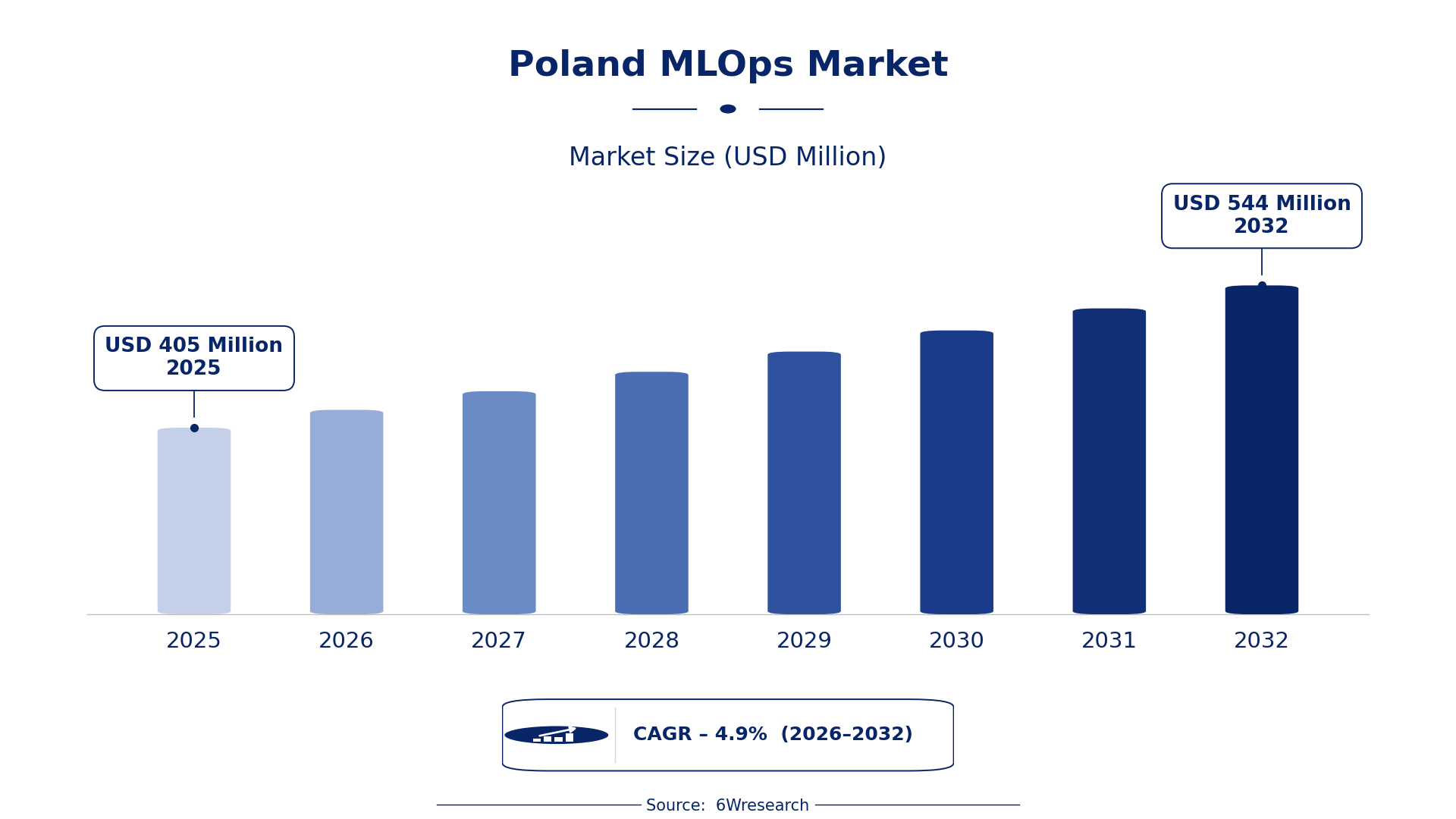
The Poland MLOps Market was estimated at USD 405 Million in 2025 and is projected to reach USD 544 Million by 2032, growing at a CAGR of 4.9% from 2026 to 2032.
Poland MLOps Market Synopsis
The driving force behind the Poland MLOps market is the surge in AI and machine learning adoption across various sectors. Businesses are increasingly realizing that implementing MLOps solutions is not just a trend but a necessity for efficient model deployment and collaboration.
As organizations strive to enhance their operational efficiency, the demand for MLOps tools continues to escalate. This market is characterized by a strong focus on automation and the need to tackle the complexities associated with machine learning projects. Companies are eager to streamline their workflows to stay competitive.
Poland MLOps Market Year-wise Growth Rate and Key Drivers
This graph illustrates the annual growth rates of the Poland MLOps Market from 2021 to 2032, highlighting a steady upward trajectory and projected expansion over the forecast period.
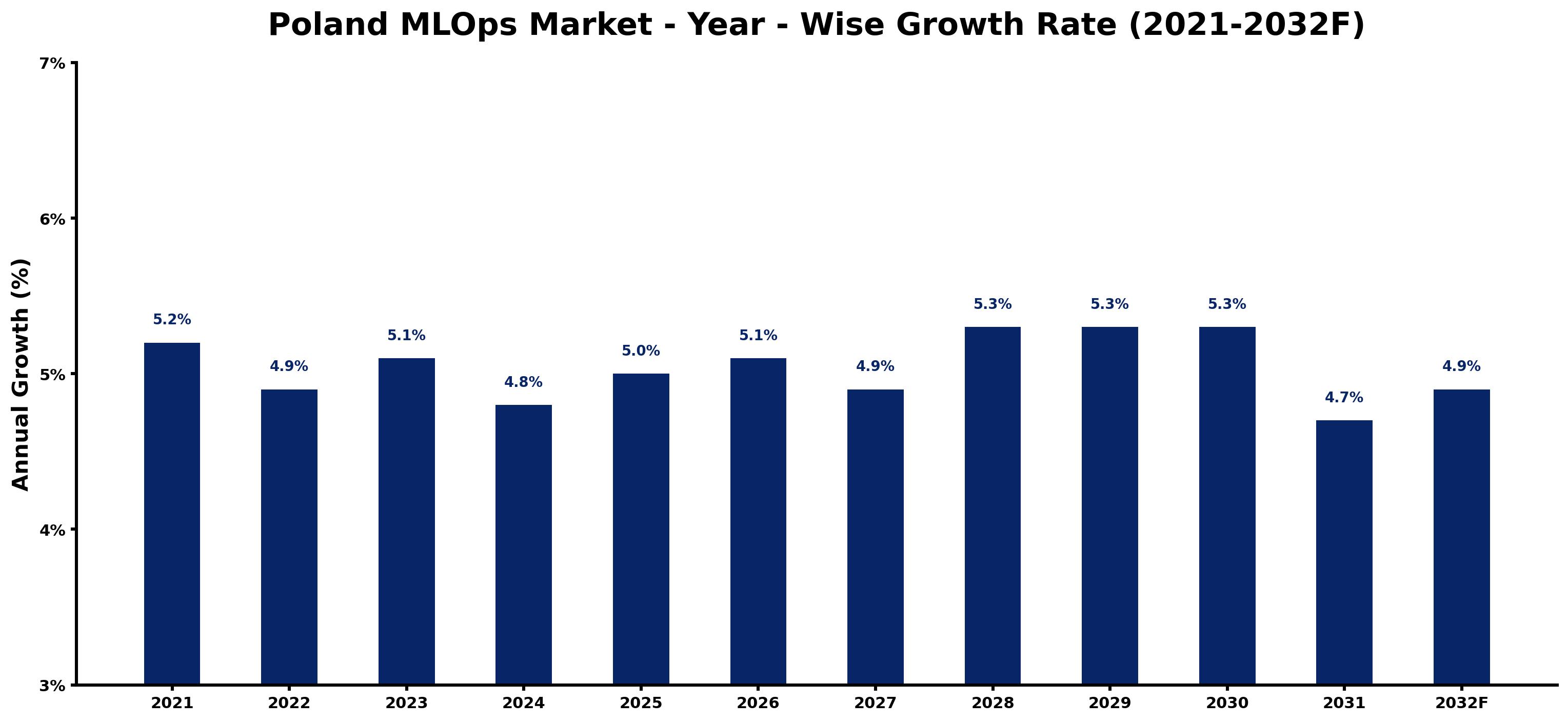
The table below presents the year‑wise growth rates along with the key drivers influencing the market
| Year | Growth Rate | Major Drivers |
| 2021 | 5.2% | Government incentives for AI development and integration. |
| 2022 | 4.9% | Rising Polish startups focusing on machine learning applications. |
| 2023 | 5.1% | Investment boost from EU funds for digital transformation projects. |
| 2024 | 4.8% | Increased adoption of AI in local healthcare services. |
| 2025 | 5.0% | Growing interest in AI ethics shaping industry standards. |
| 2026 | 5.1% | Emerging tech hubs in Warsaw attracting MLOps talent. |
| 2027 | 4.9% | Regulatory push for data-driven governance and transparency. |
| 2028 | 5.3% | Surge in local businesses implementing predictive analytics. |
| 2029 | 5.3% | Collaboration with European tech firms enhancing MLOps skills. |
| 2030 | 5.3% | Academic partnerships driving innovative MLOps research initiatives. |
| 2031 | 4.7% | Heightened focus on data privacy regulations influencing practices. |
| 2032 | 4.9% | Local demand for tailored AI solutions in agriculture. |
Note: Market size estimations and growth projections presented in this report are based on 6Wresearch's proprietary forecasting methodology, utilizing the latest available industry data, government publications, and primary research inputs.
Poland MLOps Market Key Takeaways
Below are some of the specific key takeaways from the market, including:
- The Poland MLOps market is witnessing rapid growth, fueled by the increasing integration of AI technologies.
- Organizations are prioritizing automation to reduce time-to-market and enhance productivity.
- Collaboration between data scientists and IT operations teams is becoming essential for successful MLOps implementation.
- Data governance and compliance are critical factors driving the adoption of MLOps solutions.
- Investment in talent development and training is vital to address skill shortages in the MLOps space.
Evaluation of Restraints in Poland MLOps Market
The Poland MLOps market faces tangible hurdles, particularly in talent acquisition. Companies are grappling with a shortage of qualified professionals who possess the technical expertise necessary for MLOps. This skill gap not only hinders operational efficiency but also necessitates ongoing training for existing staff to keep pace with technological advancements. Integrating MLOps within traditional IT infrastructures poses another challenge, as organizations must manage complexities surrounding data security and compliance while scaling their machine learning initiatives.
Poland MLOps Market Trends
Key trends influencing the Poland MLOps market include the increasing reliance on automation tools for model deployment and monitoring. Companies are actively seeking solutions that facilitate collaboration among data scientists, IT teams, and business stakeholders. Additionally, the focus on end-to-end management of machine learning workflows is gaining traction, addressing challenges related to scalability and governance.
Poland MLOps Market Opportunities
The potential for growth in the Poland MLOps market is vast, particularly in the development of comprehensive platforms that streamline the machine learning lifecycle. Organizations are looking for solutions that can effectively manage the complexities of their AI initiatives while ensuring compliance and security. As industries expand, especially in fintech and healthcare, opportunities for innovation and differentiation within MLOps offerings are ripe for exploration.
Government Initiatives in the Poland MLOps Market
The Polish government is fostering a conducive environment for the MLOps market through various initiatives aimed at promoting innovation and digital transformation. Policies like the National Artificial Intelligence Strategy and the Digital Poland 2022 program emphasize the need for operationalizing machine learning technologies to enhance competitiveness. This supportive regulatory framework helps to spur collaboration between the public sector, industry, and academia, addressing the skills gap in the MLOps field.
- A recently completed initiative, the Digital Poland 2022 program, aimed to enhance digital infrastructure and promote AI applications across multiple sectors.
- A current initiative underway focuses on partnerships between universities and businesses to develop tailored training programs in MLOps.
- A planned upcoming program is the National AI Strategy, which will allocate funding for AI research and support the scaling of MLOps practices.
- The government is also promoting regulatory frameworks that encourage transparency and security in AI operations, enhancing trust in MLOps solutions.
- Ongoing efforts include workshops and seminars aimed at increasing awareness of MLOps capabilities among enterprises.
Future Insights of the Poland MLOps Market
Looking ahead to 2026-2032, the Poland MLOps market is set for substantial growth as organizations continue to recognize the value of operationalizing their machine learning processes. The proliferation of data-driven strategies across various industries will drive demand for advanced MLOps solutions. As technological advancements unfold, the integration of automation and DevOps practices will further enhance the efficiency of machine learning operations, positioning Poland as a key player in the AI space.
Poland MLOps Market Latest Developments
In the past year, the Poland MLOps market has seen notable activity as businesses ramp up their AI initiatives. Companies are investing in innovative solutions and partnerships to enhance their machine learning capabilities. This trend indicates a strong commitment to advancing MLOps practices across sectors.
- A leading regional operator launched a new MLOps platform in early 2025, aimed at simplifying model deployment for enterprises.
- In Q3 2025, a major technology vendor announced an ongoing collaboration with local universities to enhance training programs in data science and MLOps.
- An initiative expected to begin in mid-2026 will focus on developing a national MLOps certification program to standardize skills across the industry.
- By late 2025, a consortium of tech firms completed a pilot project integrating MLOps tools into existing IT infrastructures for improved data handling.
- A rollout of new compliance guidelines for MLOps is planned for early 2026, designed to enhance security and governance in AI applications.
Poland MLOps Market - Key Attractiveness of the Report
- 10 Years of Market Numbers
- Historical Data Starting from 2022 to 2025
- Base Year: 2025
- Forecast Data until 2032
- Key Performance Indicators Impacting the Market
- Major Upcoming Developments and Projects
Key Highlights of the Report:
- Poland MLOps Market Outlook
- Market Size of Poland MLOps Market, 2025
- Forecast of Poland MLOps Market, 2032
- Historical Data and Forecast of Poland MLOps Revenues & Volume for the Period 2022-2032F
- Poland MLOps Market Trend Evolution
- Poland MLOps Market Drivers and Challenges
- Poland MLOps Price Trends
- Poland MLOps Porter's Five Forces
- Poland MLOps Industry Life Cycle
- Historical Data and Forecast of Poland MLOps Market Revenues & Volume By Component for the Period 2022-2032F
- Historical Data and Forecast of Poland MLOps Market Revenues & Volume By Platform for the Period 2022-2032F
- Historical Data and Forecast of Poland MLOps Market Revenues & Volume By Services for the Period 2022-2032F
- Historical Data and Forecast of Poland MLOps Market Revenues & Volume By Deployment Mode for the Period 2022-2032F
- Historical Data and Forecast of Poland MLOps Market Revenues & Volume By Cloud for the Period 2022-2032F
- Historical Data and Forecast of Poland MLOps Market Revenues & Volume By On-premises for the Period 2022-2032F
- Historical Data and Forecast of Poland MLOps Market Revenues & Volume By Organization Size for the Period 2022-2032F
- Historical Data and Forecast of Poland MLOps Market Revenues & Volume By Large Enterprises for the Period 2022-2032F
- Historical Data and Forecast of Poland MLOps Market Revenues & Volume By SMEs for the Period 2022-2032F
- Historical Data and Forecast of Poland MLOps Market Revenues & Volume By Vertical for the Period 2022-2032F
- Historical Data and Forecast of Poland MLOps Market Revenues & Volume By BFSI for the Period 2022-2032F
- Historical Data and Forecast of Poland MLOps Market Revenues & Volume By Healthcare and Life Sciences for the Period 2022-2032F
- Historical Data and Forecast of Poland MLOps Market Revenues & Volume By Retail and eCommerce for the Period 2022-2032F
- Historical Data and Forecast of Poland MLOps Market Revenues & Volume By Telecom for the Period 2022-2032F
- Poland MLOps Import Export Trade Statistics
- Market Opportunity Assessment By Component
- Market Opportunity Assessment By Deployment Mode
- Market Opportunity Assessment By Organization Size
- Market Opportunity Assessment By Vertical
- Poland MLOps Top Companies Market Share
- Poland MLOps Competitive Benchmarking By Technical and Operational Parameters
- Poland MLOps Company Profiles
- Poland MLOps Key Strategic Recommendations






































