Poland Modified Starch Market: Import Trend Analysis
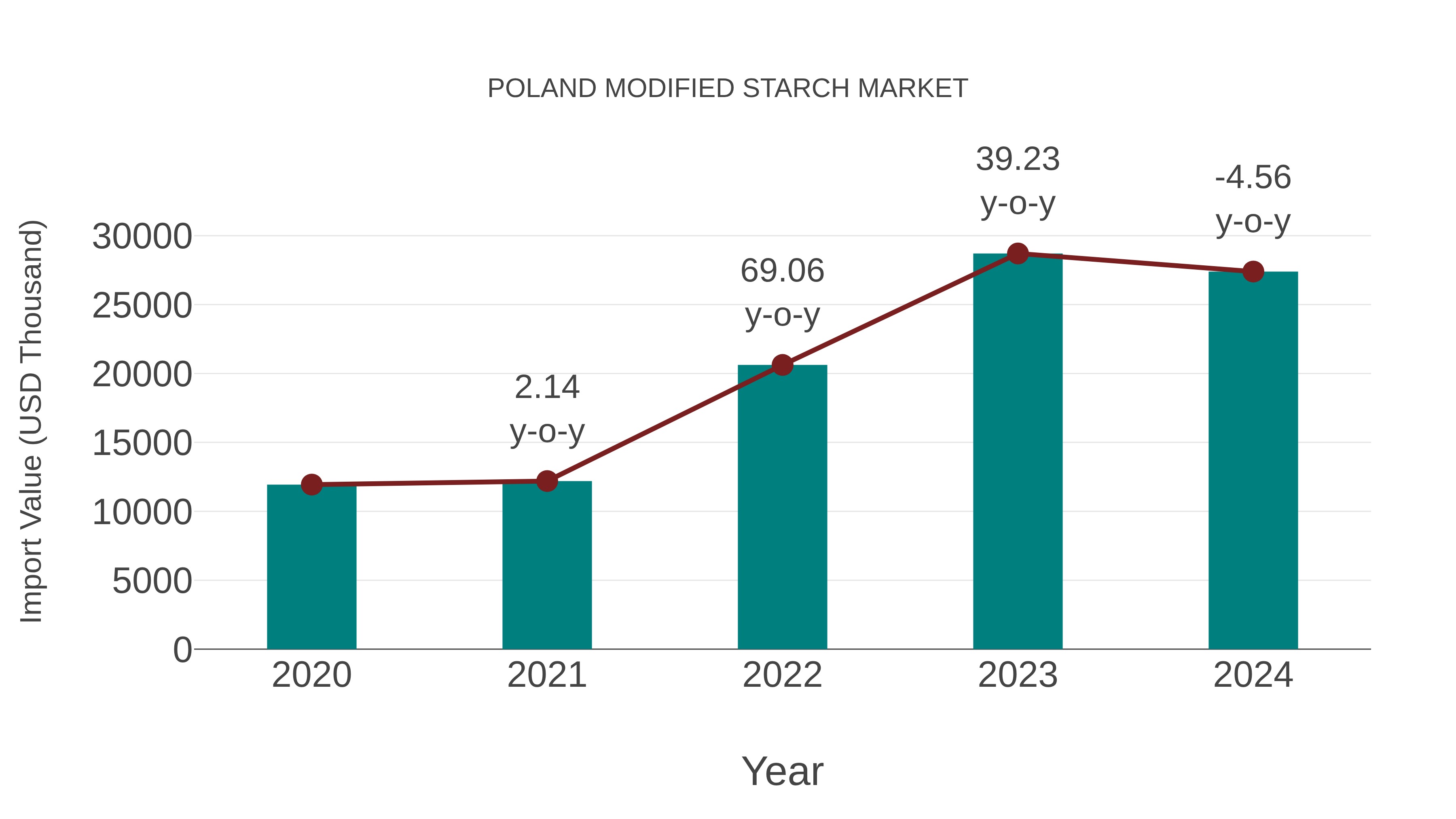
In the Poland modified starch market, the import trend experienced a decline from 2023 to 2024, with a growth rate of -4.56%. However, the compound annual growth rate (CAGR) for the period 2020-2024 stood at 23.08%. This shift may be attributed to fluctuations in demand dynamics or changes in trade policies impacting market stability.
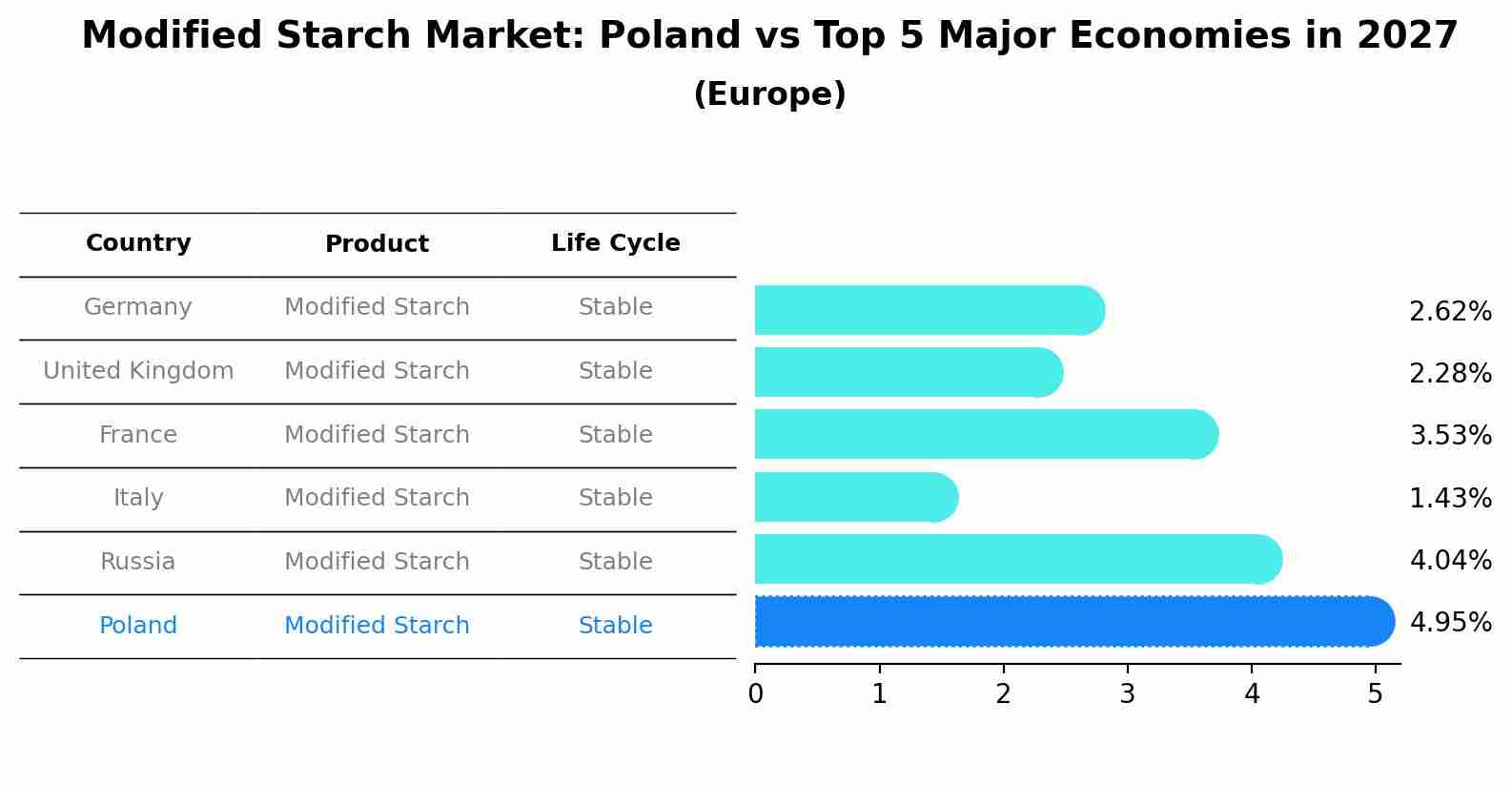
Modified Starch Market: Poland vs Top 5 Major Economies in 2027 (Europe)
By 2027, Poland's Modified Starch market is forecasted to achieve a stable growth rate of 4.95%, with Germany leading the Europe region, followed by United Kingdom, France, Italy and Russia.
Poland Modified Starch Market Overview
The Poland Modified Starch Market is experiencing steady growth due to increasing demand from various end-use industries such as food and beverage, pharmaceuticals, and paper production. The market is driven by factors such as the growing food processing industry, changing consumer preferences towards convenience foods, and the functional properties of modified starches like thickening, stabilizing, and enhancing texture. Moreover, the rising trend of clean-label products and the development of innovative starch modification techniques are expected to further propel market growth. Key players in the Poland Modified Starch Market include Cargill, Ingredion Incorporated, and Roquette Frères, among others, who are focusing on product innovation and expansion strategies to meet the evolving consumer demands and maintain a competitive edge in the market.
Poland Modified Starch Market Trends
The Poland Modified Starch Market is experiencing several key trends currently. One major trend is the increasing demand for clean label and natural ingredients in food products, leading to a rise in the use of modified starches derived from natural sources such as tapioca and corn. Another trend is the growing popularity of convenience foods and ready-to-eat products, driving the usage of modified starches for texture enhancement and stability. Additionally, there is a focus on product innovation and development of functional properties in modified starches to cater to the expanding food and beverage industry in Poland. Sustainability and environmentally friendly sourcing practices are also becoming more important considerations for manufacturers and consumers, influencing the market dynamics of modified starches in Poland.
Poland Modified Starch Market Challenges
In the Poland Modified Starch Market, some key challenges include increasing competition from other starch alternatives, fluctuating raw material prices impacting manufacturing costs, and the need for continuous innovation to meet changing consumer preferences and regulatory requirements. Additionally, the market may face challenges related to supply chain disruptions and sustainability concerns, as consumers are becoming more conscious of environmental issues. Companies operating in this market will need to focus on product differentiation, cost efficiency, and sustainability initiatives to remain competitive and address these challenges effectively.
Poland Modified Starch Market Investment Opportunities
The Poland Modified Starch Market presents several promising investment opportunities due to the increasing demand for modified starch in various industries such as food and beverage, pharmaceuticals, and paper manufacturing. With the growing trend towards clean label and natural ingredients in food products, there is a rising need for specialty modified starches that offer functional benefits while meeting consumer preferences. Investing in companies that specialize in producing specialty modified starches tailored to specific industry needs could be lucrative. Additionally, the ongoing research and development efforts in the field of modified starches to improve functionalities and applications further enhance the market`s growth potential. Overall, the Poland Modified Starch Market offers opportunities for investors to capitalize on the rising demand for innovative and sustainable starch solutions across multiple industries.
Poland Modified Starch Market Government Policy
In Poland, government policies related to the modified starch market primarily focus on ensuring food safety, quality control, and environmental sustainability. The Polish government has implemented regulations and standards to monitor the production, distribution, and labeling of modified starch products to safeguard consumer health and prevent misleading information. Additionally, there are policies in place to promote innovation and competitiveness within the industry while adhering to stringent environmental protection guidelines. The government also supports research and development initiatives to enhance the technological capabilities of local manufacturers and maintain high industry standards. Overall, the government`s policies aim to foster a transparent and efficient modified starch market in Poland that prioritizes consumer welfare and sustainable practices.
Poland Modified Starch Market Future Outlook
The future outlook for the Poland Modified Starch market appears promising, with anticipated growth driven by factors such as increasing demand from the food and beverage industry for applications in processed foods, convenience foods, and functional food products. Additionally, the rising trend of clean-label and natural ingredients in food products is expected to boost the demand for modified starch as a natural and versatile ingredient. The market is likely to witness innovation and product development in response to changing consumer preferences and regulatory requirements. Furthermore, the expanding industrial applications of modified starch in sectors such as pharmaceuticals, textiles, and paper production are projected to contribute to market growth. Overall, the Poland Modified Starch market is expected to experience steady expansion in the coming years.
Key Highlights of the Report:
- Poland Modified Starch Market Outlook
- Market Size of Poland Modified Starch Market, 2021
- Forecast of Poland Modified Starch Market, 2031
- Historical Data and Forecast of Poland Modified Starch Revenues & Volume for the Period 2018 - 2031
- Poland Modified Starch Market Trend Evolution
- Poland Modified Starch Market Drivers and Challenges
- Poland Modified Starch Price Trends
- Poland Modified Starch Porter's Five Forces
- Poland Modified Starch Industry Life Cycle
- Historical Data and Forecast of Poland Modified Starch Market Revenues & Volume By Source for the Period 2018 - 2031
- Historical Data and Forecast of Poland Modified Starch Market Revenues & Volume By Corn for the Period 2018 - 2031
- Historical Data and Forecast of Poland Modified Starch Market Revenues & Volume By Wheat for the Period 2018 - 2031
- Historical Data and Forecast of Poland Modified Starch Market Revenues & Volume By Cassava for the Period 2018 - 2031
- Historical Data and Forecast of Poland Modified Starch Market Revenues & Volume By Potato for the Period 2018 - 2031
- Historical Data and Forecast of Poland Modified Starch Market Revenues & Volume By Application for the Period 2018 - 2031
- Historical Data and Forecast of Poland Modified Starch Market Revenues & Volume By Food & Beverages for the Period 2018 - 2031
- Historical Data and Forecast of Poland Modified Starch Market Revenues & Volume By Animal Feed for the Period 2018 - 2031
- Historical Data and Forecast of Poland Modified Starch Market Revenues & Volume By Others for the Period 2018 - 2031
- Poland Modified Starch Import Export Trade Statistics
- Market Opportunity Assessment By Source
- Market Opportunity Assessment By Application
- Poland Modified Starch Top Companies Market Share
- Poland Modified Starch Competitive Benchmarking By Technical and Operational Parameters
- Poland Modified Starch Company Profiles
- Poland Modified Starch Key Strategic Recommendations






































