Poland Molded Pulp Packaging Market Size, Share & Growth Rate
The Poland Molded Pulp Packaging Market was estimated at USD 492 Million in 2025 and is projected to reach USD 677 Million by 2032, growing at a CAGR of 4.7% from 2026 to 2032. This growth trajectory reflects the increasing industrial pivot towards eco-friendly packaging solutions, primarily driven by consumer demand for sustainability. As businesses across sectors such as food and beverage, electronics, and consumer goods embrace molded pulp packaging, the market is further buoyed by advancements in molding technology that enhance product durability and functionality.
Poland Molded Pulp Packaging Market Year-wise Growth Rate and Key Drivers
This graph highlights how the Poland Molded Pulp Packaging Market has steadily grown over the years, supported by major growth factors.
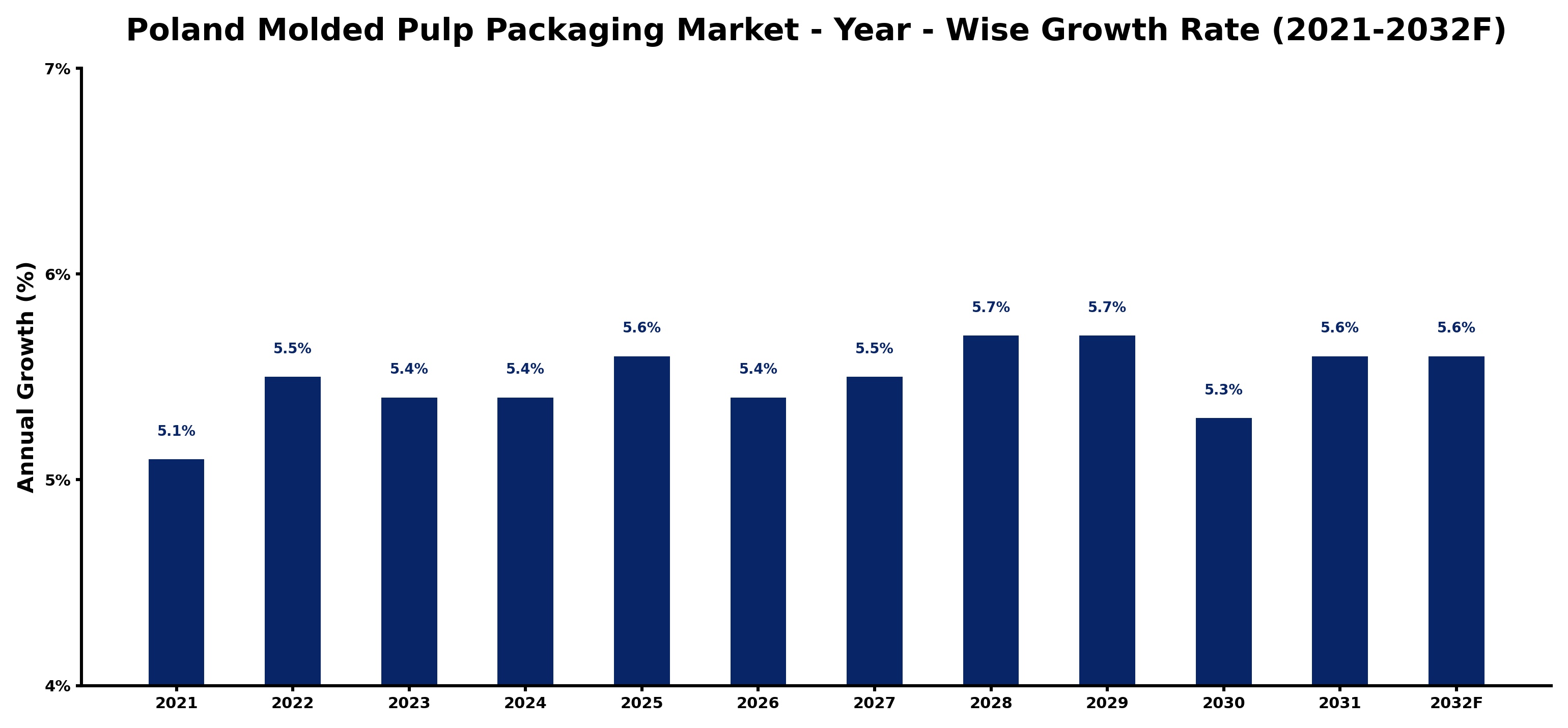
The table below presents the year‑wise growth rates along with the key drivers influencing the market
| Year | Growth Rate | Major Drivers |
| 2021 | 5.1% | Government infrastructure modernization initiatives |
| 2022 | 5.5% | Expansion of manufacturing activities |
| 2023 | 5.4% | Increasing smart city development projects |
| 2024 | 5.4% | Increasing industrial automation investments |
| 2025 | 5.6% | Expansion of transportation and logistics networks |
| 2026 | 5.4% | Expansion of transportation and logistics networks |
| 2027 | 5.5% | Increasing adoption of advanced technologies |
| 2028 | 5.7% | Increasing adoption of advanced technologies |
| 2029 | 5.7% | Expansion of manufacturing activities |
| 2030 | 5.3% | Increasing industrial automation investments |
| 2031 | 5.6% | Increasing industrial infrastructure investments |
| 2032 | 5.6% | Expansion of commercial construction activities |
Note - Market size estimations and growth projections presented in this report are based on 6Wresearch's advanced forecasting approach, validated with industry datasets as of June 2026.
Poland Molded Pulp Packaging Market Synopsis
The molded pulp packaging market in Poland is currently experiencing dynamic growth, characterized by a shift from traditional materials to sustainable alternatives. However, as industries navigate this transition, the focus is increasingly on innovation and meeting diverse packaging needs effectively.
Looking ahead, the market is expected to continue evolving, with technological advancements and heightened environmental awareness steering its future. The growing integration of circular economy principles into production processes is likely to further solidify molded pulp packaging's position as a viable option for various applications.
Poland Molded Pulp Packaging Market Key Takeaways
- The market is driven by a surge in demand for sustainable packaging solutions across multiple industries.
- Technological advancements are enhancing the functionality and durability of molded pulp products.
- Government policies are increasingly promoting eco-friendly packaging initiatives, supporting market growth.
- Consumer preference is shifting towards recyclable and biodegradable materials, impacting purchasing decisions.
- Effective cost management and raw material sourcing remain crucial for manufacturers in this evolving landscape.
Evaluation of Restraints in Poland Molded Pulp Packaging Market
Despite the positive outlook, the Poland Molded Pulp Packaging Market faces several restraints that could temper growth. Key among these are the fluctuations in raw material prices, which can significantly impact production costs. Additionally, ensuring consistent product quality while maintaining cost-efficiency poses a challenge for manufacturers. The competition from alternative packaging materials, particularly plastics and metals, remains a pressing concern as well. Lastly, compliance with stringent environmental regulations necessitates ongoing investment in sustainable practices, which could strain financial resources for some players.
Poland Molded Pulp Packaging Market Trends
Current trends in the Poland Molded Pulp Packaging Market illustrate a clear movement towards more sustainable practices. Companies are increasingly adopting innovative designs that not only reduce waste but also enhance product appeal. Furthermore, an uptick in consumer awareness about environmental issues is pushing businesses to adopt molded pulp solutions that resonate with eco-conscious consumers. Additionally, the rise of e-commerce has spurred demand for protective yet sustainable packaging options, indicating a transformative period for molded pulp applications.
Poland Molded Pulp Packaging Market Opportunities
As sustainability remains a focal point for many industries, the molded pulp packaging market is presented with ample opportunities for expansion. New product development targeting niche markets such as pharmaceuticals and cosmetics can yield significant returns. Moreover, investments in research and development to enhance molding technologies may lead to the creation of more versatile and durable packaging solutions. Expanding the export potential of Polish molded pulp products to neighboring regions could also provide lucrative avenues for growth.
Government Initiatives in the Poland Molded Pulp Packaging Market
The Polish government has been actively promoting initiatives that align with circular economy principles and sustainable packaging practices. Policies designed to enhance waste management and recycling programs are being implemented to support industries in their transition towards eco-friendly alternatives. Additionally, public investments in green technologies and incentives for companies that adopt sustainable practices contribute significantly to the growth and viability of the molded pulp packaging market.
Future Insights of the Poland Molded Pulp Packaging Market
Looking forward to the period between 2026 and 2032, the Poland Molded Pulp Packaging Market is expected to experience robust growth driven by a combination of consumer demand and regulatory support for sustainable practices. The advancement of packaging technologies will likely broaden the application scope for molded pulp, making it suitable for more complex packaging requirements. As businesses continue to prioritize sustainability, the market is poised to strengthen its foothold, positioning molded pulp as a leading alternative to conventional packaging materials.
Poland Molded Pulp Packaging Market Latest Developments (May 2025 - June 2026)
In recent months, there has been a notable shift in the industry as companies adopt new technologies aimed at improving the efficiency and environmental impact of production processes. Collaborations between industry players and research institutions have also increased, focusing on the development of innovative materials and methods. Additionally, heightened consumer awareness surrounding environmental sustainability is prompting brands to rethink their packaging strategies, favoring molded pulp solutions that cater to these preferences.
Poland Molded Pulp Packaging Market - Key Attractiveness of the Report
- 10 Years of Market Numbers
- Historical Data Starting from 2022 to 2025
- Base Year: 2025
- Forecast Data until 2032
- Key Performance Indicators Impacting the Market
- Major Upcoming Developments and Projects
Key Highlights of the Report:
- Poland Molded Pulp Packaging Market Outlook
- Market Size of Poland Molded Pulp Packaging Market, 2025
- Forecast of Poland Molded Pulp Packaging Market, 2032
- Historical Data and Forecast of Poland Molded Pulp Packaging Revenues & Volume for the Period 2022-2032F
- Poland Molded Pulp Packaging Market Trend Evolution
- Poland Molded Pulp Packaging Market Drivers and Challenges
- Poland Molded Pulp Packaging Price Trends
- Poland Molded Pulp Packaging Porter's Five Forces
- Poland Molded Pulp Packaging Industry Life Cycle
- Historical Data and Forecast of Poland Molded Pulp Packaging Market Revenues & Volume By Source for the Period 2022-2032F
- Historical Data and Forecast of Poland Molded Pulp Packaging Market Revenues & Volume By Wood Pulp for the Period 2022-2032F
- Historical Data and Forecast of Poland Molded Pulp Packaging Market Revenues & Volume By Non-wood Pulp for the Period 2022-2032F
- Historical Data and Forecast of Poland Molded Pulp Packaging Market Revenues & Volume By Molded Type for the Period 2022-2032F
- Historical Data and Forecast of Poland Molded Pulp Packaging Market Revenues & Volume By Thick Wall for the Period 2022-2032F
- Historical Data and Forecast of Poland Molded Pulp Packaging Market Revenues & Volume By Transfer for the Period 2022-2032F
- Historical Data and Forecast of Poland Molded Pulp Packaging Market Revenues & Volume By Thermoformed for the Period 2022-2032F
- Historical Data and Forecast of Poland Molded Pulp Packaging Market Revenues & Volume By Processed for the Period 2022-2032F
- Historical Data and Forecast of Poland Molded Pulp Packaging Market Revenues & Volume By Product for the Period 2022-2032F
- Historical Data and Forecast of Poland Molded Pulp Packaging Market Revenues & Volume By Trays for the Period 2022-2032F
- Historical Data and Forecast of Poland Molded Pulp Packaging Market Revenues & Volume By End Caps for the Period 2022-2032F
- Historical Data and Forecast of Poland Molded Pulp Packaging Market Revenues & Volume By Bowls & Cups for the Period 2022-2032F
- Historical Data and Forecast of Poland Molded Pulp Packaging Market Revenues & Volume By Clamshells for the Period 2022-2032F
- Historical Data and Forecast of Poland Molded Pulp Packaging Market Revenues & Volume By Plates for the Period 2022-2032F
- Historical Data and Forecast of Poland Molded Pulp Packaging Market Revenues & Volume By Others for the Period 2022-2032F
- Poland Molded Pulp Packaging Import Export Trade Statistics
- Market Opportunity Assessment By Source
- Market Opportunity Assessment By Molded Type
- Market Opportunity Assessment By Product
- Poland Molded Pulp Packaging Top Companies Market Share
- Poland Molded Pulp Packaging Competitive Benchmarking By Technical and Operational Parameters
- Poland Molded Pulp Packaging Company Profiles
- Poland Molded Pulp Packaging Key Strategic Recommendations






































