Poland Multifunctional Composite Materials Market Summary
The poland multifunctional composite materials market was estimated at USD 394 Million in 2025 and is projected to reach USD 557 Million by 2032, growing at a CAGR of 5.6% from 2026 to 2032.
Poland Multifunctional Composite Materials Market Year-wise Growth Rate and Key Drivers
This graph highlights how the Poland Multifunctional Composite Materials Market has steadily grown over the past five years, supported by major growth factors.
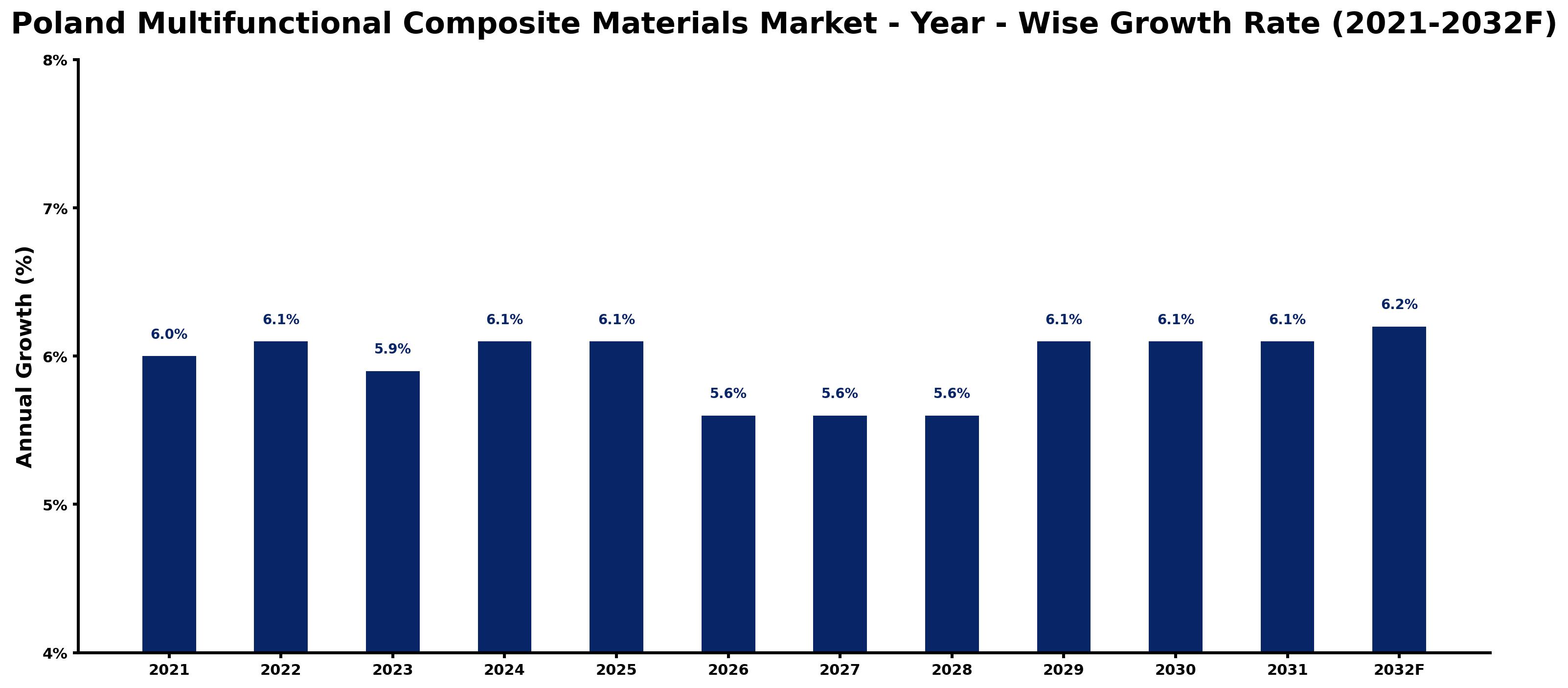
The table below presents the year wise growth rates along with the key drivers influencing the market
| Year | Growth Rate | Major Drivers |
| 2021 | 6.0% | Post-pandemic recovery emphasized the need for durable materials in construction. |
| 2022 | 6.1% | Local manufacturers began investing heavily in advanced composite production technologies. |
| 2023 | 5.9% | Companies started exploring lightweight materials for automotive applications and sustainability. |
| 2024 | 6.1% | Emerging sectors like renewable energy demanded multifunctional materials for efficiency. |
| 2025 | 6.1% | Collaborations between universities and industries sparked innovation in composite applications. |
| 2026 | 5.6% | Technological breakthroughs in nanocomposites enhanced performance and durability significantly. |
| 2027 | 5.6% | An influx of foreign investment aimed to boost local composite production capacities. |
| 2028 | 5.6% | Market players began focusing on recycling initiatives to address environmental concerns. |
| 2029 | 6.1% | Consumer preferences shifted towards eco-friendly materials, impacting manufacturing strategies. |
| 2030 | 6.1% | Research institutions established partnerships to drive advancements in composite technologies. |
| 2031 | 6.1% | Poland's strategic location attracted logistics companies seeking composite material suppliers. |
| 2032 | 6.2% | The automotive sector's transformation accelerated the demand for high-performance composites. |
Note - Market size estimations and growth projections presented in this report are based on 6Wresearch's advanced forecasting approach, validated with industry datasets as of June 2026.
Poland Multifunctional Composite Materials Market Synopsis
The Poland Multifunctional Composite Materials Market is projected to reach 5.6% and witness significant growth during the forecast period (2026-2032). This expansion is driven by increasing adoption across various industrial sectors, including aerospace, automotive, and construction, where the properties of multifunctional composites enhance overall performance and sustainability.
Poland Multifunctional Composite Materials Market Growth Drivers
The growth of the Poland Multifunctional Composite Materials Market can be attributed to several key factors:
- The rising demand for lightweight and high-strength materials is a primary driver in sectors such as aerospace and automotive, where reducing weight can lead to improved fuel efficiency and performance.
- Technological advancements in composite material manufacturing processes have led to enhanced mechanical properties, making these composites more appealing for high-performance applications.
- The increasing focus on sustainability and reducing carbon footprints has encouraged industries to adopt multifunctional composites, which often have a lower environmental impact compared to traditional materials.
- Innovative applications of multifunctional composites are expanding into new sectors, such as renewable energy and sports equipment, further broadening market opportunities.
- Growing investments in research and development are facilitating the exploration of advanced composite materials, addressing complex engineering challenges across various industries.
Poland Multifunctional Composite Materials Market Challenges and Restraints
Despite its growth potential, the Poland Multifunctional Composite Materials Market faces several challenges:
- The complexity of developing composites that balance multiple performance characteristics, such as strength, weight, and environmental resistance, poses significant technical challenges for manufacturers.
- Higher costs associated with raw materials and production processes may deter some companies from transitioning to multifunctional composites, especially in price-sensitive markets.
- Competition from alternative materials, such as metals and ceramics, remains a concern, as these traditional options are often well-established and trusted in various applications.
- Supply chain disruptions and material sourcing issues can impact the availability and pricing of vital components needed for composite production.
- Maintaining consistent quality and performance in multifunctional composites is critical, necessitating ongoing investment in quality control and material testing.
Poland Multifunctional Composite Materials Market Government Investment and Initiatives
The Polish government plays a significant role in shaping the multifunctional composite materials market through various initiatives and investments:
- Government policies aimed at bolstering the aerospace and defense sectors have led to increased funding for research and development of advanced materials, including multifunctional composites.
- Public spending on infrastructure projects and initiatives promoting the construction of sustainable buildings have created opportunities for the application of composite materials.
- National strategies focusing on innovation and technology development encourage collaborations between government entities, research institutions, and the private sector.
- Supportive regulations and incentives for companies investing in environmental sustainability are steering industries toward the adoption of multifunctional materials with lower ecological footprints.
- Government-funded educational programs and initiatives aim to develop a skilled workforce proficient in composite material technologies, ensuring the industry's growth and competitiveness.
Poland Multifunctional Composite Materials Market Latest Developments (May 2025 - June 2026)
During the period from May 2025 to June 2026, the Poland Multifunctional Composite Materials Market has experienced several notable developments:
- There has been a noticeable increase in cross-industry collaborations aimed at enhancing the performance of composites, particularly between automotive manufacturers and material scientists.
- Technological advancements in manufacturing techniques, such as 3D printing, have begun to transform the way multifunctional composites are produced, making processes more efficient and cost-effective.
- The market has seen heightened interest from the renewable energy sector, particularly in wind energy applications, as companies seek lightweight and durable materials for turbine construction.
- Developments in recycling technologies for composite materials are gaining traction, supporting sustainability goals and reducing waste associated with composite production.
- Research initiatives focusing on bio-based composites have emerged, reflecting a growing trend toward environmentally friendly materials in various applications.
Poland Multifunctional Composite Materials Market - Key Attractiveness of the Report
- 10 Years of Market Numbers
- Historical Data Starting from 2022 to 2025
- Base Year: 2025
- Forecast Data until 2032
- Key Performance Indicators Impacting the Market
- Major Upcoming Developments and Projects
Key Highlights of the Report:
- Poland Multifunctional Composite Materials Market Outlook
- Market Size of Poland Multifunctional Composite Materials Market, 2025
- Forecast of Poland Multifunctional Composite Materials Market, 2032
- Historical Data and Forecast of Poland Multifunctional Composite Materials Revenues & Volume for the Period 2022-2032F
- Poland Multifunctional Composite Materials Market Trend Evolution
- Poland Multifunctional Composite Materials Market Drivers and Challenges
- Poland Multifunctional Composite Materials Price Trends
- Poland Multifunctional Composite Materials Porter's Five Forces
- Poland Multifunctional Composite Materials Industry Life Cycle
- Historical Data and Forecast of Poland Multifunctional Composite Materials Market Revenues & Volume By Product Type for the Period 2022-2032F
- Historical Data and Forecast of Poland Multifunctional Composite Materials Market Revenues & Volume By Carbon Fiber for the Period 2022-2032F
- Historical Data and Forecast of Poland Multifunctional Composite Materials Market Revenues & Volume By Fabrics/Reinforcements for the Period 2022-2032F
- Historical Data and Forecast of Poland Multifunctional Composite Materials Market Revenues & Volume By Prepregs/Resins for the Period 2022-2032F
- Historical Data and Forecast of Poland Multifunctional Composite Materials Market Revenues & Volume By Adhesives for the Period 2022-2032F
- Historical Data and Forecast of Poland Multifunctional Composite Materials Market Revenues & Volume By Honeycomb for the Period 2022-2032F
- Historical Data and Forecast of Poland Multifunctional Composite Materials Market Revenues & Volume By Other for the Period 2022-2032F
- Historical Data and Forecast of Poland Multifunctional Composite Materials Market Revenues & Volume By Applications for the Period 2022-2032F
- Historical Data and Forecast of Poland Multifunctional Composite Materials Market Revenues & Volume By Aerospace Industry for the Period 2022-2032F
- Historical Data and Forecast of Poland Multifunctional Composite Materials Market Revenues & Volume By Medical Industry for the Period 2022-2032F
- Historical Data and Forecast of Poland Multifunctional Composite Materials Market Revenues & Volume By Machinery Industry for the Period 2022-2032F
- Historical Data and Forecast of Poland Multifunctional Composite Materials Market Revenues & Volume By Achitechture Industry for the Period 2022-2032F
- Historical Data and Forecast of Poland Multifunctional Composite Materials Market Revenues & Volume By Other for the Period 2022-2032F
- Poland Multifunctional Composite Materials Import Export Trade Statistics
- Market Opportunity Assessment By Product Type
- Market Opportunity Assessment By Applications
- Poland Multifunctional Composite Materials Top Companies Market Share
- Poland Multifunctional Composite Materials Competitive Benchmarking By Technical and Operational Parameters
- Poland Multifunctional Composite Materials Company Profiles
- Poland Multifunctional Composite Materials Key Strategic Recommendations






































