Poland MVNO Market Size & Growth Rate (2026-2032)
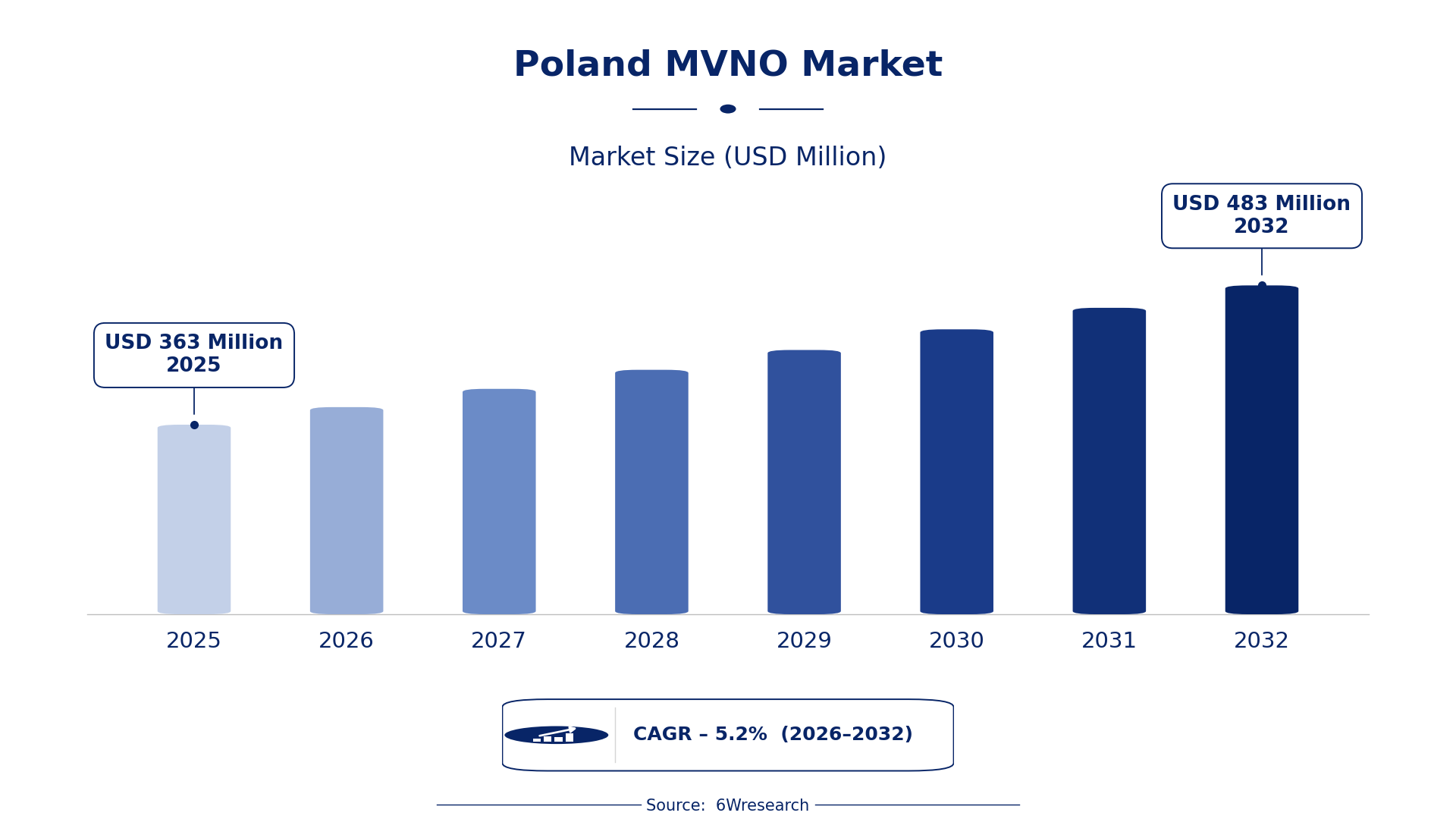
The Poland MVNO Market was estimated at USD 363 Million in 2025 and is projected to reach USD 483 Million by 2032, growing at a CAGR of 5.2% from 2026 to 2032.
Poland MVNO Market Synopsis
The Poland MVNO market is becoming increasingly dynamic as consumers seek affordable and flexible mobile service options. With a growing emphasis on data-heavy plans, MVNOs are well-positioned to attract price-sensitive customers who prioritize value.
Several MVNOs in Poland are specifically targeting niche segments, such as students and international travelers, with tailored offerings. This approach not only differentiates them from major operators but also enhances customer loyalty by addressing specific needs.
Poland MVNO Market Year-wise Growth Rate and Key Drivers
This graph illustrates the annual growth rates of the Poland MVNO Market from 2021 to 2032, highlighting a steady upward trajectory and projected expansion over the forecast period.
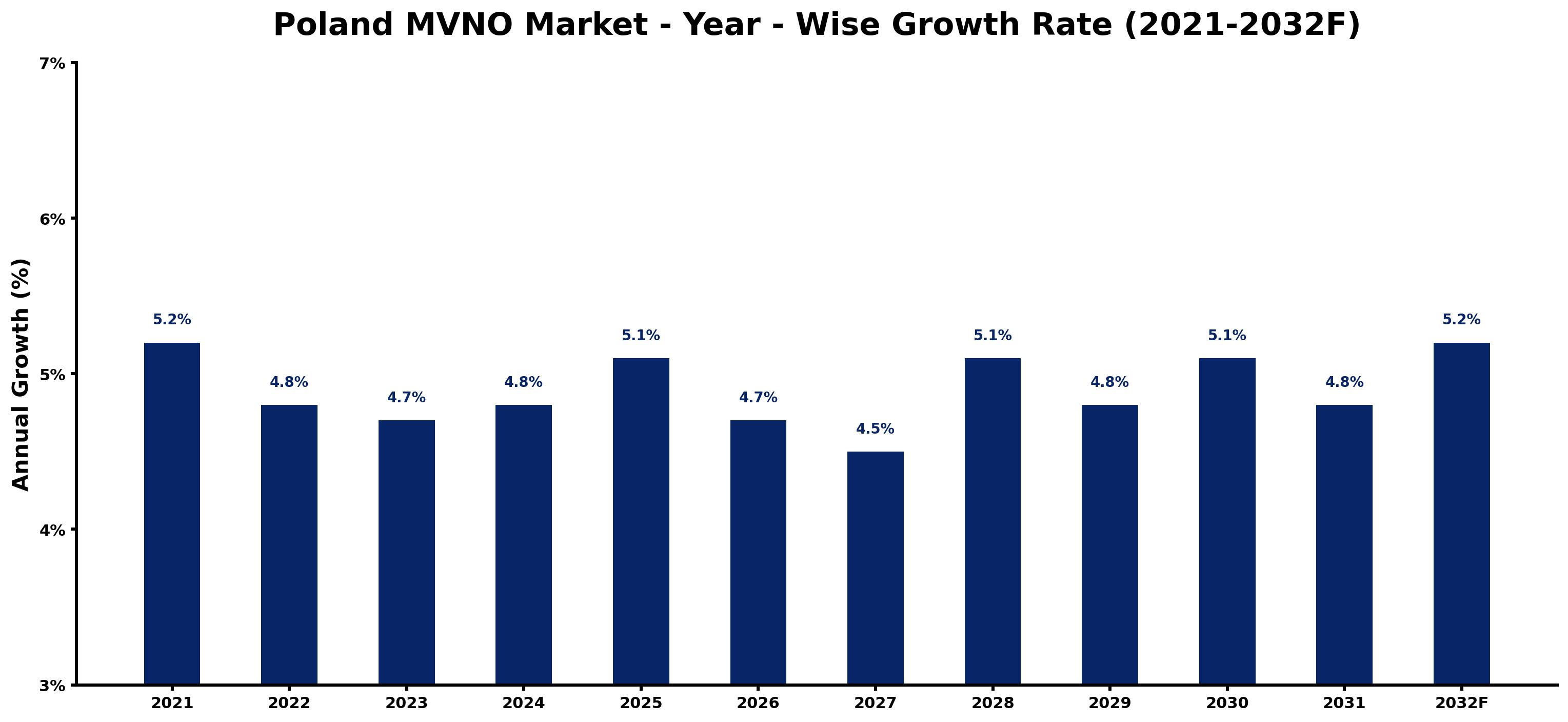
The table below presents the year‑wise growth rates along with the key drivers influencing the market
| Year | Growth Rate | Major Drivers |
| 2021 | 5.2% | Launch of new digital-only MVNOs in Poland |
| 2022 | 4.8% | Increased demand for budget-friendly mobile services |
| 2023 | 4.7% | Regulatory support for mobile network sharing agreements |
| 2024 | 4.8% | Growing adoption of mobile payment solutions in Poland |
| 2025 | 5.1% | Poland's youth market demanding flexible data plans |
| 2026 | 4.7% | Rising number of remote workers needing affordable plans |
| 2027 | 4.5% | Stable regulation fostering competition among MVNOs |
| 2028 | 5.1% | Increased smartphone penetration enhancing MVNO offerings |
| 2029 | 4.8% | Enhanced data services driving subscriber growth |
| 2030 | 5.1% | Sustained growth in localized content consumption |
| 2031 | 4.8% | Development of innovative bundling strategies by MVNOs |
| 2032 | 5.2% | Government incentives for tech startup collaboration |
Note: Market size estimations and growth projections presented in this report are based on 6Wresearch's proprietary forecasting methodology, utilizing the latest available industry data, government publications, and primary research inputs.
Poland MVNO Market Key Takeaways
Below are some of the specific key takeaways from the market, including:
- The increasing smartphone penetration is driving demand for data-centric mobile plans.
- Partnerships with major operators allow MVNOs to provide competitive pricing and services.
- Niche targeting strategies are enhancing customer engagement and satisfaction.
- Regulatory frameworks are evolving to foster competition and protect consumer interests.
- Value-added services, such as international roaming and data rollover, are becoming commonplace.
Evaluation of Restraints in Poland MVNO Market
Despite the positive outlook, several restraints are constraining the Poland MVNO market. Intense competition from established MNOs makes it challenging for MVNOs to carve out a distinctive identity. Limited access to essential infrastructure and spectrum further complicates the operational landscape for new entrants. Regulatory hurdles, including stringent licensing requirements, can deter potential players. Finally, the rapid evolution of consumer preferences necessitates constant adaptation, putting additional pressure on MVNOs to innovate.
Poland MVNO Market Trends
The Poland MVNO market is currently witnessing several noteworthy trends. MVNOs are increasingly focusing on offering customizable plans that cater to specific consumer demographics. The surge in mobile internet usage has prompted these operators to enhance their data offerings, with many introducing unlimited data plans and family bundles. on top of that, partnerships for integrated services are on the rise, enabling MVNOs to provide additional features like mobile banking and streaming services.
Poland MVNO Market Opportunities
A wealth of growth opportunities exists in the Poland MVNO market. Collaborations with established mobile operators can provide access to necessary infrastructure and broaden service offerings. Innovative pricing strategies tailored to specific customer segments can attract a larger audience. The ongoing digital transformation offers avenues for MVNOs to enhance customer experience through improved online platforms and customer service solutions. on top of that, as consumer demands for transparency and flexibility grow, MVNOs can capitalize on these trends by offering clear and adaptable service packages.
Government Initiatives in the Poland MVNO Market
The Polish government's regulatory framework plays a critical role in shaping the MVNO market. By promoting competition and protecting consumer rights, the Office of Electronic Communications (UKE) ensures a level playing field. Recent initiatives have been aimed at modernizing the telecom sector, thereby enhancing the overall market environment for MVNOs.
- A regulatory framework introduced in 2025 mandating clearer billing practices for MVNOs.
- An ongoing initiative to upgrade national telecommunications infrastructure, expected to improve connectivity by 2026.
- A recently completed program aimed at simplifying licensing processes for new MVNO entrants.
- Planned public-private partnerships focused on expanding rural connectivity, set to commence in late 2026.
- Current efforts to monitor and ensure fair interconnection agreements between MNOs and MVNOs.
Future Insights of the Poland MVNO Market
Looking ahead to 2026-2032, the Poland MVNO market is set for continued growth. With the increasing demand for affordable mobile services and the ongoing shift towards mobile data consumption, MVNOs will find ample opportunities to expand their market share. The focus on consumer-centric offerings and partnerships with major network operators will be crucial in distinguishing themselves in a competitive environment. Regulatory support will further enhance the landscape, allowing MVNOs to innovate and respond to changing consumer needs effectively.
Poland MVNO Market Latest Developments
Recent developments in the Poland MVNO market indicate a vibrant and competitive atmosphere. As MVNOs adapt to evolving consumer needs, numerous initiatives and product launches have emerged over the past year, showcasing their agility in this fast-paced sector.
- A leading MVNO launched a new unlimited data plan in early 2025, catering to heavy data users.
- Currently ongoing is a service enhancement initiative that began in mid-2025, focusing on improving customer support through AI technologies.
- In Q3 2025, a partnership between an MVNO and a tech vendor was announced, aimed at integrating advanced mobile payment solutions.
- Plans for a service expansion into underserved rural areas are scheduled to begin in late 2026, focusing on increasing access.
- Several MVNOs are currently upgrading their mobile applications to provide enhanced user experiences and service management tools.
Poland MVNO Market - Key Attractiveness of the Report
- 10 Years of Market Numbers
- Historical Data Starting from 2022 to 2025
- Base Year: 2025
- Forecast Data until 2032
- Key Performance Indicators Impacting the Market
- Major Upcoming Developments and Projects
Key Highlights of the Report:
- Poland MVNO Market Outlook
- Market Size of Poland MVNO Market, 2025
- Forecast of Poland MVNO Market, 2032
- Historical Data and Forecast of Poland MVNO Revenues & Volume for the Period 2022-2032F
- Poland MVNO Market Trend Evolution
- Poland MVNO Market Drivers and Challenges
- Poland MVNO Price Trends
- Poland MVNO Porter's Five Forces
- Poland MVNO Industry Life Cycle
- Historical Data and Forecast of Poland MVNO Market Revenues & Volume By Operational Model for the Period 2022-2032F
- Historical Data and Forecast of Poland MVNO Market Revenues & Volume By Reseller for the Period 2022-2032F
- Historical Data and Forecast of Poland MVNO Market Revenues & Volume By Service Operator for the Period 2022-2032F
- Historical Data and Forecast of Poland MVNO Market Revenues & Volume By Full MVNO for the Period 2022-2032F
- Historical Data and Forecast of Poland MVNO Market Revenues & Volume By Organization Size for the Period 2022-2032F
- Historical Data and Forecast of Poland MVNO Market Revenues & Volume By SMES for the Period 2022-2032F
- Historical Data and Forecast of Poland MVNO Market Revenues & Volume By Large Enterprise for the Period 2022-2032F
- Historical Data and Forecast of Poland MVNO Market Revenues & Volume By Subscriber for the Period 2022-2032F
- Historical Data and Forecast of Poland MVNO Market Revenues & Volume By Consumer for the Period 2022-2032F
- Historical Data and Forecast of Poland MVNO Market Revenues & Volume By Enterprise for the Period 2022-2032F
- Poland MVNO Import Export Trade Statistics
- Market Opportunity Assessment By Operational Model
- Market Opportunity Assessment By Organization Size
- Market Opportunity Assessment By Subscriber
- Poland MVNO Top Companies Market Share
- Poland MVNO Competitive Benchmarking By Technical and Operational Parameters
- Poland MVNO Company Profiles
- Poland MVNO Key Strategic Recommendations






































