Poland Oil & Gas Pumps Market Size, Share & Growth Rate
The Poland Oil & Gas Pumps Market was estimated at USD 194 Million in 2025 and is projected to reach USD 257 Million by 2032, growing at a CAGR of 4.1% from 2026 to 2032. This upward trajectory is primarily fueled by substantial investments in oil and gas exploration and production activities across Poland. Coupled with rising energy demands and advancements in pump technologies, the market is set for robust growth as companies increasingly seek efficiency and reliability in their operations.
Poland Oil & Gas Pumps Market Year-wise Growth Rate and Key Drivers
This graph highlights how the Poland Oil & Gas Pumps Market has steadily grown over the years, supported by major growth factors.
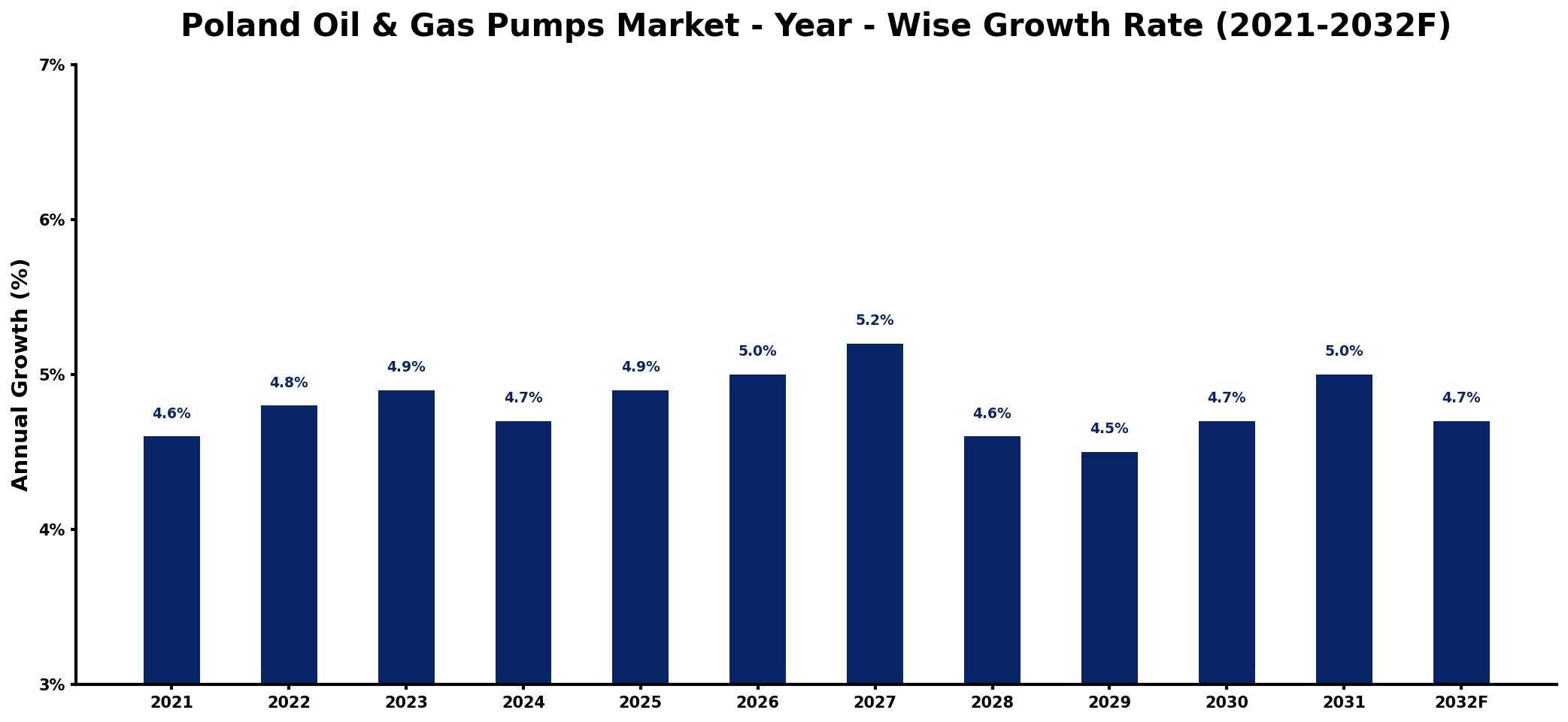
The table below presents the year‑wise growth rates along with the key drivers influencing the market
| Year | Growth Rate | Major Drivers |
| 2021 | 4.6% | Increased industrial manufacturing activities |
| 2022 | 4.8% | Rising energy sector investments |
| 2023 | 4.9% | Expansion of renewable energy projects |
| 2024 | 4.7% | Growing infrastructure development initiatives |
| 2025 | 4.9% | Higher transportation sector requirements |
| 2026 | 5.0% | Strengthened international trade relations |
| 2027 | 5.2% | Advancements in automation technologies |
| 2028 | 4.6% | Emergence of new market entrants |
| 2029 | 4.5% | Improved regulatory frameworks established |
| 2030 | 4.7% | Surge in construction projects ongoing |
| 2031 | 5.0% | Enhanced research and development funding |
| 2032 | 4.7% | Increased focus on sustainability practices |
Note: Market size estimations and growth projections presented in this report are based on 6Wresearch's proprietary forecasting methodology, utilizing the latest available industry data, government publications, and primary research inputs.
Poland Oil & Gas Pumps Market Synopsis
A significant force currently shaping the Poland Oil & Gas Pumps Market is the ongoing transition toward smarter, more automated pumping solutions. As operators strive for efficiency, theres a notable shift towards integrating advanced technologies that facilitate real-time monitoring and predictive maintenance.
Additionally, the sector's growth is underpinned by rising demand for energy and the emphasis on sustainability. With regulatory frameworks pushing for environmentally friendly practices, manufacturers are innovating to create pumps that not only meet operational needs but also address environmental concerns.
- The market is experiencing a shift towards automated and intelligent pumping technologies.
- Regulatory pressures are shaping product development towards sustainability and efficiency.
- Investment in infrastructure is critical for expanding production capacity in the oil and gas sector.
- Companies are increasingly focusing on high-performance, low-maintenance pump solutions.
- Digital transformation within the industry presents new avenues for growth and operational optimization.
Despite its promising growth trajectory, the Poland Oil & Gas Pumps Market faces several constraints that could temper its expansion. Stringent regulations related to environmental impacts and operational safety add layers of complexity to project execution. Moreover, fluctuating oil prices introduce uncertainty, which can adversely affect investment decisions. The growing emphasis on renewable energy sources poses a challenge, compelling traditional oil and gas sectors to adapt quickly or risk falling behind. As such, it is essential for stakeholders to navigate these hurdles through innovation and strategic adaptation.
The market is witnessing a pronounced trend toward advanced technology adoption. Companies are increasingly integrating IoT capabilities into their pumping systems, enabling functionalities like remote control and data analytics. Additionally, there is a concerted effort to enhance energy efficiency and sustainability through the use of eco-friendly materials and designs. Furthermore, as offshore drilling becomes more prevalent, theres a corresponding demand for pumps capable of withstanding harsh operational environments.
As Polands energy sector continues to develop, the Oil & Gas Pumps Market presents compelling investment opportunities. With the government's focus on enhancing energy security and diversifying sources, infrastructure improvements will necessitate modern, efficient pumping systems. Additionally, the push towards digitalization in the sector opens doors for companies that specialize in cutting-edge pump technologies, smart solutions, and comprehensive maintenance services. This environment is ripe for businesses that can offer innovative, cost-effective products that meet evolving regulatory and operational demands.
Government policies play a critical role in shaping the Poland Oil & Gas Pumps Market. Strategic frameworks, such as the Energy Policy of Poland until 2040, emphasize reducing greenhouse gas emissions while enhancing the share of renewable energy. Furthermore, the National Energy Security Strategy highlights the importance of diversifying energy sources and strengthening infrastructure. Compliance with drilling regulations and environmental assessments also underscores the governments commitment to sustainable exploration and extraction practices. These initiatives ensure that market players operate within a framework that promotes responsible growth.
Looking ahead to 2026-2032, the outlook for the Poland Oil & Gas Pumps Market remains optimistic. The anticipated increase in exploration activities, driven by rising energy demands, will likely sustain market growth. Technological advancements will continue to be pivotal, as industry stakeholders seek to enhance operational efficiency and reduce downtime through innovative pumping solutions. However, ongoing environmental regulations and the shift towards renewables will necessitate agility and adaptation from traditional players, paving the way for a more sustainable industry landscape.
Recent developments in the Poland Oil & Gas Pumps Market indicate a growing emphasis on digital solutions and automation. Industry players are increasingly exploring partnerships to develop smart pumping systems that integrate IoT technologies. Additionally, advancements in pump designs that enhance energy efficiency are gaining traction, reflecting the industrys shift towards sustainability. The focus on research and development is expected to intensify, aiming to meet stringent regulatory standards while ensuring operational reliability.
- 10 Years of Market Numbers
- Historical Data Starting from 2022 to 2025
- Base Year: 2025
- Forecast Data until 2032
- Key Performance Indicators Impacting the Market
- Major Upcoming Developments and Projects
Key Highlights of the Report:
- Poland Oil & Gas Pumps Market Outlook
- Market Size of Poland Oil & Gas Pumps Market, 2025
- Forecast of Poland Oil & Gas Pumps Market, 2032
- Historical Data and Forecast of Poland Oil & Gas Pumps Revenues & Volume for the Period 2022-2032F
- Poland Oil & Gas Pumps Market Trend Evolution
- Poland Oil & Gas Pumps Market Drivers and Challenges
- Poland Oil & Gas Pumps Price Trends
- Poland Oil & Gas Pumps Porter's Five Forces
- Poland Oil & Gas Pumps Industry Life Cycle
- Historical Data and Forecast of Poland Oil & Gas Pumps Market Revenues & Volume By Type for the Period 2022-2032F
- Historical Data and Forecast of Poland Oil & Gas Pumps Market Revenues & Volume By Submersible Pumps for the Period 2022-2032F
- Historical Data and Forecast of Poland Oil & Gas Pumps Market Revenues & Volume By Non-submersible Pumps for the Period 2022-2032F
- Historical Data and Forecast of Poland Oil & Gas Pumps Market Revenues & Volume By Pump Type for the Period 2022-2032F
- Historical Data and Forecast of Poland Oil & Gas Pumps Market Revenues & Volume By Centrifugal Pump for the Period 2022-2032F
- Historical Data and Forecast of Poland Oil & Gas Pumps Market Revenues & Volume By Positive Displacement Pump for the Period 2022-2032F
- Historical Data and Forecast of Poland Oil & Gas Pumps Market Revenues & Volume By Cryogenic Pump for the Period 2022-2032F
- Historical Data and Forecast of Poland Oil & Gas Pumps Market Revenues & Volume By Application for the Period 2022-2032F
- Historical Data and Forecast of Poland Oil & Gas Pumps Market Revenues & Volume By Upstream for the Period 2022-2032F
- Historical Data and Forecast of Poland Oil & Gas Pumps Market Revenues & Volume By Midstream for the Period 2022-2032F
- Historical Data and Forecast of Poland Oil & Gas Pumps Market Revenues & Volume By Downstream for the Period 2022-2032F
- Poland Oil & Gas Pumps Import Export Trade Statistics
- Market Opportunity Assessment By Type
- Market Opportunity Assessment By Pump Type
- Market Opportunity Assessment By Application
- Poland Oil & Gas Pumps Top Companies Market Share
- Poland Oil & Gas Pumps Competitive Benchmarking By Technical and Operational Parameters
- Poland Oil & Gas Pumps Company Profiles
- Poland Oil & Gas Pumps Key Strategic Recommendations






































