Poland Organ Preservation Market Size, Share & Growth Rate
The Poland Organ Preservation Market was estimated at USD 270 Million in 2025 and is projected to reach USD 371 Million by 2032, growing at a CAGR of 4.6% from 2026 to 2032. This growth trajectory is propelled by a significant rise in organ transplant demand due to increasing incidences of organ failure. Additionally, technological advancements in preservation methods are enhancing the viability of donor organs, further supporting market expansion.
Poland Organ Preservation Market Year-wise Growth Rate and Key Drivers
This graph highlights how the Poland Organ Preservation Market has steadily grown over the years, supported by major growth factors.
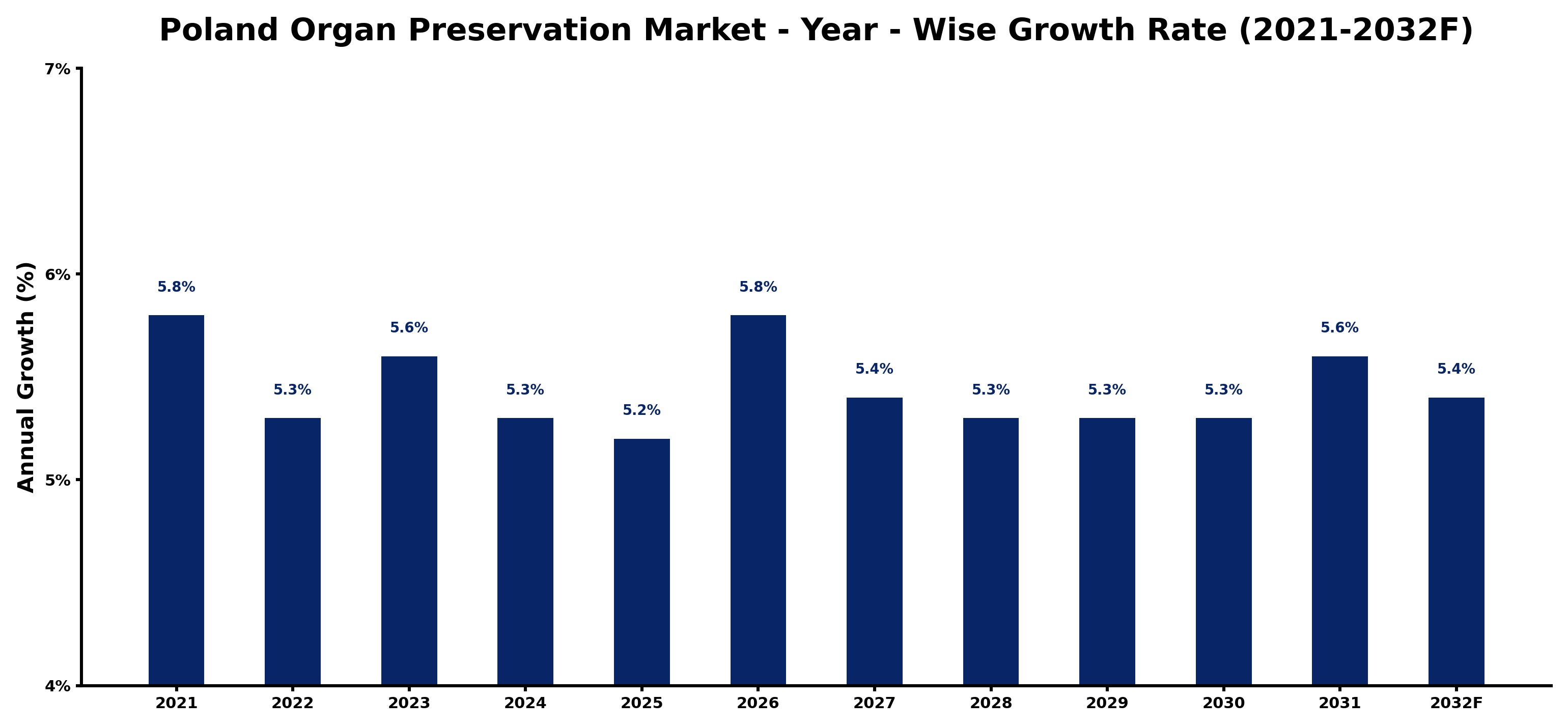
The table below presents the year‑wise growth rates along with the key drivers influencing the market
| Year | Growth Rate | Major Drivers |
| 2021 | 5.8% | Rising electricity demand across industries |
| 2022 | 5.3% | Increasing industrial infrastructure investments |
| 2023 | 5.6% | Government infrastructure modernization initiatives |
| 2024 | 5.3% | Growing renewable energy integration projects |
| 2025 | 5.2% | Expansion of transportation and logistics networks |
| 2026 | 5.8% | Rapid growth in telecom and data center sectors |
| 2027 | 5.4% | Expansion of transportation and logistics networks |
| 2028 | 5.3% | Expansion of transportation and logistics networks |
| 2029 | 5.3% | Growing urbanization and commercial development |
| 2030 | 5.3% | Increasing adoption of advanced technologies |
| 2031 | 5.6% | Growing urbanization and commercial development |
| 2032 | 5.4% | Expansion of commercial construction activities |
Note - Market size estimations and growth projections presented in this report are based on 6Wresearch’s advanced forecasting approach, validated with industry datasets as of June 2026.
Poland Organ Preservation Market Synopsis
In Poland, the escalating demand for organ transplants is a direct result of rising chronic diseases, which frequently lead to organ failure. Consequently, there is an urgent need for effective preservation techniques that extend organ viability, particularly as the healthcare system strives to address this critical gap.
The market is also witnessing an increased focus on advanced technologies, such as machine perfusion systems and cryopreservation, to enhance organ quality during transportation and storage. This shift reflects a broader trend of innovation within Poland's healthcare landscape aimed at improving transplant outcomes and mitigating the ongoing organ shortage.
Poland Organ Preservation Market Key Takeaways
- The market is driven by increasing transplant demand fueled by rising chronic illnesses.
- Advancements in preservation technologies are enhancing organ viability and quality.
- There is a growing emphasis on personalized preservation strategies tailored to individual patient needs.
- Investment in training programs and technology advancements is vital for improving outcomes.
- Government policies focus on ethical practices and enhancing public awareness of organ donation.
Evaluation of Restraints in Poland Organ Preservation Market
Despite the positive outlook, the Poland Organ Preservation Market faces considerable restraints. A significant barrier is the limited access to advanced preservation technologies across the healthcare system, which can negatively impact organ viability and transplant success. Additionally, the shortage of skilled professionals proficient in organ preservation techniques further complicates the situation. Regulatory challenges and budgetary constraints may also hinder the adoption of innovative preservation solutions, slowing market growth. Addressing these barriers will be crucial in enhancing the effectiveness of organ transplant procedures.
Poland Organ Preservation Market Trends
Emerging trends in the Poland Organ Preservation Market include a notable shift towards more sophisticated preservation methods. Technologies such as hypothermic and normothermic machine perfusion are gaining traction, as they are proven to extend organ viability more effectively than traditional storage methods. Furthermore, there is a rising focus on the development of personalized preservation strategies tailored to different organ types and patient-specific requirements, which aims to improve transplant outcomes and address the existing donor organ shortage.
Poland Organ Preservation Market Opportunities
The market presents substantial investment opportunities, particularly in the realm of innovative organ preservation technologies. As the demand for organ transplants rises, there is an urgent need for advanced preservation methods to enhance transplant success rates and broaden the pool of viable donor organs. Investing in research and development of cutting-edge techniques such as normothermic organ preservation can significantly improve patient outcomes. Additionally, enhancing the infrastructure for organ storage and transportation systems could streamline processes and yield better results for patients in need.
Government Initiatives in the Poland Organ Preservation Market
Government policies in Poland aim to foster ethical practices within the organ preservation market, emphasizing the importance of transparency in organ donation and transplantation processes. Strict regulations are enforced to ensure the safety and quality of preserved organs, while initiatives are underway to elevate public awareness regarding organ donation. Such policies are pivotal in maintaining the integrity of the organ preservation market and ensuring that organs are available for patients in need of transplants.
Future Insights of the Poland Organ Preservation Market
The future of the Poland Organ Preservation Market appears robust, with growth driven by ongoing advancements in preservation technologies and increasing transplant demand. The rising incidence of chronic diseases leading to organ failure underscores the critical need for effective organ preservation solutions. Collaborative efforts between healthcare institutions and technology firms are expected to enhance preservation methods, further propelling market expansion and responding to the evolving needs of patients and healthcare providers.
Poland Organ Preservation Market Latest Developments (May 2025 - June 2026)
Recent developments in the Poland Organ Preservation Market indicate a surge in investments directed towards innovative preservation technologies. This includes enhancements in machine perfusion systems and an increase in research partnerships aimed at improving organ viability. Moreover, there is a growing emphasis on developing regulatory frameworks to better integrate these technologies within the existing healthcare infrastructure, positioning Poland as a competitive player in the global organ preservation landscape.
Poland Organ Preservation Market - Key Attractiveness of the Report
- 10 Years of Market Numbers
- Historical Data Starting from 2022 to 2025
- Base Year: 2025
- Forecast Data until 2032
- Key Performance Indicators Impacting the Market
- Major Upcoming Developments and Projects
Key Highlights of the Report:
- Poland Organ Preservation Market Outlook
- Market Size of Poland Organ Preservation Market, 2025
- Forecast of Poland Organ Preservation Market, 2032
- Historical Data and Forecast of Poland Organ Preservation Revenues & Volume for the Period 2022-2032F
- Poland Organ Preservation Market Trend Evolution
- Poland Organ Preservation Market Drivers and Challenges
- Poland Organ Preservation Price Trends
- Poland Organ Preservation Porter's Five Forces
- Poland Organ Preservation Industry Life Cycle
- Historical Data and Forecast of Poland Organ Preservation Market Revenues & Volume By Solution for the Period 2022-2032F
- Historical Data and Forecast of Poland Organ Preservation Market Revenues & Volume By University of Wisconsin (UW) for the Period 2022-2032F
- Historical Data and Forecast of Poland Organ Preservation Market Revenues & Volume By Custodial HTK for the Period 2022-2032F
- Historical Data and Forecast of Poland Organ Preservation Market Revenues & Volume By Perfadex for the Period 2022-2032F
- Historical Data and Forecast of Poland Organ Preservation Market Revenues & Volume By Others for the Period 2022-2032F
- Historical Data and Forecast of Poland Organ Preservation Market Revenues & Volume By Organ Type for the Period 2022-2032F
- Historical Data and Forecast of Poland Organ Preservation Market Revenues & Volume By Kidneys for the Period 2022-2032F
- Historical Data and Forecast of Poland Organ Preservation Market Revenues & Volume By Liver for the Period 2022-2032F
- Historical Data and Forecast of Poland Organ Preservation Market Revenues & Volume By Lung for the Period 2022-2032F
- Historical Data and Forecast of Poland Organ Preservation Market Revenues & Volume By Heart for the Period 2022-2032F
- Historical Data and Forecast of Poland Organ Preservation Market Revenues & Volume By Others for the Period 2022-2032F
- Historical Data and Forecast of Poland Organ Preservation Market Revenues & Volume By Preservation Technology for the Period 2022-2032F
- Historical Data and Forecast of Poland Organ Preservation Market Revenues & Volume By Static Cold Storage for the Period 2022-2032F
- Historical Data and Forecast of Poland Organ Preservation Market Revenues & Volume By Hypothermic Machine Perfusion for the Period 2022-2032F
- Historical Data and Forecast of Poland Organ Preservation Market Revenues & Volume By Normothermic Machine Perfusion for the Period 2022-2032F
- Historical Data and Forecast of Poland Organ Preservation Market Revenues & Volume By Others for the Period 2022-2032F
- Poland Organ Preservation Import Export Trade Statistics
- Market Opportunity Assessment By Solution
- Market Opportunity Assessment By Organ Type
- Market Opportunity Assessment By Preservation Technology
- Poland Organ Preservation Top Companies Market Share
- Poland Organ Preservation Competitive Benchmarking By Technical and Operational Parameters
- Poland Organ Preservation Company Profiles
- Poland Organ Preservation Key Strategic Recommendations






































