Poland Pasta And Noodles Market Size (2020-2030)
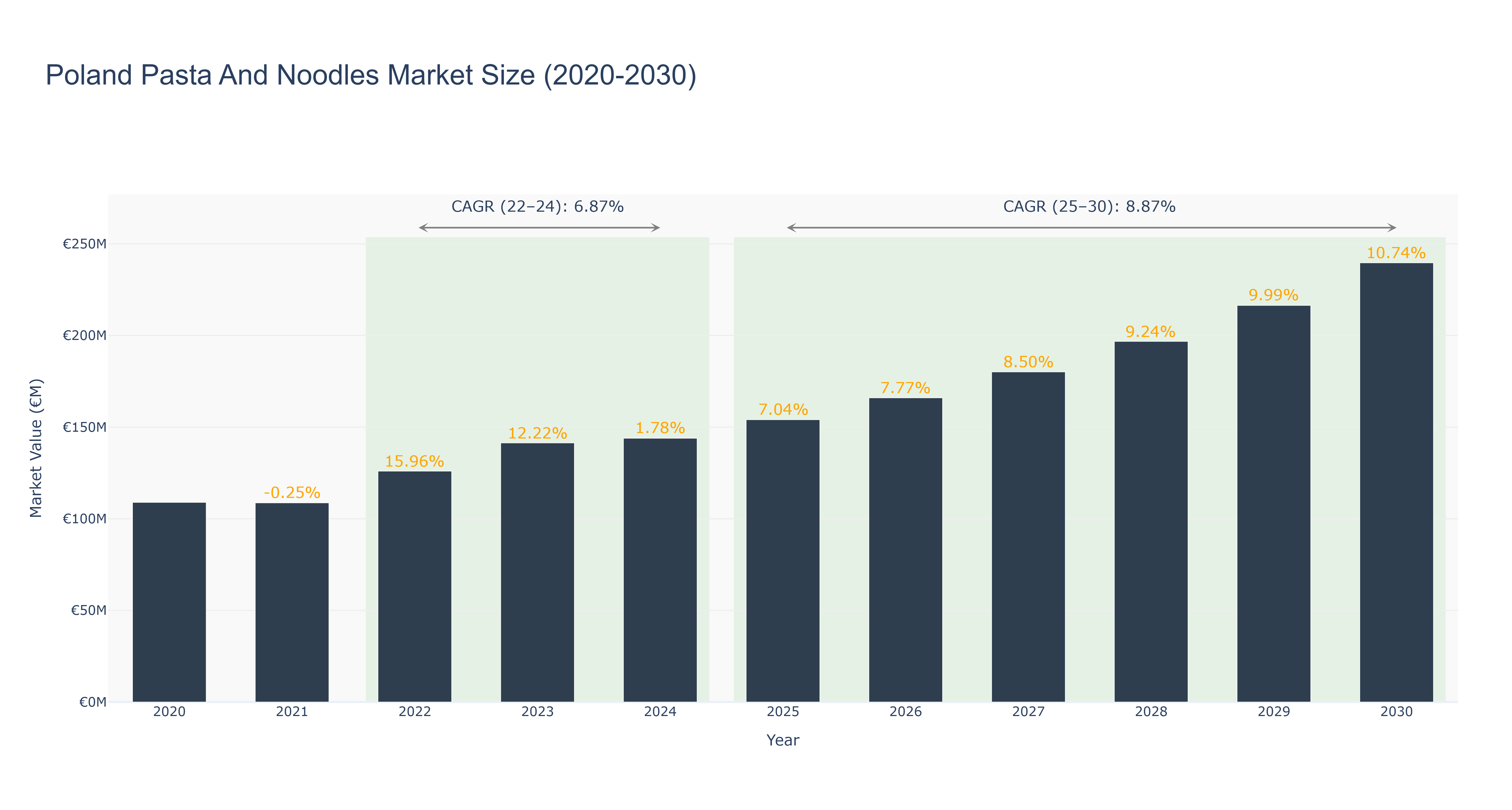
The Poland Pasta and Noodles Market exhibited a notable recovery after a slight decline in 2021, peaking at €141.38 million in 2023, with a robust growth rate of 12.22% year-on-year. The actual market size rose from €108.91 million in 2020 to €143.90 million in 2024, reflecting a compound annual growth rate (CAGR) of 6.87% during this period. As we look ahead to the forecasted period from 2025 to 2030, the market is projected to reach €239.65 million, with a CAGR of 8.87%. This anticipated growth is driven by increasing consumer demand for convenient meal options, health-oriented products, and innovative pasta varieties. Furthermore, the expansion of retail channels and rising disposable incomes are likely to bolster market dynamics. Ongoing investments in production technology and sustainability will also play a critical role in enhancing competitiveness and meeting evolving consumer preferences.
Poland Pasta And Noodles Market: Production & Trade Performance (2019-2025)
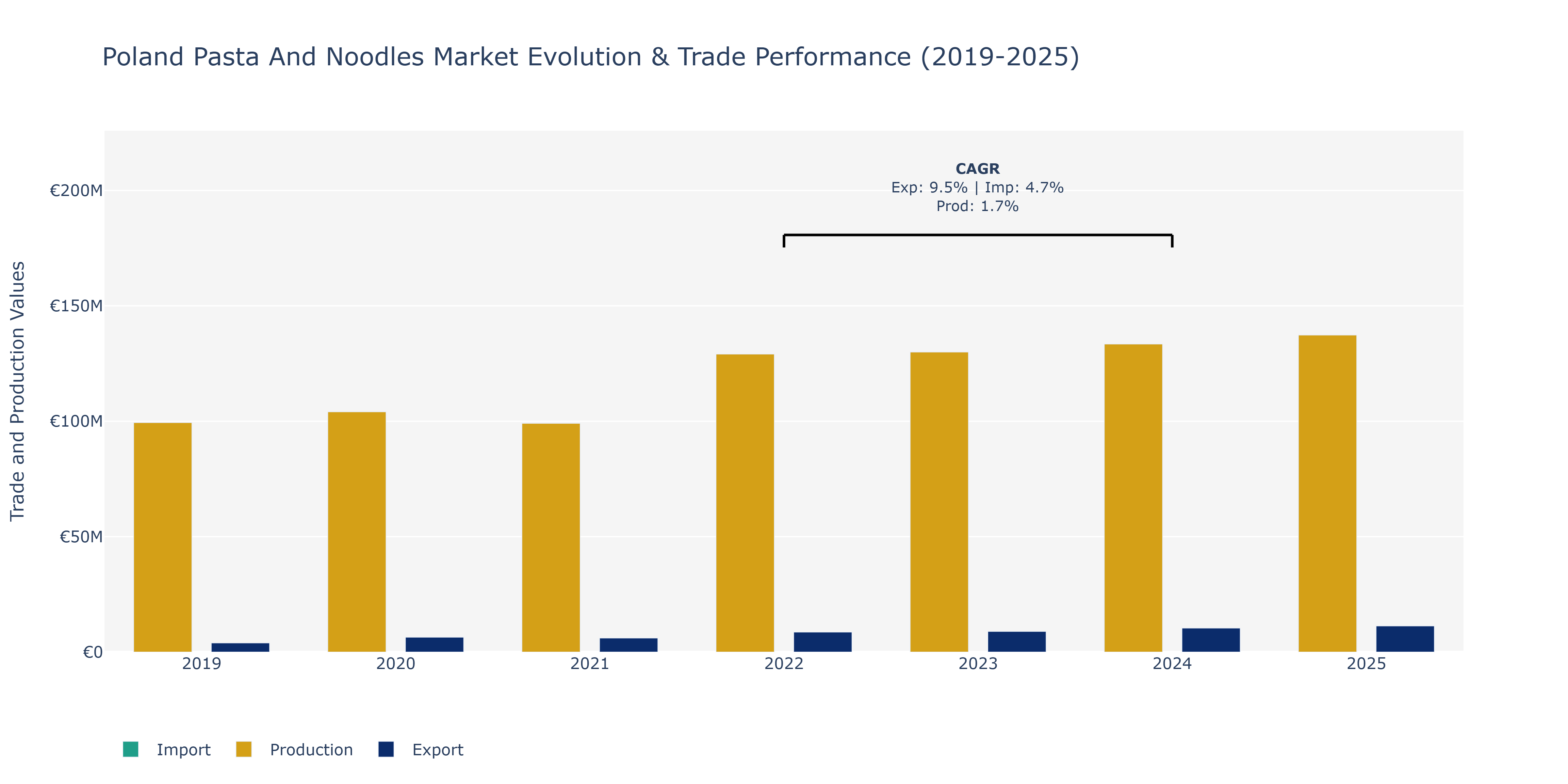
Between 2019 and 2025, Poland's Pasta and Noodles Market witnessed notable variations in exports, imports, and production. Exports surged from €3.93 million in 2019 to €11.29 million in 2025, showing consistent growth. Conversely, imports fluctuated, reaching €24.02 million in 2025 after a peak of €22.81 million in 2024. Production displayed an upward trajectory, increasing from €99.39 million in 2019 to €137.32 million in 2025. The market's export growth can be attributed to increased demand for Polish pasta and noodles globally, driven by the product's quality and competitive pricing. On the import side, fluctuations could be influenced by international trade agreements affecting the inflow of raw materials. The steady rise in production indicates the market's capacity expansion to meet growing domestic and international demand, possibly supported by technological advancements improving efficiency and output quality.
Poland Pasta and Noodles Market Overview
The Poland Pasta and Noodles Market is experiencing steady growth driven by changing consumer preferences towards convenient and quick meal options. The market is characterized by a wide variety of pasta and noodle products, including traditional Polish varieties such as pierogi and kluski, as well as international options like spaghetti and ramen. The increasing trend of health-conscious eating habits has led to a rise in demand for whole grain and gluten-free pasta and noodles. Key players in the market are focusing on product innovation, such as introducing organic and fortified varieties, to cater to the evolving consumer needs. The market is highly competitive, with players engaging in marketing strategies and promotional activities to differentiate their offerings and gain a competitive edge. Overall, the Poland Pasta and Noodles Market is poised for continued growth in the coming years.
Poland Pasta and Noodles Market Trends
The Poland Pasta and Noodles Market is experiencing several key trends. One significant trend is the growing demand for healthier and more natural products, leading to an increase in sales of whole grain and vegetable-based pasta and noodles. Convenience is also a driving factor, with consumers seeking quick and easy meal solutions, resulting in the popularity of ready-to-eat pasta and noodles. Additionally, there is a rising interest in ethnic flavors and varieties, with Polish consumers exploring different cuisines through pasta and noodle dishes. Lastly, sustainability and eco-friendly packaging are becoming more important to consumers, leading to a greater emphasis on environmentally conscious products in the market. Overall, these trends indicate a shift towards healthier, convenient, diverse, and sustainable options in the Poland Pasta and Noodles Market.
Poland Pasta and Noodles Market Challenges
The Poland Pasta and Noodles Market faces several challenges, including increasing competition from international brands, fluctuating raw material prices, and changing consumer preferences towards healthier alternatives. Additionally, rising production costs and logistics challenges contribute to the overall complexity of the market. Adapting to evolving consumer trends, such as the growing demand for gluten-free or organic options, presents a significant challenge for companies operating in the sector. Furthermore, ensuring product quality and food safety standards while maintaining competitive pricing adds another layer of difficulty for market players. Overall, navigating these challenges requires strategic planning, innovation, and a deep understanding of consumer needs to stay relevant and competitive in the Poland Pasta and Noodles Market.
Poland Pasta and Noodles Market Investment Opportunities
The Poland Pasta and Noodles Market presents several investment opportunities due to changing consumer preferences towards convenient and healthy food options. Investing in innovative product development to cater to health-conscious consumers, such as gluten-free or organic options, could be lucrative. Additionally, there is a growing trend of exploring traditional Polish flavors and ingredients in pasta and noodles, offering a unique selling point in the market. Investing in marketing strategies to promote these authentic flavors could attract a wider consumer base. Furthermore, expanding distribution channels to reach more customers, both in traditional retail outlets and online platforms, could drive growth in the market. Overall, investing in product innovation, marketing, and distribution channels could lead to success in the Poland Pasta and Noodles Market.
Poland Pasta and Noodles Market Government Policy
In Poland, the Pasta and Noodles Market is governed by various regulations and policies aimed at ensuring food safety, quality, and fair competition. The Polish government, through the Polish Food and Nutrition Institute (PFI), sets standards for the production, labeling, and marketing of pasta and noodles to protect consumers. Additionally, the market is also subject to regulations related to import and export procedures, including tariffs and trade agreements within the European Union. The Polish Competition and Consumer Protection Authority (UOKiK) oversees competition in the market to prevent anti-competitive practices and safeguard consumer interests. Overall, the government policies in Poland`s Pasta and Noodles Market focus on maintaining high quality standards, fair competition, and consumer protection.
Poland Pasta and Noodles Market Future Outlook
The Poland Pasta and Noodles Market is expected to experience steady growth in the coming years, driven by increasing consumer demand for convenient and affordable meal options. Factors such as busy lifestyles, changing dietary preferences, and the rising popularity of pasta and noodles as comfort foods are likely to contribute to the market`s expansion. Additionally, the growing trend towards ethnic cuisines and the introduction of innovative product variants are anticipated to further fuel market growth. However, challenges such as fluctuating raw material prices and increasing competition from alternative food products may impact the market`s growth trajectory. Overall, the Poland Pasta and Noodles Market is projected to see sustained growth opportunities, with key players focusing on product innovation, marketing strategies, and expanding distribution channels to stay competitive in the market.
Key Highlights of the Report:
- Poland Pasta and Noodles Market Outlook
- Market Size of Poland Pasta and Noodles Market, 2021
- Forecast of Poland Pasta and Noodles Market, 2031
- Historical Data and Forecast of Poland Pasta and Noodles Revenues & Volume for the Period 2018 - 2031
- Poland Pasta and Noodles Market Trend Evolution
- Poland Pasta and Noodles Market Drivers and Challenges
- Poland Pasta and Noodles Price Trends
- Poland Pasta and Noodles Porter's Five Forces
- Poland Pasta and Noodles Industry Life Cycle
- Historical Data and Forecast of Poland Pasta and Noodles Market Revenues & Volume By Product for the Period 2018 - 2031
- Historical Data and Forecast of Poland Pasta and Noodles Market Revenues & Volume By Ambient for the Period 2018 - 2031
- Historical Data and Forecast of Poland Pasta and Noodles Market Revenues & Volume By Dried for the Period 2018 - 2031
- Historical Data and Forecast of Poland Pasta and Noodles Market Revenues & Volume By Chilled for the Period 2018 - 2031
- Poland Pasta and Noodles Import Export Trade Statistics
- Market Opportunity Assessment By Product
- Poland Pasta and Noodles Top Companies Market Share
- Poland Pasta and Noodles Competitive Benchmarking By Technical and Operational Parameters
- Poland Pasta and Noodles Company Profiles
- Poland Pasta and Noodles Key Strategic Recommendations






































