Poland Policy Management in Telecom Market Size & Growth Rate (2026-2032)
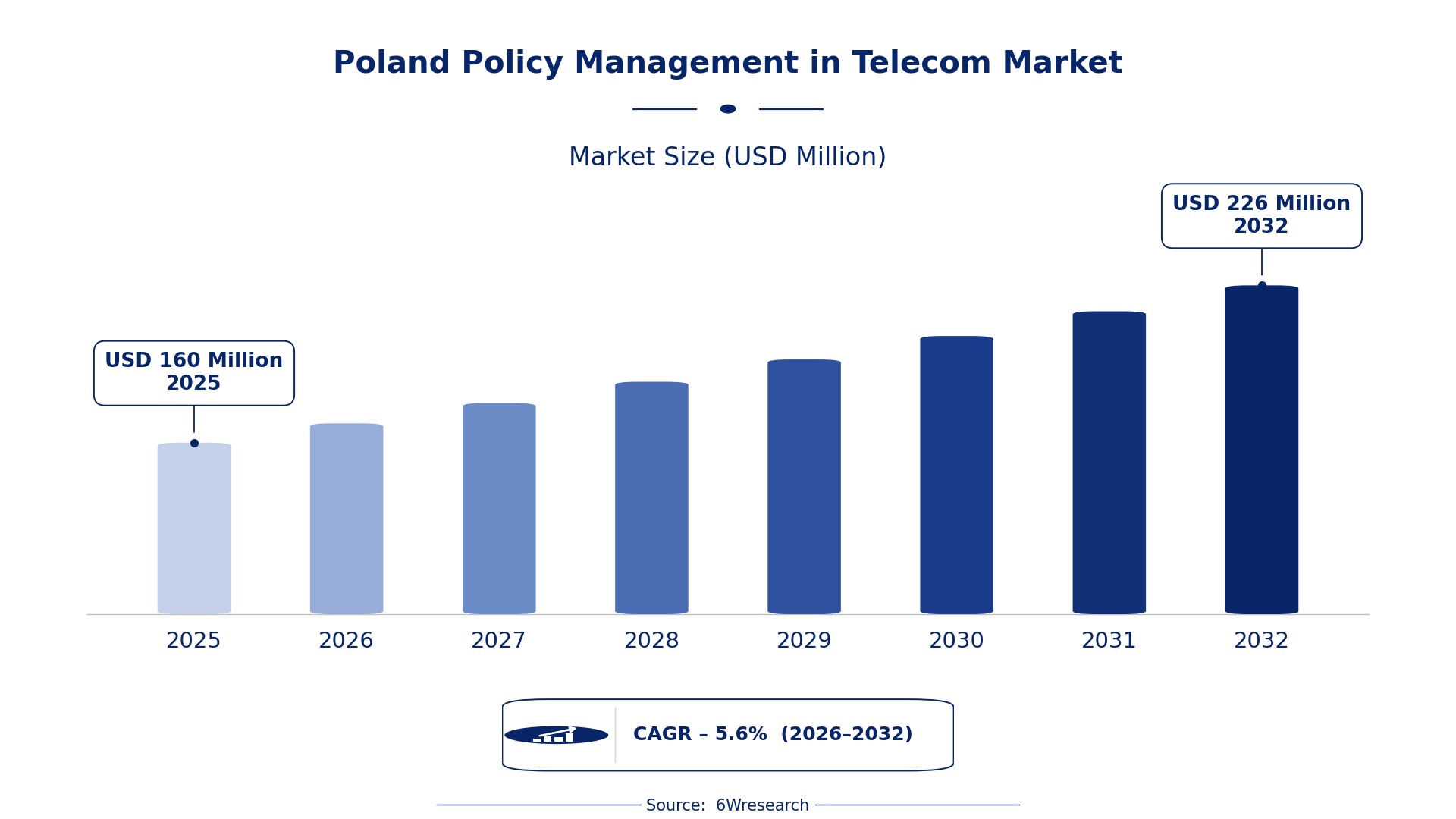
The Poland Policy Management in Telecom Market was estimated at USD 160 Million in 2025 and is projected to reach USD 226 Million by 2032, growing at a CAGR of 5.6% from 2026 to 2032.
Poland Policy Management in Telecom Market Synopsis
As Polish telecom operators expand their services, the demand for effective policy management solutions has surged. This growing need stems from the complex nature of telecommunications, requiring systems that can efficiently enforce rules on network usage, billing, and service quality.
Operators in Poland are increasingly looking for tools that not only enhance customer satisfaction but also streamline their internal processes. The focus on personalized services is making advanced policy management a crucial component of modern telecom strategies.
Poland Policy Management in Telecom Market Year-wise Growth Rate and Key Drivers
This graph illustrates the annual growth rates of the Poland Policy Management in Telecom Market from 2021 to 2032, highlighting a steady upward trajectory and projected expansion over the forecast period.
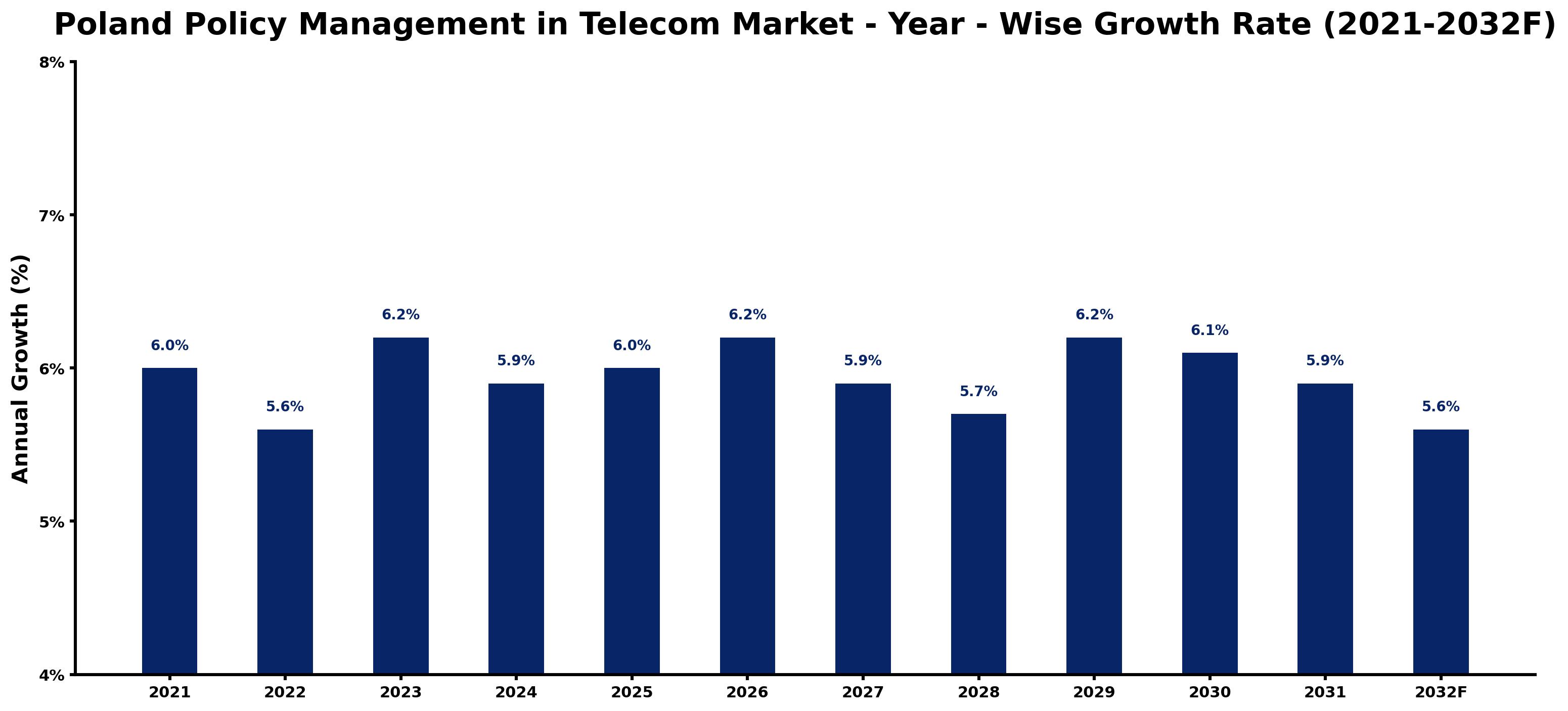
The table below presents the year‑wise growth rates along with the key drivers influencing the market
| Year | Growth Rate | Major Drivers |
| 2021 | 6.0% | 5G rollout accelerates regulatory compliance demands. |
| 2022 | 5.6% | Polish Telecom Office enhances consumer protection regulations. |
| 2023 | 6.2% | Increased fiber optic deployment mandates from government initiatives. |
| 2024 | 5.9% | Rising cybersecurity laws boost policy management requirements. |
| 2025 | 6.0% | EU digital sovereignty initiatives spur telecom policy updates. |
| 2026 | 6.2% | Government push for universal internet access drives policies. |
| 2027 | 5.9% | Regulatory adaptations for IoT devices support industry growth. |
| 2028 | 5.7% | Evolving data privacy laws reshape consumer telecom policies. |
| 2029 | 6.2% | Increased mobile data usage necessitates stricter regulatory frameworks. |
| 2030 | 6.1% | Government support for digital services amplifies compliance needs. |
| 2031 | 5.9% | Emerging fintech regulations demand telecom policy adjustments. |
| 2032 | 5.6% | Regulatory updates focus on enhancing digital customer trust. |
Note: Market size estimations and growth projections presented in this report are based on 6Wresearch's proprietary forecasting methodology, utilizing the latest available industry data, government publications, and primary research inputs.
Poland Policy Management in Telecom Market Key Takeaways
Below are some of the specific key takeaways from the market, including:
- Robust growth projected at a CAGR of 5.9% from 2026 to 2032.
- Increased demand for solutions to manage service quality and customer experiences.
- Advancements in telecom technologies fueling market expansion.
- Government regulations significantly influencing market dynamics.
- Personalization of services driving investment in policy management tools.
Evaluation of Restraints in Poland Policy Management in Telecom Market
The market faces various challenges, primarily stemming from rapid regulatory changes. Telecom companies are under constant pressure to adapt to evolving EU policies. Balancing the need for effective policy management with data privacy concerns complicates implementations. As legislation becomes stricter, operators must invest in systems that can ensure compliance without compromising customer trust. These factors often slow the adoption of advanced solutions, creating a barrier to faster growth.
Poland Policy Management in Telecom Market Trends
One notable trend is the shift toward real-time policy management, allowing operators to respond swiftly to network demands. This aligns with the growing need for more personalized customer experiences. Additionally, artificial intelligence is starting to play a significant role, automating processes related to policy enforcement and customer support. As more consumers demand tailored services, the integration of these technologies will become increasingly vital for telecom providers.
Poland Policy Management in Telecom Market Opportunities
A wealth of opportunities is emerging in this sector, particularly in enhancing customer relationship management through advanced policy management systems. The growing shift toward subscription-based models presents a chance for operators to refine their billing practices. Furthermore, as demand for 5G services escalates, there will be a pressing need for updated policy management frameworks to ensure service quality meets customer expectations. These areas provide fertile ground for investment and innovation.
Government Initiatives in the Poland Policy Management in Telecom Market
Government policy has a notable impact on the Poland Policy Management in Telecom Market, shaping the competitive environment for service providers. Regulations designed to promote transparency and competition are influencing how telecom companies deploy policy management solutions. Ensuring consumer protection remains a priority, pushing for better quality in telecom services.
- A recently completed national policy initiative aimed to enhance billing transparency across telecom operators.
- An ongoing government program focuses on upgrading digital infrastructure to support more advanced telecom services.
- A planned regulatory framework to be introduced by 2027 will enhance data privacy measures for customer information.
- The government is currently promoting public-private partnerships aimed at increasing access to telecom services in underserved areas.
Future Insights of the Poland Policy Management in Telecom Market
From 2026 to 2032, the Poland Policy Management in Telecom Market is set to evolve significantly. The increasing complexity of telecom services will necessitate greater investment in policy management systems. More operators will adopt AI-driven solutions to keep pace with consumer demands, leading to improvements in operational efficiency. The market is expected to see a shift towards proactive management of customer experiences, supported by sophisticated data analytics tools.
Poland Policy Management in Telecom Market Latest Developments
Recent activity in the Poland Policy Management in Telecom Market indicates a clear drive towards modernization and compliance. Operators are actively seeking solutions that not only enhance customer satisfaction but also align with evolving regulations.
- A major technology vendor launched a new policy management platform aimed at improving service quality in Q2 2025.
- An initiative that began in early 2025 to integrate AI capabilities into existing policy management systems is currently underway.
- A rollout expected to begin in late 2026 aims to enhance network management tools for operators across Poland.
- By mid-2025, a leading regional operator will implement a customer feedback system that informs policy adjustments in real time.
Poland Policy Management in Telecom Market - Key Attractiveness of the Report
- 10 Years of Market Numbers
- Historical Data Starting from 2022 to 2025
- Base Year: 2025
- Forecast Data until 2032
- Key Performance Indicators Impacting the Market
- Major Upcoming Developments and Projects
Key Highlights of the Report:
- Poland Policy Management in Telecom Market Outlook
- Market Size of Poland Policy Management in Telecom Market, 2025
- Forecast of Poland Policy Management in Telecom Market, 2032
- Historical Data and Forecast of Poland Policy Management in Telecom Revenues & Volume for the Period 2022-2032F
- Poland Policy Management in Telecom Market Trend Evolution
- Poland Policy Management in Telecom Market Drivers and Challenges
- Poland Policy Management in Telecom Price Trends
- Poland Policy Management in Telecom Porter's Five Forces
- Poland Policy Management in Telecom Industry Life Cycle
- Historical Data and Forecast of Poland Policy Management in Telecom Market Revenues & Volume By Network for the Period 2022-2032F
- Historical Data and Forecast of Poland Policy Management in Telecom Market Revenues & Volume By Fixed for the Period 2022-2032F
- Historical Data and Forecast of Poland Policy Management in Telecom Market Revenues & Volume By Wireless for the Period 2022-2032F
- Historical Data and Forecast of Poland Policy Management in Telecom Market Revenues & Volume By Component for the Period 2022-2032F
- Historical Data and Forecast of Poland Policy Management in Telecom Market Revenues & Volume By Solutions for the Period 2022-2032F
- Historical Data and Forecast of Poland Policy Management in Telecom Market Revenues & Volume By Services for the Period 2022-2032F
- Historical Data and Forecast of Poland Policy Management in Telecom Market Revenues & Volume By Deployment for the Period 2022-2032F
- Historical Data and Forecast of Poland Policy Management in Telecom Market Revenues & Volume By Cloud for the Period 2022-2032F
- Historical Data and Forecast of Poland Policy Management in Telecom Market Revenues & Volume By On-Premises for the Period 2022-2032F
- Poland Policy Management in Telecom Import Export Trade Statistics
- Market Opportunity Assessment By Network
- Market Opportunity Assessment By Component
- Market Opportunity Assessment By Deployment
- Poland Policy Management in Telecom Top Companies Market Share
- Poland Policy Management in Telecom Competitive Benchmarking By Technical and Operational Parameters
- Poland Policy Management in Telecom Company Profiles
- Poland Policy Management in Telecom Key Strategic Recommendations






































