Poland Portland Cement Market Size (2020-2030)
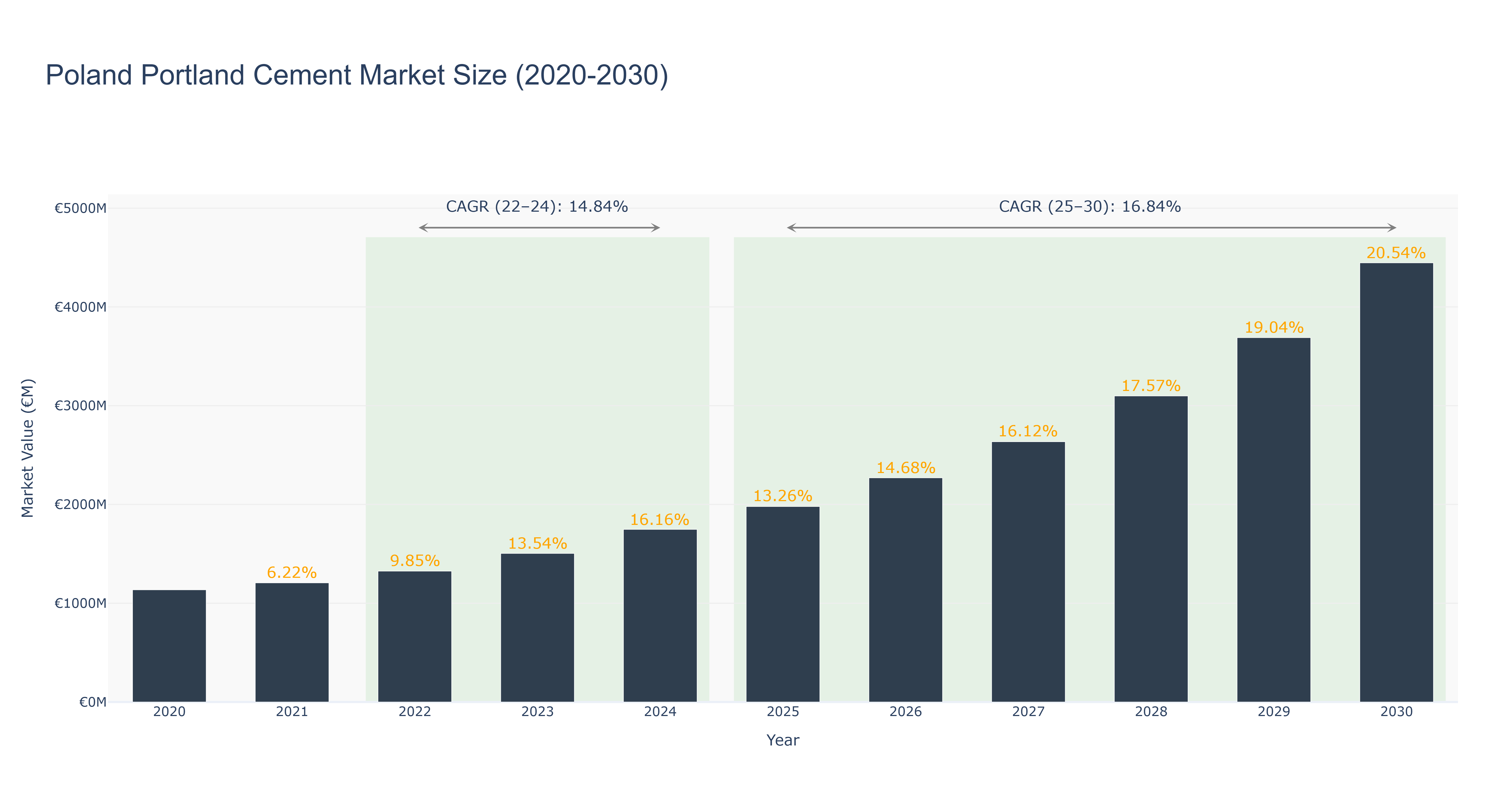
Poland Portland Cement Market has shown a promising growth trajectory over the years. The market reached its peak size of €4446.41 million in 2030, with a steady increase from €1135.52 million in 2020. Notably, the market experienced significant growth from 2020 to 2024, driven by increasing construction projects and infrastructure development in the region. The forecasted market size from 2025 to 2030 is expected to continue this upward trend, with a CAGR of 16.84%. The market's CAGR from 2022 to 2024 was 14.84%, indicating a strong growth period during those years. Looking ahead, Poland's cement market is set to benefit from upcoming infrastructure projects, such as the construction of new highways and residential complexes, further boosting demand for Portland cement in the country. This favorable outlook is supported by the government's initiatives to invest in sustainable urban development and modernization projects, driving the cement market's growth in the coming years.
Poland Portland Cement Market: Production & Trade Performance (2019-2025)
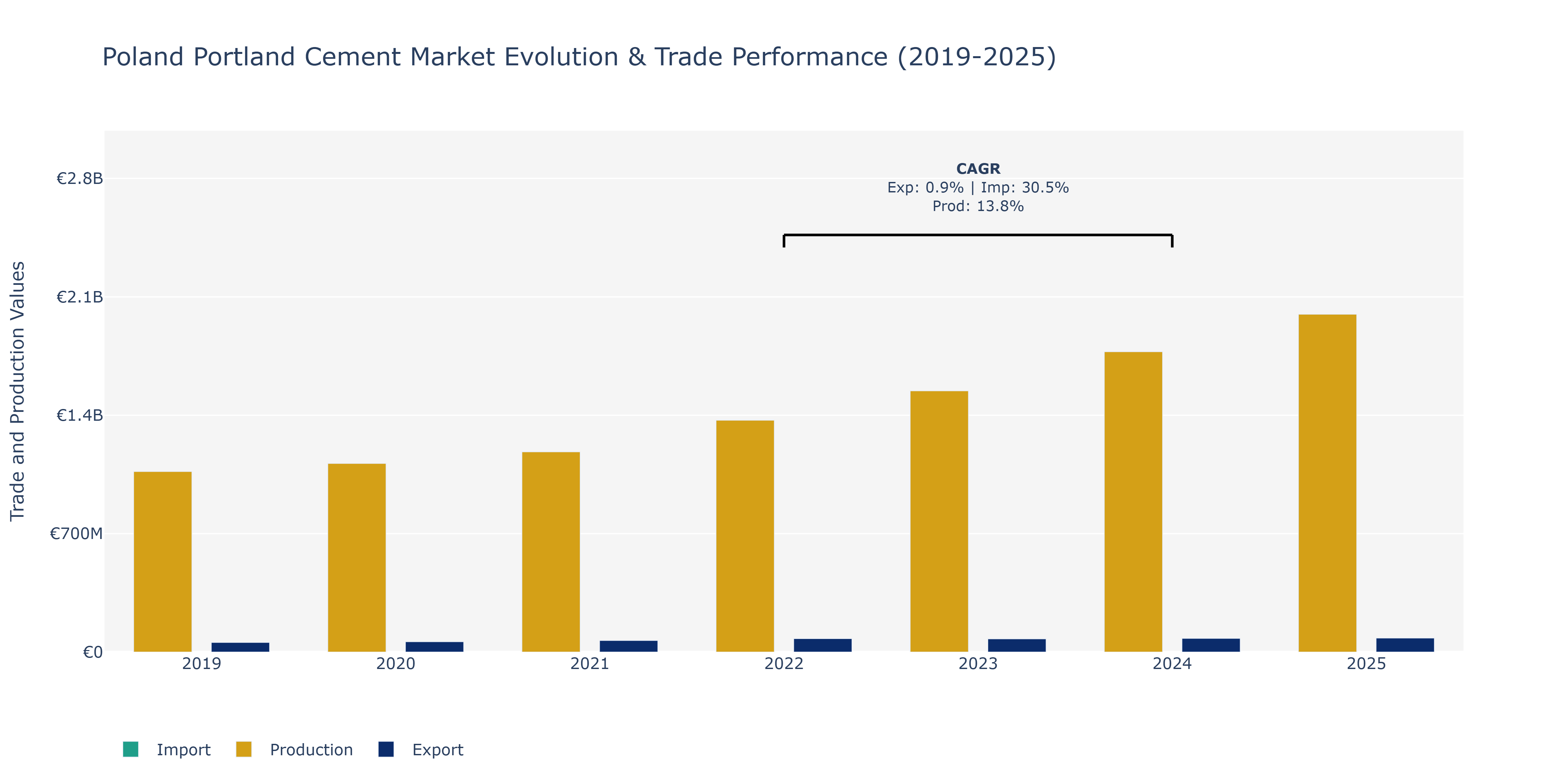
Between 2019 and 2025, the Poland Portland Cement Market witnessed growth in Exports, Imports, and Production. Exports increased from €56.5 million in 2019 to nearly €82.56 million in 2025, showing steady growth over the period. Imports surged notably from €74.94 million in 2019 to around €204.72 million in 2025, indicating a substantial rise driven by increasing demand or domestic supply constraints. Production also saw significant growth, escalating from €1.1 billion in 2019 to approximately €2.0 billion in 2025, reflecting a consistent upward trend. The sharp increase in imports in 2025 could be attributed to infrastructure development projects or increased construction activities, necessitating higher cement import volumes to meet demand. The surge in production indicates the market's response to the growing construction sector in Poland, supported by infrastructure projects and urbanization trends in the country.
Poland Portland Cement Market Synopsis
The Poland Portland Cement Market is characterized by steady growth driven primarily by infrastructure development, residential construction, and industrial projects. The market is dominated by key players such as LafargeHolcim, HeidelbergCement, and Cemex, who compete based on product quality, pricing, and distribution networks. The increasing demand for sustainable and high-performance building materials has led to the introduction of innovative Portland cement products with enhanced properties like high strength, durability, and reduced environmental impact. Government initiatives to boost infrastructure investments and promote sustainable construction practices are expected to further drive market growth. However, challenges such as fluctuating raw material prices and environmental regulations pose potential constraints to market expansion. Overall, the Poland Portland Cement Market presents opportunities for companies to innovate and cater to the evolving needs of the construction industry.
Poland Portland Cement Market Trends
The Poland Portland Cement Market is experiencing steady growth due to the increasing demand for construction materials driven by infrastructure development and urbanization projects. Key trends in the market include a shift towards sustainable and eco-friendly cement production methods to reduce carbon emissions and environmental impact. Additionally, there is a growing focus on the use of alternative raw materials and innovative technologies to improve the quality and durability of cement products. Market players are also investing in research and development to introduce advanced cement formulations that offer higher strength, durability, and resistance to harsh weather conditions. Overall, the Poland Portland Cement Market is poised for continued growth with a strong emphasis on sustainability, innovation, and quality in the coming years.
Poland Portland Cement Market Challenges
In the Poland Portland Cement Market, some of the key challenges include fluctuating raw material prices, increasing competition from imported cement, and the need for sustainable production practices to meet environmental regulations. Additionally, the market is also impacted by infrastructural limitations and economic fluctuations that can affect construction activity and demand for cement. Companies operating in this market need to continuously innovate to improve efficiency, reduce costs, and differentiate their products to stay competitive. Adapting to changing market dynamics, maintaining high-quality standards, and investing in technology and sustainability initiatives are crucial for cement manufacturers in Poland to navigate these challenges and maintain a strong position in the market.
Poland Portland Cement Market Investment Opportunities
The Poland Portland Cement Market presents promising investment opportunities due to the country`s robust construction industry and infrastructure development projects. With the increasing demand for high-quality cement products in residential, commercial, and industrial construction projects, there is a growing need for reliable cement suppliers. Investors can capitalize on this by investing in cement manufacturing companies operating in Poland or by establishing their own cement production facilities. Additionally, the government`s focus on sustainable development and green construction practices opens up opportunities for investments in eco-friendly cement production technologies. Overall, the Poland Portland Cement Market offers a favorable investment climate for those looking to participate in the country`s thriving construction sector.
Poland Portland Cement Market Future Outlook
The future outlook for the Poland Portland Cement Market appears promising, driven by various infrastructure development projects, urbanization, and growth in the construction sector. The market is expected to witness steady growth due to increasing investments in residential, commercial, and industrial construction projects. Additionally, the government`s initiatives to improve infrastructure, such as roads, bridges, and public transportation, will further boost the demand for Portland cement in the country. Technological advancements, sustainability concerns, and the adoption of innovative construction techniques are also likely to shape the market`s future dynamics. Overall, the Poland Portland Cement Market is anticipated to experience growth opportunities in the coming years, supported by the ongoing construction activities and infrastructure development efforts in the country.
Key Highlights of the Report:
- Poland Portland Cement Market Outlook
- Market Size of Poland Portland Cement Market, 2021
- Forecast of Poland Portland Cement Market, 2031
- Historical Data and Forecast of Poland Portland Cement Revenues & Volume for the Period 2018 - 2031
- Poland Portland Cement Market Trend Evolution
- Poland Portland Cement Market Drivers and Challenges
- Poland Portland Cement Price Trends
- Poland Portland Cement Porter's Five Forces
- Poland Portland Cement Industry Life Cycle
- Historical Data and Forecast of Poland Portland Cement Market Revenues & Volume By Type for the Period 2018 - 2031
- Historical Data and Forecast of Poland Portland Cement Market Revenues & Volume By Type 1 for the Period 2018 - 2031
- Historical Data and Forecast of Poland Portland Cement Market Revenues & Volume By Type 2 for the Period 2018 - 2031
- Historical Data and Forecast of Poland Portland Cement Market Revenues & Volume By Type 3 for the Period 2018 - 2031
- Historical Data and Forecast of Poland Portland Cement Market Revenues & Volume By Type 4 for the Period 2018 - 2031
- Historical Data and Forecast of Poland Portland Cement Market Revenues & Volume By Type 5 for the Period 2018 - 2031
- Historical Data and Forecast of Poland Portland Cement Market Revenues & Volume By for the Period 2018 - 2031
- Historical Data and Forecast of Poland Portland Cement Market Revenues & Volume By Application for the Period 2018 - 2031
- Historical Data and Forecast of Poland Portland Cement Market Revenues & Volume By Residential for the Period 2018 - 2031
- Historical Data and Forecast of Poland Portland Cement Market Revenues & Volume By Commercial for the Period 2018 - 2031
- Historical Data and Forecast of Poland Portland Cement Market Revenues & Volume By Industrial for the Period 2018 - 2031
- Historical Data and Forecast of Poland Portland Cement Market Revenues & Volume By for the Period 2018 - 2031
- Historical Data and Forecast of Poland Portland Cement Market Revenues & Volume By Packing Type for the Period 2018 - 2031
- Historical Data and Forecast of Poland Portland Cement Market Revenues & Volume By 10 KG for the Period 2018 - 2031
- Historical Data and Forecast of Poland Portland Cement Market Revenues & Volume By 15 KG for the Period 2018 - 2031
- Historical Data and Forecast of Poland Portland Cement Market Revenues & Volume By 25 KG for the Period 2018 - 2031
- Historical Data and Forecast of Poland Portland Cement Market Revenues & Volume By Others for the Period 2018 - 2031
- Poland Portland Cement Import Export Trade Statistics
- Market Opportunity Assessment By Type
- Market Opportunity Assessment By Application
- Market Opportunity Assessment By Packing Type
- Poland Portland Cement Top Companies Market Share
- Poland Portland Cement Competitive Benchmarking By Technical and Operational Parameters
- Poland Portland Cement Company Profiles
- Poland Portland Cement Key Strategic Recommendations






































