Poland Radioactive Waste Management Market Size, Share & Growth Rate
The Poland Radioactive Waste Management Market was estimated at USD 238 Million in 2025 and is projected to reach USD 336 Million by 2032, growing at a CAGR of 5.0% from 2026 to 2032. This growth trajectory is significantly driven by Poland's increasing commitment to nuclear energy as a means of diversifying its energy portfolio, alongside heightened public and governmental focus on safety in waste management. As nuclear power facilities expand, the demand for safe disposal methods and advanced technologies to handle radioactive waste will naturally rise, further propelling the market.
Poland Radioactive Waste Management Market Year-wise Growth Rate and Key Drivers
This graph highlights how the Poland Radioactive Waste Management Market has steadily grown over the years, supported by major growth factors.
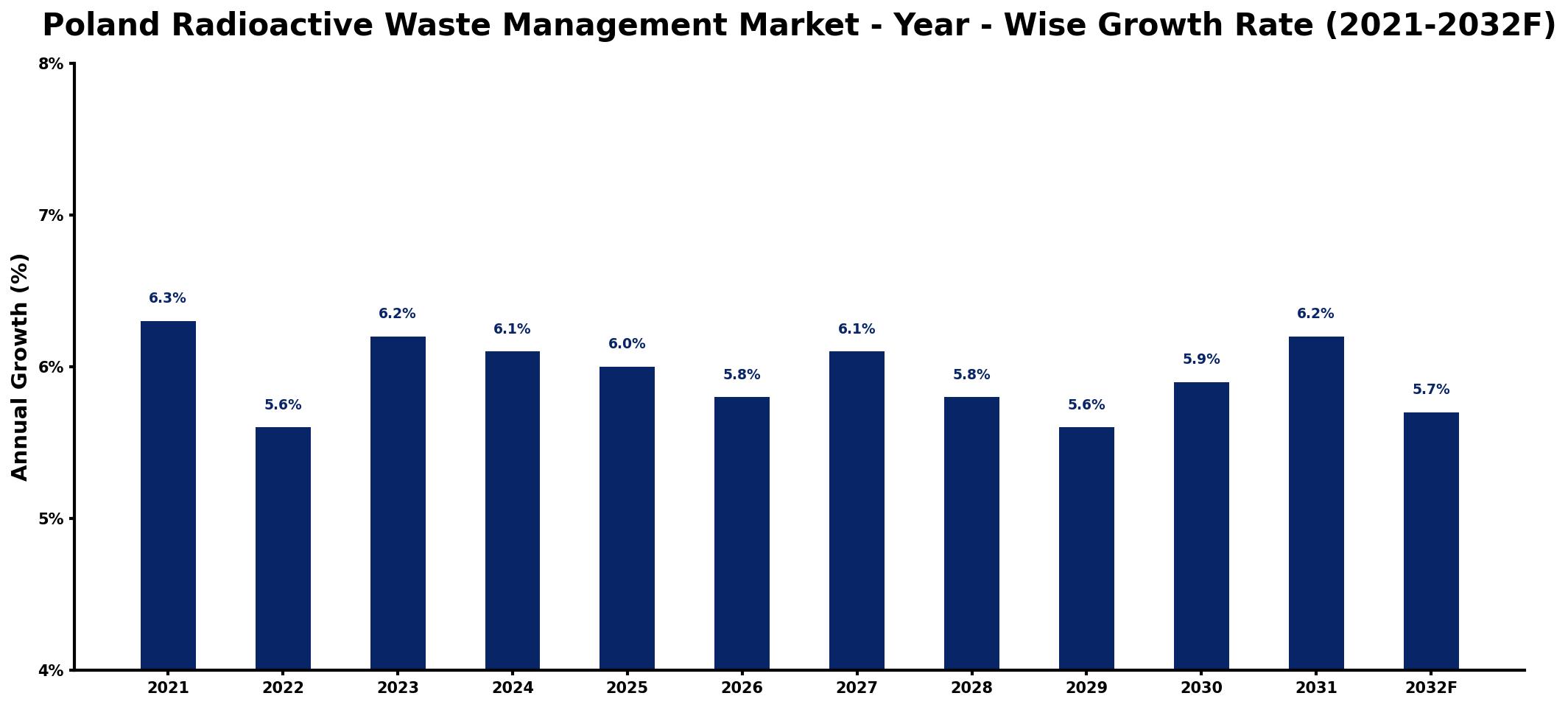
The table below presents the year‑wise growth rates along with the key drivers influencing the market
| Year | Growth Rate | Major Drivers |
| 2021 | 6.3% | Increased regulatory compliance requirements |
| 2022 | 5.6% | Growing public awareness initiatives |
| 2023 | 6.2% | Expansion of nuclear energy projects |
| 2024 | 6.1% | Investment in sustainable technologies |
| 2025 | 6.0% | Rise in energy sector collaborations |
| 2026 | 5.8% | Enhanced safety protocol implementations |
| 2027 | 6.1% | Government funding for infrastructure |
| 2028 | 5.8% | Technological advancements in recycling |
| 2029 | 5.6% | increased overall sector activity |
| 2030 | 5.9% | Surge in environmental protection policies |
| 2031 | 6.2% | Development of new disposal methods |
| 2032 | 5.7% | Focus on long-term sustainability practices |
Note: Market size estimations and growth projections presented in this report are based on 6Wresearch's proprietary forecasting methodology, utilizing the latest available industry data, government publications, and primary research inputs.
Poland Radioactive Waste Management Market Synopsis
In recent years, Poland has demonstrated a strong inclination towards enhancing its radioactive waste management protocols. This is evident in the adoption of innovative technologies aimed at minimizing the risks associated with radioactive materials from a variety of sectors, including healthcare and nuclear energy.
The landscape of the Poland Radioactive Waste Management Market is rapidly evolving, driven by increasing regulatory scrutiny and the need for compliance with international standards. Moreover, societal concerns regarding the safety and environmental impact of radioactive waste disposal are steering policies and investments towards more robust management strategies.
Poland Radioactive Waste Management Market Key Takeaways
- Growth is driven by the expansion of nuclear energy and enhanced safety measures for radioactive waste disposal.
- Technological advancements are revolutionizing waste management processes to ensure minimal environmental impact.
- Government policies are tightening around waste management, fostering a compliance-driven market environment.
- Public awareness and demand for safer radioactive waste management solutions are on the rise.
- Healthcare and industrial sectors are significant contributors to the overall waste generated, influencing market dynamics.
Evaluation of Restraints in Poland Radioactive Waste Management Market
Despite the promising growth of the Poland Radioactive Waste Management Market, several constraints exist that may hinder its potential. The substantial financial investments required for the safe disposal and long-term storage of radioactive waste present a barrier to market entrants and existing players alike. Furthermore, the complex regulatory environment requires strict adherence, which can be a challenge for organizations lacking expertise. Public opposition to the establishment of waste management facilities continues to be a significant hurdle, often delaying project approvals and affecting operational timelines.
Poland Radioactive Waste Management Market Trends
Current trends indicate a growing emphasis on sustainable and environmentally friendly practices within the radioactive waste management sector. Advanced technologies such as robotic systems and artificial intelligence are being integrated into waste treatment processes to improve efficiency and safety. Moreover, collaboration between public and private sectors is emerging as a key trend, enabling knowledge sharing and resource pooling for effective waste management solutions.
Poland Radioactive Waste Management Market Opportunities
Opportunities in the Poland Radioactive Waste Management Market are abundant, particularly in the realm of technological innovation. Companies focusing on developing cost-effective and efficient waste treatment technologies stand to gain significantly. Additionally, the recent governmental push towards upgrading national infrastructure for waste management offers a fertile ground for investment. The integration of public-private partnerships is another promising avenue, facilitating advancements in research and development aimed at safer disposal methods.
Government Initiatives in the Poland Radioactive Waste Management Market
The Polish government has been proactive in establishing policies that prioritize environmental safety and the responsible management of radioactive waste. With national guidelines emphasizing the sustainable disposal and treatment of radioactive materials, there is a clear commitment to enhancing regulatory frameworks. Government funding for research and development in waste management technologies further underlines the dedication to improving the overall safety and efficiency of radioactive waste handling.
Future Insights of the Poland Radioactive Waste Management Market
Looking ahead to the period from 2026 to 2032, the Poland Radioactive Waste Management Market is expected to continue its upward trend. As the demand for nuclear energy grows, so too will the need for innovative waste management solutions. The market will likely see advancements in technologies that reduce costs and improve safety outcomes, driven by both governmental initiatives and private sector innovations. A comprehensive approach to waste management, incorporating sustainability and public engagement, will be essential in shaping the future landscape of this sector.
Poland Radioactive Waste Management Market Latest Developments (2025 - 2026)
Recent developments in the Poland Radioactive Waste Management Market indicate a strong focus on technological innovation and regulatory compliance. New partnerships have emerged between government entities and private companies, aiming to enhance waste treatment methods and improve overall safety standards. Additionally, discussions are ongoing regarding the expansion of existing waste management facilities to accommodate increasing volumes, reflecting the growing awareness and commitment to responsible waste disposal.
Poland Radioactive Waste Management Market - Key Attractiveness of the Report
- 10 Years of Market Numbers
- Historical Data Starting from 2022 to 2025
- Base Year: 2025
- Forecast Data until 2032
- Key Performance Indicators Impacting the Market
- Major Upcoming Developments and Projects
Key Highlights of the Report:
- Poland Radioactive Waste Management Market Outlook
- Market Size of Poland Radioactive Waste Management Market, 2025
- Forecast of Poland Radioactive Waste Management Market, 2032
- Historical Data and Forecast of Poland Radioactive Waste Management Revenues & Volume for the Period 2022-2032F
- Poland Radioactive Waste Management Market Trend Evolution
- Poland Radioactive Waste Management Market Drivers and Challenges
- Poland Radioactive Waste Management Price Trends
- Poland Radioactive Waste Management Porter's Five Forces
- Poland Radioactive Waste Management Industry Life Cycle
- Historical Data and Forecast of Poland Radioactive Waste Management Market Revenues & Volume By Type for the Period 2022-2032F
- Historical Data and Forecast of Poland Radioactive Waste Management Market Revenues & Volume By Exempt Waste and Very Low-Level Waste(VLLW) for the Period 2022-2032F
- Historical Data and Forecast of Poland Radioactive Waste Management Market Revenues & Volume By Low-Level Waste(LLW) for the Period 2022-2032F
- Historical Data and Forecast of Poland Radioactive Waste Management Market Revenues & Volume By Intermediate-Level Waste(ILW) for the Period 2022-2032F
- Historical Data and Forecast of Poland Radioactive Waste Management Market Revenues & Volume By High-Level Waste(HLW) for the Period 2022-2032F
- Historical Data and Forecast of Poland Radioactive Waste Management Market Revenues & Volume By Application for the Period 2022-2032F
- Historical Data and Forecast of Poland Radioactive Waste Management Market Revenues & Volume By Industrial for the Period 2022-2032F
- Historical Data and Forecast of Poland Radioactive Waste Management Market Revenues & Volume By Utility for the Period 2022-2032F
- Poland Radioactive Waste Management Import Export Trade Statistics
- Market Opportunity Assessment By Type
- Market Opportunity Assessment By Application
- Poland Radioactive Waste Management Top Companies Market Share
- Poland Radioactive Waste Management Competitive Benchmarking By Technical and Operational Parameters
- Poland Radioactive Waste Management Company Profiles
- Poland Radioactive Waste Management Key Strategic Recommendations






































