Poland Retail Industry Market Size, Share & Growth Rate
The Poland Retail Industry Market was estimated at USD 404 Million in 2025 and is projected to reach USD 513 Million by 2032, growing at a CAGR of 3.5% from 2026 to 2032. This steady growth trajectory is largely fueled by an expanding middle class, which is driving increased consumer spending across various sectors. Additionally, the rapid rise of e-commerce and the adoption of omnichannel retail strategies are reshaping traditional shopping paradigms, enabling retailers to cater to a more tech-savvy consumer base.
Poland Retail Industry Market Year-wise Growth Rate and Key Drivers
This graph highlights how the Poland Retail Industry Market has steadily grown over the years, supported by major growth factors.
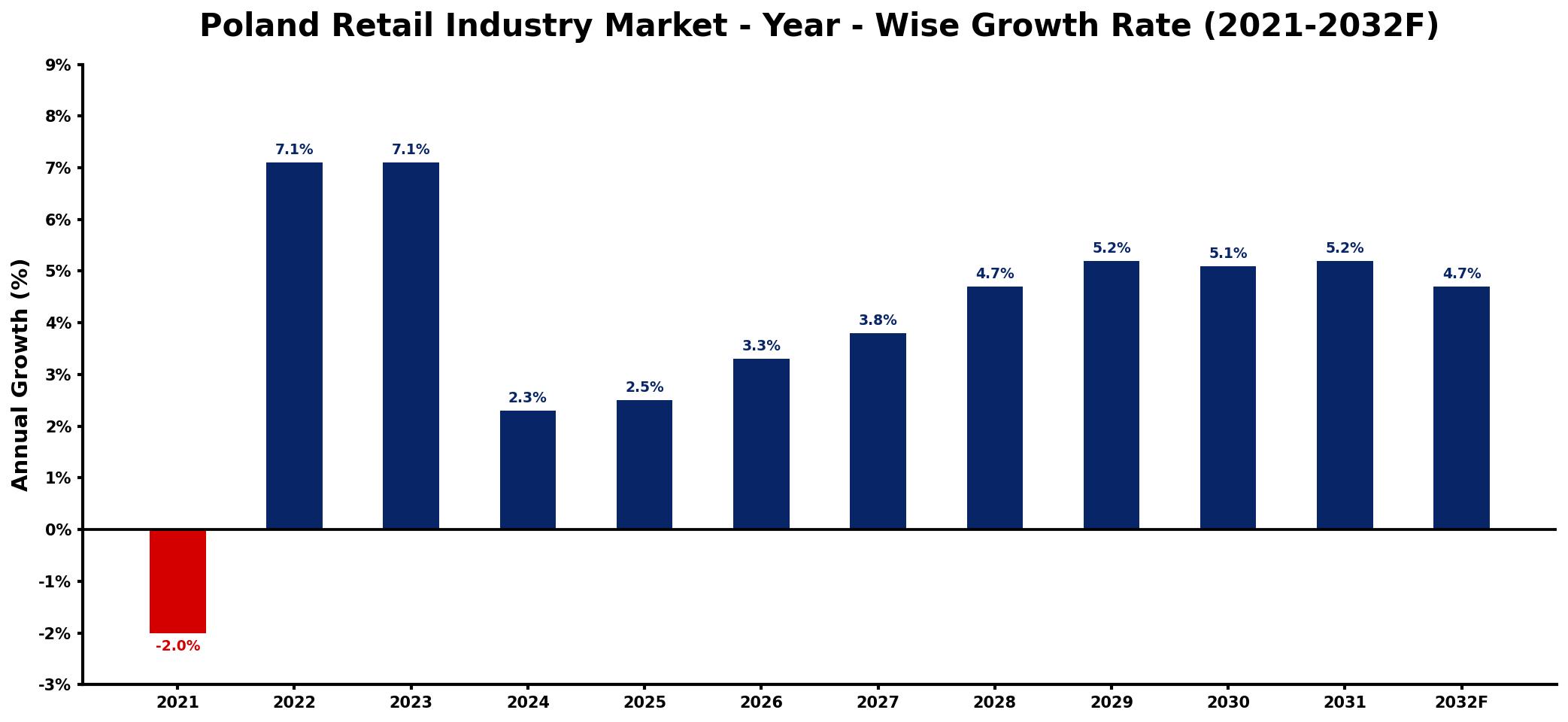
The table below presents the year‑wise growth rates along with the key drivers influencing the market
| Year | Growth Rate | Major Drivers |
| 2021 | -2.0% | decrease in consumer spending habits |
| 2022 | 7.1% | rise in disposable income levels |
| 2023 | 7.1% | growth in online shopping platforms |
| 2024 | 2.3% | expansion of local brands presence |
| 2025 | 2.5% | increase in consumer confidence indices |
| 2026 | 3.3% | development of new shopping experiences |
| 2027 | 3.8% | enhancement of supply chain efficiency |
| 2028 | 4.7% | surge in population urbanization trends |
| 2029 | 5.2% | growing commercial sector adoption |
| 2030 | 5.1% | growing regional consumption patterns |
| 2031 | 5.2% | expanding industrial usage applications |
| 2032 | 4.7% | increased focus on health-conscious options |
Note: Market size estimations and growth projections presented in this report are based on 6Wresearch's proprietary forecasting methodology, utilizing the latest available industry data, government publications, and primary research inputs.
Poland Retail Industry Market Synopsis
Recently, the Poland retail market has seen remarkable momentum, propelled by shifting consumer behaviors and enhanced digital infrastructure. However, while the momentum is promising, challenges persist, including economic fluctuations that could impact consumer confidence and spending patterns.
Looking ahead, the market is at a pivotal juncture, as retailers increasingly adapt to emerging trends such as sustainability and personalized shopping experiences. The balance between traditional retail and digital avenues will be critical in defining the market's future landscape.
Poland Retail Industry Market Key Takeaways
- The Poland retail market is supported by a growing middle class and rising disposable incomes.
- E-commerce is becoming a dominant force, with increasing adoption of digital payment options.
- Urbanization is driving demand for diverse retail formats, from local shops to international brands.
- Government policies are aimed at enhancing consumer protection and modernizing retail operations.
- International brands are expanding their footprint, attracted by Poland's favorable economic climate.
Evaluation of Restraints in Poland Retail Industry Market
Despite its strong growth potential, the Poland retail industry faces significant restraints. Chief among these is the rapid evolution of consumer preferences, which requires retailers to remain agile and responsive to market demands. Additionally, the swift rise of e-commerce poses a challenge to brick-and-mortar stores, necessitating a reevaluation of business models. Economic volatility can also adversely affect consumer spending habits, while compliance with increasingly stringent regulations related to product safety and transparency may add operational complexities for businesses seeking to establish themselves in this dynamic market.
Poland Retail Industry Market Trends
The Poland retail industry is experiencing several notable trends, including a shift toward sustainable products as consumers become more environmentally conscious. Retailers are also integrating advanced technologies to enhance customer experience, such as augmented reality and AI-driven personalization. Moreover, the pandemic has accelerated the acceptance of digital payment solutions, enabling smoother transactions both online and in-store. Social media continues to play a pivotal role in shaping consumer opinions, influencing purchasing decisions, and creating brand loyalty.
Poland Retail Industry Market Opportunities
Growth and investment opportunities in the Poland retail market abound, particularly in the e-commerce sector, where brands can reach a wider audience with lower overhead costs. The increasing demand for health-conscious and organic products also presents a niche opportunity for retailers to expand their product lines. Additionally, improvements in logistics and distribution networks will facilitate faster delivery times, further enhancing the shopping experience and appealing to consumers seeking convenience.
Government Initiatives in the Poland Retail Industry Market
Poland's government is actively involved in shaping the retail landscape through various initiatives aimed at fostering economic growth and enhancing consumer protection. Policies are in place to regulate product safety and ensure transparent pricing practices, promoting fair trade. The government is also encouraging investments in technology and innovation, supporting programs that modernize the retail sector and improve the overall shopping experience for consumers.
Future Insights of the Poland Retail Industry Market
As we look towards the future, the Poland retail market is poised for robust growth between 2026 and 2032. The increasing integration of digital platforms into retail strategies will likely continue to elevate consumer expectations and reshape market dynamics. Sustainability will play a critical role in consumer purchasing decisions, compelling retailers to innovate and adapt. Ultimately, those who can harness technological advancements while maintaining a customer-centric approach will be well-positioned to thrive in this evolving landscape.
Poland Retail Industry Market Latest Developments (2025 - 2026)
In the recent months, the Poland retail industry has been focusing on enhancing online shopping experiences as consumer preferences shift towards digital transactions. Retailers are investing in technology to streamline logistics and improve customer service. Additionally, there is a growing emphasis on sustainable practices, with many companies adopting eco-friendly packaging and sourcing initiatives. These developments reflect a broader trend of aligning business operations with consumer values, indicating a shift toward a more responsible retail environment.
Poland Retail Industry Market - Key Attractiveness of the Report
- 10 Years of Market Numbers
- Historical Data Starting from 2022 to 2025
- Base Year: 2025
- Forecast Data until 2032
- Key Performance Indicators Impacting the Market
- Major Upcoming Developments and Projects
Key Highlights of the Report:
- Poland Retail Industry Market Outlook
- Market Size of Poland Retail Industry Market, 2025
- Forecast of Poland Retail Industry Market, 2032
- Historical Data and Forecast of Poland Retail Industry Revenues & Volume for the Period 2022-2032F
- Poland Retail Industry Market Trend Evolution
- Poland Retail Industry Market Drivers and Challenges
- Poland Retail Industry Price Trends
- Poland Retail Industry Porter's Five Forces
- Poland Retail Industry Industry Life Cycle
- Historical Data and Forecast of Poland Retail Industry Market Revenues & Volume By Product for the Period 2022-2032F
- Historical Data and Forecast of Poland Retail Industry Market Revenues & Volume By Food and Beverages for the Period 2022-2032F
- Historical Data and Forecast of Poland Retail Industry Market Revenues & Volume By Personal and Household Care for the Period 2022-2032F
- Historical Data and Forecast of Poland Retail Industry Market Revenues & Volume By Apparel, Footwear, and Accessories for the Period 2022-2032F
- Historical Data and Forecast of Poland Retail Industry Market Revenues & Volume By Furniture, Toys, and Hobby for the Period 2022-2032F
- Historical Data and Forecast of Poland Retail Industry Market Revenues & Volume By Electronic and Household Appliances for the Period 2022-2032F
- Historical Data and Forecast of Poland Retail Industry Market Revenues & Volume By Other Products for the Period 2022-2032F
- Historical Data and Forecast of Poland Retail Industry Market Revenues & Volume By Distribution Channel for the Period 2022-2032F
- Historical Data and Forecast of Poland Retail Industry Market Revenues & Volume By Supermarkets/Hypermarkets for the Period 2022-2032F
- Historical Data and Forecast of Poland Retail Industry Market Revenues & Volume By Convenience Stores for the Period 2022-2032F
- Historical Data and Forecast of Poland Retail Industry Market Revenues & Volume By Department Stores for the Period 2022-2032F
- Historical Data and Forecast of Poland Retail Industry Market Revenues & Volume By Specialty Stores for the Period 2022-2032F
- Historical Data and Forecast of Poland Retail Industry Market Revenues & Volume By Online for the Period 2022-2032F
- Historical Data and Forecast of Poland Retail Industry Market Revenues & Volume By Other Distribution Channels for the Period 2022-2032F
- Poland Retail Industry Import Export Trade Statistics
- Market Opportunity Assessment By Product
- Market Opportunity Assessment By Distribution Channel
- Poland Retail Industry Top Companies Market Share
- Poland Retail Industry Competitive Benchmarking By Technical and Operational Parameters
- Poland Retail Industry Company Profiles
- Poland Retail Industry Key Strategic Recommendations






































