Poland Smart Retail Market Size, Share & Growth Rate
The Poland Smart Retail Market was estimated at USD 1482 Million in 2025 and is projected to reach USD 2683 Million by 2032, growing at a CAGR of 8.8% from 2026 to 2032. This remarkable growth trajectory is being fueled by the rapid integration of artificial intelligence, IoT, and big data analytics within the retail sector. As retailers increasingly focus on enhancing customer engagement and operational efficiency, innovative solutions are becoming paramount in meeting the evolving preferences of Polish consumers.
Poland Smart Retail Market Year-wise Growth Rate and Key Drivers
This graph highlights how the Poland Smart Retail Market has steadily grown over the years, supported by major growth factors.
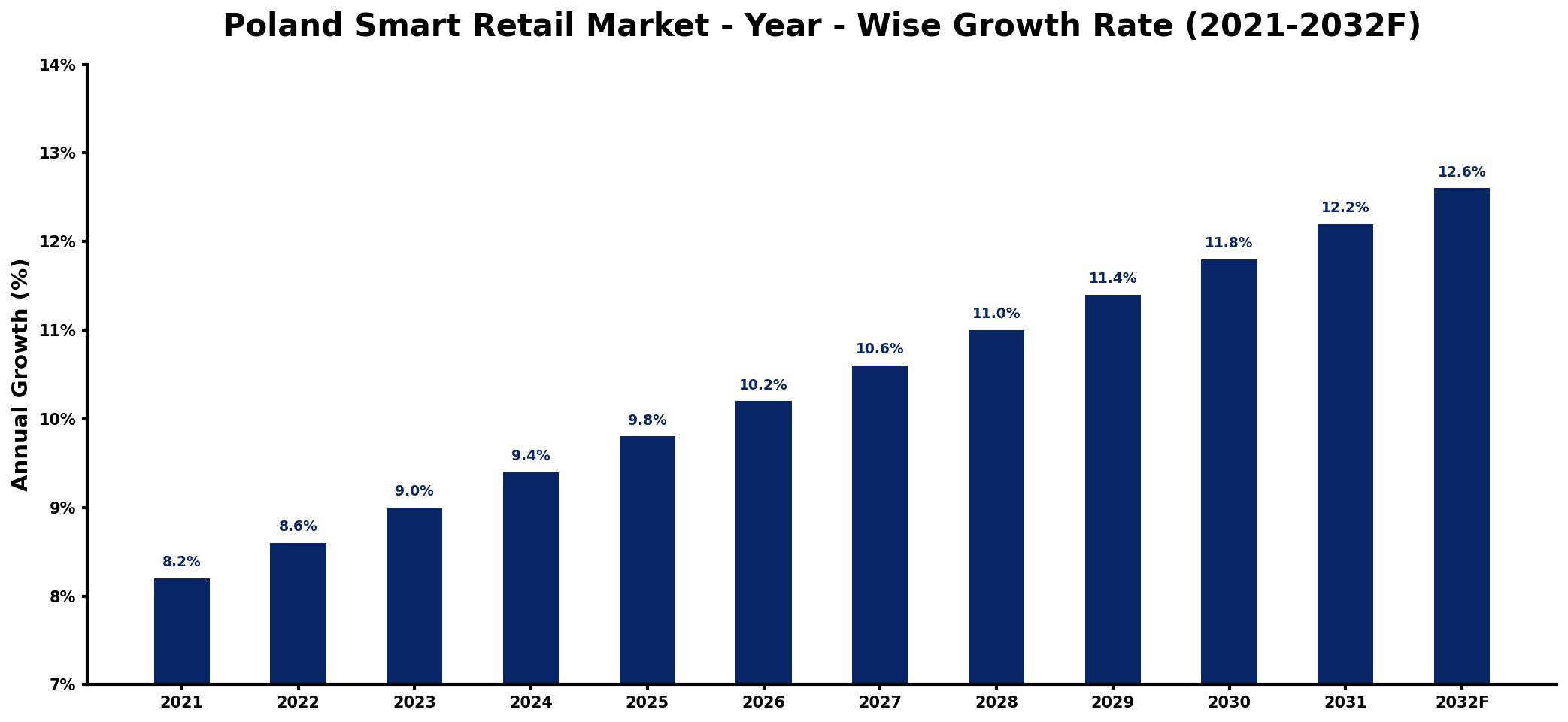
The table below presents the year‑wise growth rates along with the key drivers influencing the market
| Year | Growth Rate | Major Drivers |
| 2021 | 8.2% | Increased consumer technology adoption |
| 2022 | 8.6% | Rising demand for automation solutions |
| 2023 | 9.0% | Expansion of digital payment systems |
| 2024 | 9.4% | Growth in data analytics applications |
| 2025 | 9.8% | Investment in artificial intelligence technologies |
| 2026 | 10.2% | Enhanced supply chain efficiencies |
| 2027 | 10.6% | Surge in mobile shopping trends |
| 2028 | 11.0% | Development of personalized shopping experiences |
| 2029 | 11.4% | Integration of IoT devices |
| 2030 | 11.8% | Focus on sustainability initiatives |
| 2031 | 12.2% | Advancements in customer engagement strategies |
| 2032 | 12.6% | Emergence of omnichannel shopping platforms |
Note: Market size estimations and growth projections presented in this report are based on 6Wresearch's proprietary forecasting methodology, utilizing the latest available industry data, government publications, and primary research inputs.
Poland Smart Retail Market Synopsis
In recent years, the Poland Smart Retail Market has seen substantial investments in technology-driven solutions that transform the shopping experience. Retailers are embracing smart shelves, cashier-less environments, and personalized engagement strategies to cater to the demands of a tech-savvy populace.
The ongoing digital transformation in Poland's retail landscape is largely driven by the surge in demand for omnichannel solutions and contactless payment methods. As consumer behavior shifts towards convenience and seamless shopping experiences, the smart retail sector is poised for continued evolution and growth.
Poland Smart Retail Market Key Takeaways
- The increasing integration of AI and IoT technologies is reshaping the retail landscape.
- Retailers are prioritizing personalized shopping experiences to enhance customer satisfaction.
- Adoption of contactless payment solutions is accelerating in response to changing consumer preferences.
- Investment in smart inventory management systems is on the rise to improve operational efficiency.
- Public policies are increasingly supporting digital transformation in the retail sector.
Evaluation of Restraints in Poland Smart Retail Market
Despite the growth potential, the Poland Smart Retail Market faces several constraints that could impede its progress. One of the primary challenges is the significant upfront investment necessary to implement advanced technologies such as IoT devices and data analytics tools. Retailers may find it difficult to allocate the required resources, particularly small to medium-sized businesses. Additionally, concerns over data privacy and security can deter retailers from fully embracing smart technologies. The complexity of integrating multiple systems and keeping pace with rapid technological advancements further complicates the landscape, necessitating ongoing innovation and adaptation to remain competitive.
Poland Smart Retail Market Trends
Several trends are emerging in the Poland Smart Retail Market, driven by technological advancements and shifting consumer expectations. Retailers are increasingly utilizing AI-driven customer analytics to tailor experiences and optimize inventory management. Mobile payment solutions are becoming essential, enabling seamless transactions and enhancing customer convenience.
Moreover, the COVID-19 pandemic has hastened the transition towards e-commerce and contactless shopping, leading to an intensified focus on digital marketing strategies. This trend highlights the importance of developing omnichannel retailing capabilities to meet the expectations of digitally-savvy consumers.
Poland Smart Retail Market Opportunities
Investment opportunities within the Poland Smart Retail Market are abundant and diverse. There is a growing demand for innovative solutions in areas such as smart shelving, real-time inventory management systems, and advanced customer analytics powered by AI. Retailers are eager to enhance operational efficiency and customer satisfaction, creating a ripe environment for investments in these sectors.
Additionally, as the market evolves, partnerships with local retailers and e-commerce platforms will be critical for integrating smart retail solutions and maximizing growth potential. Companies that offer cutting-edge technologies in areas like blockchain and IoT stand to benefit significantly from this shift.
Government Initiatives in the Poland Smart Retail Market
The Polish government has implemented several initiatives aimed at fostering innovation and digital transformation in the retail sector. These include policies designed to promote the adoption of smart technologies such as IoT, AI, and data analytics, providing a supportive framework for retailers looking to modernize their operations. Moreover, regulations focused on consumer data privacy and cybersecurity are being established to ensure ethical practices in the deployment of smart retail solutions.
Financial incentives and grants are also offered to encourage retailers to invest in advanced technologies, ultimately nurturing a competitive and technologically adept retail environment.
Future Insights of the Poland Smart Retail Market
The outlook for the Poland Smart Retail Market is overwhelmingly positive, with projected growth driven by the need for enhanced customer engagement and the widespread adoption of mobile payment solutions. As technological advancements continue to unfold, retailers will increasingly invest in smart technologies to not only optimize operations but also adapt to the dynamic retail landscape.
The shift towards personalized shopping experiences and omnichannel retailing is expected to strengthen, ensuring that the smart retail market remains a vibrant and competitive sector in Poland's economy.
Poland Smart Retail Market Latest Developments (2025 - 2026)
In the most recent months, the Poland Smart Retail Market has seen a surge in initiatives focused on improving customer engagement through enhanced digital interfaces. Retailers are increasingly investing in AI-driven solutions to analyze consumer behavior and tailor offerings. Additionally, the trend towards contactless shopping continues to grow, with many retailers enhancing their mobile payment systems to provide a seamless shopping experience.
Furthermore, there is a notable uptick in collaboration between technology providers and retail businesses, aimed at integrating innovative solutions into existing infrastructures to maximize efficiency and drive customer satisfaction.
Poland Smart Retail Market - Key Attractiveness of the Report
- 10 Years of Market Numbers
- Historical Data Starting from 2022 to 2025
- Base Year: 2025
- Forecast Data until 2032
- Key Performance Indicators Impacting the Market
- Major Upcoming Developments and Projects
Key Highlights of the Report:
- Poland Smart Retail Market Outlook
- Market Size of Poland Smart Retail Market, 2025
- Forecast of Poland Smart Retail Market, 2032
- Historical Data and Forecast of Poland Smart Retail Revenues & Volume for the Period 2022-2032F
- Poland Smart Retail Market Trend Evolution
- Poland Smart Retail Market Drivers and Challenges
- Poland Smart Retail Price Trends
- Poland Smart Retail Porter's Five Forces
- Poland Smart Retail Industry Life Cycle
- Historical Data and Forecast of Poland Smart Retail Market Revenues & Volume By System for the Period 2022-2032F
- Historical Data and Forecast of Poland Smart Retail Market Revenues & Volume By Digital Signage Solutions for the Period 2022-2032F
- Historical Data and Forecast of Poland Smart Retail Market Revenues & Volume By Smart Labels for the Period 2022-2032F
- Historical Data and Forecast of Poland Smart Retail Market Revenues & Volume By Smart Payment Systems for the Period 2022-2032F
- Historical Data and Forecast of Poland Smart Retail Market Revenues & Volume By Intelligent Vending Machines for the Period 2022-2032F
- Historical Data and Forecast of Poland Smart Retail Market Revenues & Volume By Augmented Reality Solutions for the Period 2022-2032F
- Historical Data and Forecast of Poland Smart Retail Market Revenues & Volume By Virtual Reality Solutions for the Period 2022-2032F
- Historical Data and Forecast of Poland Smart Retail Market Revenues & Volume By POS Solutions for the Period 2022-2032F
- Historical Data and Forecast of Poland Digital Signage Solutions Smart Retail Market Revenues & Volume By Smart Carts for the Period 2022-2032F
- Historical Data and Forecast of Poland Smart Retail Market Revenues & Volume By Application for the Period 2022-2032F
- Historical Data and Forecast of Poland Smart Retail Market Revenues & Volume By Foot-traffic Monitoring for the Period 2022-2032F
- Historical Data and Forecast of Poland Smart Retail Market Revenues & Volume By Inventory Management for the Period 2022-2032F
- Historical Data and Forecast of Poland Smart Retail Market Revenues & Volume By Loyalty Management and Payment for the Period 2022-2032F
- Historical Data and Forecast of Poland Smart Retail Market Revenues & Volume By Predictive Equipment Maintenance for the Period 2022-2032F
- Historical Data and Forecast of Poland Smart Retail Market Revenues & Volume By Brand Protection for the Period 2022-2032F
- Historical Data and Forecast of Poland Smart Retail Market Revenues & Volume By Smart Fitting Rooms for the Period 2022-2032F
- Historical Data and Forecast of Poland Smart Retail Market Revenues & Volume By Retail Offering for the Period 2022-2032F
- Historical Data and Forecast of Poland Smart Retail Market Revenues & Volume By Apparel and Accessories for the Period 2022-2032F
- Historical Data and Forecast of Poland Smart Retail Market Revenues & Volume By Fast-moving Consumer Goods for the Period 2022-2032F
- Historical Data and Forecast of Poland Smart Retail Market Revenues & Volume By Hardlines and Leisure Goods for the Period 2022-2032F
- Historical Data and Forecast of Poland Smart Retail Market Revenues & Volume By Others for the Period 2022-2032F
- Poland Smart Retail Import Export Trade Statistics
- Market Opportunity Assessment By System
- Market Opportunity Assessment By Application
- Market Opportunity Assessment By Retail Offering
- Poland Smart Retail Top Companies Market Share
- Poland Smart Retail Competitive Benchmarking By Technical and Operational Parameters
- Poland Smart Retail Company Profiles
- Poland Smart Retail Key Strategic Recommendations






































