Poland Stainless Steel Tableware And Kitchenware Market Size (2020-2030)
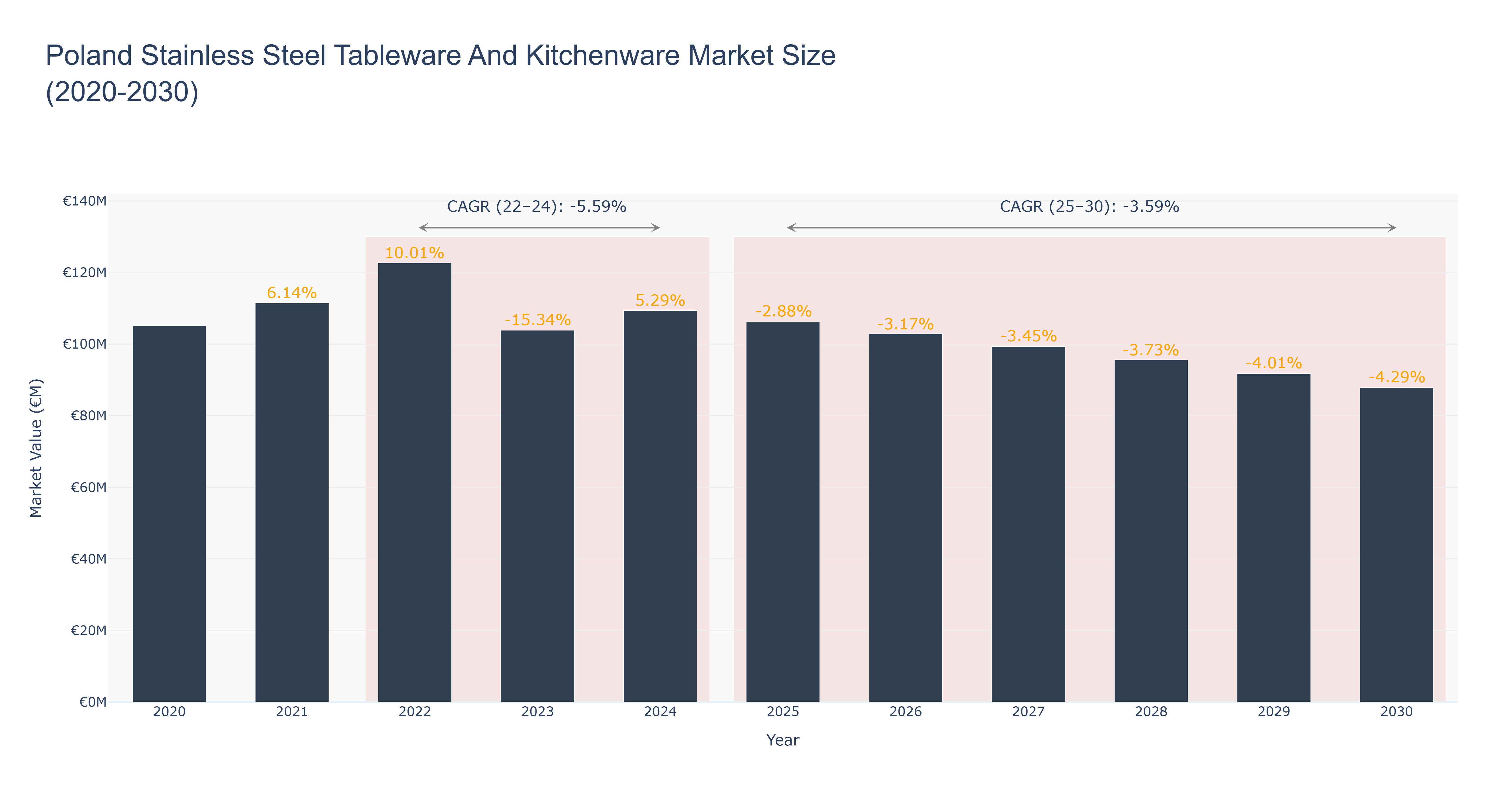
Poland Stainless Steel Tableware And Kitchenware Market has seen fluctuations in market size over the years. The peak market size of €122.71 million was recorded in 2022, followed by a decline to €103.89 million in 2023. The market showed a slight recovery in 2024 with a size of €109.38 million. However, from 2025 to 2030, the market is forecasted to experience a continued decline, with the size expected to decrease to €87.84 million in 2030. The CAGR for the period 2022-24 is -5.59%, while for 2025-30, it is -3.59%. The downward trend can be attributed to changing consumer preferences towards more sustainable and eco-friendly alternatives. Looking ahead, Poland is set to introduce new regulations promoting the use of recycled materials in kitchenware production, aiming to boost sustainability in the market.
Poland Stainless Steel Tableware And Kitchenware Market: Production & Trade Performance (2019-2025)
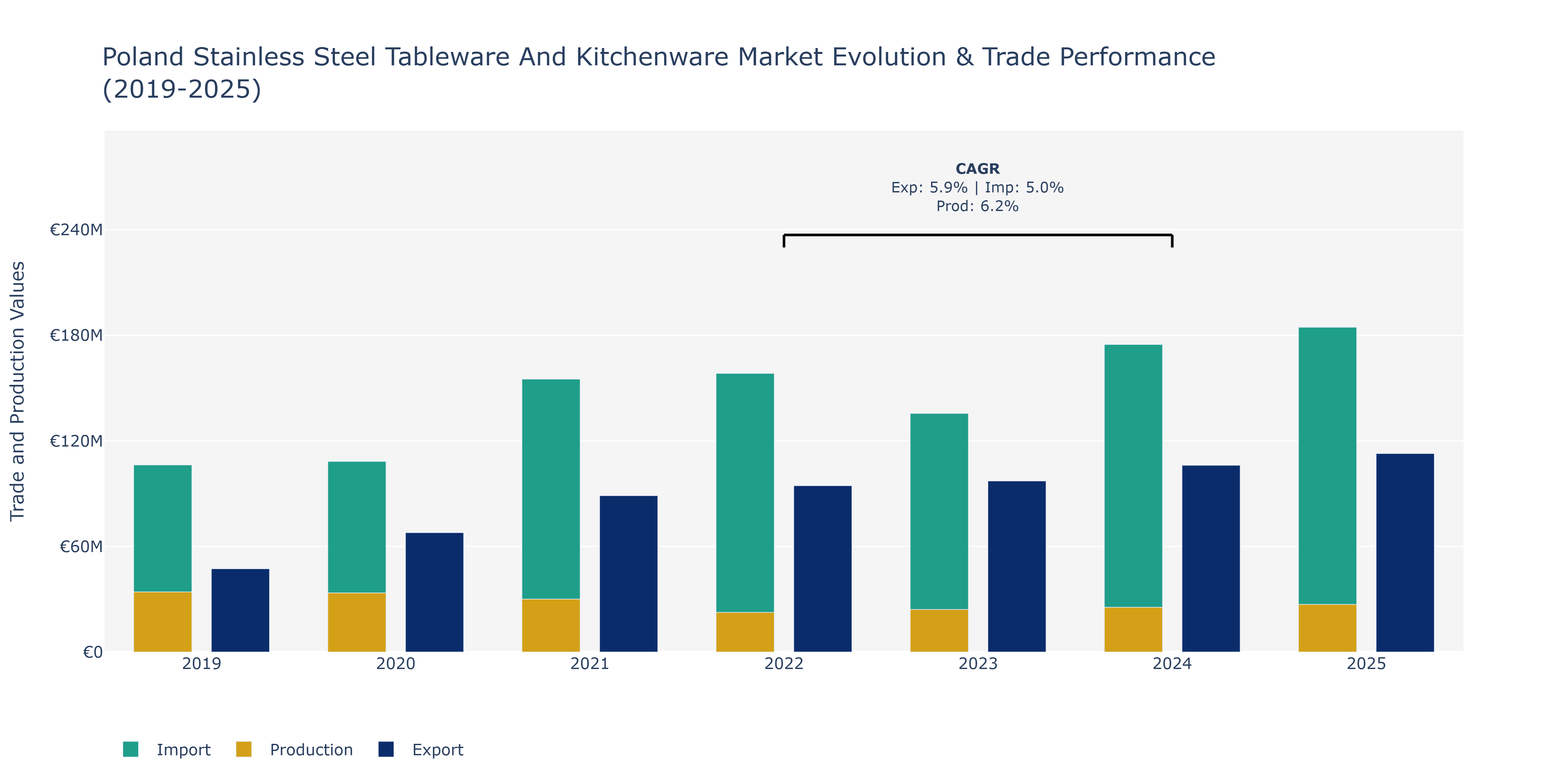
In the Poland Stainless Steel Tableware And Kitchenware Market, from 2019 to 2025, there were notable fluctuations in exports, imports, and production. Exports showed a consistent upward trend, increasing from €47.34 million in 2019 to a peak of €112.84 million in 2025. Imports followed a similar pattern, rising steadily from €106.34 million in 2019 to €184.59 million in 2025. However, production witnessed fluctuations, reaching its lowest point in 2022 at €22.53 million but rebounding to €27.08 million by 2025. These trends can be attributed to various factors such as changing consumer preferences for stainless steel kitchenware, fluctuations in raw material costs, and evolving design trends driving export demand. The increasing focus on sustainability and durability in kitchen products globally could have also impacted the market positively, leading to the overall growth observed in exports and imports.
Key Highlights of the Report:
- Poland Stainless Steel Tableware and Kitchenware Market Outlook
- Market Size of Poland Stainless Steel Tableware and Kitchenware Market, 2025
- Forecast of Poland Stainless Steel Tableware and Kitchenware Market, 2032
- Historical Data and Forecast of Poland Stainless Steel Tableware and Kitchenware Revenues & Volume for the Period 2022-2032F
- Poland Stainless Steel Tableware and Kitchenware Market Trend Evolution
- Poland Stainless Steel Tableware and Kitchenware Market Drivers and Challenges
- Poland Stainless Steel Tableware and Kitchenware Price Trends
- Poland Stainless Steel Tableware and Kitchenware Porter's Five Forces
- Poland Stainless Steel Tableware and Kitchenware Industry Life Cycle
- Historical Data and Forecast of Poland Stainless Steel Tableware and Kitchenware Market Revenues & Volume By Product for the Period 2022-2032F
- Historical Data and Forecast of Poland Stainless Steel Tableware and Kitchenware Market Revenues & Volume By Tableware for the Period 2022-2032F
- Historical Data and Forecast of Poland Stainless Steel Tableware and Kitchenware Market Revenues & Volume By Kitchenwares for the Period 2022-2032F
- Historical Data and Forecast of Poland Stainless Steel Tableware and Kitchenware Market Revenues & Volume By Application for the Period 2022-2032F
- Historical Data and Forecast of Poland Stainless Steel Tableware and Kitchenware Market Revenues & Volume By Domestic Use for the Period 2022-2032F
- Historical Data and Forecast of Poland Stainless Steel Tableware and Kitchenware Market Revenues & Volume By Commercial Use for the Period 2022-2032F
- Poland Stainless Steel Tableware and Kitchenware Import Export Trade Statistics
- Market Opportunity Assessment By Product
- Market Opportunity Assessment By Application
- Poland Stainless Steel Tableware and Kitchenware Top Companies Market Share
- Poland Stainless Steel Tableware and Kitchenware Competitive Benchmarking By Technical and Operational Parameters
- Poland Stainless Steel Tableware and Kitchenware Company Profiles
- Poland Stainless Steel Tableware and Kitchenware Key Strategic Recommendations






































