Poland Television Broadcasting Market Size, Share & Growth Rate
The Poland Television Broadcasting Market was estimated at USD 592 Million in 2025 and is projected to reach USD 987 Million by 2032, growing at a CAGR of 7.6% from 2026 to 2032. This growth is significantly influenced by the rapid shift towards digital broadcasting and the rising consumer preference for on-demand content. Furthermore, the incorporation of advanced technologies like high-definition and 4K services enhances viewer experiences, thereby propelling market expansion.
Poland Television Broadcasting Market Year-wise Growth Rate and Key Drivers
This graph highlights how the Poland Television Broadcasting Market has steadily grown over the years, supported by major growth factors.
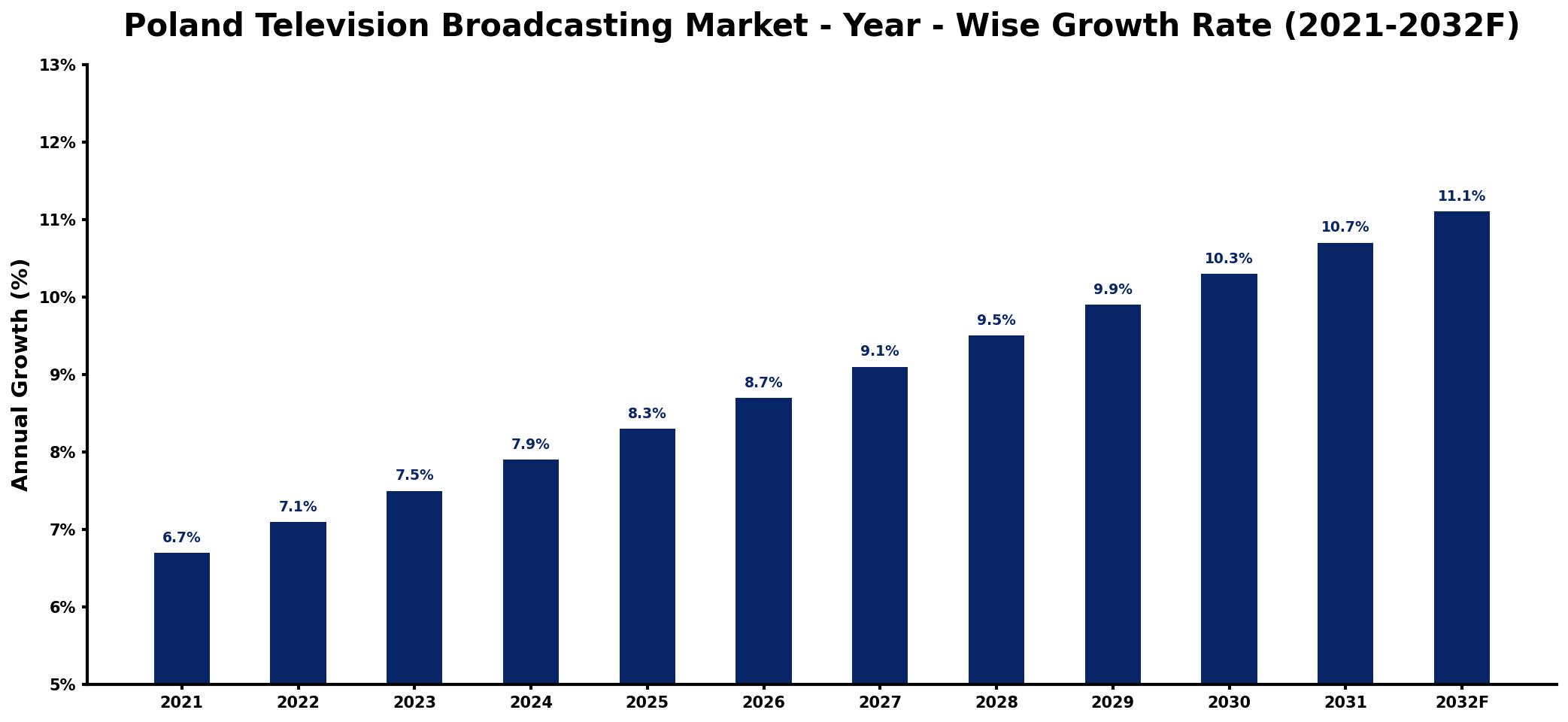
The table below presents the year‑wise growth rates along with the key drivers influencing the market
| Year | Growth Rate | Major Drivers |
| 2021 | 6.7% | Increased consumer digital engagement |
| 2022 | 7.1% | Growth in subscription services |
| 2023 | 7.5% | Rise in advertising expenditure |
| 2024 | 7.9% | Expansion of streaming platforms |
| 2025 | 8.3% | Higher demand for original content |
| 2026 | 8.7% | Investment in advanced technologies |
| 2027 | 9.1% | Surge in mobile content consumption |
| 2028 | 9.5% | Increase in cross-platform partnerships |
| 2029 | 9.9% | Growth of local content production |
| 2030 | 10.3% | Demand for interactive experiences |
| 2031 | 10.7% | rising export shipment volumes |
| 2032 | 11.1% | Higher integration of AI solutions |
Note: Market size estimations and growth projections presented in this report are based on 6Wresearch's proprietary forecasting methodology, utilizing the latest available industry data, government publications, and primary research inputs.
Poland Television Broadcasting Market Synopsis
The most significant force currently shaping the Poland Television Broadcasting Market is the transition from traditional broadcasting methods to digital platforms, including OTT services and streaming. This shift is not only changing the way content is consumed but also challenging broadcasters to innovate and adapt to new technologies.
In addition, consumer habits are evolving toward more personalized viewing experiences, driving demand for interactive content delivery. Broadcasters are now tasked with creating engaging formats that cater to these new preferences while integrating cutting-edge technologies that enhance accessibility and viewer satisfaction.
Poland Television Broadcasting Market Key Takeaways
- The market is on a robust growth trajectory driven by digital transformation.
- Technological advancements, including HD and 4K broadcasting, are enhancing viewer experiences.
- Consumer preferences are shifting towards on-demand and interactive content.
- Government policies are supporting the industry's transition to digital platforms.
- Investment in infrastructure is crucial for maintaining competitiveness in this evolving landscape.
Evaluation of Restraints in Poland Television Broadcasting Market
Despite its promising growth, the Poland Television Broadcasting Market faces significant restraints. The increasing popularity of online streaming platforms poses a formidable challenge to traditional broadcasters. As more consumers opt for flexible viewing options, the pressure mounts on established television networks to innovate and retain their audiences. Additionally, the need for substantial investment in digital infrastructure is critical, and many broadcasters must navigate the complexities of upgrading their systems while also competing with agile OTT providers.
Poland Television Broadcasting Market Trends
Current trends indicate a strong movement towards personalized content delivery systems, with an emphasis on data analytics to understand viewer preferences. The rise of smart TVs and mobile devices is also shaping demand, enabling consumers to access content seamlessly across different platforms. Moreover, the integration of interactive features in broadcasting, such as voting and live feedback, is creating new ways to engage with audiences, further transforming the viewing experience.
Poland Television Broadcasting Market Opportunities
Growth opportunities in the Poland Television Broadcasting Market are primarily found in technological innovation and strategic partnerships. The expansion of 5G networks opens doors for faster and more reliable streaming services, creating a conducive environment for immersive content experiences. Furthermore, collaborations between traditional broadcasters and tech firms can yield innovative solutions that enhance service offerings and reach untapped markets, particularly in rural areas.
Government Initiatives in the Poland Television Broadcasting Market
The Polish government has implemented various initiatives to bolster the television broadcasting market amidst rapid technological shifts. Emphasizing the importance of television in cultural expression and information dissemination, policies have been designed to promote competition and diversity within the sector. The government is also focusing on enhancing digital literacy among consumers and ensuring that broadcasting services are accessible to all regions, thereby fostering inclusivity and preserving Polands rich cultural identity.
Future Insights of the Poland Television Broadcasting Market
Looking ahead to 2026-2032, the Poland Television Broadcasting Market is expected to continue its evolution, driven by technological advancements and the integration of new viewing experiences. As consumers increasingly embrace digital platforms, traditional broadcasters will need to adapt quickly, focusing on hybrid models that combine live content with on-demand offerings. The demand for immersive and interactive formats will likely shape content creation strategies, while ongoing government support will facilitate a more dynamic broadcasting landscape.
Poland Television Broadcasting Market Latest Developments (2025 - 2026)
In recent months, the Poland Television Broadcasting Market has seen significant industry shifts, with an increase in partnerships between traditional networks and technology firms aimed at enhancing content delivery. There has been a notable push towards the incorporation of virtual reality and augmented reality technologies in programming, allowing for more engaging viewer experiences. Additionally, discussions on regulations regarding content standards and accessibility have emerged, reflecting the government's commitment to ensuring a competitive and diverse broadcasting environment.
Poland Television Broadcasting Market - Key Attractiveness of the Report
- 10 Years of Market Numbers
- Historical Data Starting from 2022 to 2025
- Base Year: 2025
- Forecast Data until 2032
- Key Performance Indicators Impacting the Market
- Major Upcoming Developments and Projects
Key Highlights of the Report:
- Poland Television Broadcasting Market Outlook
- Market Size of Poland Television Broadcasting Market, 2025
- Forecast of Poland Television Broadcasting Market, 2032
- Historical Data and Forecast of Poland Television Broadcasting Revenues & Volume for the Period 2022-2032F
- Poland Television Broadcasting Market Trend Evolution
- Poland Television Broadcasting Market Drivers and Challenges
- Poland Television Broadcasting Price Trends
- Poland Television Broadcasting Porter's Five Forces
- Poland Television Broadcasting Industry Life Cycle
- Historical Data and Forecast of Poland Television Broadcasting Market Revenues & Volume By Type for the Period 2022-2032F
- Historical Data and Forecast of Poland Television Broadcasting Market Revenues & Volume By Television Station for the Period 2022-2032F
- Historical Data and Forecast of Poland Television Broadcasting Market Revenues & Volume By Television Network for the Period 2022-2032F
- Historical Data and Forecast of Poland Television Broadcasting Market Revenues & Volume By Broadcaster Type for the Period 2022-2032F
- Historical Data and Forecast of Poland Television Broadcasting Market Revenues & Volume By Public for the Period 2022-2032F
- Historical Data and Forecast of Poland Television Broadcasting Market Revenues & Volume By Commercial for the Period 2022-2032F
- Historical Data and Forecast of Poland Television Broadcasting Market Revenues & Volume By Revenue Source for the Period 2022-2032F
- Historical Data and Forecast of Poland Television Broadcasting Market Revenues & Volume By Subscription-based for the Period 2022-2032F
- Historical Data and Forecast of Poland Television Broadcasting Market Revenues & Volume By Advertisement-based for the Period 2022-2032F
- Poland Television Broadcasting Import Export Trade Statistics
- Market Opportunity Assessment By Type
- Market Opportunity Assessment By Broadcaster Type
- Market Opportunity Assessment By Revenue Source
- Poland Television Broadcasting Top Companies Market Share
- Poland Television Broadcasting Competitive Benchmarking By Technical and Operational Parameters
- Poland Television Broadcasting Company Profiles
- Poland Television Broadcasting Key Strategic Recommendations






































