Poland Time and Attendance Software Market Size, Share & Growth Rate
The Poland Time and Attendance Software Market was estimated at USD 267 Million in 2025 and is projected to reach USD 351 Million by 2032, growing at a CAGR of 4.0% from 2026 to 2032. This growth is primarily fueled by the increasing need for companies to streamline workforce management processes, especially in light of rising remote working trends. Additionally, the integration of advanced technologies such as biometric authentication and mobile accessibility are further propelling the demand for sophisticated time tracking solutions.
Poland Time and Attendance Software Market Year-wise Growth Rate and Key Drivers
This graph highlights how the Poland Time and Attendance Software Market has steadily grown over the years, supported by major growth factors.
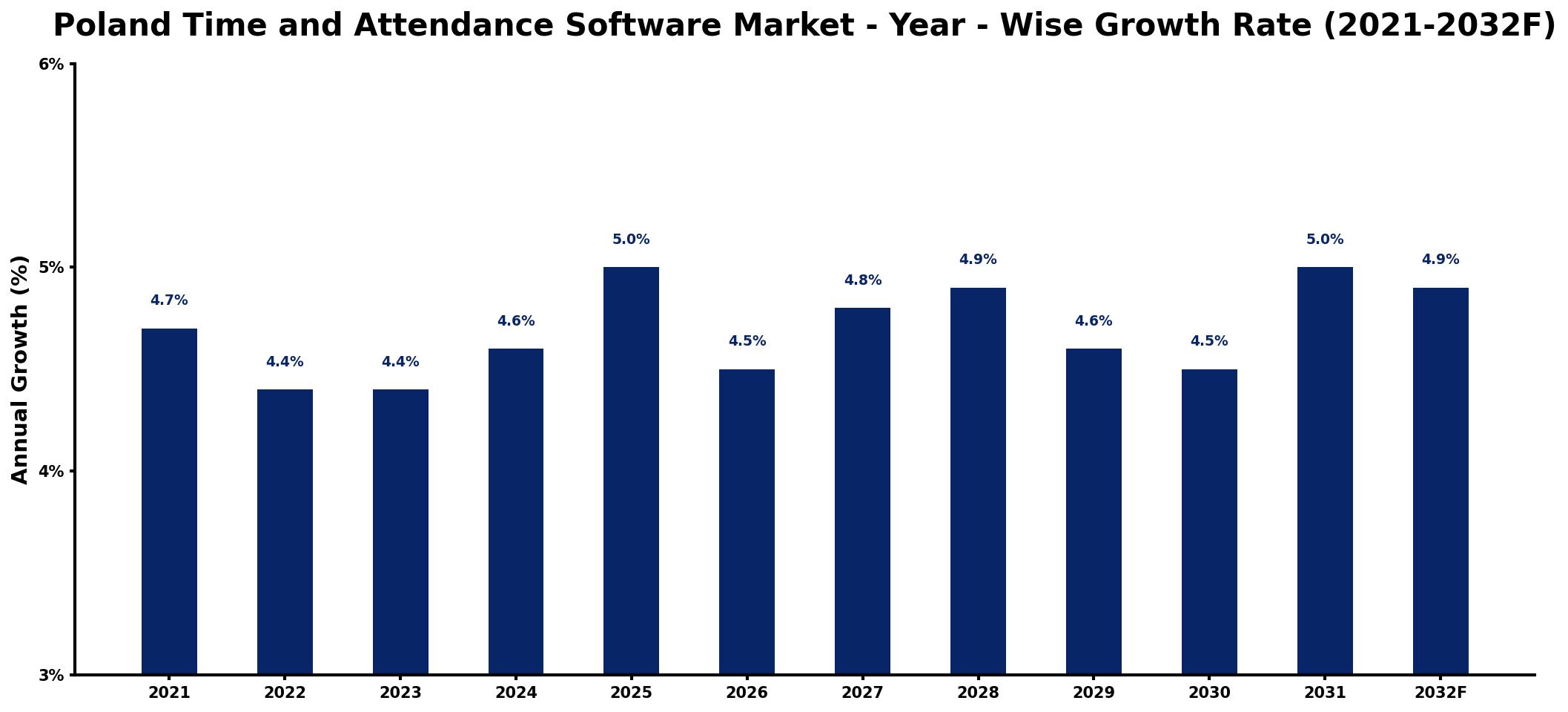
The table below presents the year‑wise growth rates along with the key drivers influencing the market
| Year | Growth Rate | Major Drivers |
| 2021 | 4.7% | Remote work adoption drives demand |
| 2022 | 4.4% | Regulatory compliance enhances market interest |
| 2023 | 4.4% | Cloud technology gains popularity |
| 2024 | 4.6% | Integration with HR systems grows |
| 2025 | 5.0% | Increased workforce mobility necessitates solutions |
| 2026 | 4.5% | AI advancements improve efficiency |
| 2027 | 4.8% | Rising labor costs prompt investment |
| 2028 | 4.9% | Data analytics usage expands rapidly |
| 2029 | 4.6% | Focus on employee engagement increases |
| 2030 | 4.5% | Customization options attract new clients |
| 2031 | 5.0% | Sustainability initiatives drive new solutions |
| 2032 | 4.9% | Globalization enhances cross-border applications |
Note: Market size estimations and growth projections presented in this report are based on 6Wresearch's proprietary forecasting methodology, utilizing the latest available industry data, government publications, and primary research inputs.
Poland Time and Attendance Software Market Synopsis
The Poland Time and Attendance Software Market is witnessing remarkable momentum as organizations turn towards digital transformation to enhance operational efficiency. As traditional methods become obsolete, businesses are investing significantly in advanced software solutions that promise improved attendance management, compliance, and employee engagement.
Looking ahead, the market is poised for further expansion, driven by continuous innovations and the growing demand for features like real-time analytics and seamless integration with existing HR systems. The overall shift towards cloud-based platforms will also play a critical role in shaping the future landscape of workforce management in Poland.
Poland Time and Attendance Software Market Key Takeaways
- The market is on track for steady growth, supported by the increasing adoption of advanced workforce management solutions.
- Cloud-based offerings are becoming the standard, reflecting the shift towards remote and flexible working arrangements.
- Biometric technologies are being integrated to enhance the accuracy of time tracking and improve security.
- Compliance with local labor laws is driving the adoption of sophisticated attendance software across industries.
- Investments in AI and machine learning capabilities are expected to revolutionize data processing and insights in the market.
Evaluation of Restraints in Poland Time and Attendance Software Market
Despite the positive outlook, certain factors could restrain growth in the Poland Time and Attendance Software Market. Intensified competition among software providers often leads to pricing pressures, which can affect profitability. Moreover, the rapid pace of technological evolution necessitates ongoing innovation to meet shifting customer needs, a challenge not every vendor can navigate. Data security also remains a significant concern, especially in light of stringent regulations like GDPR. Companies might also encounter employee resistance when implementing new technologies, making change management a critical focus for successful adoption.
Poland Time and Attendance Software Market Trends
The market is witnessing several key trends that are reshaping demand. The move towards cloud-based solutions stands out as organizations embrace the flexibility and scalability that these platforms offer. Integration of biometric systems enhances accuracy and security, while mobile applications provide greater accessibility for employees. Furthermore, the inclusion of real-time tracking and analytical capabilities is becoming essential as businesses aim to optimize their operational efficiency. There is also a pronounced shift towards using AI and machine learning, aimed at automating processes and delivering predictive insights to improve workforce management.
Poland Time and Attendance Software Market Opportunities
The Poland Time and Attendance Software Market offers lucrative opportunities for investors and companies willing to innovate. There is a strong demand for advanced solutions that not only meet compliance needs but also drive productivity enhancements. This is particularly true for firms focusing on cloud-based, mobile-integrated systems equipped with advanced biometric features. Established providers and emerging startups alike can find opportunities in developing solutions tailored to the unique needs of local businesses. As the digital landscape continues to evolve, stakeholders are encouraged to explore partnerships and integrations that can amplify their offerings in this competitive environment.
Government Initiatives in the Poland Time and Attendance Software Market
Government policies in Poland play a crucial role in shaping the Time and Attendance Software Market. Regulations require employers to track working hours accurately to ensure compliance with labor laws and prevent any violations. The government has been advocating for the adoption of technology to enhance tracking processes, thereby improving operational efficiency across sectors. Furthermore, existing data protection laws, including GDPR, necessitate that software providers implement strict measures to safeguard employee data. Overall, public policy is increasingly focused on promoting transparency and fairness in labor practices.
Future Insights of the Poland Time and Attendance Software Market
Looking forward, the Poland Time and Attendance Software Market is set to flourish from 2026 to 2032, largely due to the ongoing digital transformation trends. Organizations are increasingly recognizing the value of automating time tracking processes, which enhances productivity and operational efficiency. With a growing emphasis on compliance and workforce management, software solutions will need to evolve continuously to meet these requirements. Innovative features, including AI-driven analytics and mobile compatibility, will be crucial in catering to the dynamic needs of businesses in Poland.
Poland Time and Attendance Software Market Latest Developments (2025 - 2026)
In recent months, the Poland Time and Attendance Software Market has seen a surge in investments focused on developing cloud-based solutions that enhance user experience. Companies are prioritizing the integration of advanced features, including real-time analytics and mobile access, in response to shifting workforce demands. Additionally, increased collaboration between technology providers and businesses is expected to drive innovation and refine user interfaces, aligning with industry standards. These developments underline the market's commitment to meeting the evolving expectations of employers and employees alike.
Poland Time and Attendance Software Market - Key Attractiveness of the Report
- 10 Years of Market Numbers
- Historical Data Starting from 2022 to 2025
- Base Year: 2025
- Forecast Data until 2032
- Key Performance Indicators Impacting the Market
- Major Upcoming Developments and Projects
Key Highlights of the Report:
- Poland Time and Attendance Software Market Outlook
- Market Size of Poland Time and Attendance Software Market, 2025
- Forecast of Poland Time and Attendance Software Market, 2032
- Historical Data and Forecast of Poland Time and Attendance Software Revenues & Volume for the Period 2022-2032F
- Poland Time and Attendance Software Market Trend Evolution
- Poland Time and Attendance Software Market Drivers and Challenges
- Poland Time and Attendance Software Price Trends
- Poland Time and Attendance Software Porter's Five Forces
- Poland Time and Attendance Software Industry Life Cycle
- Historical Data and Forecast of Poland Time and Attendance Software Market Revenues & Volume By Component for the Period 2022-2032F
- Historical Data and Forecast of Poland Time and Attendance Software Market Revenues & Volume By Software for the Period 2022-2032F
- Historical Data and Forecast of Poland Time and Attendance Software Market Revenues & Volume By Services for the Period 2022-2032F
- Historical Data and Forecast of Poland Time and Attendance Software Market Revenues & Volume By Deployment Mode for the Period 2022-2032F
- Historical Data and Forecast of Poland Time and Attendance Software Market Revenues & Volume By On-premise for the Period 2022-2032F
- Historical Data and Forecast of Poland Time and Attendance Software Market Revenues & Volume By Cloud for the Period 2022-2032F
- Historical Data and Forecast of Poland Time and Attendance Software Market Revenues & Volume By Hybrid for the Period 2022-2032F
- Historical Data and Forecast of Poland Time and Attendance Software Market Revenues & Volume By Organization Size for the Period 2022-2032F
- Historical Data and Forecast of Poland Time and Attendance Software Market Revenues & Volume By Large Enterprises for the Period 2022-2032F
- Historical Data and Forecast of Poland Time and Attendance Software Market Revenues & Volume By SMES for the Period 2022-2032F
- Historical Data and Forecast of Poland Time and Attendance Software Market Revenues & Volume By Industry Vertical for the Period 2022-2032F
- Historical Data and Forecast of Poland Time and Attendance Software Market Revenues & Volume By BFSI for the Period 2022-2032F
- Historical Data and Forecast of Poland Time and Attendance Software Market Revenues & Volume By Manufacturing for the Period 2022-2032F
- Historical Data and Forecast of Poland Time and Attendance Software Market Revenues & Volume By Healthcare for the Period 2022-2032F
- Historical Data and Forecast of Poland Time and Attendance Software Market Revenues & Volume By Government for the Period 2022-2032F
- Historical Data and Forecast of Poland Time and Attendance Software Market Revenues & Volume By Retail & E-commerce for the Period 2022-2032F
- Historical Data and Forecast of Poland Time and Attendance Software Market Revenues & Volume By IT & Telecom for the Period 2022-2032F
- Historical Data and Forecast of Poland Time and Attendance Software Market Revenues & Volume By Education for the Period 2022-2032F
- Historical Data and Forecast of Poland Time and Attendance Software Market Revenues & Volume By Others for the Period 2022-2032F
- Poland Time and Attendance Software Import Export Trade Statistics
- Market Opportunity Assessment By Component
- Market Opportunity Assessment By Deployment Mode
- Market Opportunity Assessment By Organization Size
- Market Opportunity Assessment By Industry Vertical
- Poland Time and Attendance Software Top Companies Market Share
- Poland Time and Attendance Software Competitive Benchmarking By Technical and Operational Parameters
- Poland Time and Attendance Software Company Profiles
- Poland Time and Attendance Software Key Strategic Recommendations






































