Poland Video Conferencing Market Size & Growth Rate (2026-2032)
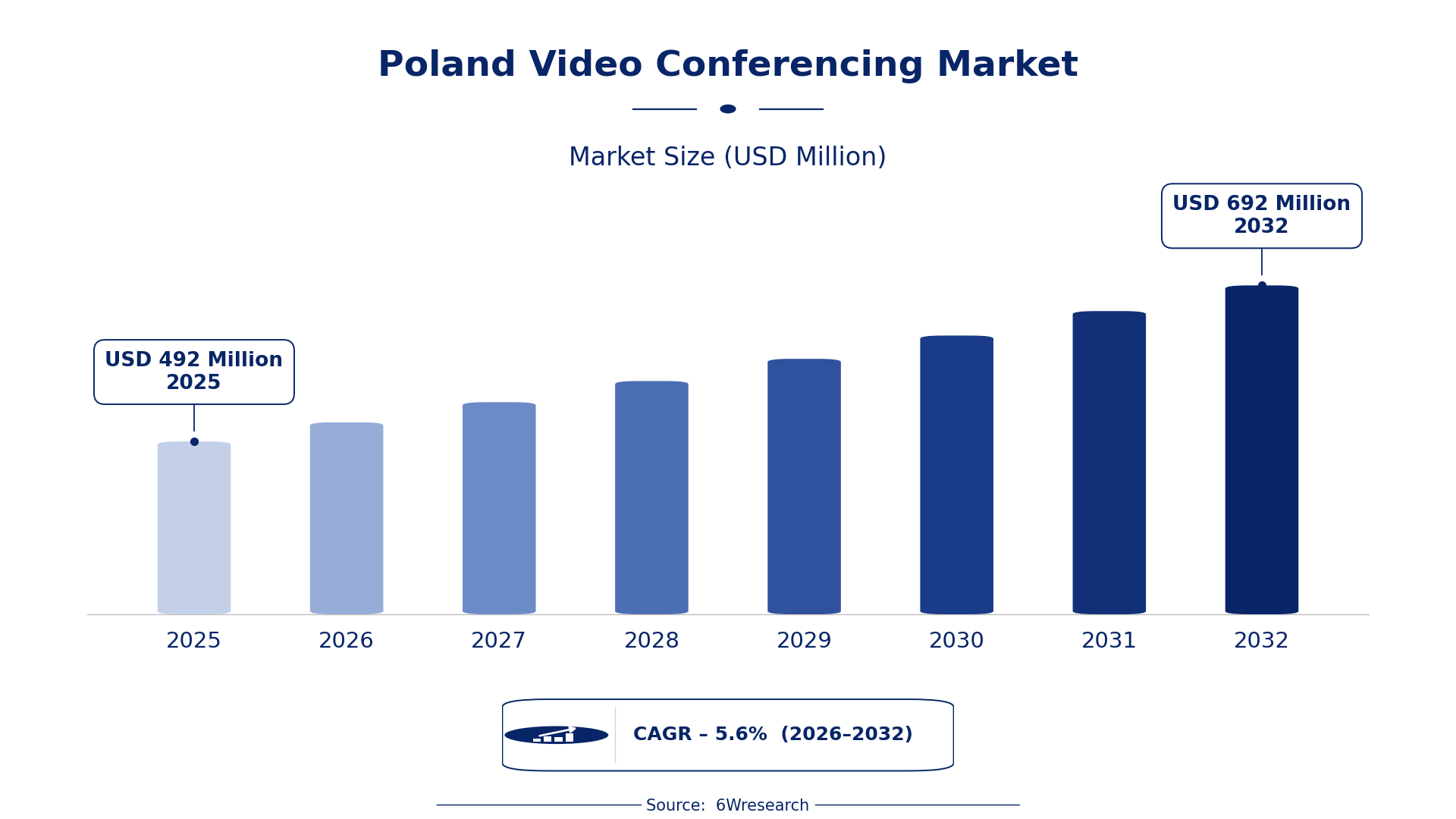
The Poland Video Conferencing Market was estimated at USD 492 Million in 2025 and is projected to reach USD 692 Million by 2032, growing at a CAGR of 5.6% from 2026 to 2032.
Poland Video Conferencing Market Synopsis
The demand for video conferencing solutions in Poland has surged, driven by the substantial increase in remote work and virtual collaboration across industries. Businesses and educational institutions alike are adopting these technologies not only to enhance communication but also to maintain productivity in hybrid work environments.
Technological advancements are key to this market's evolution, with innovative software and hardware solutions integrating AI and cloud services. This evolution addresses the growing expectations for seamless user experiences and high-quality communications, thereby further solidifying the market's trajectory.
Poland Video Conferencing Market Year-wise Growth Rate and Key Drivers
This graph illustrates the annual growth rates of the Poland Video Conferencing Market from 2021 to 2032, highlighting a steady upward trajectory and projected expansion over the forecast period.
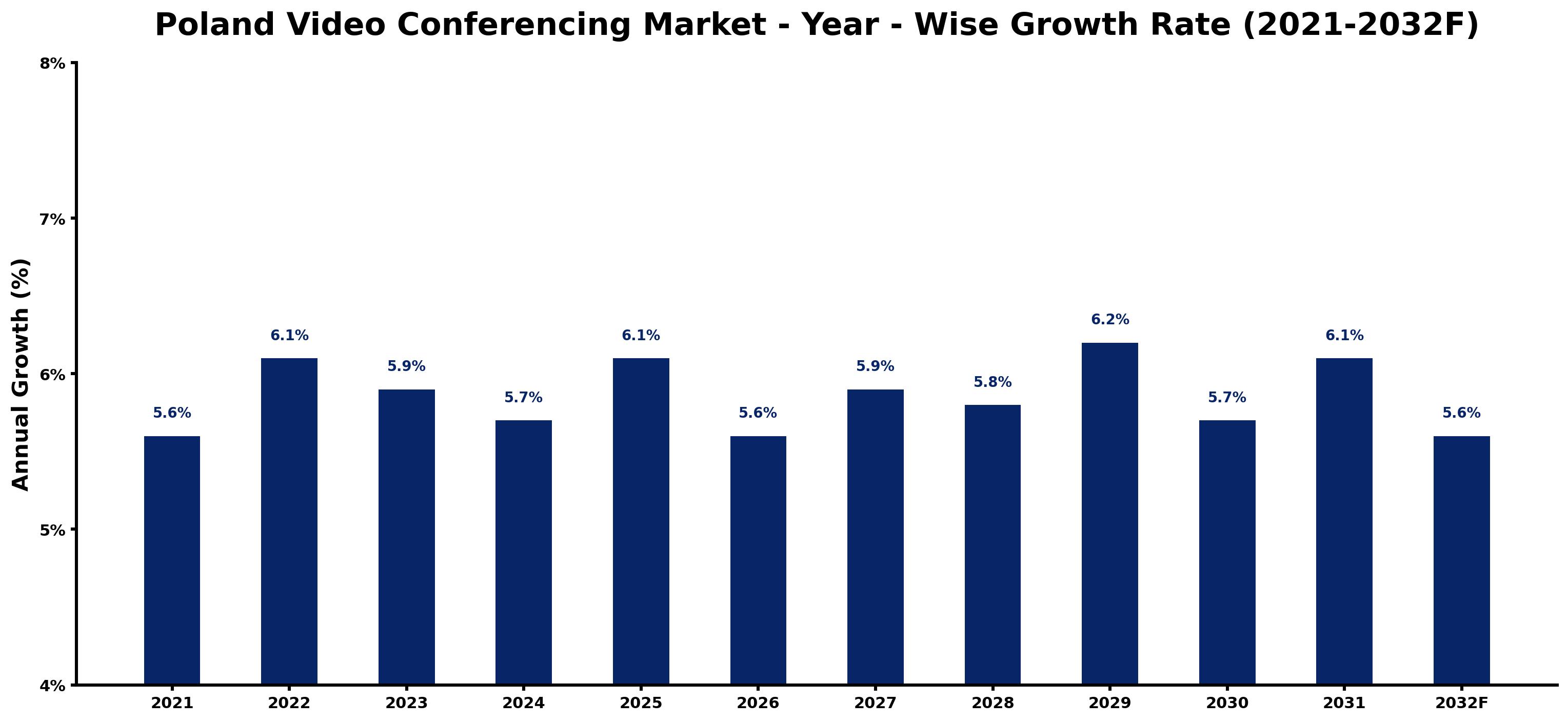
The table below presents the year‑wise growth rates along with the key drivers influencing the market
| Year | Growth Rate | Major Drivers |
| 2021 | 5.6% | Rise in remote work policies post-pandemic |
| 2022 | 6.1% | Increased investment in digital collaboration tools by SMEs |
| 2023 | 5.9% | Government grants supporting telecommunication system upgrades |
| 2024 | 5.7% | Growing adoption of hybrid work models in enterprises |
| 2025 | 6.1% | Strong demand for educational platforms using video conferencing |
| 2026 | 5.6% | Poland's digitalization strategy boosting online communication tools |
| 2027 | 5.9% | Enhanced internet infrastructure improving video conferencing quality |
| 2028 | 5.8% | Surge in online events and webinars driving usage |
| 2029 | 6.2% | Supportive IT policies fostering tech innovations in communication |
| 2030 | 5.7% | Poland’s tech startup ecosystem expanding video solutions market |
| 2031 | 6.1% | Increased focus on cybersecurity for video conferencing solutions |
| 2032 | 5.6% | Higher demand for international corporate training via video |
Note: Market size estimations and growth projections presented in this report are based on 6Wresearch's proprietary forecasting methodology, utilizing the latest available industry data, government publications, and primary research inputs.
Poland Video Conferencing Market Key Takeaways
Below are some of the specific key takeaways from the market, including:
- Rapid growth driven by the rise of remote work and virtual meetings.
- Advancements in technology are enhancing user experience and functionality.
- Cybersecurity concerns are significant, necessitating robust protective measures.
- Government regulations, especially regarding data protection, are shaping market dynamics.
- High-quality internet infrastructure remains critical for optimal performance.
Evaluation of Restraints in Poland Video Conferencing Market
Despite its promising growth, the Poland Video Conferencing Market faces real challenges that cannot be overlooked. Cybersecurity risks are escalating as the reliance on digital communication grows. Companies must invest heavily in encryption and secure systems to protect sensitive information. on top of that, varying quality in internet infrastructure across regions poses a challenge to delivering high-definition video and audio, which is essential for effective communication.
Poland Video Conferencing Market Trends
The market is witnessing several trends that are reshaping its future. One notable trend is the integration of artificial intelligence in video conferencing tools, enhancing features like automated transcription and real-time translation. This technology not only improves communication efficiency but also broadens accessibility.
Additionally, there’s a growing emphasis on hybrid work solutions, prompting vendors to develop tools that support both in-person and remote interactions. This dual focus caters to diverse business needs and fosters a more inclusive work culture.
Poland Video Conferencing Market Opportunities
Investment opportunities are ripe in this market, particularly in enhancing internet infrastructure. As more businesses transition to remote operations, the demand for reliable connectivity will only increase. This creates a significant opportunity for service providers to expand their offerings and ensure high-quality, uninterrupted service.
on top of that, the education sector presents a substantial growth avenue. Schools and universities are increasingly adopting video conferencing to facilitate online learning, thus requiring tailored solutions that meet their specific needs.
Government Initiatives in the Poland Video Conferencing Market
The Polish government is actively shaping the video conferencing market through a framework of regulations focused on data protection and cybersecurity. Compliance with GDPR is enforced to ensure that personal information shared during video conferences is safeguarded. This regulatory environment is crucial for building trust among users and encouraging further adoption of video conferencing technologies.
- A national digital infrastructure upgrade programme now in its rollout phase aims to improve internet connectivity across urban and rural areas.
- A regulatory framework introduced in 2025 mandating billing transparency for video conferencing services enhances consumer protection.
- A public-private initiative expected to expand telecom infrastructure access by 2028 is set to boost connectivity.
- Current efforts focus on enhancing cybersecurity standards for video conferencing tools, responding to increasing threats.
- Planned workshops and seminars by the government aim to educate businesses on best practices for secure video conferencing.
Future Insights of the Poland Video Conferencing Market
Looking ahead to 2026-2032, the Poland Video Conferencing Market is expected to continue its upward trajectory. The demand for flexible and efficient communication solutions will drive innovations in technology and service delivery. Companies that invest in enhancing security features and improving user experiences are likely to stand out in this competitive landscape. As the workforce evolves, the market's adaptability will be key to capturing new opportunities.
Poland Video Conferencing Market Latest Developments
Recent activity in the Poland Video Conferencing Market indicates a dynamic shift towards more integrated and user-friendly solutions. Companies are rolling out innovative features designed to enhance functionality and user experience. These developments are critical as businesses adapt to new communication demands.
- A major technology vendor launched a new video conferencing platform in early 2025, featuring enhanced AI capabilities for automatic background blurring and noise cancellation.
- An ongoing initiative by a leading regional operator aims to expand high-speed internet access in remote areas, improving connectivity for video conferencing users.
- A partnership between educational institutions and tech providers began in Q2 2025, focusing on developing tailored video conferencing solutions for online learning.
- A rollout expected to begin in the second half of 2026 will introduce new security protocols for video conferencing applications, enhancing user data protection.
- A recent upgrade to existing video conferencing software, completed by mid-2025, improved integration with popular productivity tools, streamlining workflow for users.
Poland Video Conferencing Market - Key Attractiveness of the Report
- 10 Years of Market Numbers
- Historical Data Starting from 2022 to 2025
- Base Year: 2025
- Forecast Data until 2032
- Key Performance Indicators Impacting the Market
- Major Upcoming Developments and Projects
Key Highlights of the Report:
- Poland Video Conferencing Market Outlook
- Market Size of Poland Video Conferencing Market, 2022
- Forecast of Poland Video Conferencing Market, 2032
- Historical Data and Forecast of Poland Video Conferencing Revenues & Volume for the Period 2022-2032F
- Poland Video Conferencing Market Trend Evolution
- Poland Video Conferencing Market Drivers and Challenges
- Poland Video Conferencing Price Trends
- Poland Video Conferencing Porter's Five Forces
- Poland Video Conferencing Industry Life Cycle
- Historical Data and Forecast of Poland Video Conferencing Market Revenues & Volume By Component for the Period 2022-2032F
- Historical Data and Forecast of Poland Video Conferencing Market Revenues & Volume By Hardware for the Period 2022-2032F
- Historical Data and Forecast of Poland Video Conferencing Market Revenues & Volume By Solutions for the Period 2022-2032F
- Historical Data and Forecast of Poland Video Conferencing Market Revenues & Volume By Services for the Period 2022-2032F
- Historical Data and Forecast of Poland Video Conferencing Market Revenues & Volume By Application for the Period 2022-2032F
- Historical Data and Forecast of Poland Video Conferencing Market Revenues & Volume By Corporate Communications for the Period 2022-2032F
- Historical Data and Forecast of Poland Video Conferencing Market Revenues & Volume By Training for the Period 2022-2032F
- Historical Data and Forecast of Poland Video Conferencing Market Revenues & Volume By Development for the Period 2022-2032F
- Historical Data and Forecast of Poland Video Conferencing Market Revenues & Volume By Marketing & Client Engagement for the Period 2022-2032F
- Historical Data and Forecast of Poland Video Conferencing Market Revenues & Volume By Deployment Mode for the Period 2022-2032F
- Historical Data and Forecast of Poland Video Conferencing Market Revenues & Volume By On-premises for the Period 2022-2032F
- Historical Data and Forecast of Poland Video Conferencing Market Revenues & Volume By Cloud for the Period 2022-2032F
- Historical Data and Forecast of Poland Video Conferencing Market Revenues & Volume By Vertical for the Period 2022-2032F
- Historical Data and Forecast of Poland Video Conferencing Market Revenues & Volume By BFSI for the Period 2022-2032F
- Historical Data and Forecast of Poland Video Conferencing Market Revenues & Volume By IT and Telecom for the Period 2022-2032F
- Historical Data and Forecast of Poland Video Conferencing Market Revenues & Volume By Healthcare & Lifescience for the Period 2022-2032F
- Historical Data and Forecast of Poland Video Conferencing Market Revenues & Volume By Education for the Period 2022-2032F
- Historical Data and Forecast of Poland Video Conferencing Market Revenues & Volume By Media and Entertainment for the Period 2022-2032F
- Historical Data and Forecast of Poland Video Conferencing Market Revenues & Volume By Other Verticals for the Period 2022-2032F
- Poland Video Conferencing Import Export Trade Statistics
- Market Opportunity Assessment By Component
- Market Opportunity Assessment By Application
- Market Opportunity Assessment By Deployment Mode
- Market Opportunity Assessment By Vertical
- Poland Video Conferencing Top Companies Market Share
- Poland Video Conferencing Competitive Benchmarking By Technical and Operational Parameters
- Poland Video Conferencing Company Profiles
- Poland Video Conferencing Key Strategic Recommendations






































