Poland Water & Wastewater Treatment Market Summary
The poland water & wastewater treatment market was estimated at USD 320 Million in 2025 and is projected to reach USD 420 Million by 2032, growing at a CAGR of 4.5% from 2026 to 2032.
Poland Water & Wastewater Treatment Market Year-wise Growth Rate and Key Drivers
This graph highlights how the Poland Water & Wastewater Treatment Market has steadily grown over the past five years, supported by major growth factors.
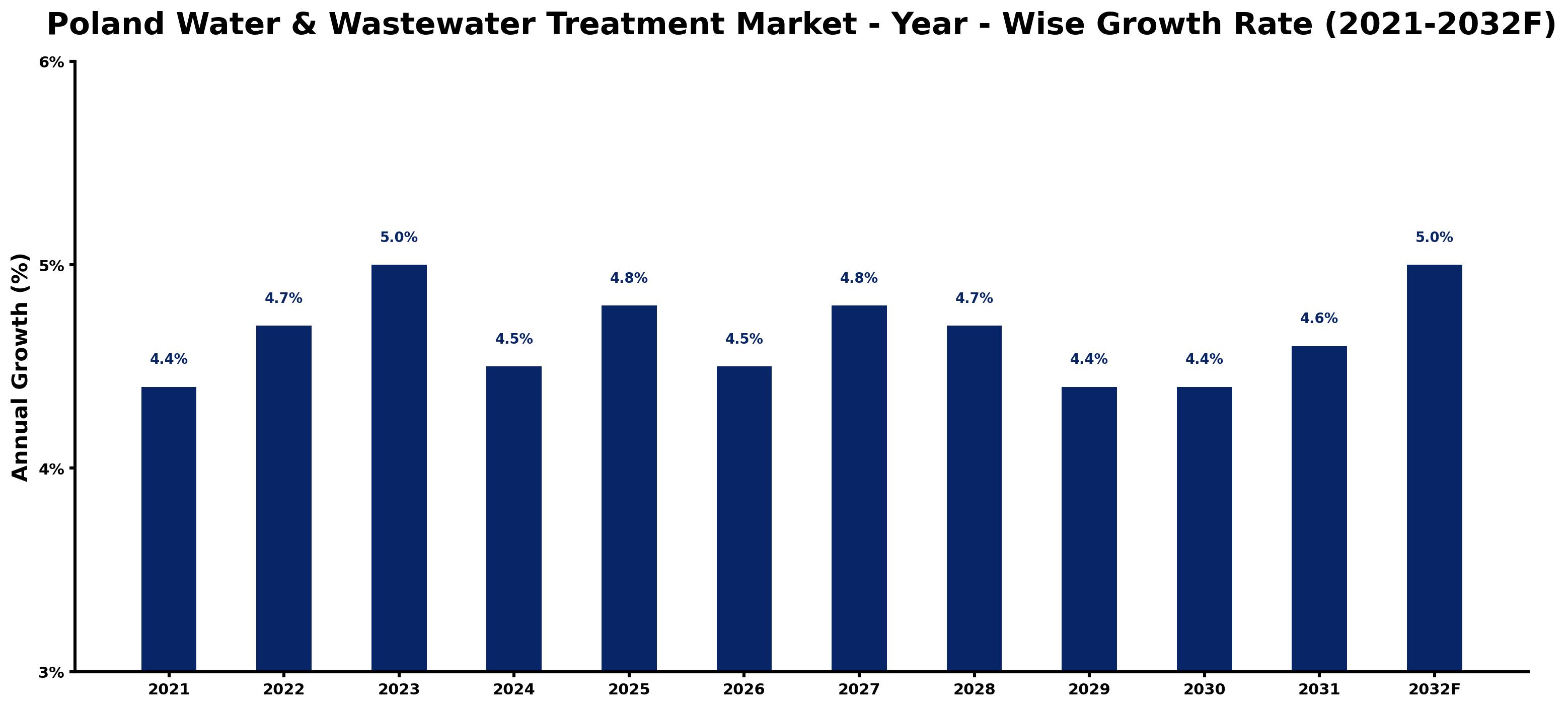
The table below presents the year wise growth rates along with the key drivers influencing the market
| Year | Growth Rate | Major Drivers |
| 2021 | 4.4% | Post-lockdown investment in infrastructure revitalizes the water treatment sector's outlook. |
| 2022 | 4.7% | Regional water scarcity issues highlight the need for innovative treatment solutions. |
| 2023 | 5.0% | Technological innovations improve efficiency in existing wastewater treatment facilities significantly. |
| 2024 | 4.5% | Public-private partnerships emerge, enhancing funding for water management projects across Poland. |
| 2025 | 4.8% | Urbanization trends compel cities to upgrade aging water treatment systems to meet demand. |
| 2026 | 4.5% | Increased awareness of environmental protection leads to better wastewater regulations and standards. |
| 2027 | 4.8% | International collaborations boost access to advanced water purification technologies and methodologies. |
| 2028 | 4.7% | The push for sustainable practices influences water reuse projects across industrial sectors. |
| 2029 | 4.4% | Climate change impacts drive investment in resilient water infrastructure and resource management. |
| 2030 | 4.4% | Emerging digital solutions optimize operational efficiency in water treatment plants nationwide. |
| 2031 | 4.6% | Community engagement initiatives foster public support for necessary water infrastructure upgrades. |
| 2032 | 5.0% | Anticipated EU funding earmarked for environmental sustainability accelerates project implementations. |
Note - Market size estimations and growth projections presented in this report are based on 6Wresearch's advanced forecasting approach, validated with industry datasets as of June 2026.
Poland Water & Wastewater Treatment Market Synopsis
The Poland Water Wastewater Treatment Market is projected to reach 4.5% and witness significant growth during the forecast period (2026-2032). This market is essential for ensuring the provision of clean water and the management of wastewater, focusing on advanced technologies and services for both potable water and wastewater treatment. A combination of regulatory compliance, environmental protection, and rising water demand drives this market's trajectory.
Poland Water & Wastewater Treatment Market Growth Drivers
The growth of the Poland Water & Wastewater Treatment Market is largely attributed to several key factors:
- Population growth in urban areas has led to an increased demand for efficient water supply systems, necessitating improvements in water treatment facilities.
- Industrialization has contributed to heightened water usage and wastewater production, directly influencing the need for robust treatment solutions.
- Government regulations aimed at improving water quality and sustainability enhance market opportunities by promoting strict compliance with treatment standards.
- Innovations in treatment technologies, such as membrane filtration and advanced oxidation processes, are being adopted to tackle the complexities of both potable water and wastewater management.
- An increasing emphasis on environmental sustainability and pollution reduction fosters investment in modern treatment processes, further propelling market expansion.
Poland Water & Wastewater Treatment Market Challenges and Restraints
While the Poland Water & Wastewater Treatment Market is positioned for growth, it also faces several challenges that must be navigated:
- The necessity for modernization of aging infrastructure poses financial and technical challenges, as many existing facilities require significant upgrades to handle increased wastewater volumes.
- Operational costs associated with new technologies, maintenance, and compliance with stringent regulations can be a burden for municipal water authorities and private entities alike.
- Emerging contaminants, including pharmaceuticals and microplastics, present complexities in treatment that challenge existing processes and demand innovation.
- The need for skilled labor and expertise in advanced treatment technologies can limit the pace of adoption and implementation across various facilities.
- Inconsistent public funding and investment in water projects may hinder long-term planning and the execution of essential infrastructure developments.
Poland Water & Wastewater Treatment Market Government Investment and Initiatives
The Polish government has instituted various policies and initiatives aimed at bolstering the Water & Wastewater Treatment Market, reflecting a commitment to improving water quality and environmental sustainability:
- Regulatory frameworks dictate stringent standards for water quality and wastewater treatment processes, ensuring that facilities meet required performance levels.
- Financial incentives and grants for technological upgrades are available to encourage investments in modern equipment and infrastructure improvements.
- Development plans focused on enhancing water resource management are being implemented, emphasizing the importance of sustainable practices.
- Collaboration with EU programs provides additional funding opportunities, supporting major projects that aim to enhance water treatment capabilities.
- Public awareness campaigns are also being conducted to educate communities about water conservation and pollution reduction, promoting active participation in sustainability efforts.
Poland Water & Wastewater Treatment Market Latest Developments (May 2025 - June 2026)
Recent developments in the Poland Water & Wastewater Treatment Market indicate a robust focus on innovation and sustainability:
- There has been a noticeable increase in the implementation of advanced treatment technologies, such as biofilters and integrated systems, which allow for more efficient management of wastewater.
- Several municipalities are entering partnerships with private entities to enhance capacity and improve service delivery amid rising population pressures.
- Regulatory changes are being discussed to further tighten standards on wastewater discharge, pushing facilities to adopt cutting-edge technologies.
- Investment in research and development has surged, aimed at developing innovative solutions to combat emerging contaminants and optimize existing processes.
- Sustainability initiatives, including water recycling and resource recovery, are gaining traction, reflecting a commitment to long-term environmental stewardship.
Poland Water & Wastewater Treatment Market - Key Attractiveness of the Report
- 10 Years of Market Numbers
- Historical Data Starting from 2022 to 2025
- Base Year: 2025
- Forecast Data until 2032
- Key Performance Indicators Impacting the Market
- Major Upcoming Developments and Projects
Key Highlights of the Report:
- Poland Water & Wastewater Treatment Market Outlook
- Market Size of Poland Water & Wastewater Treatment Market, 2025
- Forecast of Poland Water & Wastewater Treatment Market, 2032
- Historical Data and Forecast of Poland Water & Wastewater Treatment Revenues & Volume for the Period 2022-2032F
- Poland Water & Wastewater Treatment Market Trend Evolution
- Poland Water & Wastewater Treatment Market Drivers and Challenges
- Poland Water & Wastewater Treatment Price Trends
- Poland Water & Wastewater Treatment Porter's Five Forces
- Poland Water & Wastewater Treatment Industry Life Cycle
- Historical Data and Forecast of Poland Water & Wastewater Treatment Market Revenues & Volume By Product Category????????????? for the Period 2022-2032F
- Historical Data and Forecast of Poland Water & Wastewater Treatment Market Revenues & Volume By Treatment Technologies for the Period 2022-2032F
- Historical Data and Forecast of Poland Water & Wastewater Treatment Market Revenues & Volume By Delivery Equipment for the Period 2022-2032F
- Historical Data and Forecast of Poland Water & Wastewater Treatment Market Revenues & Volume By Treatment Chemicals for the Period 2022-2032F
- Historical Data and Forecast of Poland Water & Wastewater Treatment Market Revenues & Volume By Instrumentation for the Period 2022-2032F
- Historical Data and Forecast of Poland Water & Wastewater Treatment Market Revenues & Volume By Applications for the Period 2022-2032F
- Historical Data and Forecast of Poland Water & Wastewater Treatment Market Revenues & Volume By Municipal for the Period 2022-2032F
- Historical Data and Forecast of Poland Water & Wastewater Treatment Market Revenues & Volume By Industrial for the Period 2022-2032F
- Poland Water & Wastewater Treatment Import Export Trade Statistics
- Market Opportunity Assessment By Product Category?????????????
- Market Opportunity Assessment By Applications
- Poland Water & Wastewater Treatment Top Companies Market Share
- Poland Water & Wastewater Treatment Competitive Benchmarking By Technical and Operational Parameters
- Poland Water & Wastewater Treatment Company Profiles
- Poland Water & Wastewater Treatment Key Strategic Recommendations






































