Poland Work Order Management Systems Market Size & Growth Rate (2026-2032)
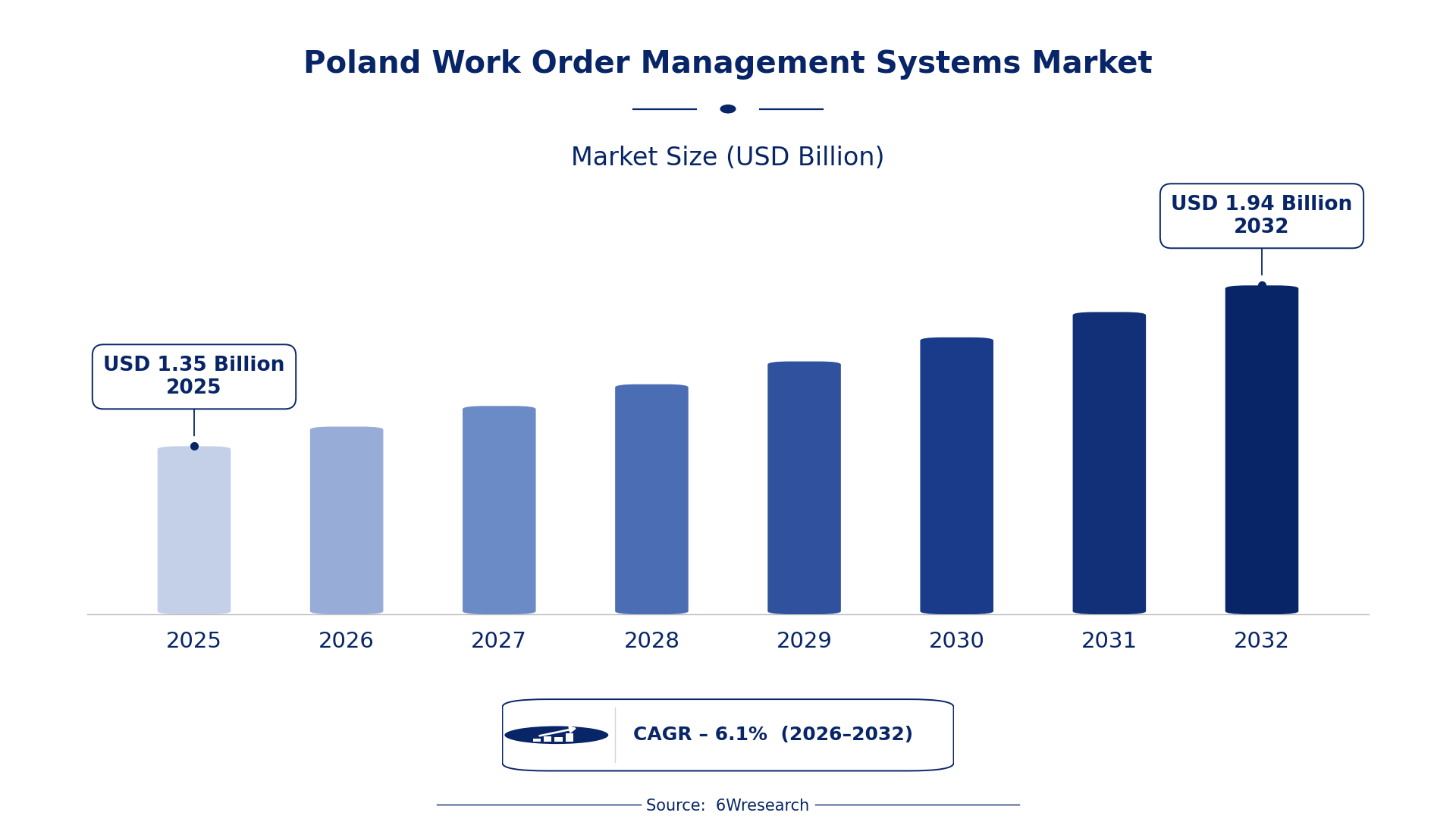
The Poland Work Order Management Systems Market was estimated at USD 1354 Million in 2025 and is projected to reach USD 1937 Million by 2032, growing at a CAGR of 6.1% from 2026 to 2032.
Poland Work Order Management Systems Market Synopsis
The demand for work order management systems in Poland is being driven by the increasing complexity of maintenance operations across industries. As enterprises expand and modernize, the need for streamlined processes has never been more critical.
A digital transformation wave is hitting sectors such as manufacturing and utilities, where efficiency and responsiveness are paramount. Organizations are recognizing that outdated methods lead to increased downtime and operational hiccups.
Poland Work Order Management Systems Market Year-wise Growth Rate and Key Drivers
This graph illustrates the annual growth rates of the Poland Work Order Management Systems Market from 2021 to 2032, highlighting a steady upward trajectory and projected expansion over the forecast period.
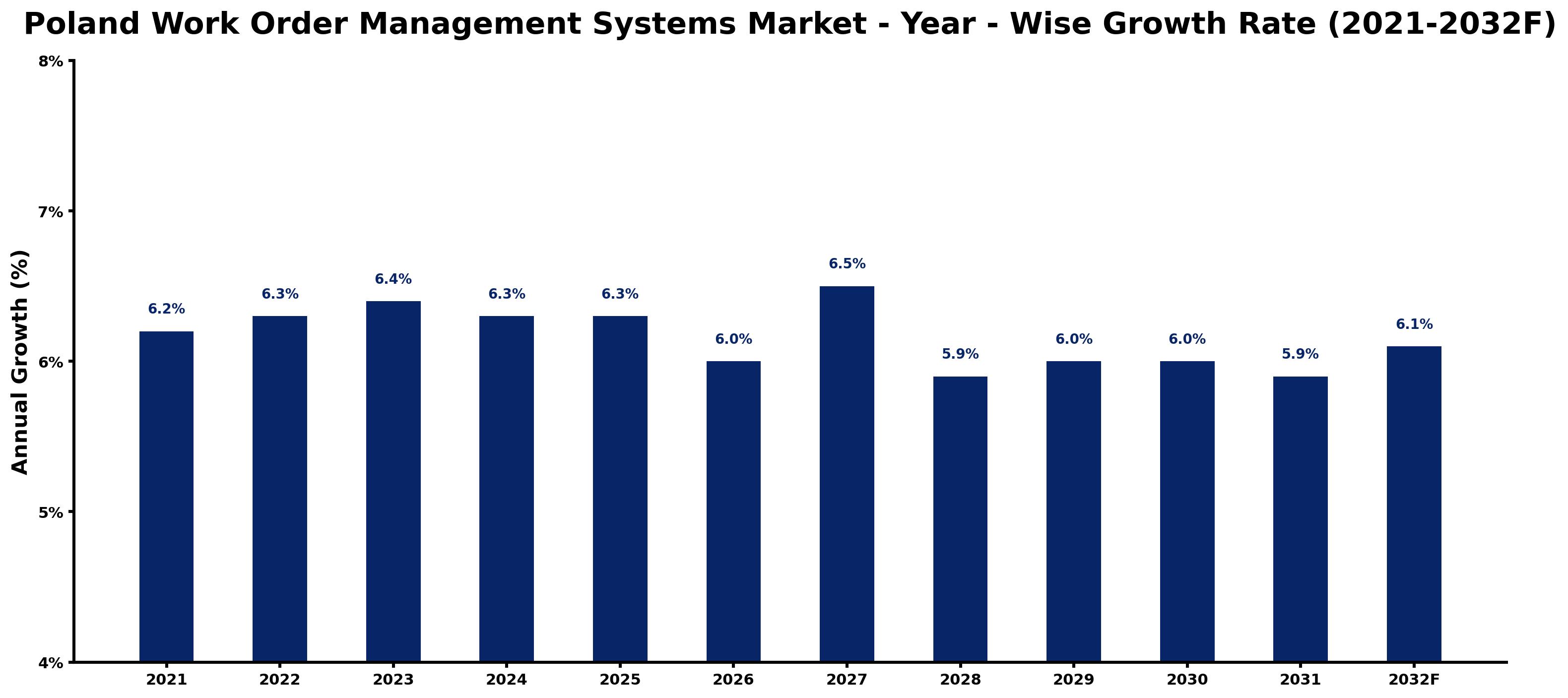
The table below presents the year‑wise growth rates along with the key drivers influencing the market
| Year | Growth Rate | Major Drivers |
| 2021 | 6.2% | Increased adoption of remote work management solutions. |
| 2022 | 6.3% | Growing focus on operational efficiency in Polish enterprises. |
| 2023 | 6.4% | Poland's push for Industry 4.0 modernization strategies. |
| 2024 | 6.3% | Higher investments in digitization by manufacturing sectors. |
| 2025 | 6.3% | Establishment of Polish digital innovation hubs boosting tech usage. |
| 2026 | 6.0% | Rising labor shortages prompting automated work order systems. |
| 2027 | 6.5% | Enhanced integration of IoT in facilities management practices. |
| 2028 | 5.9% | Need for improved asset management amid urbanization trends. |
| 2029 | 6.0% | Polish government support for smart city projects enhancing efficiency. |
| 2030 | 6.0% | Increased regulatory focus on maintenance compliance standards. |
| 2031 | 5.9% | Demand for seamless cross-organization collaboration tools rising. |
| 2032 | 6.1% | Focus on sustainability driving work order optimization technologies. |
Note: Market size estimations and growth projections presented in this report are based on 6Wresearch's proprietary forecasting methodology, utilizing the latest available industry data, government publications, and primary research inputs.
Poland Work Order Management Systems Market Key Takeaways
Below are some of the specific key takeaways from the market, including:
- The market is experiencing a surge due to heightened operational efficiency needs.
- Integration challenges with legacy systems are a prominent barrier to adoption.
- Government incentives are encouraging digital tool adoption in various sectors.
- Growing complexity in service operations is increasing the demand for management systems.
- Security concerns regarding data management in cloud solutions must be addressed for broader acceptance.
Evaluation of Restraints in Poland Work Order Management Systems Market
Poland's work order management systems market is hindered by several key restraints. A primary challenge is the integration with existing legacy systems. Many organizations are reluctant to undergo extensive customization that may disrupt their operations. on top of that, resistance to change within traditional industries poses another obstacle. This reluctance is compounded by security concerns, particularly regarding data management and the transition to cloud-based systems. Until these issues are effectively addressed, the market's growth potential will remain limited.
Poland Work Order Management Systems Market Trends
The market is currently witnessing a trend towards mobile-enabled work order management systems. As field operations increasingly rely on real-time data, mobile applications are becoming indispensable. Additionally, there is a rising interest in predictive analytics, allowing organizations to anticipate maintenance needs before they arise. Integration with IoT devices is also gaining traction, enhancing the capability to monitor equipment health and streamline work order generation.
Poland Work Order Management Systems Market Opportunities
Poland presents several growth opportunities for work order management systems. The ongoing digital transformation initiatives across various sectors create a fertile ground for new entrants and existing players to innovate. Businesses that can offer scalable solutions tailored to the specific needs of large enterprises stand to gain a competitive edge. on top of that, as more industries embrace smart technologies, there is a growing demand for integrated systems that can provide comprehensive management solutions.
Government Initiatives in the Poland Work Order Management Systems Market
The Polish government is actively promoting the digital transformation of industries, and this policy focus is significantly impacting the work order management systems market. By introducing supportive regulations and incentives, the government aims to facilitate the adoption of modern digital tools. This aligns with broader EU directives on digitalization and data protection, emphasizing the importance of compliance in the current market environment.
- A national digital infrastructure upgrade programme launched in early 2025 aims to enhance connectivity for businesses.
- The introduction of a regulatory framework in 2025 mandating digital record-keeping for maintenance operations is currently underway.
- Ongoing initiatives support public sector organizations in adopting digital workflow solutions to improve operational efficiency.
- A planned public-private partnership expected to commence by 2026 aims to foster innovation in maintenance technologies.
- Government-led training programs to promote digital skills among the workforce are being implemented throughout 2025.
Future Insights of the Poland Work Order Management Systems Market
Looking ahead to 2026-2032, the Poland work order management systems market is set to evolve significantly. As industries increasingly embrace digital tools, there will be a heightened focus on integrated systems that offer greater visibility and control over maintenance operations. The emphasis on predictive maintenance, powered by data analytics and IoT integration, will reshape service delivery standards. Organizations that prioritize innovation and adaptability will likely thrive in this rapidly changing environment.
Poland Work Order Management Systems Market Latest Developments
In the past year, the Poland work order management systems market has seen several noteworthy developments. Companies are increasingly recognizing the value of digital tools in optimizing their operations. This trend has led to a surge in collaborations and technology rollouts aimed at enhancing service delivery.
- A major technology vendor announced a new cloud-based work order management solution in Q1 2025, aimed at small and medium-sized enterprises.
- In mid-2025, a leading regional operator initiated a pilot project integrating IoT sensors with work order management systems to enhance predictive maintenance capabilities.
- Ongoing partnerships between software providers and industrial firms are focused on developing customized solutions, with several initiatives currently underway.
- By late 2025, a significant upgrade to existing systems is planned, focusing on improved mobile functionalities for field service teams.
- A rollout expected to begin in Q2 2026 will enhance data security features across several platforms, addressing key market concerns.
Poland Work Order Management Systems Market - Key Attractiveness of the Report
- 10 Years of Market Numbers
- Historical Data Starting from 2022 to 2025
- Base Year: 2025
- Forecast Data until 2032
- Key Performance Indicators Impacting the Market
- Major Upcoming Developments and Projects
Key Highlights of the Report:
- Poland Work Order Management Systems Market Outlook
- Market Size of Poland Work Order Management Systems Market, 2025
- Forecast of Poland Work Order Management Systems Market, 2032
- Historical Data and Forecast of Poland Work Order Management Systems Revenues & Volume for the Period 2022-2032F
- Poland Work Order Management Systems Market Trend Evolution
- Poland Work Order Management Systems Market Drivers and Challenges
- Poland Work Order Management Systems Price Trends
- Poland Work Order Management Systems Porter's Five Forces
- Poland Work Order Management Systems Industry Life Cycle
- Historical Data and Forecast of Poland Work Order Management Systems Market Revenues & Volume By Component for the Period 2022-2032F
- Historical Data and Forecast of Poland Work Order Management Systems Market Revenues & Volume By Solution for the Period 2022-2032F
- Historical Data and Forecast of Poland Work Order Management Systems Market Revenues & Volume By Services for the Period 2022-2032F
- Historical Data and Forecast of Poland Work Order Management Systems Market Revenues & Volume By Deployment Type for the Period 2022-2032F
- Historical Data and Forecast of Poland Work Order Management Systems Market Revenues & Volume By Cloud for the Period 2022-2032F
- Historical Data and Forecast of Poland Work Order Management Systems Market Revenues & Volume By On-premises for the Period 2022-2032F
- Historical Data and Forecast of Poland Work Order Management Systems Market Revenues & Volume By Industry Vertical for the Period 2022-2032F
- Historical Data and Forecast of Poland Work Order Management Systems Market Revenues & Volume By Manufacturing for the Period 2022-2032F
- Historical Data and Forecast of Poland Work Order Management Systems Market Revenues & Volume By Energy and Utilities for the Period 2022-2032F
- Historical Data and Forecast of Poland Work Order Management Systems Market Revenues & Volume By Transportation and Logistics for the Period 2022-2032F
- Historical Data and Forecast of Poland Work Order Management Systems Market Revenues & Volume By Construction and Real Estate for the Period 2022-2032F
- Historical Data and Forecast of Poland Work Order Management Systems Market Revenues & Volume By Consumer Goods and Retail for the Period 2022-2032F
- Historical Data and Forecast of Poland Work Order Management Systems Market Revenues & Volume By Healthcare and Life Sciences for the Period 2022-2032F
- Historical Data and Forecast of Poland Work Order Management Systems Market Revenues & Volume By Banking, Financial Services, and Insurance (BFSI) for the Period 2022-2032F
- Historical Data and Forecast of Poland Work Order Management Systems Market Revenues & Volume By Telecom and IT for the Period 2022-2032F
- Historical Data and Forecast of Poland Work Order Management Systems Market Revenues & Volume By Organization Size for the Period 2022-2032F
- Historical Data and Forecast of Poland Work Order Management Systems Market Revenues & Volume By Small and Medium-sized Enterprises for the Period 2022-2032F
- Historical Data and Forecast of Poland Work Order Management Systems Market Revenues & Volume By Large Enterprises for the Period 2022-2032F
- Poland Work Order Management Systems Import Export Trade Statistics
- Market Opportunity Assessment By Component
- Market Opportunity Assessment By Deployment Type
- Market Opportunity Assessment By Industry Vertical
- Market Opportunity Assessment By Organization Size
- Poland Work Order Management Systems Top Companies Market Share
- Poland Work Order Management Systems Competitive Benchmarking By Technical and Operational Parameters
- Poland Work Order Management Systems Company Profiles
- Poland Work Order Management Systems Key Strategic Recommendations






































