Poland Workforce Management Market Size & Growth Rate (2026-2032)
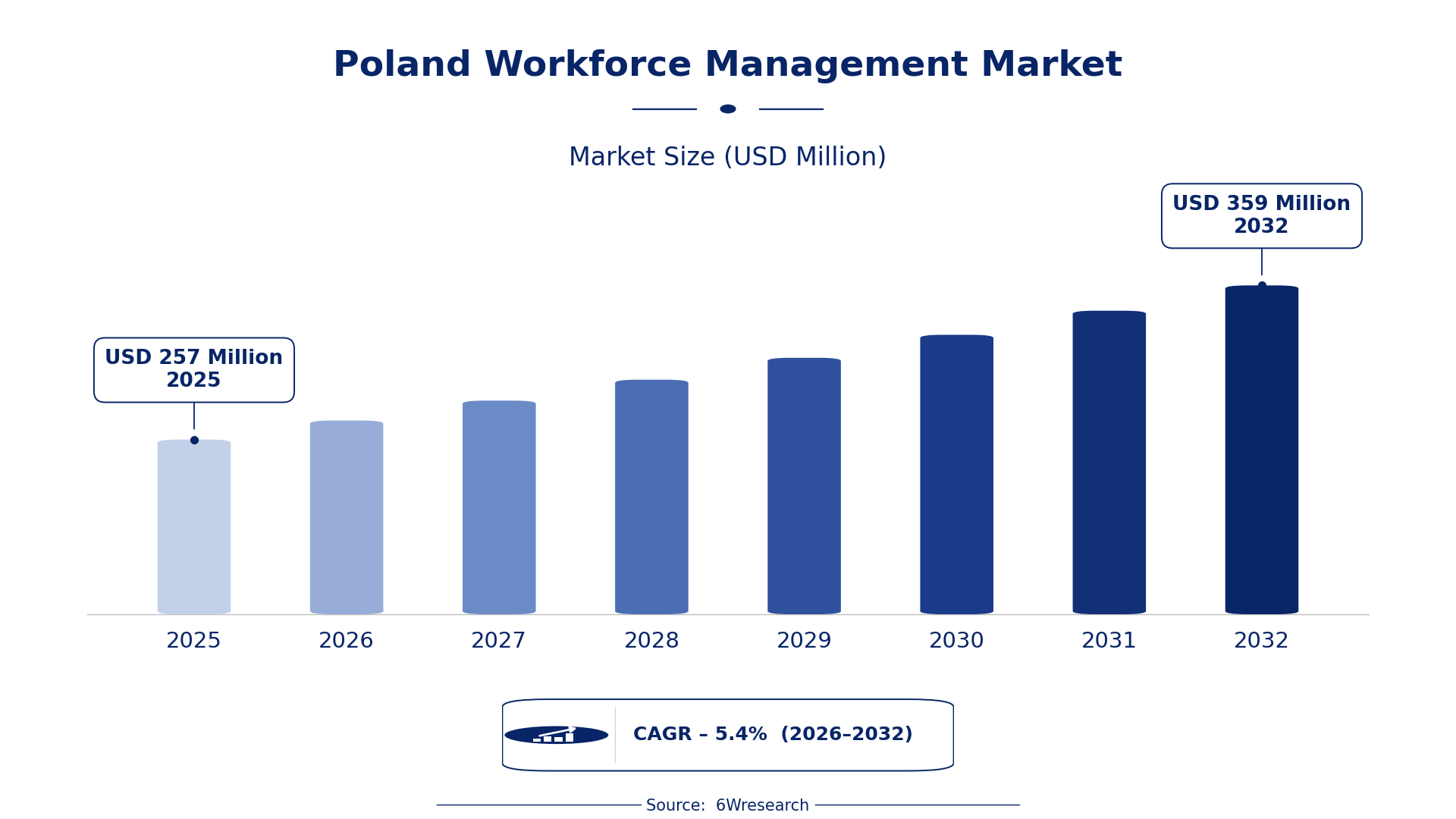
The Poland Workforce Management Market was estimated at USD 257 Million in 2025 and is projected to reach USD 359 Million by 2032, growing at a CAGR of 5.4% from 2026 to 2032.
Poland Workforce Management Market Synopsis
As organizations in Poland increasingly embrace digital solutions, the workforce management market is gaining notable momentum. The shift towards remote work and flexible scheduling is pushing businesses to adopt more comprehensive tools, driving a surge in demand across various sectors.
Moving forward, this market is expected to evolve, with a focus on enhancing employee productivity and compliance. The integration of advanced analytics and artificial intelligence will likely redefine how companies approach workforce management, emphasizing efficiency and adaptability.
Poland Workforce Management Market Year-wise Growth Rate and Key Drivers
This graph illustrates the annual growth rates of the Poland Workforce Management Market from 2021 to 2032, highlighting a steady upward trajectory and projected expansion over the forecast period.
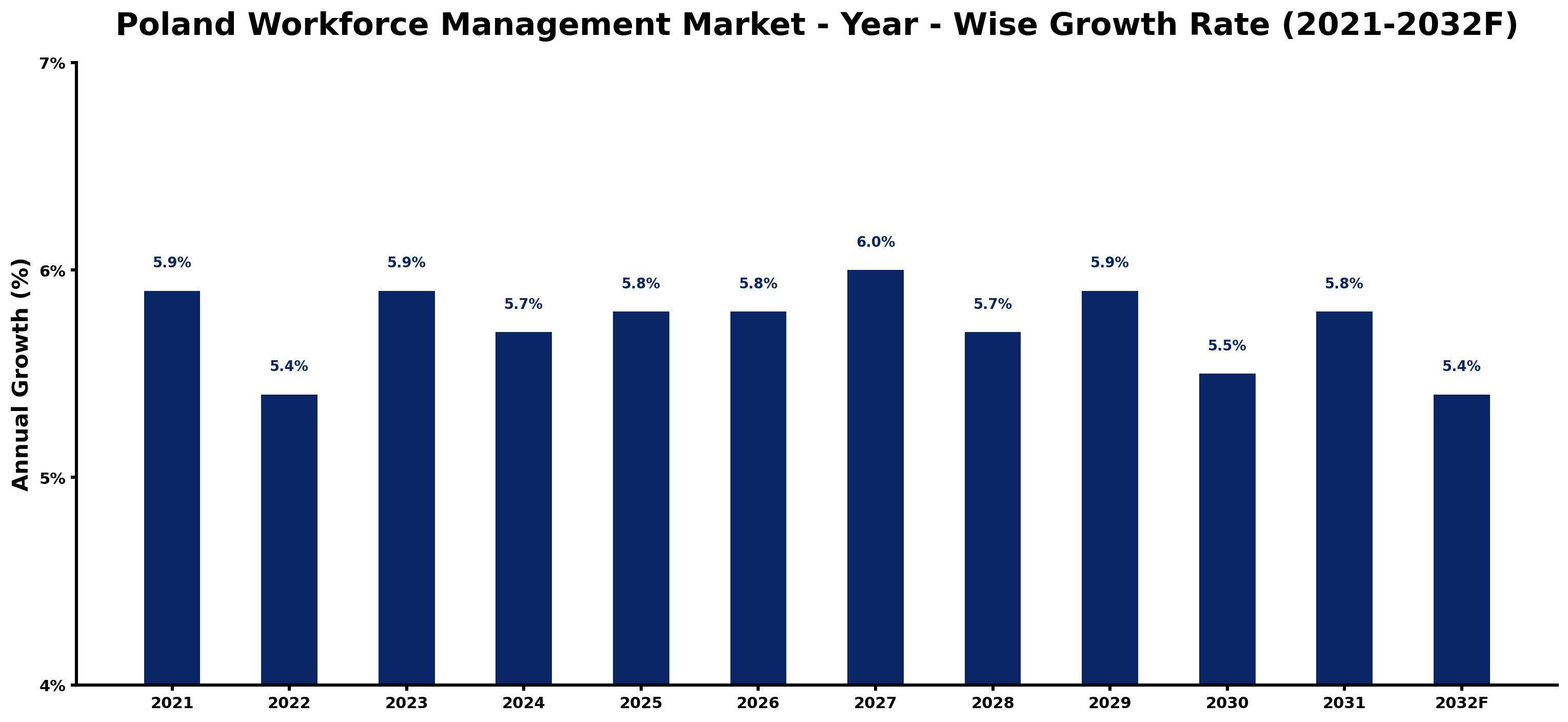
The table below presents the year‑wise growth rates along with the key drivers influencing the market
| Year | Growth Rate | Major Drivers |
| 2021 | 5.9% | Remote work policies by Polish government aiding adoption. |
| 2022 | 5.4% | Increased focus on employee well-being initiatives post-pandemic. |
| 2023 | 5.9% | Growing tech startup ecosystem driving workforce solution innovations. |
| 2024 | 5.7% | Rising labor shortages prompting automated workforce solutions. |
| 2025 | 5.8% | Government incentives for digital transformation in HR processes. |
| 2026 | 5.8% | High demand for flexible workforce management tools growth. |
| 2027 | 6.0% | Legislation favoring remote employment practices enhancing demand. |
| 2028 | 5.7% | Increased awareness of work-life balance boosting software adoption. |
| 2029 | 5.9% | Investments in AI-driven labor analytics within firms rising. |
| 2030 | 5.5% | Rising gig economy participants increasing workforce management needs. |
| 2031 | 5.8% | Focus on compliance with labor regulations boosting tool demand. |
| 2032 | 5.4% | Continuous workforce training requirements driving management solutions. |
Note: Market size estimations and growth projections presented in this report are based on 6Wresearch's proprietary forecasting methodology, utilizing the latest available industry data, government publications, and primary research inputs.
Poland Workforce Management Market Key Takeaways
Below are some of the specific key takeaways from the market, including:
- Growing demand for digital tools to optimize employee scheduling and productivity.
- Key industries fueling market growth include retail, healthcare, and manufacturing.
- The integration of advanced technologies poses challenges for legacy systems.
- Government policies are increasingly supporting flexible working arrangements.
- Small and medium enterprises exhibit low awareness of advanced workforce solutions.
Evaluation of Restraints in Poland Workforce Management Market
The workforce management market in Poland grapples with several constraints that hinder its potential. Integration challenges with existing legacy systems can lead to increased costs and prolonged implementation times. Additionally, the complexity of Poland's labor laws and regulations complicates the development of effective workforce management solutions. Many small and medium enterprises lack awareness of the advanced optimization tools available, limiting their ability to compete and innovate in this space.
Poland Workforce Management Market Trends
Several trends are shaping the Poland workforce management market. The adoption of cloud-based solutions is becoming increasingly prevalent, allowing for greater flexibility and scalability. Companies are also placing a stronger emphasis on employee engagement and well-being, recognizing its impact on productivity. on top of that, the rise of data analytics is enabling organizations to make more informed decisions regarding workforce allocation and performance assessment.
Poland Workforce Management Market Opportunities
The opportunities for growth in the Poland workforce management market are substantial. Companies can capitalize on the increasing demand for integrated solutions that enhance efficiency and compliance. As the workforce continues to evolve, there is a clear need for tools that support remote work and flexible arrangements. Additionally, the rising labor costs present a strong incentive for organizations to adopt advanced workforce management systems to optimize their operations.
Government Initiatives in the Poland Workforce Management Market
Government policies in Poland are significantly influencing the workforce management market, with an emphasis on improving operational efficiency and promoting flexible work arrangements. Recent labor market reforms have encouraged businesses to adopt workforce management systems, aligning with broader goals of enhancing productivity while ensuring compliance with labor laws.
- A national program aimed at increasing awareness of workforce management tools among SMEs was launched in early 2025.
- Currently underway is a regulatory framework that mandates improved tracking of labor hours to ensure compliance with national labor rights.
- Planned initiatives include a public-private partnership expected to facilitate the integration of advanced technologies in workforce management by 2027.
- Recent reforms introduced in 2024 incentivize businesses to adopt digital solutions for employee management.
- The government is currently developing training programs to enhance the capabilities of human resource professionals in utilizing workforce management systems.
Future Insights of the Poland Workforce Management Market
Looking ahead to 2026-2032, the Poland workforce management market is set to undergo significant transformation. The focus will likely shift toward leveraging artificial intelligence and machine learning to enhance predictive analytics in workforce planning. As organizations continue to prioritize employee experience, solutions that facilitate engagement and productivity will become paramount. The collaboration between technology vendors and businesses will also deepen, creating more tailored solutions that meet specific industry needs.
Poland Workforce Management Market Latest Developments
Recent activity in the Poland workforce management market has been marked by a notable uptick in digital solution adoption. Companies are investing in advanced technologies to streamline their workforce processes, driven by the need for greater efficiency and compliance. This trend reflects a broader commitment across industries to enhance operational effectiveness through innovative workforce management tools.
- A leading regional operator launched a new cloud-based workforce management platform in early 2025, enhancing scheduling and time tracking functionalities.
- An initiative that began in mid-2025 aims to integrate advanced analytics into existing workforce management systems to improve decision-making processes.
- A rollout expected to begin in late 2025 will introduce mobile applications designed to facilitate employee self-service capabilities.
- Current partnerships between technology vendors and healthcare providers are underway, focusing on tailored workforce solutions to address industry-specific challenges.
- By 2026, a national training program for workforce management tool implementation is set to begin, aimed at improving the skills of HR professionals.
Poland Workforce Management Market - Key Attractiveness of the Report
- 10 Years of Market Numbers
- Historical Data Starting from 2022 to 2025
- Base Year: 2025
- Forecast Data until 2032
- Key Performance Indicators Impacting the Market
- Major Upcoming Developments and Projects
Key Highlights of the Report:
- Poland Workforce Management Market Outlook
- Market Size of Poland Workforce Management Market, 2025
- Forecast of Poland Workforce Management Market, 2032
- Historical Data and Forecast of Poland Workforce Management Revenues & Volume for the Period 2022-2032F
- Poland Workforce Management Market Trend Evolution
- Poland Workforce Management Market Drivers and Challenges
- Poland Workforce Management Price Trends
- Poland Workforce Management Porter's Five Forces
- Poland Workforce Management Industry Life Cycle
- Historical Data and Forecast of Poland Workforce Management Market Revenues & Volume By Solution for the Period 2022-2032F
- Historical Data and Forecast of Poland Workforce Management Market Revenues & Volume By Time and Attendance Management for the Period 2022-2032F
- Historical Data and Forecast of Poland Workforce Management Market Revenues & Volume By Leave and Absence Management for the Period 2022-2032F
- Historical Data and Forecast of Poland Workforce Management Market Revenues & Volume By Workforce Scheduling for the Period 2022-2032F
- Historical Data and Forecast of Poland Workforce Management Market Revenues & Volume By Workforce Analytics for the Period 2022-2032F
- Historical Data and Forecast of Poland Workforce Management Market Revenues & Volume By Others for the Period 2022-2032F
- Historical Data and Forecast of Poland Workforce Management Market Revenues & Volume By Component for the Period 2022-2032F
- Historical Data and Forecast of Poland Workforce Management Market Revenues & Volume By Solutions for the Period 2022-2032F
- Historical Data and Forecast of Poland Workforce Management Market Revenues & Volume By Services for the Period 2022-2032F
- Historical Data and Forecast of Poland Workforce Management Market Revenues & Volume By Service for the Period 2022-2032F
- Historical Data and Forecast of Poland Workforce Management Market Revenues & Volume By Consulting for the Period 2022-2032F
- Historical Data and Forecast of Poland Workforce Management Market Revenues & Volume By Implementation for the Period 2022-2032F
- Historical Data and Forecast of Poland Workforce Management Market Revenues & Volume By Training, Support and Maintenance for the Period 2022-2032F
- Historical Data and Forecast of Poland Workforce Management Market Revenues & Volume By Deployment Type for the Period 2022-2032F
- Historical Data and Forecast of Poland Workforce Management Market Revenues & Volume By On-Premises for the Period 2022-2032F
- Historical Data and Forecast of Poland Workforce Management Market Revenues & Volume By Cloud for the Period 2022-2032F
- Historical Data and Forecast of Poland Workforce Management Market Revenues & Volume By Organization Size for the Period 2022-2032F
- Historical Data and Forecast of Poland Workforce Management Market Revenues & Volume By Large Enterprises for the Period 2022-2032F
- Historical Data and Forecast of Poland Workforce Management Market Revenues & Volume By Small and Medium-sized Enterprises (SMEs) for the Period 2022-2032F
- Historical Data and Forecast of Poland Workforce Management Market Revenues & Volume By Vertical for the Period 2022-2032F
- Historical Data and Forecast of Poland Workforce Management Market Revenues & Volume By Banking, Financial Services and Insurance (BFSI) for the Period 2022-2032F
- Historical Data and Forecast of Poland Workforce Management Market Revenues & Volume By Telecom for the Period 2022-2032F
- Historical Data and Forecast of Poland Workforce Management Market Revenues & Volume By Government for the Period 2022-2032F
- Historical Data and Forecast of Poland Workforce Management Market Revenues & Volume By Consumer Goods and Retail for the Period 2022-2032F
- Historical Data and Forecast of Poland Workforce Management Market Revenues & Volume By Manufacturing for the Period 2022-2032F
- Historical Data and Forecast of Poland Workforce Management Market Revenues & Volume By Energy and Utilities for the Period 2022-2032F
- Historical Data and Forecast of Poland Workforce Management Market Revenues & Volume By Transportation and Logistics for the Period 2022-2032F
- Historical Data and Forecast of Poland Workforce Management Market Revenues & Volume By Healthcare and Life Sciences for the Period 2022-2032F
- Poland Workforce Management Import Export Trade Statistics
- Market Opportunity Assessment By Solution
- Market Opportunity Assessment By Component
- Market Opportunity Assessment By Service
- Market Opportunity Assessment By Deployment Type
- Market Opportunity Assessment By Organization Size
- Market Opportunity Assessment By Vertical
- Poland Workforce Management Top Companies Market Share
- Poland Workforce Management Competitive Benchmarking By Technical and Operational Parameters
- Poland Workforce Management Company Profiles
- Poland Workforce Management Key Strategic Recommendations






































