Portugal Artificial Flowers Market Size (2020-2030)
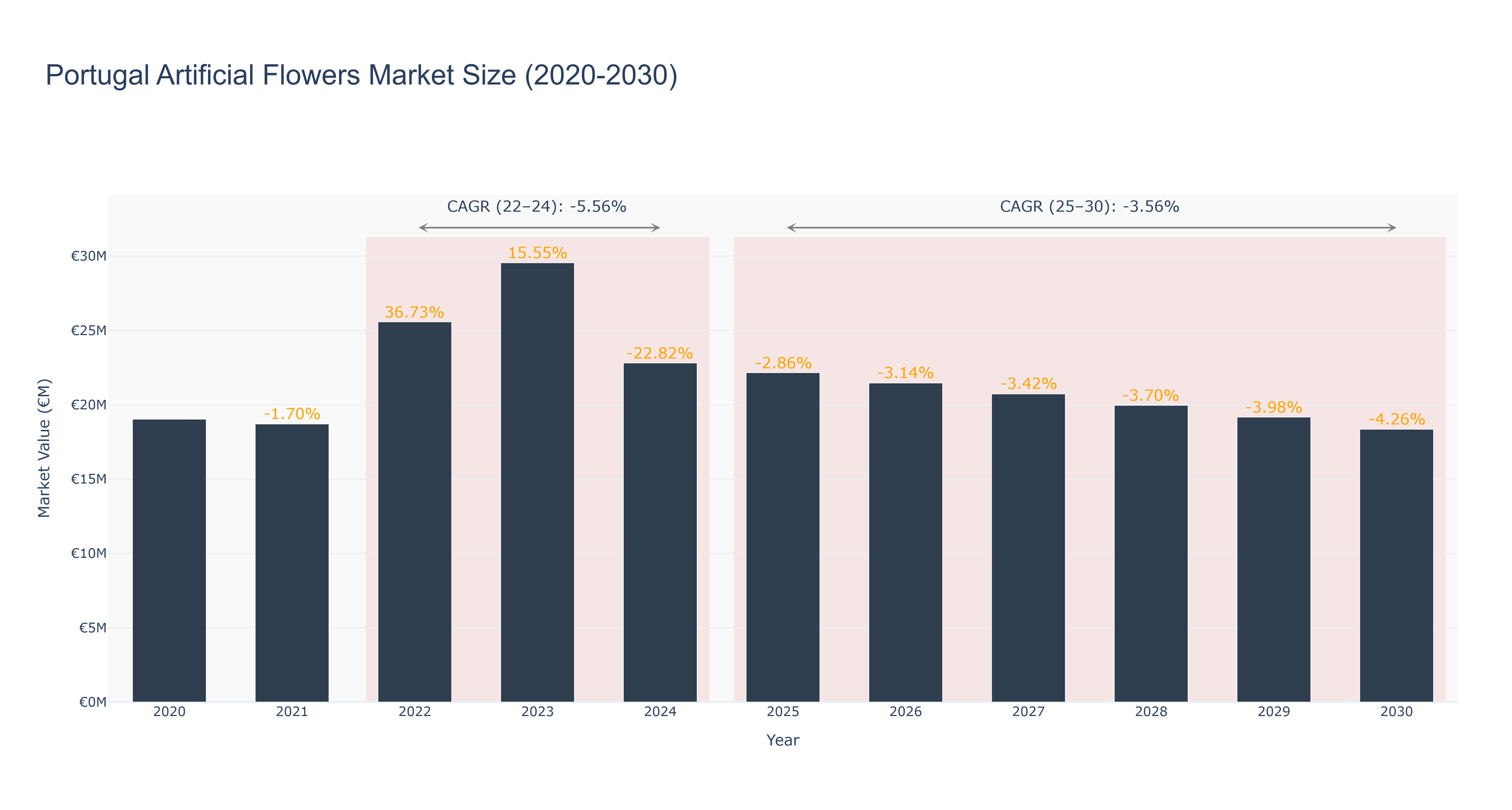
The Portugal Artificial Flowers Market experienced a peak market size of €29.55 million in 2023, showing a significant growth trend from 2020 to 2022. However, the market size saw a notable decline to €22.81 million in 2024, attributed to a negative growth rate of -22.82%. The market has continued to shrink, reaching €21.46 million in 2026, with a negative growth rate of -3.14%. The forecasted market size from 2025 to 2030 indicates a further decrease, with a CAGR of -3.56%. The downward trend can be linked to changing consumer preferences, economic uncertainties, and increased competition. Looking ahead, Portugal is set to introduce sustainable artificial flower initiatives to align with environmental consciousness, aiming to revitalize the market and drive growth in the coming years.
Portugal Artificial Flowers Market: Production & Trade Performance (2019-2025)
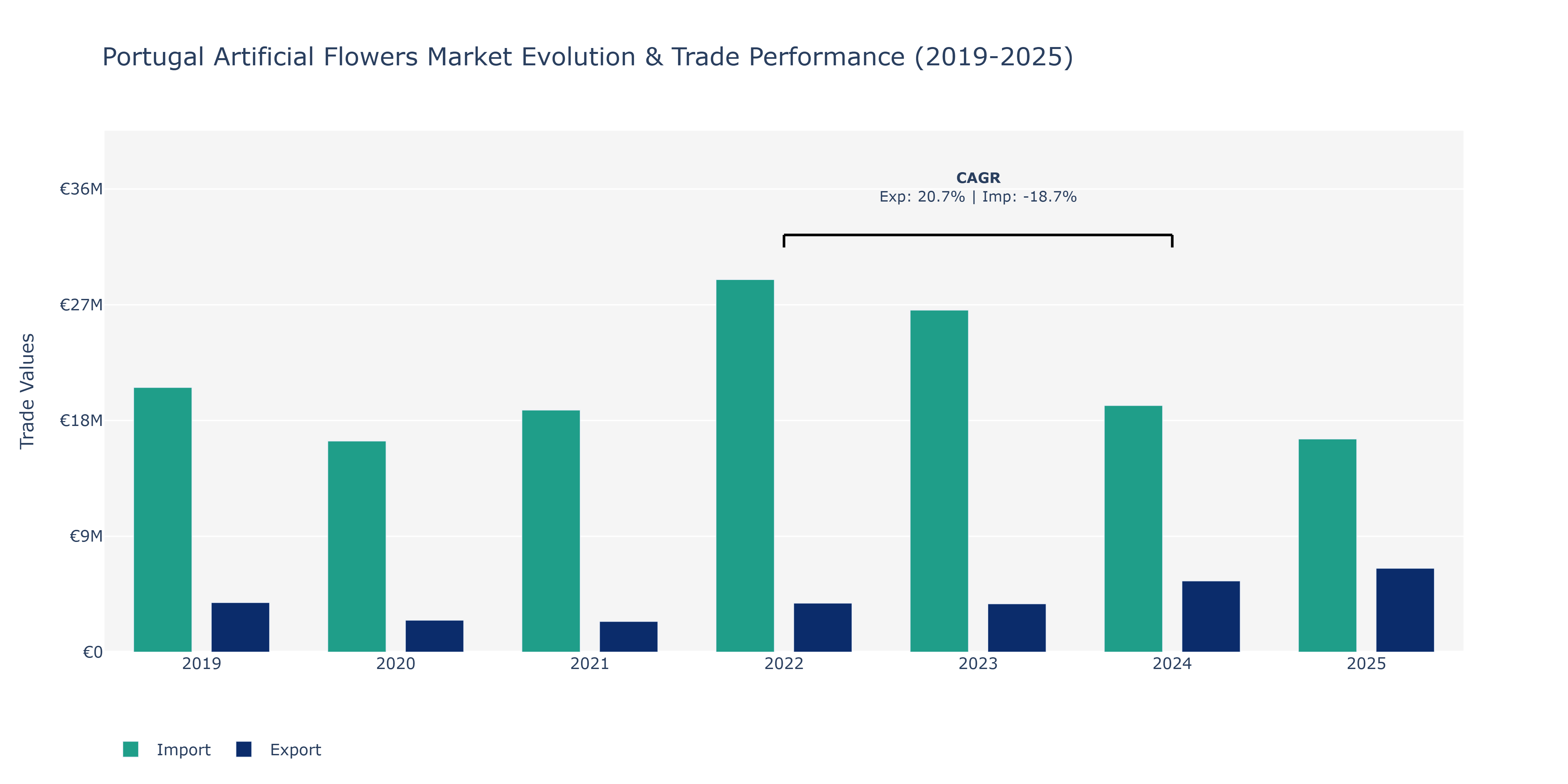
In the Portugal Artificial Flowers Market, exports experienced fluctuations over the years. In 2019, exports stood at €3.84 million, declining to €2.47 million in 2020 before rebounding to €3.79 million in 2022 and reaching a peak of €6.51 million in 2025. Conversely, imports followed a different pattern, decreasing from €20.57 million in 2019 to €16.4 million in 2020, rising to €28.95 million in 2022, and then declining to €16.56 million in 2025. The noticeable increase in exports in 2025 can be attributed to growing demand for artificial flowers globally, as consumers seek durable and low-maintenance décor options. The fluctuations in imports may reflect changes in suppliers, trade agreements, or shifts in consumer preferences towards domestically produced artificial flowers. The contrasting trends between exports and imports indicate a dynamic market influenced by both domestic and international factors, shaping the trade landscape for artificial flowers in Portugal.
Key Highlights of the Report:
- Portugal Artificial Flowers Market Outlook
- Market Size of Portugal Artificial Flowers Market, 2024
- Forecast of Portugal Artificial Flowers Market, 2031
- Historical Data and Forecast of Portugal Artificial Flowers Revenues & Volume for the Period 2021-2031
- Portugal Artificial Flowers Market Trend Evolution
- Portugal Artificial Flowers Market Drivers and Challenges
- Portugal Artificial Flowers Price Trends
- Portugal Artificial Flowers Porter`s Five Forces
- Portugal Artificial Flowers Industry Life Cycle
- Historical Data and Forecast of Portugal Artificial Flowers Market Revenues & Volume By Material Type for the Period 2021-2031
- Historical Data and Forecast of Portugal Artificial Flowers Market Revenues & Volume By Clay & Porcelain for the Period 2021-2031
- Historical Data and Forecast of Portugal Artificial Flowers Market Revenues & Volume By Cotton & Silk for the Period 2021-2031
- Historical Data and Forecast of Portugal Artificial Flowers Market Revenues & Volume By Leather & Nylon for the Period 2021-2031
- Historical Data and Forecast of Portugal Artificial Flowers Market Revenues & Volume By Paper & Wax for the Period 2021-2031
- Historical Data and Forecast of Portugal Artificial Flowers Market Revenues & Volume By Plastic & Polyester for the Period 2021-2031
- Historical Data and Forecast of Portugal Artificial Flowers Market Revenues & Volume By Application for the Period 2021-2031
- Historical Data and Forecast of Portugal Artificial Flowers Market Revenues & Volume By Commercial for the Period 2021-2031
- Historical Data and Forecast of Portugal Artificial Flowers Market Revenues & Volume By Residential for the Period 2021-2031
- Portugal Artificial Flowers Import Export Trade Statistics
- Market Opportunity Assessment By Material Type
- Market Opportunity Assessment By Application
- Portugal Artificial Flowers Top Companies Market Share
- Portugal Artificial Flowers Competitive Benchmarking By Technical and Operational Parameters
- Portugal Artificial Flowers Company Profiles
- Portugal Artificial Flowers Key Strategic Recommendations






































