Portugal Linalool Market Size (2020-2030)
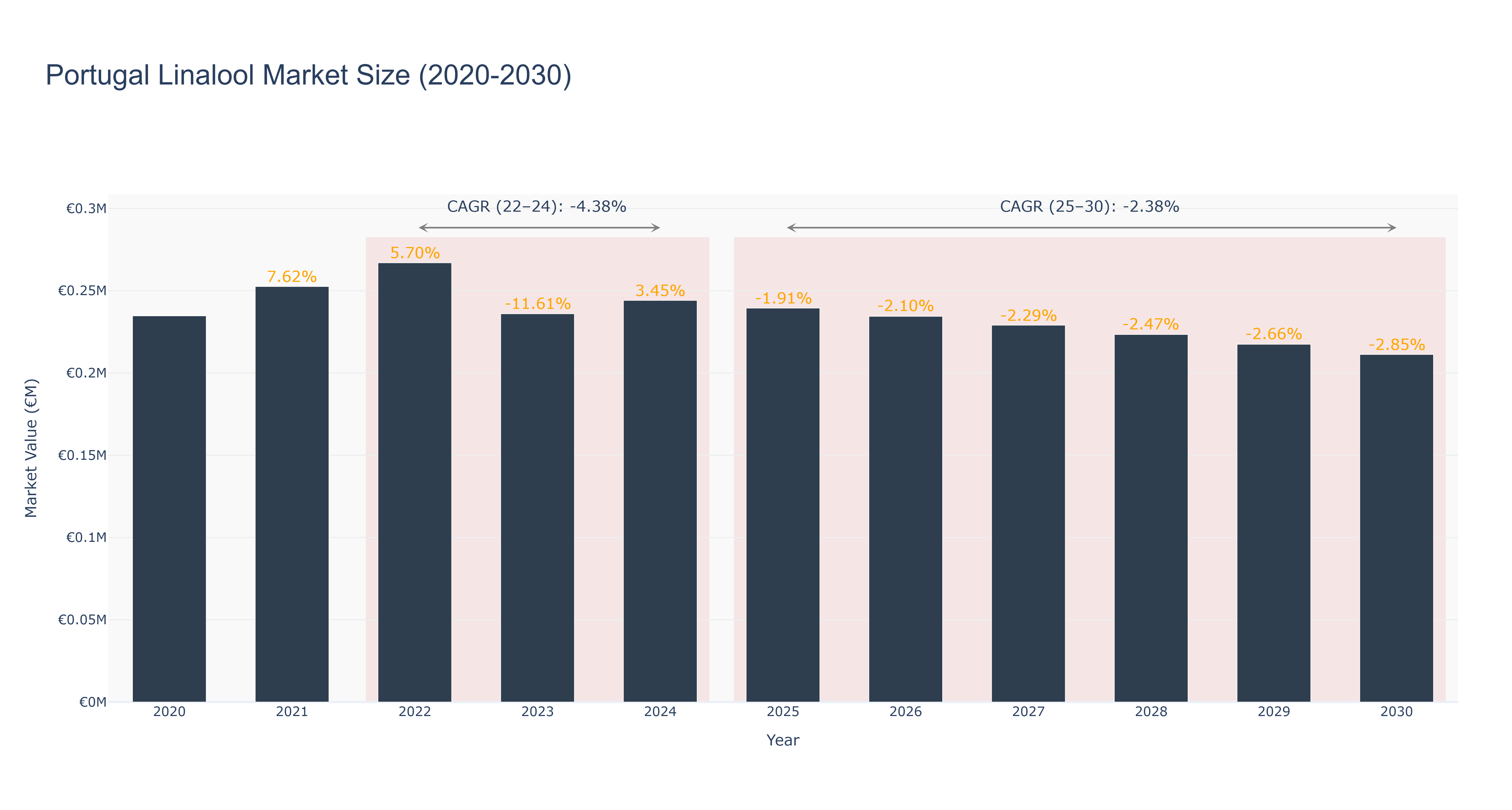
Portugal Linalool Market has shown a fluctuating trend over the past decade. The peak market size of €0.27 million was recorded in 2022, followed by a decline to €0.24 million in 2023. Despite a slight recovery in 2024 to €0.24 million, the market experienced a downward trajectory with a forecasted size of €0.23 million by 2030. The CAGR from 2022-24 was -4.38%, and from 2025-30 is projected at -2.38%. The market's decline can be attributed to factors such as changing consumer preferences, regulatory challenges, and economic instability. Looking ahead, Portugal is set to invest in sustainable sourcing practices and innovative product development within the linalool market to drive growth and competitiveness in the global market landscape.
Portugal Linalool Market: Production & Trade Performance (2019-2025)
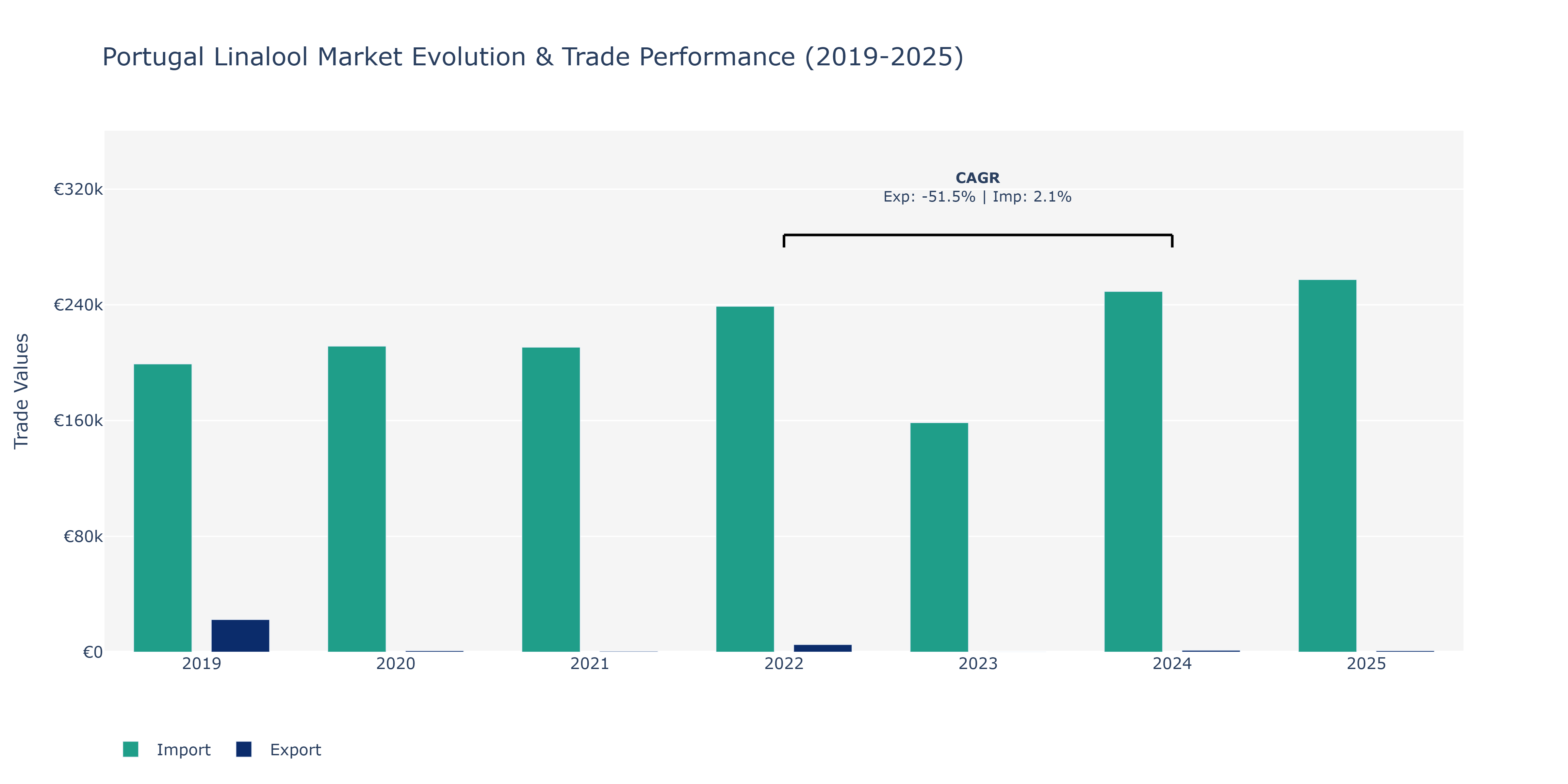
The Portugal Linalool Market witnessed fluctuations in both Exports and Imports from 2019 to 2025. In 2019, Imports led significantly at €199.12 thousand, surpassing Exports at €22.44 thousand. However, a sharp decline in Exports to €0.92 thousand in 2020 was notable, coupled with a modest decrease in Imports. The trend continued in 2021 with a further decrease in both Exports and Imports. A notable recovery in Exports to €5.13 thousand in 2022 marked a turning point, aligning with a consistent increase in Imports. The peak point for Imports was observed in 2025 at €257.42 thousand, accompanied by a gradual rise in Exports. These fluctuations could be attributed to various factors such as market demand, global economic conditions, and regulatory changes impacting trade dynamics in the fragrance industry. As the market stabilizes post-pandemic, strategic partnerships and diversified product offerings could further enhance trade prospects for Portugal's Linalool market.
Key Highlights of the Report:
- Portugal Linalool Market Outlook
- Market Size of Portugal Linalool Market, 2025
- Forecast of Portugal Linalool Market, 2032
- Historical Data and Forecast of Portugal Linalool Revenues & Volume for the Period 2022 - 2032F
- Portugal Linalool Market Trend Evolution
- Portugal Linalool Market Drivers and Challenges
- Portugal Linalool Price Trends
- Portugal Linalool Porter's Five Forces
- Portugal Linalool Industry Life Cycle
- Historical Data and Forecast of Portugal Linalool Market Revenues & Volume By Application for the Period 2022 - 2032F
- Historical Data and Forecast of Portugal Linalool Market Revenues & Volume By Essential Oils for the Period 2022 - 2032F
- Historical Data and Forecast of Portugal Linalool Market Revenues & Volume By Sedatives for the Period 2022 - 2032F
- Historical Data and Forecast of Portugal Linalool Market Revenues & Volume By Fragrances for the Period 2022 - 2032F
- Historical Data and Forecast of Portugal Linalool Market Revenues & Volume By Flavoring Agents for the Period 2022 - 2032F
- Historical Data and Forecast of Portugal Linalool Market Revenues & Volume By End User for the Period 2022 - 2032F
- Historical Data and Forecast of Portugal Linalool Market Revenues & Volume By Chemical Industry for the Period 2022 - 2032F
- Historical Data and Forecast of Portugal Linalool Market Revenues & Volume By Pharmaceutical Industry for the Period 2022 - 2032F
- Historical Data and Forecast of Portugal Linalool Market Revenues & Volume By Product Type for the Period 2022 - 2032F
- Historical Data and Forecast of Portugal Linalool Market Revenues & Volume By Synthetic Linalool for the Period 2022 - 2032F
- Historical Data and Forecast of Portugal Linalool Market Revenues & Volume By Natural Linalool for the Period 2022 - 2032F
- Portugal Linalool Import Export Trade Statistics
- Market Opportunity Assessment By Application
- Market Opportunity Assessment By End User
- Market Opportunity Assessment By Product Type
- Portugal Linalool Top Companies Market Share
- Portugal Linalool Competitive Benchmarking By Technical and Operational Parameters
- Portugal Linalool Company Profiles
- Portugal Linalool Key Strategic Recommendations






































