Portugal Sensor Market Top 5 Importing Countries and Market Competition (HHI) Analysis
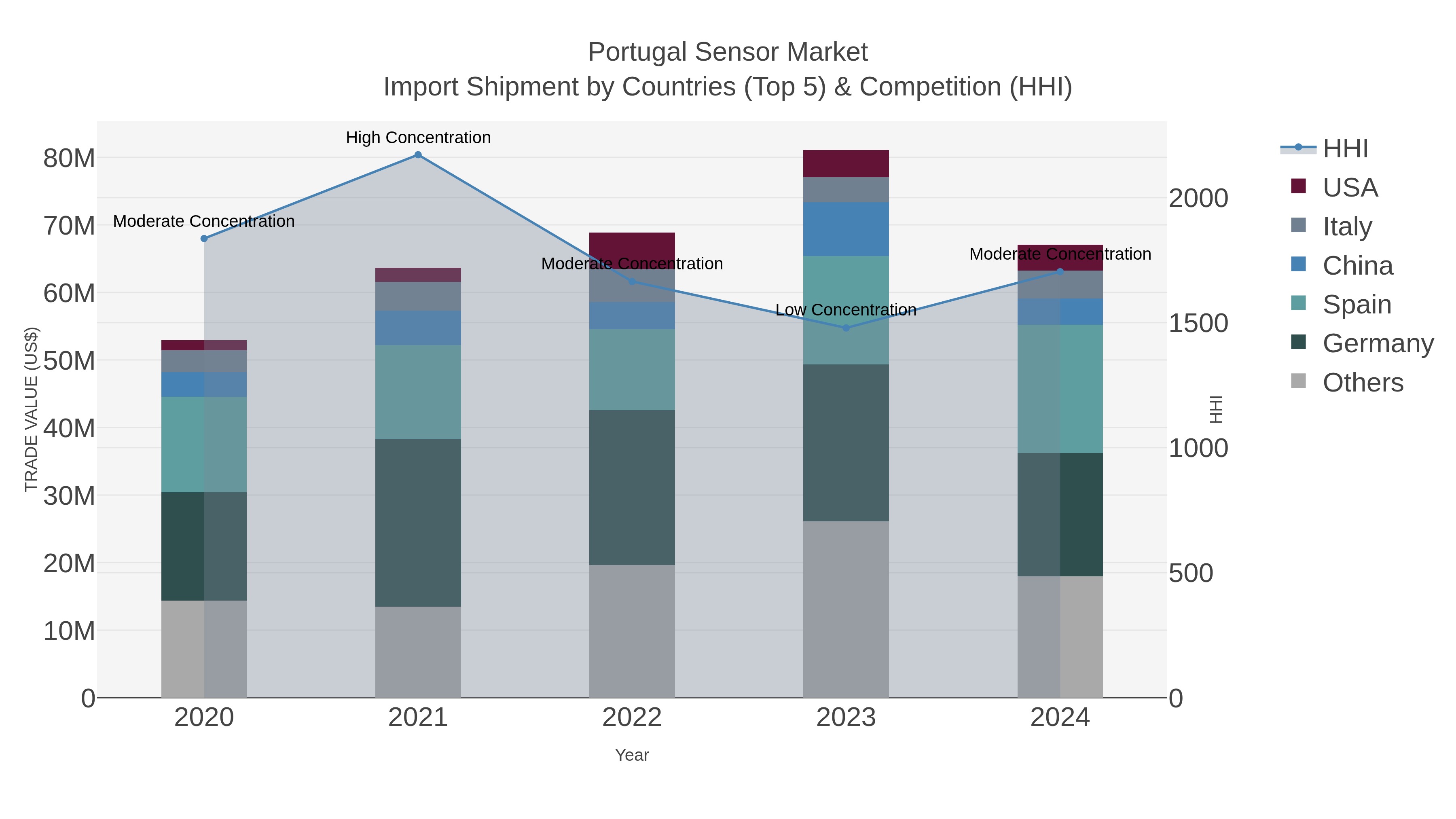
Portugal`s sensor import shipments in 2024 show a diverse range of top exporting countries, with Spain, Germany, Italy, China, and the USA leading the way. The market experienced a shift from low to moderate concentration, reflecting increasing competition among suppliers. Despite a remarkable compound annual growth rate of 6.08% from 2020 to 2024, there was a notable decline in growth rate from 2023 to 2024 at -17.3%. This suggests a temporary slowdown in the market, possibly due to various factors influencing the demand for sensors in Portugal.
Portugal Sensor Market Overview
The Portugal sensor market is witnessing steady growth driven by various factors such as increasing adoption of smart technologies, rising demand for IoT applications, and advancements in sensor technologies. Key sectors leveraging sensors in Portugal include automotive, healthcare, industrial automation, and consumer electronics. The demand for sensors in Portugal is also being fueled by initiatives aimed at promoting Industry 4.0, smart cities development, and environmental monitoring. Additionally, the government`s focus on digital transformation and investments in research and development are expected to further boost the sensor market in Portugal. Key players operating in the Portugal sensor market include Bosch, TE Connectivity, Siemens, STMicroelectronics, and Sensirion, among others. The market is characterized by intense competition, technological innovation, and a growing emphasis on sensor miniaturization and energy efficiency.
Portugal Sensor Market Trends and Opportunities
The Portugal Sensor Market is experiencing significant growth driven by advancements in IoT technology, smart infrastructure development, and the increasing adoption of sensors in various industries such as automotive, healthcare, and manufacturing. The demand for sensors with improved accuracy, sensitivity, and connectivity capabilities is on the rise, creating opportunities for market players to innovate and introduce cutting-edge sensor solutions. Additionally, the focus on sustainability and energy efficiency is driving the adoption of environmental sensors for monitoring air quality, water pollution, and energy consumption. With the ongoing digital transformation across industries, the Portugal Sensor Market presents lucrative opportunities for companies to expand their product portfolios, enhance operational efficiency, and cater to the evolving needs of customers in a rapidly changing market landscape.
Portugal Sensor Market Challenges
In the Portugal Sensor Market, some challenges that are faced include intense competition from both domestic and international sensor manufacturers, which can lead to pricing pressures and the need for continuous innovation to stay ahead. Additionally, there may be difficulties in sourcing high-quality raw materials and components required for sensor production, especially if there are supply chain disruptions or fluctuations in pricing. Another challenge is ensuring compliance with evolving regulations and standards related to sensor technology, which may require significant investments in research and development to meet changing requirements. Overall, navigating these challenges requires companies in the Portugal Sensor Market to be adaptable, technologically advanced, and customer-focused to maintain a competitive edge in the industry.
Portugal Sensor Market Drivers
The Portugal Sensor Market is driven by several key factors including the increasing demand for smart devices and Internet of Things (IoT) applications, the growing adoption of sensors in automotive and healthcare industries for safety and monitoring purposes, and the emphasis on industrial automation to improve operational efficiency. Additionally, the advancements in sensor technologies such as MEMS (Microelectromechanical Systems) sensors and the proliferation of connected devices are fueling the market growth. The focus on sustainability and energy efficiency is also driving the demand for sensors in environmental monitoring and smart building applications. Overall, the Portugal Sensor Market is expected to continue expanding as industries increasingly rely on sensor technologies to enhance performance, safety, and decision-making processes.
Portugal Sensor Market Government Policies
In Portugal, the government has implemented various policies to support the growth of the sensor market. These include initiatives to promote research and development in sensor technology, provide funding for innovative sensor projects, and encourage collaboration between industry and academia. Additionally, the government has introduced regulations to ensure the quality and safety of sensors used in different applications, such as healthcare, automotive, and environmental monitoring. Furthermore, Portugal has established incentives and tax benefits for companies investing in sensor technologies, aiming to boost competitiveness and drive economic growth in the sensor market. Overall, these policies demonstrate the government`s commitment to fostering innovation, driving technological advancements, and positioning Portugal as a leader in the global sensor industry.
Portugal Sensor Market Future Outlook
The future outlook for the Portugal Sensor Market appears promising, driven by the increasing adoption of Internet of Things (IoT) technology across various industries such as automotive, healthcare, manufacturing, and consumer electronics. The demand for sensors in smart devices, autonomous vehicles, and industrial automation is expected to fuel market growth. Additionally, the focus on environmental sustainability and energy efficiency is likely to drive the demand for sensors in areas such as smart buildings and renewable energy systems. With advancements in sensor technologies such as MEMS, IoT connectivity, and miniaturization, the market is poised for innovation and expansion. However, factors such as data security concerns and regulatory challenges may pose some constraints. Overall, the Portugal Sensor Market is anticipated to witness steady growth in the coming years.
Key Highlights of the Report:
- Portugal Sensor Market Outlook
- Market Size of Portugal Sensor Market, 2025
- Forecast of Portugal Sensor Market, 2032
- Historical Data and Forecast of Portugal Sensor Revenues & Volume for the Period 2022- 2032
- Portugal Sensor Market Trend Evolution
- Portugal Sensor Market Drivers and Challenges
- Portugal Sensor Price Trends
- Portugal Sensor Porter's Five Forces
- Portugal Sensor Industry Life Cycle
- Historical Data and Forecast of Portugal Sensor Market Revenues & Volume By Type for the Period 2022- 2032
- Historical Data and Forecast of Portugal Sensor Market Revenues & Volume By Pressure for the Period 2022- 2032
- Historical Data and Forecast of Portugal Sensor Market Revenues & Volume By Level for the Period 2022- 2032
- Historical Data and Forecast of Portugal Sensor Market Revenues & Volume By Flow for the Period 2022- 2032
- Historical Data and Forecast of Portugal Sensor Market Revenues & Volume By Chemical for the Period 2022- 2032
- Historical Data and Forecast of Portugal Sensor Market Revenues & Volume By Inertial for the Period 2022- 2032
- Historical Data and Forecast of Portugal Sensor Market Revenues & Volume By Magnetic for the Period 2022- 2032
- Historical Data and Forecast of Portugal Sensor Market Revenues & Volume By Others for the Period 2022- 2032
- Historical Data and Forecast of Portugal Sensor Market Revenues & Volume By Mode of Operation for the Period 2022- 2032
- Historical Data and Forecast of Portugal Sensor Market Revenues & Volume By Optical for the Period 2022- 2032
- Historical Data and Forecast of Portugal Sensor Market Revenues & Volume By Biosensor for the Period 2022- 2032
- Historical Data and Forecast of Portugal Sensor Market Revenues & Volume By Image for the Period 2022- 2032
- Historical Data and Forecast of Portugal Sensor Market Revenues & Volume By Capacitive for the Period 2022- 2032
- Historical Data and Forecast of Portugal Sensor Market Revenues & Volume By Lidar for the Period 2022- 2032
- Historical Data and Forecast of Portugal Sensor Market Revenues & Volume By Radar for the Period 2022- 2032
- Historical Data and Forecast of Portugal Sensor Market Revenues & Volume By Others for the Period 2022- 2032
- Historical Data and Forecast of Portugal Sensor Market Revenues & Volume By End-User Industry for the Period 2022- 2032
- Historical Data and Forecast of Portugal Sensor Market Revenues & Volume By Automotive for the Period 2022- 2032
- Historical Data and Forecast of Portugal Sensor Market Revenues & Volume By Industrial for the Period 2022- 2032
- Historical Data and Forecast of Portugal Sensor Market Revenues & Volume By Construction for the Period 2022- 2032
- Historical Data and Forecast of Portugal Sensor Market Revenues & Volume By Agriculture for the Period 2022- 2032
- Historical Data and Forecast of Portugal Sensor Market Revenues & Volume By Mining for the Period 2022- 2032
- Historical Data and Forecast of Portugal Sensor Market Revenues & Volume By Aerospace for the Period 2022- 2032
- Historical Data and Forecast of Portugal Sensor Market Revenues & Volume By Others for the Period 2022- 2032
- Portugal Sensor Import Export Trade Statistics
- Market Opportunity Assessment By Type
- Market Opportunity Assessment By Mode of Operation
- Market Opportunity Assessment By End-User Industry
- Portugal Sensor Top Companies Market Share
- Portugal Sensor Competitive Benchmarking By Technical and Operational Parameters
- Portugal Sensor Company Profiles
- Portugal Sensor Key Strategic Recommendations






































